While the narrative device of time-travel has been used by many directors around the world, it seems that Japanese directors are quite fond of its narrative and thematical capabilities. One could even argue that this fondness has led Japanese directors refine the time-travel theme, delivering highly-regarded and beloved sci-fi films at a steady pace – Summer Time Machine Blues (2005), Labyrinth of Cinema (2019), Beyond the Infinite Two Minutes (2020), It’s a Summer Film! (2021), River (2023). One film, a veritable classic in the genre, is none other than Obayashi’s adaptation of Yasutaka Tsutsui’s novel Toki o Kakeru Shōjo, the girl who leaped through time (1983). With his eccentric flair, Obayashi brought Tsutsui’s exploration of adolescence and the interconnected nature of the ego, to life on the silver screen in an inimitable way.

Haruka Hojo’s novel Rewrite echoes the enduring hold of Tsutsui’s novel and Obayashi’s film on the Japanese consciousness by utilizing the setting of and certain narrative elements from this eponymous classic. However, by adapting Hojo’s novel, Daigo Matsui does not merely pay homage to Tsutsui’s novel, but also pays his respects to cinema grand-master Obayashi and his beloved hometown, Onomichi (General-note 1).
Matsui’s Rewrite centres on Miyuki (Elaiza Ikeda), a high schooler living in the seaside town Onomichi. One day, while returning a book to the deserted library, her attention is caught by a gust of wind and an intensification of light. Turning her head, she sees transfer student Yasuhiko Sonoda (Kai Adachi) standing in front of the closed window. Sonoda, who came from the future, approaches her to erase her memory, yet he halts and asks if she can guide him in this era.
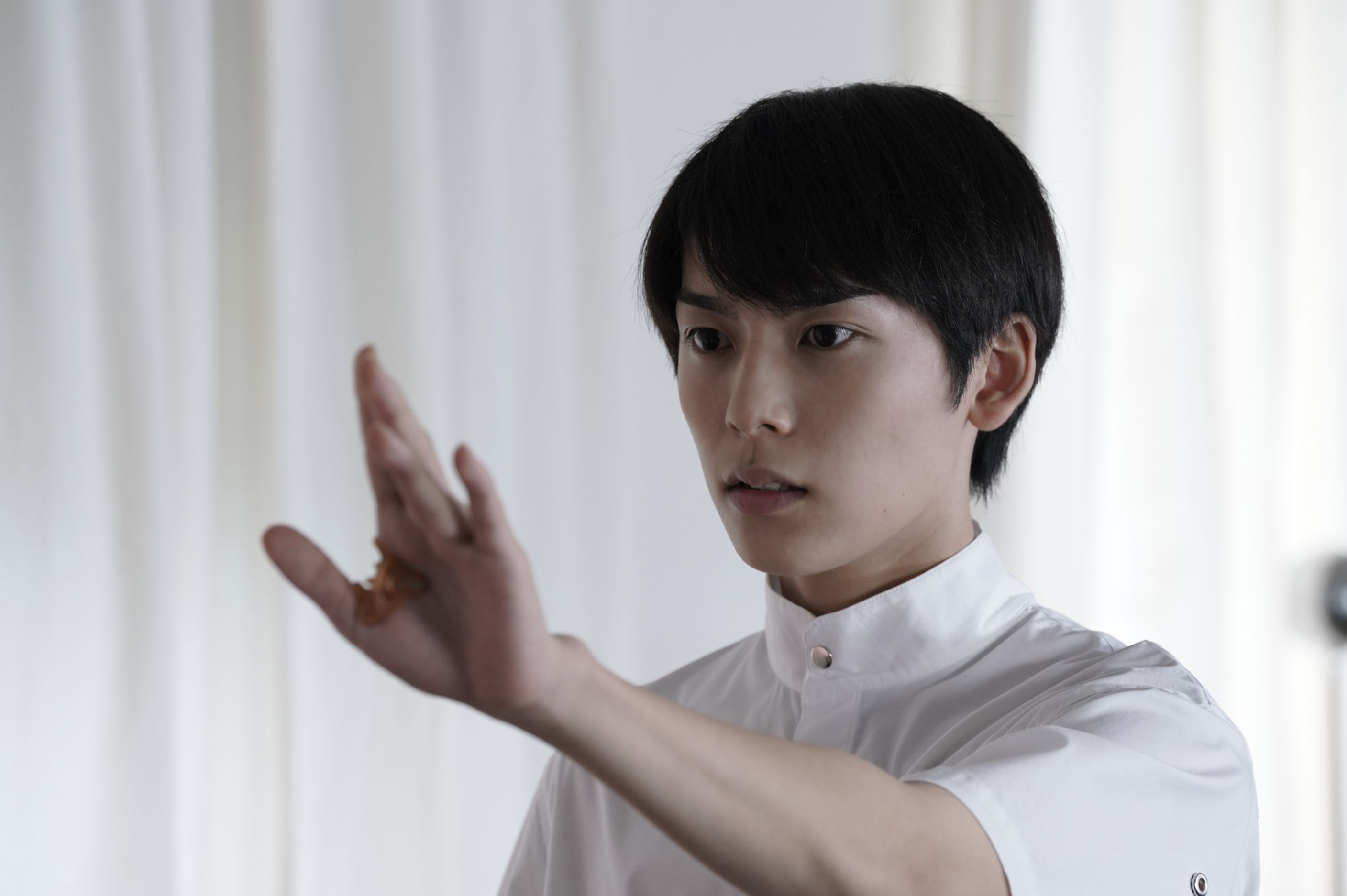
Not much later, Yasuhiko shows her the time-leap pill he invented. While Miyuki warns her that any kind of misuse of the pill could lead to a time paradox that will cause the universe to collapse, he gives her his pill, allowing her to jump ten years ahead for ten seconds for one single time. As July babbles on, Yasuhiko and Miyuki slowly grow closer. Sadly, their youthful happiness cannot endure for long.
Spectators who are hoping to watch a narrative where time-slips are utilized to erase obstacles so that a romantic relationship can be realized might be disappointed to learn the romance between Miyuki and Yasuhiko blossoms very early on the narrative – the romance is but a narrative catalyst, an integral part of the narrative set-up. The swiftness of the romantic development might feel forced for some spectators as Matsui gives little time to his audiences to emotionally invest in the blossoming of their feelings, yet, at the same time, the swift introduction of Miyuki’s youthful romance short-circuits the spectator’s ability to anticipate the surprising twists, the mystifying repetitions, and the subtle turns that structure Rewrite.
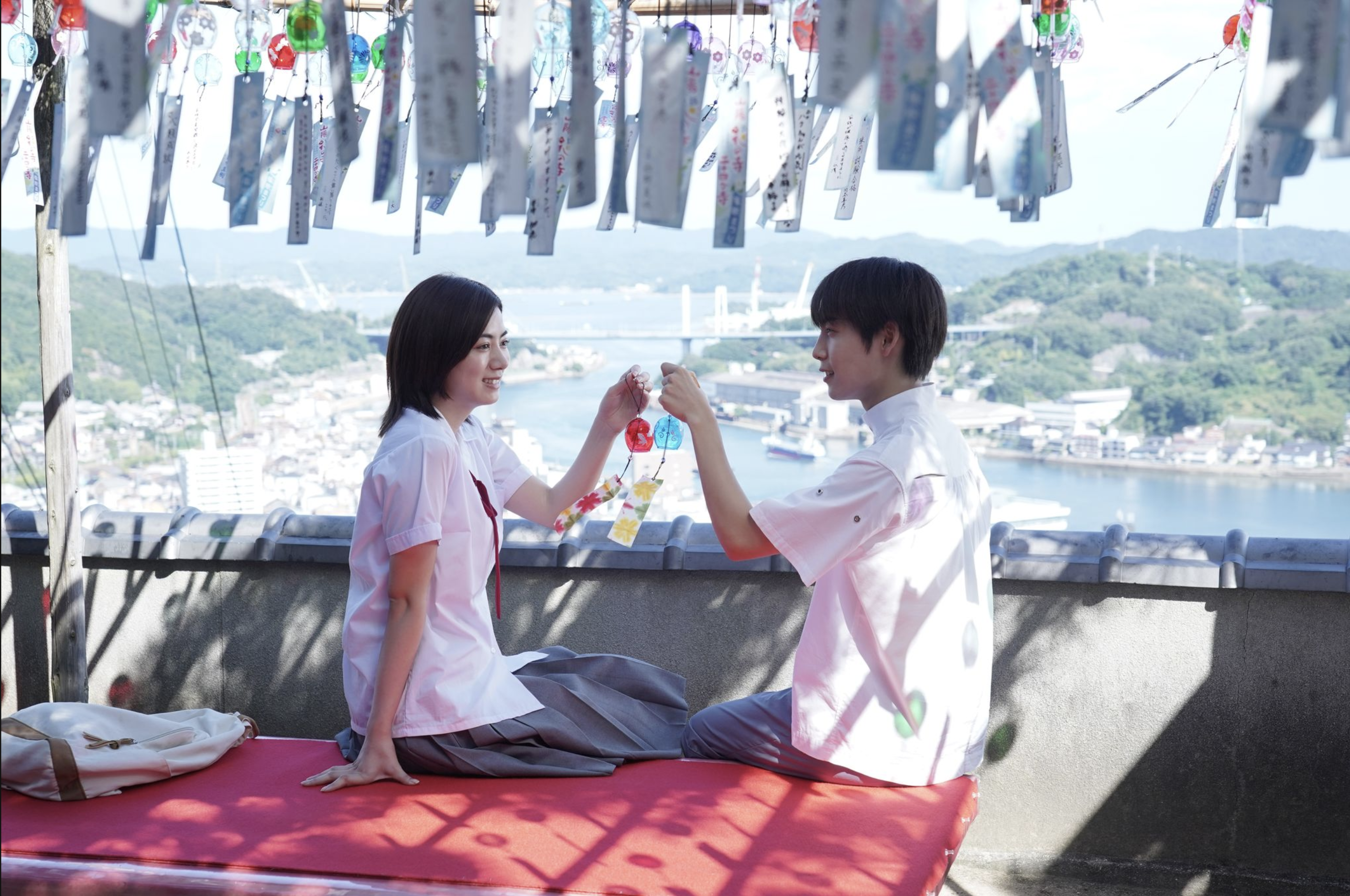
As Matsui’s narrative is built around twists and repetitions, it is impossible to explore the narrative too deeply without killing the experience for the spectator. Without giving too much away, we can divulge that Matsui’s Rewrite depicts the way Miyuki, a successful novelist in her adult-life, tries to deal with the unforeseen rupture in the perfect loop that she and Yasuhiko created with their romance. The mystery as to what caused the rupture – the seemingly neatly sewed thread of past, present and future – quickly swells as new narrative elements (e.g. Miyuki’s publisher tells her that her latest novel, which depicts her summer-romance, is stolen) start calling the past into question. Is the past rewriting itself? Or is something else the matter?
Matsui starts unfolding the answer to the riddle of this paradoxical rupture by inviting the spectator to return to that fateful summer via flashbacks. The sudden emphasis on the past and Miyuki’s former classmates – the upbeat Ayumi (Reika Oozeki), honour-student Yui (Kokoro Morita), class idol Atsuko (Kasami Yamaya), helpful Shigeru (Yuki Kura), introvert booklover Tomoe (Ai Hashimoto), class-clown Muroi (Oshiro Maeda), softball-player Haruko (Akari Fukunaga) and tennis player Suzuko (Sayu Kubota) – signals that the answer to the baffling riddle is connected to Yasuhiko, the time-shifting foreign element, and the unforeseen and unperceived effect of his sudden presence on others.
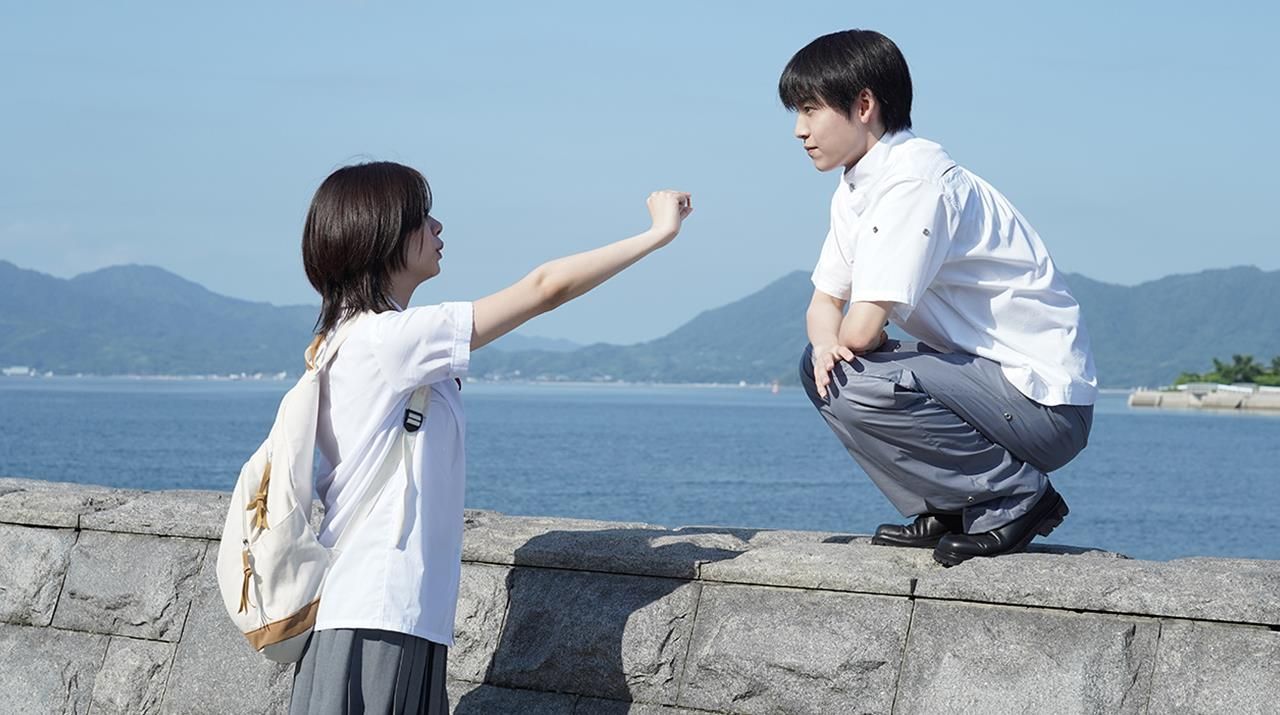
Matsui offers an evocative explanation as to why Sonoda suddenly appears in Onomichi. Surrounded by the chime of Japanese wind-chimes,Sonoda tells Miyuki that the future is radically rational and that he fell in love with this “inconvenient, irrational, and uneconomical” time-periodby reading an old youth novel. Sonoda, while not fully explaining why he came to the past, subtly suggests with the contrasting signifiers rational and irrational that what he is searching for is a thing that, due to the rationalising of society, has been excised from the societal field and thus from interpersonal interactions.
Thematically speaking, Rewrite is structured around the simply truth that an encounter with another subject always has the potential to dramatically alter and shape one’s subjective trajectory – for better or worse. Daigo Matsui’s adaptation, moreover, plays in a highly effective and satisfying way with the idea that the subject cannot but consider his own experiences as unique – the genuine nature of experiences props up our ego, stabilizing it and giving it its consistence (psycho-note 1).
With his refined sense for composition, Daigo Matsui does not merely create a concatenation of visually pleasing moments – an effective and continuous play with compositional lines and the pleasant use of depth-of-field, but also creates a visual fabric that oozes atmosphere – the mood of youthfulness intermingling with the summer ambience of the port-town of Onomichi.
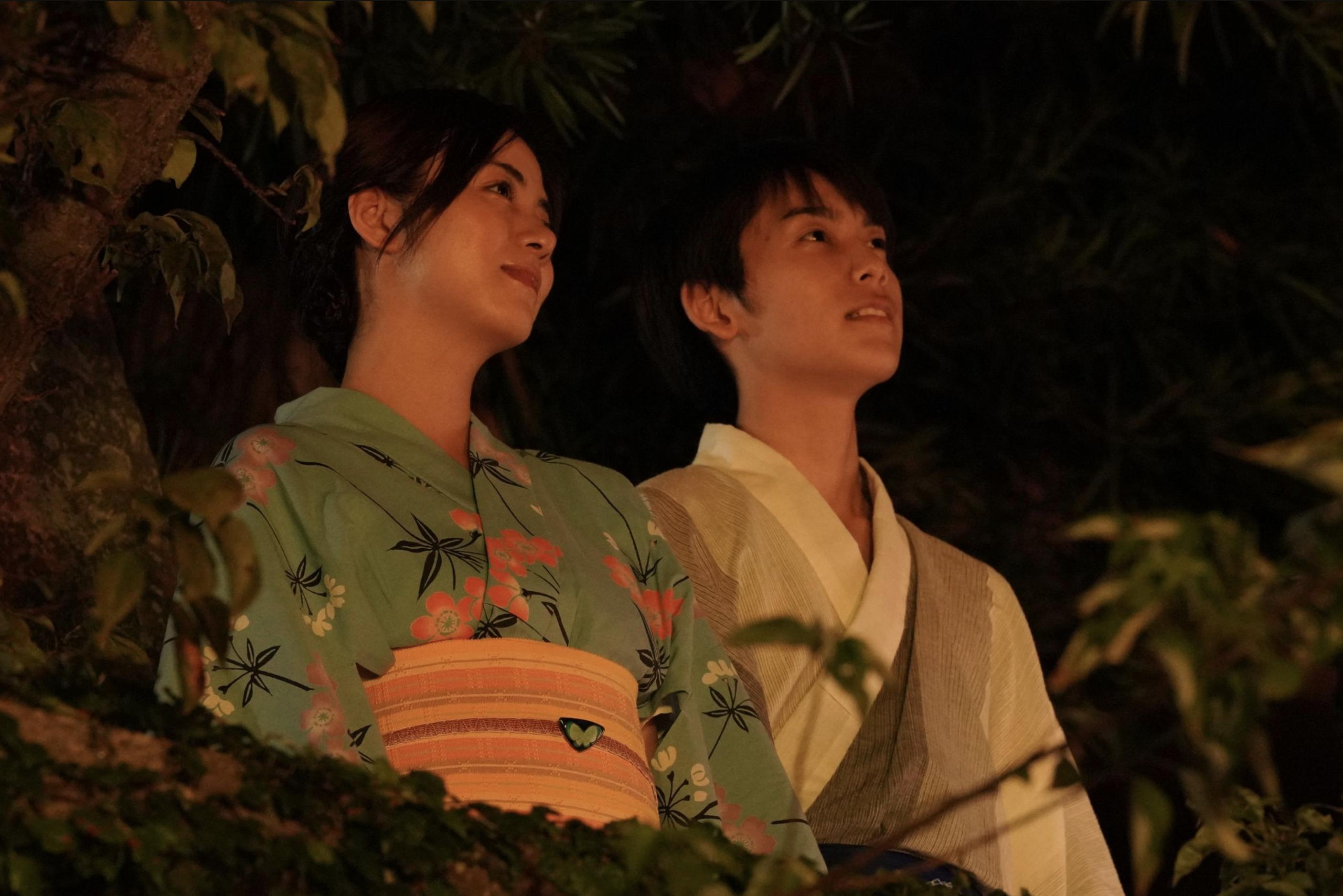
The composition, however, cannot be counted as the primary tool by which atmosphere is evoked. Rather, Matsui’s carefully composed frame functions as an amplifier that brings the summer-atmosphere to the spectator by feeding off the warm colour-schemes and the subtle summer sounds – the buzzing cicadae, the calm rushing of the sea, chirping of birds, rustling of leaves, the pattering of the rain, … etc., and by fleetingly visualizing Japanese summer traditions, e.g. hanging wind-bells (furin), going to a summer festival to enjoy the stalls with games and food and see the fireworks (Music note 1).
Some spectators will write off Rewrite in the opening twenty minutes – again, a time-twisting romance narrative, yet Daiga Matsui’s narrative ultimately develops into something that expands beyond mere romance, a surprising and highly satisfying time-loop drama. Daigo Matsui’s Rewrite proves, maybe to the surprise of some, that the genre of time-travel is far from bankrupt.

Notes:
General-note 1: That Rewrite pays homage to the original novel is evident in the similarity between the title of the novel featured in the film and Tsutui’s novel – Shōjo ha toki wo kaketa versus Toki o Kakeru Shōjo – and by linking time-travel, just like in the novel, with a lavender-like scent. There is, moreover, a vague resemblance between the cover of the novel featured in the film and the poster of the anime adaptation of 2006.
Psycho-note 1: This implies that any revelation that puts the genuine nature of our experiences into question destabilizes our ego. However, the ego, within this state of disorientation, will swiftly clasp any ‘nearby’ signifier or image to repair this unwanted breach and re-establish its fictitious consistency.
Music-note 1: The musical accompaniment is unobtrusively present throughout the narrative. Certain pieces, by virtue of their repetition and the unfolding of the narrative, become more effective at adding an emotional note.
 psychocinema