While there have been a few attempts at breathing new life into the ailing J-horror genre, most directors settle for repackaging what worked in the past or reformulating well-known story tropes into a more contemporary context. The staleness of the J-horror genre is, partially, caused by the major Japanese film studios, who have lost their trust in the horror-genre and force directors to merely feed the masses what they have become accustomed to – no risks, no creativity, a meal of tropes.

Some directors have attempted or, to put it more correctly, have been allowed by the studios to mix horror with different genres. In 2020, for instance, Hideo Nakata tried to blend romance and horror in his Stigmatized Properties. Yet, most of these undertakings have ended up being quite divisive for audiences. Striking the right balance between genres, creating a fertile visual field where the genres can blossom and attain their respective impact for the spectator, seems to have been a more difficult task for Japanese directors than their foreign contemporaries.
Yet, Koji Shiraishi, whom we should consider the unsung hero of the J-horror genre, proves, once more, with his latest that he is not only a master of horror but a master at exploiting other genres without deflating the impact of his horror. Or, to put it differently, Shiraishi shows his ability to steer his narrative away from the destructive depth called the farce.
What allows Koji Shiraishi to deliver such satisfying genre-blend is the fact that he paints the various genre-escapades on an atmospheric frame of horror (General-note 1). While the sense of horror abates at times, the atmospheric frame, which instils a subtle anticipatory feeling of horror in the spectator, ensures that every burst of horror is impactful and effective.

So, how did Shiraishi create such effective atmosphere? In short, by relying on colour-contrasts – exploiting the darkness’ potential, exploiting sound-design and integrating visual decorations into his visual fabric. The visual contrast between the blood-like reds and the pitch-dark black shadows of the opening sequence and the contrast between the blueish and greenish darkness and the orangish highlights later in the narrative offer an atmospheric frame where an eeriness gives an unheimlich quality to the characters’ presence and their acts and enunciations (Colour-note 1). The sound-design gives the atmosphere its unsettling character by creating a field of silence to be disturbed by sudden intrusive sounds – the mundane roughly ripples due to these dull and threatening sounds – and by decorating certain moments in the narrative with fleeting but tensive musical pieces.
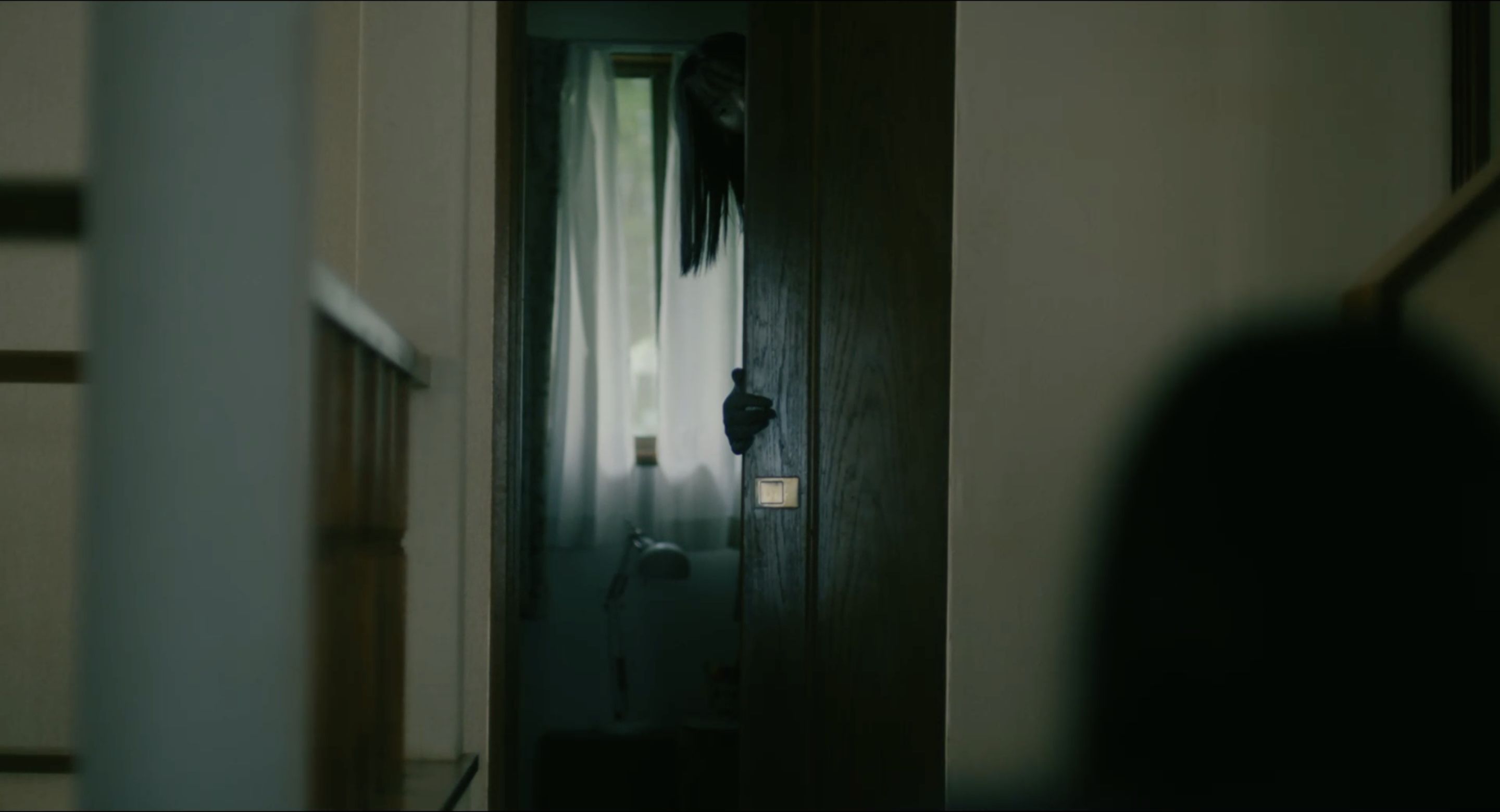
The spectator might wonder why scenes framed with a more mundane colour-palette retain a feeling of subtle eeriness and uneasiness. To let a sense of disquietude seep into the mundane visual frame, Shiraishi relies on visual punctuations common to the horror genre: visual repetition, slow zoom-ins, and unheimlich visual contrasts (e.g. the darkness of the halfway emphasizing the brightness of the light in the room beyond, the vague darkness underneath the eaves of the roof). Or, to put it more correctly, by elegantly utilizing these compositional punctuations, Shiraishi succeeds in making the eerie but confusing opening sequence silently echo within the shadows present within the more pedestrian moments, giving the mundane, at least for the spectator, a subtle threatening quality (Cine-note 1). The eerie musical decorations, furthermore, ensure that this echo does not fade away.
With the analysis of the narrative’s atmospherics under our belt, we cannot but reformulate our initial statement on the effectivity of Shiraishi’s House of Sayuri. The narrative’s effectivity, as our analysis has shown, is not simply due to the creation of an effective atmospheric frame of horror, but because the frame Shiraishi crafted is haunted by a silent anticipatory echo of horror. It is, in other words, the infestation of such eeriness within the shadows of the mundane frame that ensures that the bursting forth of disturbing imagery, i.e. imagery rippling the mundane, and the splashes of horror are effective.
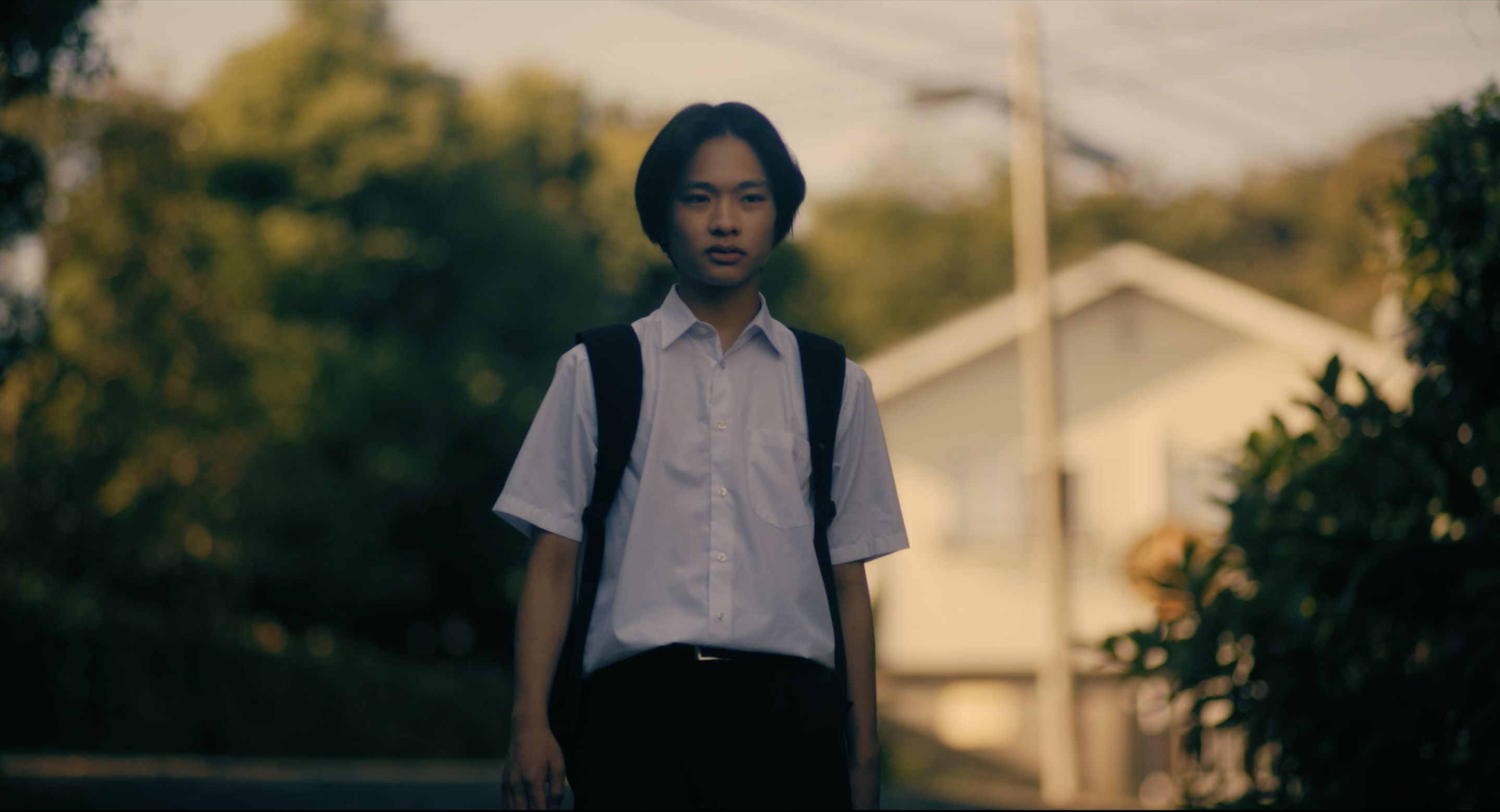
On the other hand, it is the subtlety by which such eeriness lingers within the shadows that enables the non-horror twists to impact the spectator without deflating the anticipatory sense of horror. Most of the twists within House of Sayuri are dramatic in nature – emphasizing the threat lurking within the house, but Shiraishi also sprinkles his narrative with light-hearted moments and comical intermezzo’s. These light-hearted refreshments either exploit the element of surprise or the awkwardness arising from relational misunderstandings – the tricky mendacious field of the imaginary.
House Of Sayuri might not offer anything radically different from other narratives in the onryō horror genre, yet Shiraishi does take the opportunity to reshuffle the narrative elements to illustrate the deceptive quality of the imaginary. It is because most of the Kamiki family members (e.g. Akio (Zen Kajihara), Masako (Fusako Urabe), … etc.) are invested in the fantasy of a happy family within the walls of a house that they are willing to dismiss any disturbance that signals that presence of a horrifying threat. Rather than taking the uneasiness their youngest child Shun (Ray Inomata) feels seriously and question the strange behaviour of the grandmother (Toshie Negishi), they subject themselves to the demand to rationalize all the disturbing events – the radical repression of this supernatural Real – to stay on the frail path of their father’s imaginary wish to create a happy place for his family.
It should not surprise anyone that the grandmother and the youngest brother, both in their own way, signal the presence of the enjoying evilness. The grandmother, due to her state of mental confusion, cannot inscribe herself into her son’s dream. In other words, she cannot utilize this communal fantasy to veil the lurking presence of the evil jouissance. Shun, on the other hand, is too young to fully partake in this familial fantasy and cannot veil the threatening but opaque truth of the house. Luckily, due to the intervention of Nao Sumida (Hana Kondo) at school, Norio Kamiki (Ryoka Minamide) becomes able to see past the familial fantasy and sense the otherworldly disturbance that thirsts for blood.
How can we understand the signifier ‘inochi no kousa’ [the essence of life] that plays an important role in the second half of the film, in the narrative fight between surges of horror and the repressing blossoming of anti-horror? It will not surprise anyone that, in psychoanalytic terms, we can equate this Japanese signifier with Eros and the Freudian pleasure principle. One can, as Shiraishi implies with House of Sayuri, only combat the horrifying threat by honing one’s desire – cultivating one’s lack positively – and, hereby, controlling one’s enjoyment/jouissance.
The reason why this Otherworldly evil attains the power to manipulate subjects and murder them is because its victims cannot repress their Thanatos – the death drive lingering within their Eros is allowed to blossom. The subjective logic of Sayuri’s victims is, in other words, infested by a jouissance that enjoys (the body) – Akio, for example, was subjectively poisoned by his agony.
While in many similar horror narratives the seductive element of mystery plays an important role in the narrative’s unfolding, Shiraishi does not rely on this narrative dynamic to structure his story. However, while Shiraishi does not foster a sense of mystery within House of Sayuri, he cannot stop the spectator from posing the following questions: What trauma lies at the origin of the otherworldly presence that haunts the house? And why does this presence channel itself most strongly through the sister (Kokoro Morita), turning her into a tool to enact her evil impulses? While the second question is only vaguely answered as the narrative unfolds, the answer to the first question is revealed within the narrative’s finale.
Like most other genre-bending horror films, the finale is an amalgamation of the different genre-elements – romance, drama, comedy and horror. While most directors stumble here, letting one genre-element degrade the impact of the others, Koji Shiraishi succeeds in making each genre-element come to its full right. The impact of the finale, while lessened by the various genre shifts, never annuls the impact of the sudden surges of horror nor of the dramatic and comical touches.
All Japanese directors who struggle to fluidly interweave different genre-elements within their J-horror narratives should give Koji Shiraishi’s House of Sayuri a thorough watch. Just like the spectator, he will not only be reminded of the fact that atmosphere defined the J-horror classics of the late nineties and early noughties, but also learn that the thoughtful manipulation of this atmospheric field is integral to create an effective and engaging genre-blend. Highly recommended.

Notes
General-note 1: We would argue that the success of the J-horror in the nineties was mainly due to the way directors generated atmosphere within their narratives. The horrifying impact of the J-horror classics Cure (1997), Ring (1998) and Ju-on (2002) lies not in the visualization of the horror, but in the dread that lingers threateningly within the visual fabric.
Narra-note 1: Some of Sayuri’svengeful acts do not merely echo her unabated anger but also represent her traumatic truth. Those who are responsible for her hellish state receive a punishment that fits their crime.
Colour-note 1: Shiraishi also utilizes these contrasts to turn his characters intodark silhouettes or the delineate the intrusion of the otherworldly.
Colour-note 2: In some cases, the colour-balance of the contrasts are reversed. In these cases, the orangish colours do not try to survive within a pitch-dark lake, escaping the black hole that forcefully sucks away all the colours, but the blueish and black darkness is turned threatening shadowy presences trying to devour the orangish colour-palette.
Cine-note 1: Through these visual decorations or punctuations, commonly utilized within the horror-genre, Shiraishi creates a tension-generating difference between the anticipatory knowing of the spectator – something bad will happen – and the radical ignorance of most of the characters – entering the house of their dreams. Shun feels the threat without knowing what it is and the grandmother, who suffers from dementia, perceives like no other the otherworldly intrusions in the mundane fabric
 psychocinema
2 Comments Add yours