Some film projects take years to come to full fruition. Coppola’s Megalopolis (2024), for instance, took more than forty years to evolve from mere idea to finished filmic experience. Martin Scorcese’s passion project Silence (2016), on the other hand, took over 25 years to be written, filmed and released.

In Japan, similar situations have taken place. Takeshi Kitano conceived of Kubi (2023) around the same time as the release of his first feature film, Sonatine (1997). Kitano bided his time to realize this dream-project until he could gather a group of actors who were worthy enough to bring his vision to life. Gakuryu Ishii obtained the consent of Kobo Abe to make a filmic narrative based on his novel The Box Man (1973) in 1997 and tried to realize the project in Germany the very same year, yet the project fell through as funding collapsed. Now, 27 years later, Ishii find a partner in Happinet Phantom Studios and Cogitoworks to bring his interpretation of Abe’s novel to the silver screen.
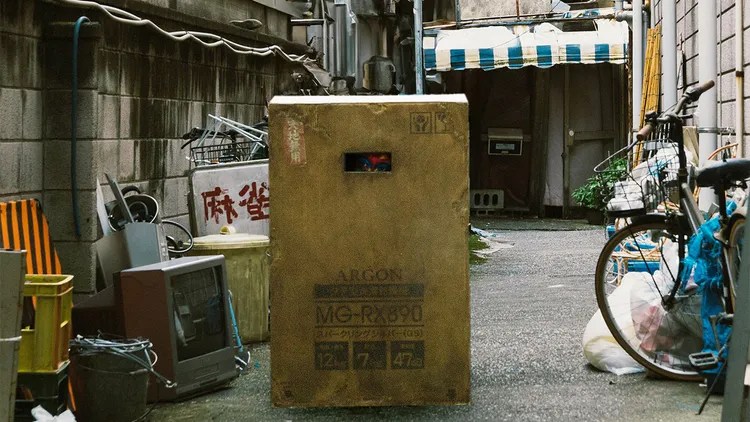
Ishii’s The Box Man opens by delineating the rather complex position a cardboard box can have within the societal field. The first aspect the box-man underlines concerns his presence is the idea that he, as box, is looked down upon – Think what you want. Look down on me all you like. In short, the suits and the female legs who wander within the societal field consider the box a mere trash-object that dirties the street and, thus, avoid turning him, with their subjective gaze, into a societal presence.
As societal absence, the box-man (Masatoshi Nagase) gazes through the black rectangular hole at the societal field. And what he perceives is a Lacanian truth neurotic subjects must ignore to function within the societal field: the fabricated nature of the Other and the misplaced faith in the Other of the Other – a fabricated box you place faith in. It is you people who live inside it. While the Other, as field of signifiers, has a certain objective existence, the subject needs to fabricate himself and subjectify the Other by utilizing the mother-tongue, the signifiers of the (m)Other. By putting faith in the Other of the Other, in the consistency of the societal field – the nom-du-père, the subject ensures that his ego obtains a certain false phantasmatic consistency. Or, to put it in metaphor of the box, the subject, to define the contours of his own body-image and ego, needs to appraise the shape of the societal box. Yet, he can only do so by believing that the societal box is without any holes.

Yet, there is another thing the box man perceives: the hidden shape of the world or, in our words, the Other as secretly shaped by unconscious desires and unconscious complexes. From the pictures that adorn the inside of the man’s box, the spectator can safely assume that this hidden desire is sexual and perverse. And what transpires between the general (Koichi Sato), the fake doctor (Tadanobu Asano), and Yoko (Ayana Shiramoto) further corroborates this.
There are, of course, subjects who cannot ignore the box and who are drawn to the black peeping hole. For them, the hole manifest itself as the Gaze, an irreducible stain that disrupts the consistence of the ego. There are, as the narrative of The Box Man underlines, two possible ways to react to this confrontation. Either one flees away to avoid the radical questioning of one’s desire – who am I, as desire? – or one becomes a subject who becomes enthralled by this gaze, either to unravel the desire that animates man in the box – e.g. the doctor-general – or to destroy its disruptive presence – the beggar (Kiyohiko Shibukawa) and the fake doctor.
While the fleeing subject escapes the sudden disruption of their societal box, the disruptive revelation of the structural inconsistency of the Other – the neurotic delusion, the ‘fascinated’ subject seeks to pacify the gaze by trying to solve the riddle of the Other’s desire or to annihilate it (Narra-note 1). The repeated enunciation “Those who obsess over the box man become the box man” underlines that only by becoming the subject in the box – by hiding one’s existence in the darkness of the box and transform oneself into an objective gaze and a hidden voyeuristic presence, one can one truly embark on the path to unravel the desire that animates the box-man.

The ultimate point The Box Man makes is that subject in the box, despite grasping the repressed truth of desire, is not immune to desiring and the seduction that emanates from the riddle of the Other’s desire (Narra-note 2). As the narrative unfolds, our box-man gets more and more obsessed with Yoko. Her acts and signifiers do not merely confront him with the indeterminability of her desire, but seductively invites him to construct a female image that arouses his desire and invites him back into the field of societal deception. The sudden blossoming of desire within him blinds him for the repressed truth of the Other he as box perceived so well (Narra-note 3).
Some readers might wonder why we remain so vague about the narrative’s unfolding, yet we deem this vagueness necessary to keep the unforgettable filmic experience Ishii crafted intact for the spectator. Ishii does not merely ignite the spectator’s fascination with its compelling and evocatively delivered narrative set-up, but succeeds in keeping the spectator engrossed by delivering an unpredictable denouement riddled with puzzling yet deeply intriguing narrative moments and some strange but thrilling action-sequences.
Gakuryu Ishii delivers a composition – a concatenation of static shots and floaty dynamic moments – that keeps the spectator engaged throughout the narrative with ease (Cine-note 1). He does not only please the spectator by littering his composition with many visually pleasing shot-competitions and playful evocative visual sequences, but also by thoughtfully exploiting pace to create satisfying and energetic action sequences.
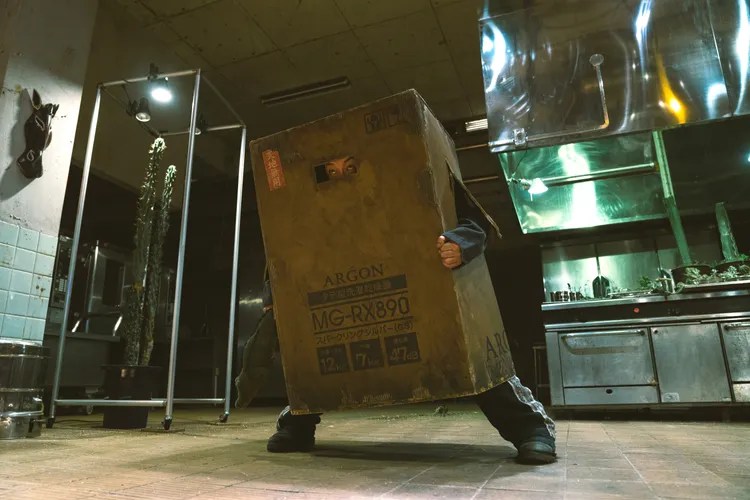
The composition is further elevated by a playful switch between monochrome and polychrome colours. While these shifts do not have deep thematical dynamic like in Nobuhiko Obayashi’s His Motorbike, her island (1986), Ishii utilizes these fluid alternations to express himself in aesthetically and compositionally divergent ways and please the scopic drive of the spectator in different ways.
The rhythmical musical accompaniment of The Box Man does not merely spice up the concatenation of shots – the visual flow – and, in certain cases, also the framed movement within the shot, but also helps in keeping the spectator glued to the screen by seducing him with a sense of mystery and infusing an enticing tinge of excitement into the atmosphere of the elaborate narrative.
The Box Man is an incredible satisfying cinematic experience, one that enthrals the spectator from start to finish. Ishii goes beyond the mere frame of homelessness and the conflict between a search for anonymity and a desire for desire to deliver an evocative exploration of the absent presence of the gaze, the register of scopic ‘voyeuristic’ pleasure, the misrecognition of the logic of desire, and the fakeness that structures the register of the ego.

Notes
Narra-note 1: Many of those who chase the box-man mediate their relation with the box through a variety of lenses (e.g. the scope on a rifle, the camera, cctv…, etc.). In our view, the utilization of such a lens allows the chasing subject to avoid the destabilizing confrontation with the black gaping gap, the gaze.
Narra-note 2: It is important to realizethat the position of the box-man assumes within the societal field is radically self-deceptive. By looking down on others from the gaping hole of his box, he does not only mistakenly think he has escaped the fabricated Other, but also short-circuits the questioning of his own subjective logic. In short, the perceived societal truth blinds him for his own subjective truth, for his own sexual desire as traced out on the inner walls of his box.
The ending of the narrative confronts the voyeuristic spectator directly with the fact that he, enamoured by the box that his ego is, fails to see his own unconscious logic and desire. The Box man might assume that he has “abandoned all that is fake” and “obtain[ed] the real thing”, yet he radically misrecognizes that the real thing is a mere lid that closes of his own subjective void.
Narra-note 3: The blinding effect of desire is illustrated by the following sentence he writes about Yoko in his notebook: “Lewd acts are so unbecoming of her”. This sentence underlines that the box-man is trying to avoid accepting Yoko’s sexual desire and protect her image of desirability.
Cine-note 1: Ishii does not merely use still photography to establish the context of the narrative is, but also to explicitly refer to Kobo Abe’s novel.
 psychocinema
One Comment Add yours