Introduction
Kenichi Ugana has had a big miss with Goodbye Silence (2018) and one satisfying narrative with Extraneous Matter – Complete edition (2020). While Ugana generally writes his own scripts, he opted this time to use a script written by Hirobumi Watanabe, known from indie-gems like Life Finds A Way (2018), Cry (2019), I’m Really Good (2020) . Can Ugana deliver another hit or will he serve the spectator another miss?

Review
While Wakaba has a caring mother (Hitomi Takahashi), who does her best to record every television appearance of her daughter’s idol Kohei Shirasaki, her father (Tomoki Kimura) disturbs the familial dynamic with his constant complaining and recurring enunciations that his wife is a failure.
At school, Wakaba and her friend Kanna, who is also a fan of Kohei Shirasaki, keep witnessing two of their classmates bullying Koki. One time during lunch, after one of the boys poured milk over Koki’s head, Wakaba offers him her handkerchief. Of course, the bullies immediately exploit this opportunity to loudly declare that she loves him and should marry him.
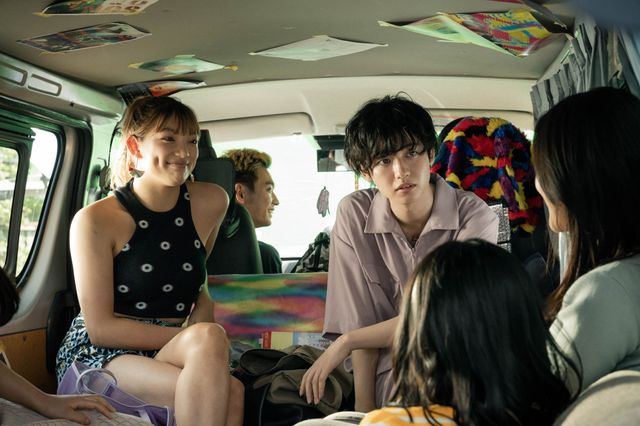
The next day, when the bullying of Wakaba reaches a new height, Koki (Yuzu Aoki) decides to repay her act of kindness and perform his love by defenestrating the two bullies. Seven years later, Wakaba (Sayu Kubota) and her friend Kanna (Riko) are on a trip with some musicians. While Wakaba remains naïve and trusting, her friend rightly assumes that their intent is far from pure. Yet, before any sexual approaches can be made, Wakaba realizes that two of the musicians, Tomoya (-) and Moeka (-), have disappeared.
Love Will Tear Us Apart offers a nice twist on the romance genre by exploring the dimension of love within the confines of a bloody slasher film. Yet, Ugana does not merely deliver a narrative about love and its expression, it also takes time to investigate, within the confines of the romance narrative, the subjective impact of bullying and the violence of the signifier and the violent signifying act.
The opening 20 minutes of the narrative – until Koki’s murderous act, are thematically quite dense in order to make the murderous twists and bloody that follow to have some sense. The narrative, in fact, succeeds in highlighting that some murderous acts go beyond the simple and flawed opposition of good and bad.
Before delving deeper into the sense the violent acts might have, we need to explore the problematic familial situation our two subjects – Koki and Wakaba – are subjected to. Wakaba is, most of the time, only a witness to her father’s verbal violence towards her mother – you are not good enough as a wife, while Koki is the subject of his mother’s abusive acts and signifiers (Narra-note 1). What causes Koki’s motherly violence is the phantasmatic belief that life would have been easier if he hadn’t been born. What thus fuels her violence is not the lack that marks her son, but that he, within her phantasmatic world, is made the cause of all her lacks. For Koki, this violence can only be translated as follows: I’m not loved, I’m unwanted; I’m not the object of her desire, but of her hate.

The bullying of Koki and Wakaba by the two others follows a simple dynamic of exploitation. What the bullying subject aims at with his acts of violence is not merely a shot of enjoyment, but a kind of enjoyment that feeds his fantasy of superiority/normality – it is in the act that he can fleetingly satisfy this fantasy. It is, therefore, not surprising that the object of bullying is Other and whose Otherness can be exploited to feed the fantasy of superior normality. Koki, due to being so aloof and silent, puts his Otherness on the stage and Wakaba reveals her Otherness via her act of kindness.
The biggest shock for many spectators will be the radical refusal of the teacher to accept the reality of the bullying. While it might seem implausible, there are well-known cases where such kind of ignorance has led to teenage suicide. There are two reasons why a teacher remains blind to such violence, First, the subject wants to protect his/her own image of teacher. To accept that bullying happens within her classroom is equal to confessing his/her failure as a teacher. Secondly, the teacher aims to protect the reputation of the school. The presence of bullying within the walls of the school would dirty the pristine image of the school.
Koki’s act of defenestration is, like we mentioned before, not merely a way to repay Wakaba for her unexpected kindness and to protect her from further harm, but to express his love for her in a twisted way – to put himself as lover on the stage and rise her up to the status of beloved. Koki’s violent acts, appearing after a long period of letting himself be passively subjected to acts of bullying, is thus of a confessional nature. Because of that, these acts, these bloody signs of his love, incorporate a demand to Wakaba – a demand to see his love answered.

The violent eruptions that follow Wakaba in her later life is targeted at the exploitation of the female subject and her reduction to an object to be enjoyed sexually as well as phallically. In other words, what the violence aims at is the very fact that male subjects utilize the female subject to repair their sense of being phallically insufficient.
Besides offering an engaging exploration of the intersection of violence and love, Love Will Tear Us Apart also pleases the spectator with the various subjective shifts that mark the side-characters. While some of these shifts can only be considered deeply hypocritical, they essentially show that the past cannot but be rewritten from one’s present position. This kind of rewriting of the past solely happens to safeguard our ego and to efface those elements that do not fit for the societal Other – e.g. the complicity in the acts of bullying.
Ugana’s composition – a pleasant combination of static and dynamic shots – offers the spectator visual pleasure with its elegantly utilizing floaty and fluid dynamic moments (Cine-note 1). This dynamism, which marks many of Ugana’s shots, allows these shots to infuse a dash of naturalism into the performances and echo, whenever the situation call for, the tension that disturbs the atmosphere. Said tension is either function of relational clashes or by the infraction of something that radically disturbs the peaceful equilibrium of the societal field.

In the latter case, the slow dynamic moments tend to be decorated with tensive musical accompaniment. Dynamism and music work, in these cases, hand in hand to engage the spectator with the tension within the narrative and to generate a quantum of enjoyable tension within the spectator. What makes these moments, moreover, so effective is the fact that Ugana exploits the element of the unseen to play the spectator’s expectations and fuel his imagination.
Ugana created a nice balance between showing the bloody gore and letting the spectator image the cruelty of the violent acts. The gore-effects are, moreover, quite convincing and satisfying to watch. While some narratives are too ambitious and ruin or derail the visual continuity with awkward effects, Ugana ensures that the imagery of gore supports the unfolding of Wakaba and Koki’s story.
Love Will Tear Us Apart is a narrative that blows a refreshing wind in both the slasher and the romance genre. Yet, in our view, Ugana and Watanabe’s most pleasing contribution lies in highlighting that there is a kind of violence that lies beyond the simple moral division of good and bad. In any case, fans of both genres should not miss this bloody great narrative.

Notes
Cine-note 1: Shaky shots are utilized to powerfully reverberate the subjective turmoil the sight of the violence causes.
Narra-note 1: Of course,while Wakaba generally avoids her father’s verbal violence, she is still subjected to the violent tension between her mother and father.
Sometimes, the father’s frustration does shift from mother to her. In these moments, what he ultimately targets is his wife within her rather than her subject as such. While Wakaba can deflect his verbal attacks, she remains victim of the frustration that radically complicates the familial atmosphere.
 psychocinema
One Comment Add yours