While cinema is, first and foremost, a visual medium, one cannot under the importance the auditive dimension – diegetic as well as non-diegetic sound and music – has in elevating the visual fabric.
The centrality of sounds and music within the cinematic field is one of the reasons why the musical found its way to the silver screen. Even in Japanese cinema, directors have turned to sing and dance to tell their story and express themselves creatively. Shinobu Yaguchi charmed audiences with his Dance With Me (2019). Sion Sono turned to the rap-genre to create Tokyo Tribe (2014) and Takashi Miike experimented with music for his For Love’s Sake (2012). Yukinori Makabe and Matsuya Onoe, on the other hand, delivered an eclectic human drama with his Love, Live, and Goldfish (2021) and Kenjo McCurtain turned to the visual style of the Hollywood musical of old to give his indie-musical Make-Believers (2021)a distinguishing touch.

Besides the pure musical, where people burst out in sing and song every now and then, there are also films where music is naturally interweaved into the narrative. Not unsurprisingly, this kind of movies often deal with singers and band-performances. Sion Sono surprised audiences with his fantastical narrative exploration of the rise and fall of a rock musician in Love And Peace (2015) and Akihiko Shiota explored romantic struggles within a band in his touching Farewell Song (2019).
Nobuhiro Yamashita is not a stranger to the second kind of musical film. In 2005, he pleased domestic and international audiences alike with his celebration of youth in Linda, Linda, Linda (2005) and, ten years later, he delivered another musical youth narrative with La La La at Rock Bottom (2015). His latest film, Let’s Go Karaoke (2023), the winner of Audience Award at the Camera Japan Festival, is quite similar, exploiting the emotional potential of music and song to breathe life into the unfolding of the seishun-drama.
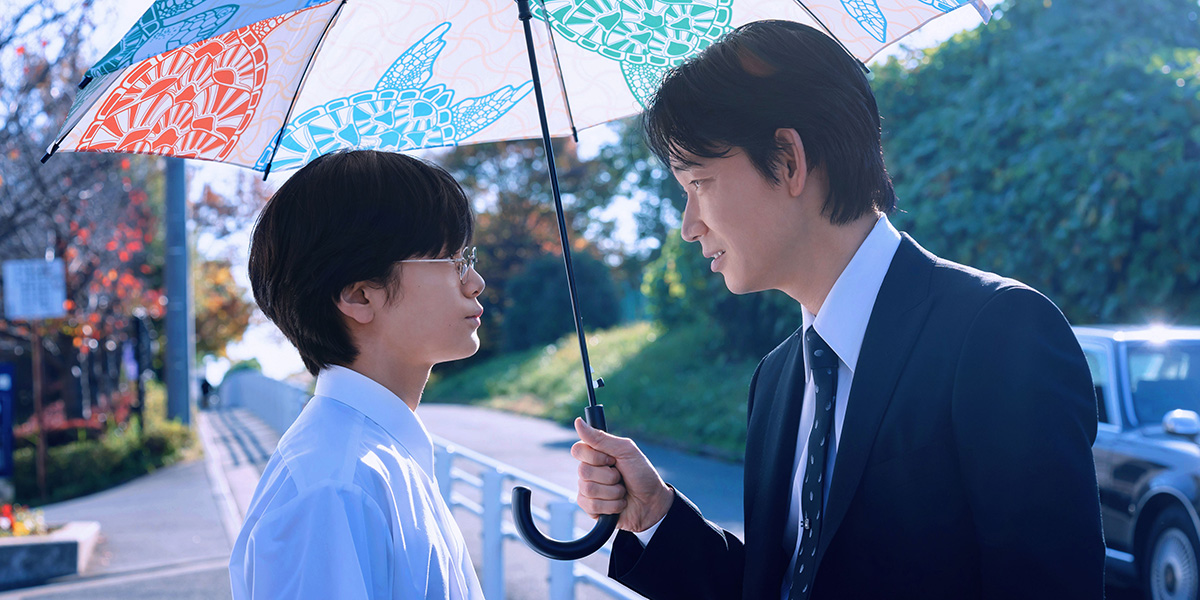
Yamashita’s film stages the unlikely friendship between Kyoji Narita (Go Ayano), a yakuza, and Satomi Oka (Jun Saito), a third-year junior high school student and choir leader. They meet each other, for the first time, in a hallway in the venue of the Junior High Choral Contest. On his way to fetch the trophy for getting the third place, Satomi Oka is suddenly stopped in his tracks by a drenched yakuza, who promptly invites him to Karaoke and ask him to help him prepare for the coming karaoke composition and avoid coming in last and getting tattooed by the boss, a hobby tattooist with no drawing talent whatsoever.
Let’s go Karaoke offers the spectator a well-shaken cocktail of comedy, youth-drama, and music. While many directors would have struggled to balance the drama and the comedy, Nobuhiro Yamashita has the experience to craft a narrative that honours the narrative’s silly premise and succeeds in making the denouement of Satomi Oka’s subjective struggle emotionally impactful.
While Yamashita, of course, utilizes the element of music – i.e. the choral singing and the out-of-tune karaoke sessions – to rhyme both emotional sides together, this rhyming is facilitated by the fact that comedy arises in a ‘natural’ way within the narrative. Yamashita mainly plays with contrasts (e.g. the singing yakuza versus the deadpan presence of the choir leader, the silence of the yakuza after listening to an outrageously bad performance, … etc.) to deliver comical moments with his narrative. In fact, much of the light-heartedness in Let’s Go Karaoke stems from offering the spectator a voyeuristic glance at the life within the karaoke booth and seeing the subject undressing himself of his ego-defences – i.e. the socially accepted facade under the gaze of the Other – to produce auto-erotic jouissance by vibrating his vocal cords and produce song.
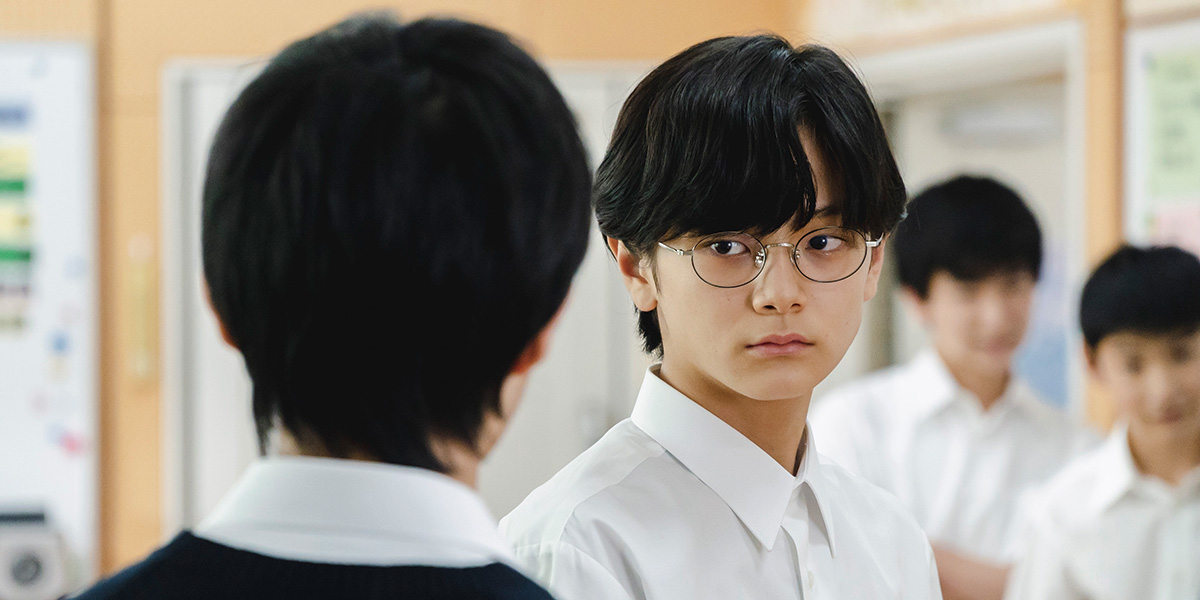
Yamashita’s reliance on comically contrasting the subject protected by his own ego-mantle and the subject who undresses himself in the Karaoke booth also allows him to touch upon the aggression that logically slips within a societal structure that elevates the imaginary dimension. The director, yet not without some exaggeration, shows the spectator that a societal field structured around the signifiers honour-dishonour results in a frail relational network unsettled by imaginary attacks and bursts of violence to suture, as swiftly as possible, the inflicted gash in the subject’s ego.
The comical dimension of Let’s Go Karaoke! is, however, not simply function of Yamashita’s elegant use of the element of contrast. Yamashita also subverts the spectator’s expectations to deliver comical punch-lines and exploits the dimension of misunderstanding – of speaking from different levels on the musical scale – to allow light-heartedness to blossom from the clashing of signifiers and the sliver of non-sense that such clashing produces.
The dramatic dimension of Yamashita’s narrative turns around the riddle of what the signifier ‘love’ signifies. The puzzling riddle is introduced by Ms. Morimoto (Kyoko Yoshine) when she, in her answer to a question by Wada (Kiyoto Uchiro), states that a tiny lack of love might be the cause of the choir’s failure to secure the win at the choral contest. Wada, who is obsessed with concrete facts, dismisses her answer as ridiculous, while others shrug off her answer by framing her as a daydream believer. Yet, the student’s refusal of Morimoto’s answer echoes the fact that, for these young subjects, love is a signifier with a vague undefined signified.
Satomi, however, receives a possible answer to this riddle from his friend Kuriyama (Izawa Tetsu), whom he was watching a classic Hollywood romance with in the film club room: Love is all about giving, giving what one does not want to someone who wants it. While one does not touch upon the symbolic dynamic of love, Yamashita’s narrative does illustrate what love amounts to in the imaginary. Imaginary love is all about exchanging objects and circulating concrete signs proving one’s love. While it might not be evident at first glance, the imaginary dynamic of love structures the finale of Let’s Go Karaoke. Without giving too much away, the touching finale sees Satomi Oka assuming a position that allows him to grant two different people (i.e. Kyoji Narita and Wada) signs of his love.
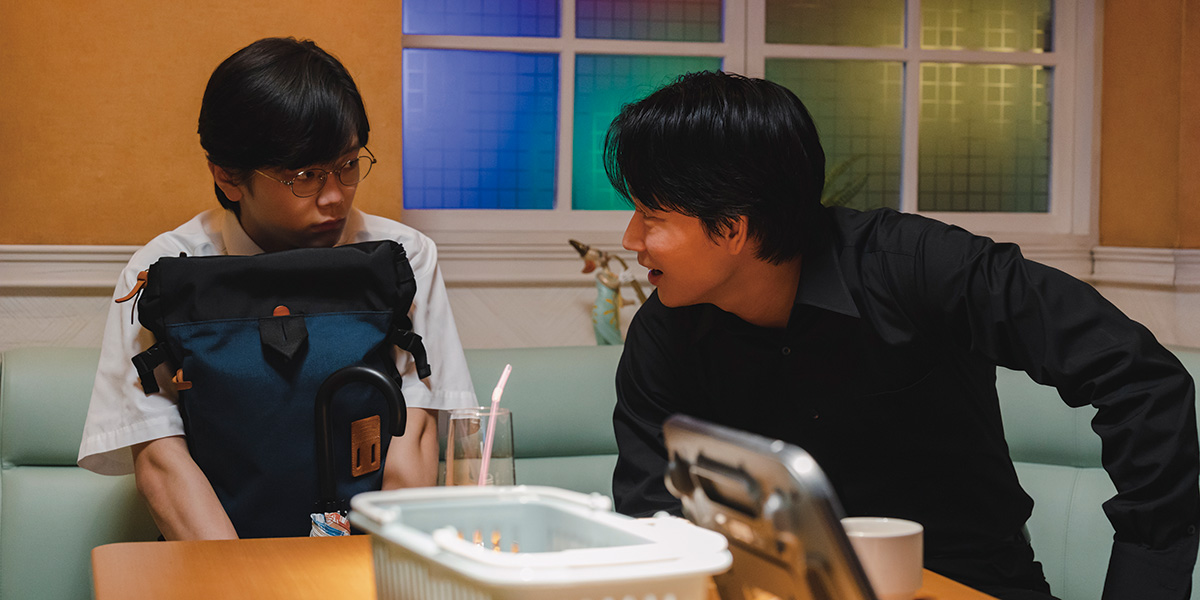
The composition of Let’s Go Karaoke! is a straightforward affair – a balanced but unremarkable blend of fluid dynamism and static shots. In fact, the composition cannot be said to play an important role in satisfying the spectator’s scopic drive. What does play an important role in ensuring the visual pleasure of the spectator is the pleasing lighting and colour-design. There are many shots within Let’s Go Karaoke where the contrasting encounter between colours create pleasing gradations that, beyond setting the mood, accentuate the spatial dimensions (i.e. the relief and depth) of the interiors (e.g. the hallway of the venue, the karaoke booth).
The balance between the comical dimension and the dramatic dimension of Let’s Go Karaoke! is also supported by the non-diegetic and the diegetic music. While the former – i.e. the electronic musical accompaniment – always echo the light-hearted essence of the narrative, the later becomes, especially in the latter half of the narrative, the gateway through which the dramatic dimension can come to full blossom. Both dimensions also receive their support from the acting-performances, which range from naturalistic to slightly caricatural.
Let’s Go Karaoke! is a perfect crowd-pleaser. Nobuhiro Yamashita strikes a perfect balance between comedy and drama to put many smiles on the spectator’s face and some tears in his eyes. This is perfect film for anyone who, after a long day full of struggles, wants to sit in a comfy chair and relax.

 psychocinema