Among people interested in Japanese cinema, Akiko Ohku is best known for her work in the romcom genre – Tremble All You Want (2017), Marriage Hunting Beauty (2018), Hold Me Back (2020), Wedding High (2022). Her latest narrative – an adaptation of Fukutoku Shusuke’s debut romance novel The Best sky Is Yet to Come (2020), threads familiar light-hearted paths before settling in a more dramatic tone to bring the subjectivity of youthful subjects – the weight of the signifiers they formulate – to life in a more authentic and, also, more touching manner (General—note 1).
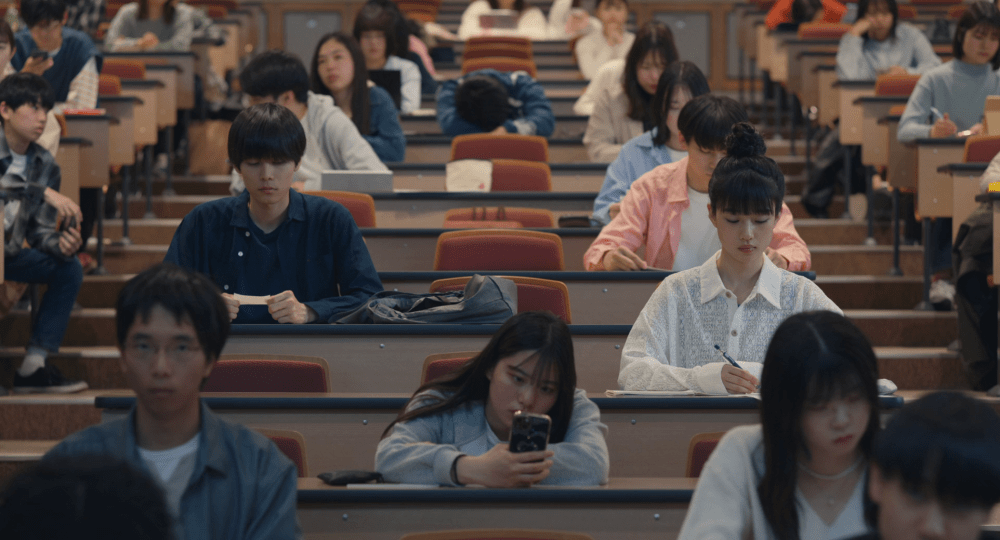
Ohku’s narrative commences when, Toru Konishi (Riku Hagiwara), after a six months absence, finally returns to Osaka to restart his university life at Kansai university. Seated in the lecture hall, the equilibrium of his ego is subtly shaken by the attractive female shape of Hana Sakurada (Yumi Kawai) – his desire has found its aim.
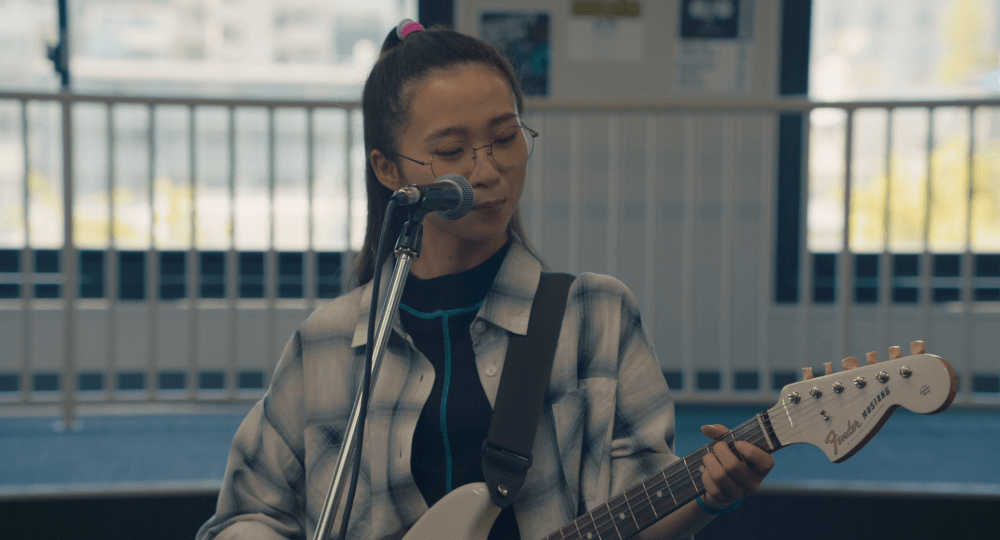
Konishi also restarts his part-time job at a local bathhouse ran by Sasaki-san (Arata Furata) and his pregnant daughter (Honoka Matsumoto). Together with Sacchan (Aoi Ito), a fellow college student and musician in a band, he cleans the baths while chatting away – She looks so happy around him.
Before delving into our thematical exploration of She Taught Me Serendipity, it is important to stand still at the narrative’s envelope. The temporal dimension of Ohku’s narrative is made explicit by dividing the story in five chapters with terms that have a poetic resonance – Full of Spring Clouds, Early Summer Rain, A rainbow, Rumbling Thunder, She taught Me Serendipity (General-note 2).
While the first four chapters seemingly have a simple seasonal referent, three of these titles are kigo (季語), seasonal signifiers reserved for haiku and other classical-style writing, and one is a sino-archaic word used in Kanshi – Chinese poetry written by Japanese poets. The introduction of such highly evocative words into the structure of the narrative signals that Ohku does not simply want to give the temporal flow of her narrative a poetic touch, but seeks to leverage their evocative quality to echo what happens at the level of the subjectivity of the main characters – Konishi, Hana, Sacchan, and Yamane (Kodai Kurosaki).
The first chapter of the narrative, for instance, is called hanagumo (花雲). This signifier does not merely refer to the cloud-like shape of cherry blossoms in full bloom, but aims to highlights the impermanence of beauty. This impermanence is visually represented by the Cherry Blossoms on the university’s rooftop but also elegantly evoked in the way the subjective impact of the fleeting passage of Hana on Konishi is framed – a fleeting moment of beauty that turns her into the aim of his desire. Ohku’s second chapter is named ryoku (緑雨) not merely to signal that the rain pitter-patters on fresh green leaves, but also to emphasize the beauty of the establishment of a minimal relationship between Toru and Hana – the ‘freshness’ of their minimal bond and the reaffirmation of Toru’s romantic interest in her.
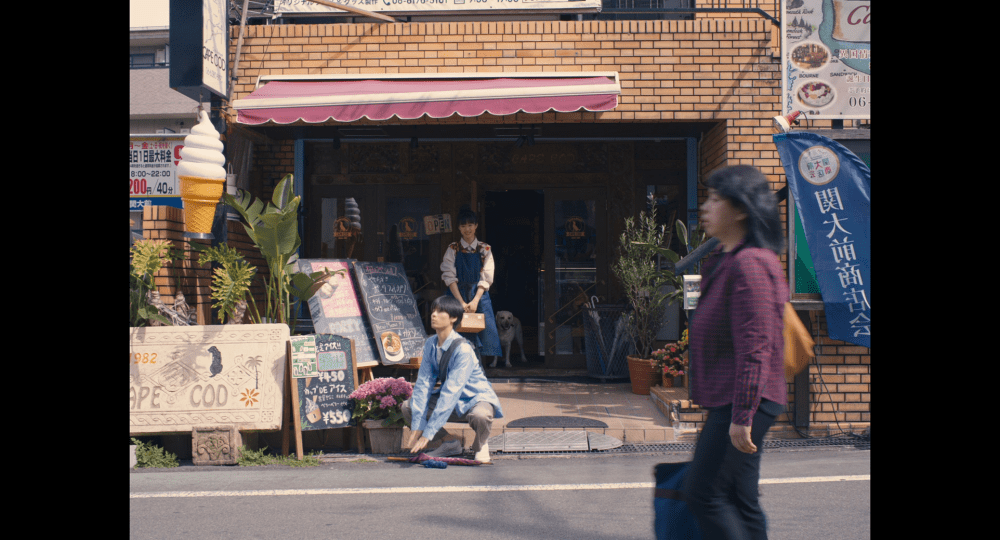
The third chapter is given the title kougei (虹霓). By adorning her chapter with this old archaic term for rainbow – a term used by Japanese poets in classical Chinese poetry, Ohku does not merely refers to Yamane’s playful equation of Miki, his girlfriend, with a rainbow, an occurrence that brings joy, but also aims to leverage its cosmic link with yin-yang thought to playfully evoke the safe relational balance that Toru and Hana have attained.
The spectator might wonder why Hana, in her first real interaction with Konishi, feels compelled to tell him all about her subjective peculiarities (e.g. her strange hobby, the dead of the father, … etc). This speech has, from a psychoanalytic perspective, two different aims. The first aim of Hana’s speech is to position herself as an enigma to Konishi as Other (Narra-note 1). She feeds him knowledge to keep him and his desire engaged. The second aim of her confessional speech is to implicitly ask the Other whether he, despite all her peculiarities, can love her. She offers him her strangeness – I lack with respect to the feminine ideal – in the hope to be desired for that ‘lacking’ eccentricity.
Konishi, however, does not respond to these revelations by becoming ‘fatherly’, but by letting them exist and, subsequently, revealing his own lack to her – his own weakness (Narra-note 2). Yet, sadly, that is precisely what Hana, as hysterical subject, does not have a need for – she does not grant her lack to him to be gifted a lack in return. The hysteric female does not need a hysteric male, but a subject that can (but fails to) replace the father (Structure-note 1, Narra-note 3).
Konishi proves himself to be quite deaf to what the signifiers of the female Other implies. In this sense, Akiko Ohku delivers a drama of the signifier – of the inability of discerning what words, beyond their facade of meaning, ultimately imply and the blindness of what one’s uncontrollably evokes to the Other with one’s own speech. Ohku reveals, in a very touching way, that speech is not made up of signs, but signifiers. On the other hand, She Taught Me Serendipity also underlines the importance and the inherent danger of symbolic speech – of speech that puts the subject on the relational stage.
The fact that She Taught me Serendipity succeeds in touching the spectator so profoundlyis not merely due to Ohku’s narrative poetic play, but also because Yumi Kawai, Riku Hagiwara, and Aoi Ito make the most of the space given by the director to breathe life into their character’s subjective position. They impress with their performances – and succeed in bringing the emotions of their characters in a genuine way to life on the silver screen.
Akiko Ohku thrusts the spectator into her narrative with a rather energetically composed opening sequence. Her blend of fast cutting, dynamism, and slow-motion decorations, while somewhat disorienting, is effective in introducing the spectator to the two main characters, Konishi and Hana Sakurada, and visually emphasize his romantic interest in her (Cine-note 1).

Of course, the energy of Ohku’s composition drops after these opening minutes – playful compositions make way for more subdued framing of conversational moments. Yet, she makes sure her dynamic composition retains some of its energetic feel by fluidly interweaving surges of compositional play (e.g. jump-cuts, split-screen, slow-motion) and delivering playful visual moments that ensure the mood of the narrative remains light. The dynamic feel of the composition also allows her to fluidly interweave beautiful shot-compositions – shots that, beyond utilizing geometry thoughtfully, also attain a subtle poetic feel.
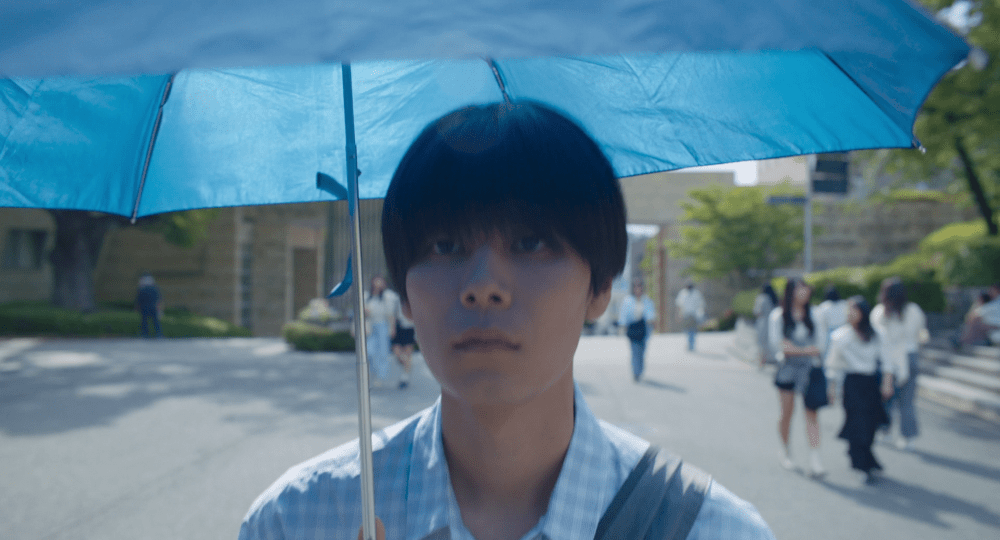
However, the spectator will have no trouble in perceiving that these decorative moments always seek to evocatively stage Konishi’s subjective position – these moments stage, in a certain sense, the subtle subjective tremble caused by certain perceptions (e.g. the elegant shape of Hana Sakurada as it becomes the aim of his desire) and certain acts (e.g. Konishi having spoken to Hana for the first time). Ohku’s use of shaky framing, on the other hand, seek to strengthen the naturalism of the interactions – the ‘reality’ of the subjectivities involved and the ‘genuine’ nature of emotions that pour out the body and the signifiers.
The energetic opening is supported by an equally dramatic play with diegetic sounds – a dramatization of the ebb and flow of sounds (e.g. murmuring dying out, …). This thoughtful manipulation of sounds does not only make the aural reality feel more real – enhancing the poetic dimension of the seasonal atmosphere, but also introduces the spectator into the experiential reality of Konishi and invite him to sympathize with his subjective position. Ohku utilize such ‘subjectivizing’ play throughout her narrative.
Much like with the compositional energy, the soundscapes quickly turn more straightforward. Yet, by delivering this dramatic opening, she retains the rights to sprinkle her composition with light-hearted aural decorations (e.g. adding a reverb to Yamane’s enunciation yummy, overlaying a visual sequence that juxtapositions Konishi’s trajectory after class with a repetition by Sacchan’s band at the university with the song the latter are rehearsing.)
She Taught Me Serendipity steers away from delivering a clear-cut romantic fantasy to confront the spectator with the messy consequences of utilizing signifiers in the game of love in a very moving way. While some spectators might consider the film’s ending sequence a cop-out, Ohku’s emphasis on the confession – on the importance of bringing love as subjectively-invested signifier into play – tasks the spectator to carefully read the subjective stances of the main characters and decide, for better or worse, the ultimate outcome of her narrative. Highly recommended.

Notes
General-note 1: Akiko Okhu also takes the time to honour Kitamura Kaneko, the first female student of Kansai university and journalist that passed away at a young age (1903–31). She integrates some of her spoken words in the narrative in her narrative to signal (the pressing need for women to express anger at) the persistent gender gap in Japanese society.
General-note 2: The Japanese title for the fifth chapter is quite different from the English translation. In Japanese, the chapter is called I cannot yet say that I love today’s sky the most – 今日の空が一番好き、とまだ言えない僕は.
Narra-note 1: Hana’s sudden departure has the same function: to posit herself as an enigma and provoke his desire. Later in the narrative, Hana’s act of not showing up for a planned lunch can be read in the same manner.
Narra-note 2: The spectator should immediately notice that Hana, rather than letting his feeling exist, immediately undertakes an attempt to repair him – to put the lose fragment back in its place so that the ‘phallic’ image, once more, covers over his structural lack. Hana, moreover, seeks to dismiss any attempt by Konishi to undo her state of lacking.
Narra-note 3: Even with our reading of Hana’s subjective position, the ending of She Taught me Serendipity remains open-ended. Whether one interprets the finale in a hopeful way or not depends on whether the spectator believes that Konishi’s assumption of Hana’s fatherly language allows her to love her father through him.
Structure-note 1: The fourth chapter is called raimei (雷鳴), a kigo-signifier strongly linked to mid- to late summer. This signifier, beyond introducing the time-frame to the spectator, implies a break in the stillness, foreshadows emotional turning points. Without revealing anything, the spectator is not ready for all the drama that erupts because we speak with signifiers and not with signs.
Cine-note 1: Ohku emphasizes Konishi’s interest in Hana by utilizing slow motion moments for shots that coincide with his field of view, for shots that are POV by proxy.
 psychocinema