Fans of Takashi Miike always look forward when the master delivers a new filmic experience. However, in recent years, Miike’s output has been rather inconsistent, delivering a mix of easy digestible but uninspired experiences for the greater public and filmic narratives where his desire to play to his strengths and give expression to his sensibilities is apparent. Lumberjack The Monster, an adaptation of Mayusuke Kurai’s novel of the same name, sadly falls in the former category.
One day, police officers led by Kitajima (Masayuki Deai) barge into the home of Kazuo Toma (Ryushin Tei) to apprehend his wife Midori (Reon Yuzuki). The find her in a room filled with surgical instruments with a child who has bandages around his head. Some moments later, an officer barges in announcing the discovery of fifteen barrels with bodies of children. Midori slits her own throat.
Many years later, a string of brutal murders with an axe-like weapon forces the police to establish a special investigation team. Unit Chief Hirose (Keisuke Horibe) explains to his colleagues that the killer collects his victims’ brains and highlight that each victim committed criminal transgressions. SSBC Analyst and Inspector Ranko Toshiro (Nanao) adds that, considering the evidence or the lack thereof, the perpetrator, whose violence indicates psychopathic tendencies, had a clear motive to target his victims.
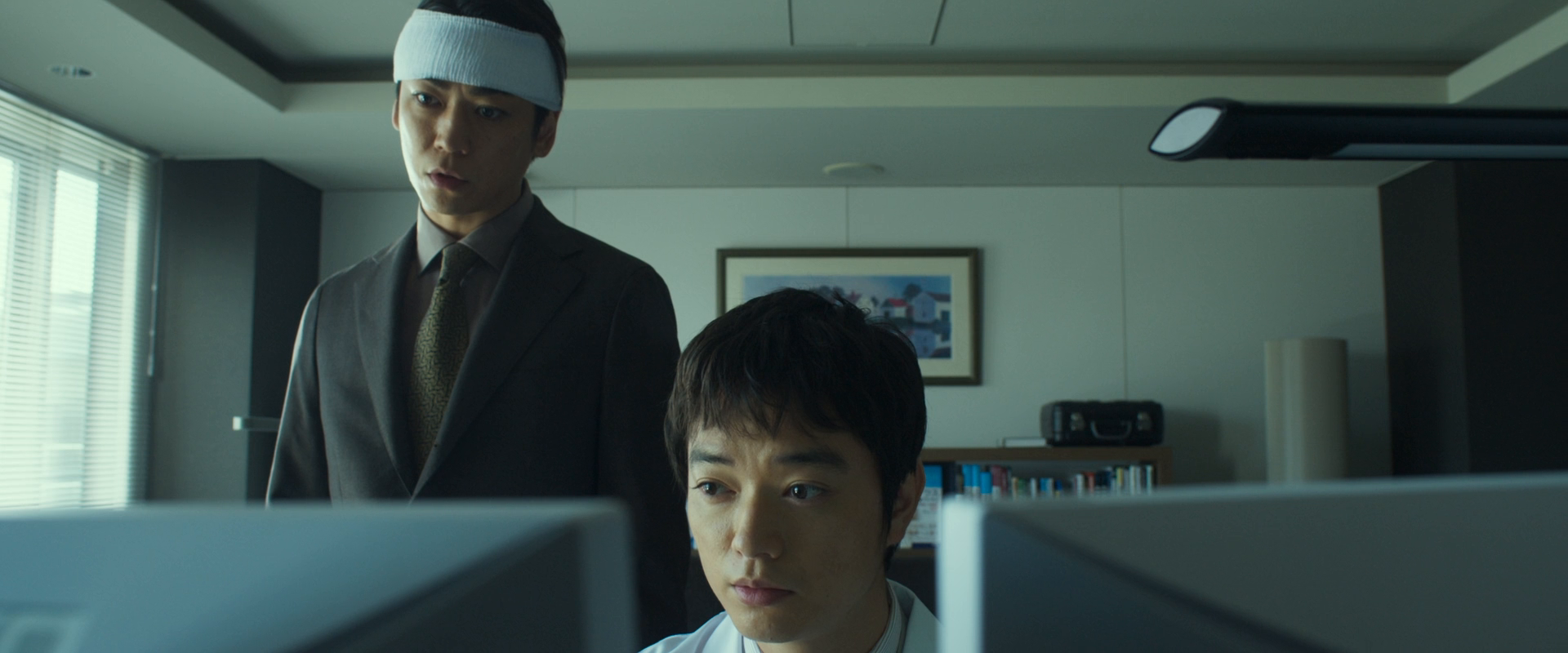
One of the killer’s targets is none other than lawyer Akira Ninomiya (Kazuya Kamenashi), a narcissistic man who has no qualms in transgressing the law to violently protect doctor Sugitani (Shota Sometani), a doctor who, in the name of medical progress, experiments on live humans. After surviving an attack by the axe-wielding killer in the parking lot – “Monsters like you deserve to die”, he learns at the hospital, much to his surprise, about the neuro-chip implanted in his brain.

Takashi Miike’s Lumberjack The Monster opens with a sequence that introduces a few puzzle-pieces to the spectator that do not yet fit – Midori’s surgical intervention on children, Sugitani’s experiments, the brutal brain-thefts, attack on Ninomiya with an axe-like object, and the presence of a neuro-chip in his brain, yet do sketch out one possible narrative silhouette – the killer collects neuro-chips implanted by Midori Toma.
While it is obvious that the ‘puzzle’ like opening aims to ensnare the spectator’s attention, engage him with Ninomiya’s story and ensure he remains glued to his screen, it struggles to do so. The spectator might be intrigued – his interest piqued – by the premise, yet the way the puzzle pieces are delivered is not seductive enough to immediately and completely engage him. What hinders the seductive aim of these narrative revelations is nothing other than the a-dramatic visual composition. Miike is far too conservative with his visual pace and the use of dynamism to ensure that the intriguing cocktail of dramatic music, brutal images, and foreshadowing signifiers leaves us thirsting for more.
However, as the narrative of Lumberjack The Monster unfolds and the spectator’s suspicions concerning the killer’s intent are confirmed, the spectator will – much to his surprise – find himself hooked. What allows Miike’s narrative to ultimately engage the spectator is the simple fact that, after the riddle receives its rather predicable resolution, the spectator is plunged in a narrative sea of unpredictability – spectators who have not read the novel cannot predict how the cat-and-mouse-like game between police, Ninomiya, and Toshiro and Assistant inspector Inui (Kiyohiko Shibukawa) will unfold.

Thematically speaking, Miike plays with the contrast between ego and subject and touches upon the idea of the malleability of human subjectivity. The opening of the narrative, which evokes the story of the Monstrous lumberjack – a monster secretly living among people, evokes that every subject is divided between the facade he presents to the Other and the subjective logic that animates him. In the case of the ‘psychopath’, the performed facade of charm and social agreeability hides a cold logic that seeks to exploit others for his own jouissance.
The malleability of human subjectivity is evoked within Lumberjack The Monster via the narrative element of the neuro-chip. The element of the neuro-chip – the anchor around which the entire narrative is structured – introduces the false idea that anti-social acts have a strict biological origin. To put it differently, Lumberjack The Monster mistakenly implies that the birth of psychopathic behaviour can be elicited or prevented by a technological intervention within the brain – an impulse that can flicked on or off with a switch and will seek its expression in accordance with the societal environment. While this idea allows Miike to craft a pleasant thriller, it is pure scientific bullocks. Psychopathy is not a treatable or inducible brain-injury, but an effect of the interaction between genetic predispositions and the social environment in which one must subjectify oneself.
The composition of Lumberjack The Monster is quite straightforward – a composition by the books and marked by a subtle lack of commitment. There are some beautiful shot-compositions here and there and action sequences are framed with fluid dynamism (Cine-note 1).
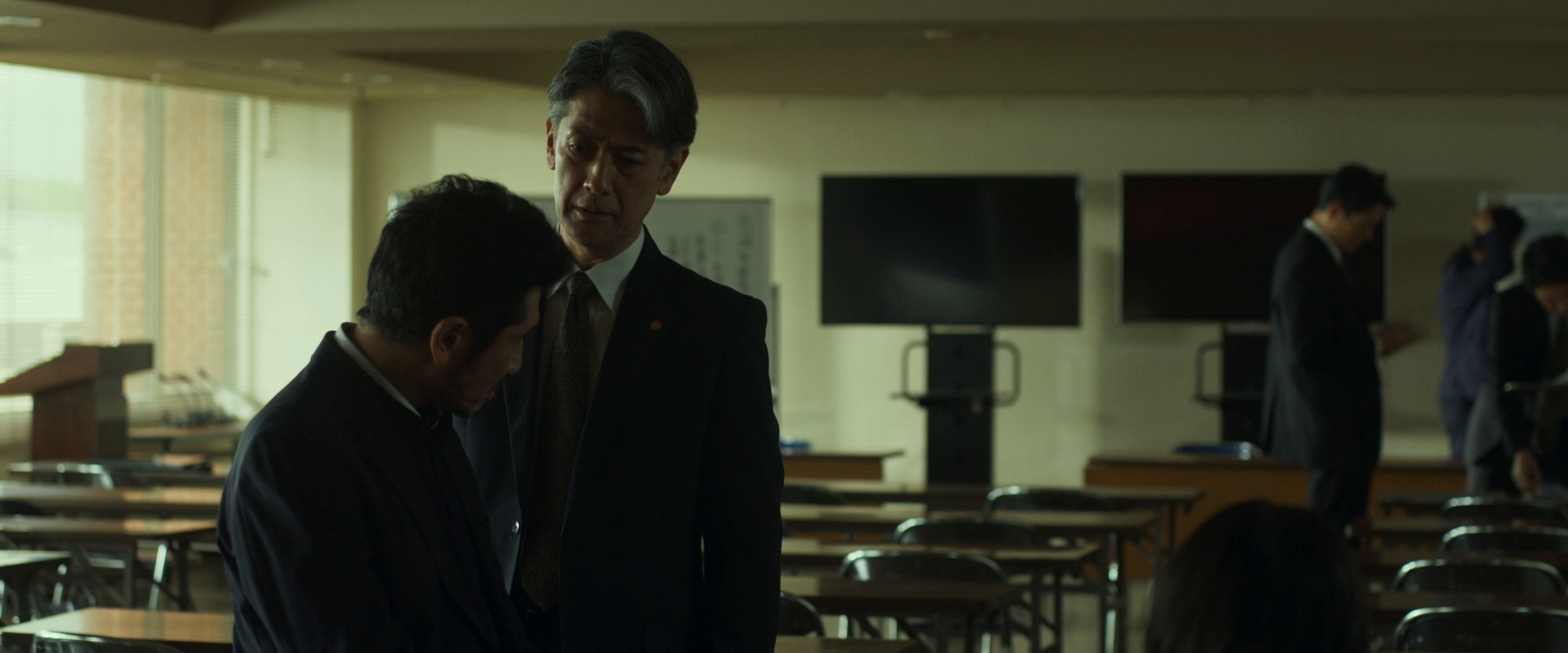
However, the tension that arises within most of the action sequences is not due to Miike’s framing, but due to the use of effective musical accompaniment. To put it simply, the musical beats dictate the tension not the visual flow. The dramatic music does accord with the turns and twists within Lumberjack The Monster – and sometimes even with the cutting. The tension, which feels, at first, forced upon the spectator, becomes a bit more effective as the twists and turns come to support its evocation.
Miike frames the many ‘splatter’ moments – i.e. the blood-splatter, the blood patterns on the floor – with simple static-shots so that he can emphasize the brutality of the violence for the spectator. Furthermore, he smartly exploits sounds (e.g. swishing of a surgical knife,) to aurally evoke what is not directly shown (e.g. the cutting of the throat). To put it in more general terms, Miike entices the spectator’s imagination with an effective combination of visually showing the initiating moment of the violent act, aurally evoking the completion of the act, and exposing of its brutal and destructive effects.
Lumberjack The Monster is a great example of a filmic experience that is helmed by a director that is uninvested in the narrative material of the story and, consequently, merely does his bare minimum. Miike’s film is not bad by any means – it is fun, yet the spectator feels, at every turn, that the true potential of Mayusuke Kurai’s narrative has been wasted.

Notes
Cine-note 1: In the car-chase sequence, Miike creates a contrast between the slower pace of the camera and the movement of the car to emphasize its speed.
 psychocinema