While it is far too early to speak about a J-horror revival, a return to form, recent years has proven to be very fruitful in introducing spectator to new fresh voices in Japanese horror cinema. Ryota Kondo burst on the scene with Missing Child Videotape (2024) and Keishi Kondo delivered utterly compelling New Religion (2022). And Yuta Shimotsu did no only impress with his Best Wishes to All (2023) but corroborated his promise as J-horror talent with New Group (2025). In fact, the latter might very well be considered a companion piece to Masaki Nishiyama’s convincing debut feature The Invisible Half.

Masaki Nishiyama’s film focuses on Elena Takahashi (Lisa Siera), a young ha-fu who, due to the continuous acts of bullying, ends up in the hospital. After changing schools, she succeeds in becoming friends with Akari (Miyu Okuno), yet behind her back other girls are already exploited her Otherness for their pleasure. One day, the two class bullies drive Nyan Ito (Runa Hirasawa), their usual victim, into despair by taking her phone and putting it into Elena’s bag. The following day, a vase with flowers adorns her desk – she seemingly committed suicide. Yet, after cutting herself on Nyan’s phone while reaching into her backpack, Elena is suddenly able to see an invisible monstrous presence that lurks around.
The invisible Half establishes, from the get-go, the following simple truth concerning bullying: it the exploitation of difference. Bullies reduce others to objects-to-be-enjoyed to utilize them to elevate and savour a certain societal ideal (e.g. being fully Japanese), neatly fitting into the fantasy of societal harmony – and to suppress their own inner-struggle with respect to the Other – e.g. the envy of the other’s Otherness.
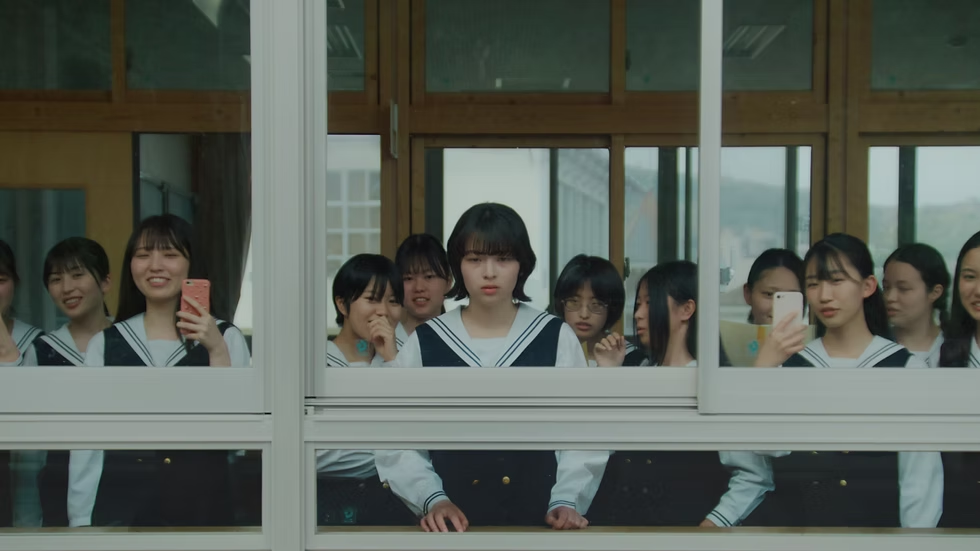
With Nyan Ito, the dynamic is different. She became the ridicule of the Other because her name constitutes a joke. It is because her name, down to the Kanji – a combination of cat and sing, produces pleasure by enunciating it and introduces a sliver of non-sense into the concatenation of signifiers that she, as subject, is all but erased from the societal field. Yet, her attempt to lock out the presence of the enjoying Other – i.e. wearing headphones, putting on a mask, keeping her long hair straight, focusing on her phone – puts her straight into its gaze.
However, in both cases, the bullying subjects support the creation of a suffocating atmosphere, of a societal space where the absent gaze becomes a constant persecutory presence. The question for the bullied subjects is not whether the gaze will manifest itself or not – it is always lurking around, but when it will materialize its aim, lash out to exploit them as objects-of-enjoyment.
As strange happenings start concatenating in the narrative, the spectator is invited to question what the invisible half, the monstrous thing that Elena can only see by holding her phone and hear by plugging her earphones in, represents. At a first glance, this blind monstrous being represents the visually absent gaze – the lingering object in the societal field that signals its oppressive presence by attaining a persecutory quality for the subject (Psycho-note 1).
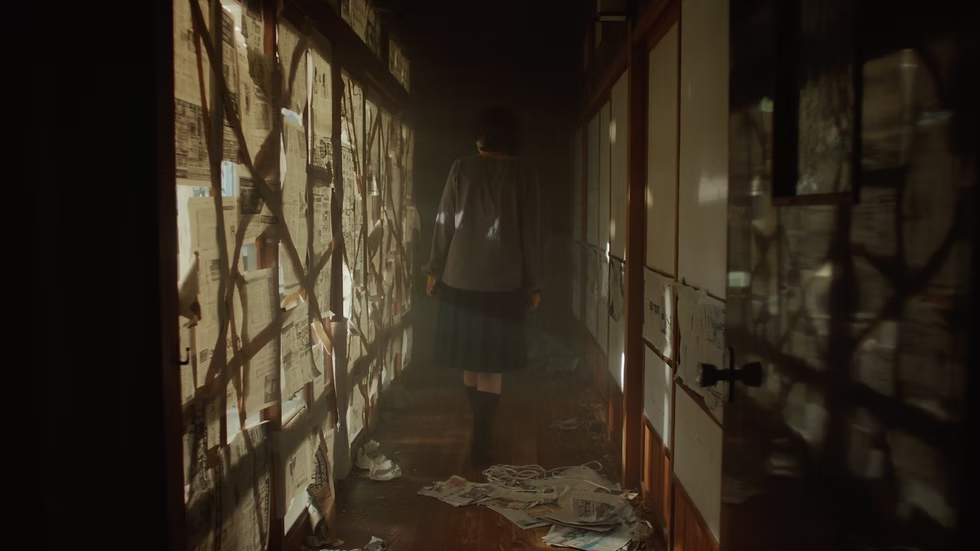
However, such reading is incomplete as this being can signal its presence in the societal field through acts – e.g. pushing desks away with his movements, hitting people with brute force, … etc. Its rhythm of absence and presence answers to a lord that reigns the subject’s ‘Andere Shauplatz’, the unconscious. This lord is nothing other than the tangle of unconscious desires, complexes, fears, and drives whose secret organizing principle is nothing other than Thanatos – destruction and self-destruction.
Put in this way, Elena does not merely attempt to avoid the persecutory effects of the monstrous societal gaze – an external gaze function of the subject, but also to escape the monstrous Otherness that resides within her and defines, whether she likes it or not, who she is within the given societal field she wanders in.
While we have no qualms with the message of The Invisible Half – embrace your Otherness – we do feel that the path to the film’s resolution misses one big opportunity. It is, from a psychoanalytic perspective, strange that Nishiyama chose the path of repression instead of acceptance for his ending. Not only does he, by gambling on the dynamic of repression, meekly accepts the rigidity of the Japanese societal field, but also creates a subtle discordance between Elena’s repressive act and her final signifiers (Psycho-note 2). To put it more evocatively, Nishiyama seemingly forgets that repression always fails and merely organizes the stage for its return.
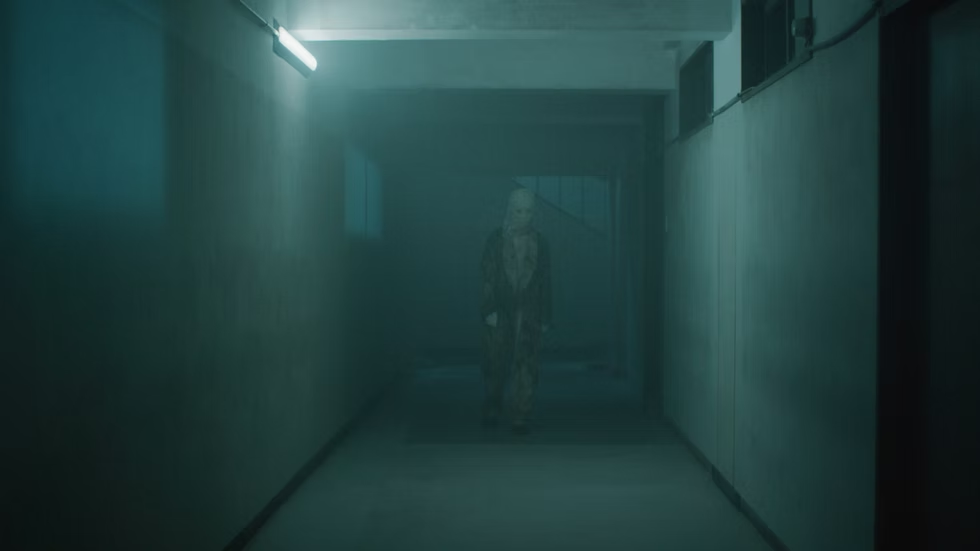
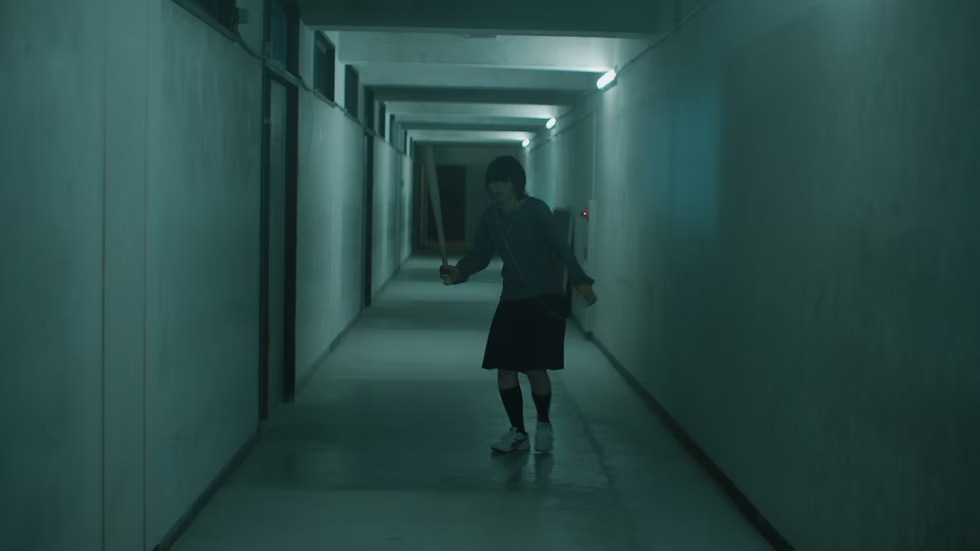
Nishiyama invites the spectator into a visual fabric that plays with subdued sombre colour-contrasts and well-composed stalemates between faint light-sources and crude overpowering shadows. While the draining of all warmth from the narrative’s atmosphere represents the precarious mental state of Elena – the visual landscape visualizing her psyche, the drab darkish atmosphere also functions as a background upon which the imagery of horror can realize itself in an effective way.
To ensure the darkness of the shadows remains a lingering threat – the threat of the yet unseen – throughout the narrative, Nishiyama relies on compositional tricks that are quite common in horror cinema. He relies on slow dynamism (e.g. zoom-in and zoom-out shots, spatial movement, …), subtle shaky framing, shots that focus on the character’s act of looking to give what remains unseen for the spectator an ominous quality.
Luckily, The Invisible Half is not a mere rehash of the compositional tools the J-horror director has as his disposal. Nishiyama seeks to add some personal touches to the familiar visual language of J-horror. In one of Elena’s nightmare sequences, for instance, he puts intertitles to a great use.
Nishiyama, furthermore, employs two nifty little tricks to introduce the spectator to the character whose perspective he must, imaginarily, take as his own. The first shot of The Invisibly Half fleetingly coincides the spectator’s eye with Elena’s, with what is reflected in her eye, and in the following hospital scene our ear is forced to hear the sounds as Elena hears them – e.g. the dulling of sounds by the passive noise cancelling to the sudden intensification of sounds by her mother’s act of pulling her right earphone out (Narra-note 1). Later in the narrative, Nishiyama fluidly integrates some POV-shots into the visual fabric as a sort of continual reminder that her subjective logic forms the central dynamic of the narrative (Cine-note 2).
Nishiyama smartly and thoughtfully peppers his visual fabric with familial decorative sounds to craft an effective flow of anticipatory tension, a frothing sense of mystery, and burgeoning horror. Even the element of the earphones is utilized to reduce the soundscape of certain tensive moments to the mere uneven breathing of Elena.
The performance of Lisa Siera must be applauded. It is quite impressive how she, in the opening moments of the narrative, convincingly evokes the weight of the Other as gaze pressing on her body, of the anticipatory fear of being erased as subject that has conquered her body. She proves that she can take hold over her character, breathe life into the themes of bullying and Otherness, and pulls the spectator into the narrative and ensure he remains glued to the screen.
With The Invisible Half, Nishiyama promptly establishes himself as a new promising talent in the field of Japanese horror. While he relies on the compositional toolbox of those who came before him, he succeeds, with great effect, in adding his own compositional and thematical twists to the genre. While Masaki Nishiyama nearly undercuts the narrative’s message by a contradictory narrative choice, his message still resounds clearly: embrace your Otherness, despite all the societal hammers seeking to hammer you, the nail that sticks out, down.

Notes
Psycho-note 1: The fact that the monstrous being’s eyes are sewn shut is quite interesting.In a certain sense, this element emphasises the difference between the eye and the gaze – they are not synonymous.
Psycho-note 2: To put our critique differently, we do not have any problem with the annulment of the gaze or the pacifying of the death-drive, but with how this annulment and pacification is obtained.
Narra-note 1: The dynamic of the earphone, besides its initial function, also function as a plot-element linked with the absence and presence of the object of horror.
Cine-note 1: While the spectator remains a lingering absence within the frame – he is, in a certain sense, the frame that circles around Elena, these little tricks do invite the spectator to focus on her signifiers and acts, on her subjective logic.
Cine-note 2: Nishiyama also utilizes a POV-shot to focus on Akari’s perspective during a sequence of horror.
 psychocinema
One Comment Add yours