If you are a fan of Japanese cinema, it is quite likely that one has seen a movie directed by Yukihiko Tsutsumi. While he is not a household-name international audiences can vividly recall, he has delivered some films that are well-received like 2LDK (2002), Initiation Love (2015), Sanada 10 Braves (2016), 12 Suicidal Teens (2019), and First Love (2021).

However, with the first feature film produced by Super Sapienss, Yukihiko Tsutsumi tries something different, leaving the rusted system of production committees behind. With his project, Tsutumi and his collaborators Katsuyuki Motohiro and Yuichi Sato aim to show that an alternative model – a decentralized one – to produce and distribute film is also viable.
While it is much too early to decide whether the project will cause a shift within the Japanese cinema industry or not, we can safely say that Yukihiko Tsutsumi’s brutal fantasy delivers on its absurd premise. While some spectators might feel like they wander through a disconnected forest of loosely connected ideas, Tsutsumi does succeed in turning the various elements into an entertaining whole.

The narrative of Killer Goldfish starts not much after the first victims of goldfish are discovered. Yukine Tachibana (Yoshinari Takahashi) and Denzo Yamanaka (Genpachi Ikenami) approach Erika Tamaki (Erika Oka), one of two officers of the marucho division – the unit dealing with the extra-ordinary, to crack the strange case of the murderous fish. While the officers of the first division try to rationalize the murders – thrill-kills with deformed goldfish as signature, Tamaki dismisses that idea, telling them that either someone is exploiting goldfish to kill or that the goldfish, harbouring grudges, murder people on their own accord.
While the spectator is subtly led to prefer the latter idea, Tamaki ousts herself as a firm believer of the former. Yet, if someone is controlling the goldfish, one must solve the riddle of his motive – who is turning goldfish into killer-machines of middle-aged men? And what is the significance of the recently excavated 50.000-year-old artifact and a strange recurring sign?
To get straight to the point, does Killer Goldfish explore more than the resentment animals could feel by the aggressive and/or inattentive way humans treat other animals, like goldfish, dogs, and monkeys?

In short, yes. While the aggression inherent to relationships and interactions forms the main thematical structure of the film, Yukihiko Tsutsumi and screenwriter Takayuki Kayano also take the time to evocatively reveal that the source of this structural disaccord lies in the imperfect modes of human information transmission.
By playing with the idea of an immaculate information transmission medium – a direct intervention on the optic nerve, a photosynthetic-like process that bypasses signifiers – in the narrative, Yukihiko Tsutsumi emphasizes that interactions are, due to reliance of humans on signifiers, structured by an irresolvable defect. Our false sense of understanding the other – ego and alter-ego, is built upon the foundational misrecognition and misunderstanding of the other as subject.
The narrative element of honour-students disappearing around Japan underlines that the signifier is not merely utilized to establish a false, yet pacifying sense of understanding among egos, but also to ostracize what is Other to support one’s imaginary sense of belonging and arouse some pleasure from such fiction.
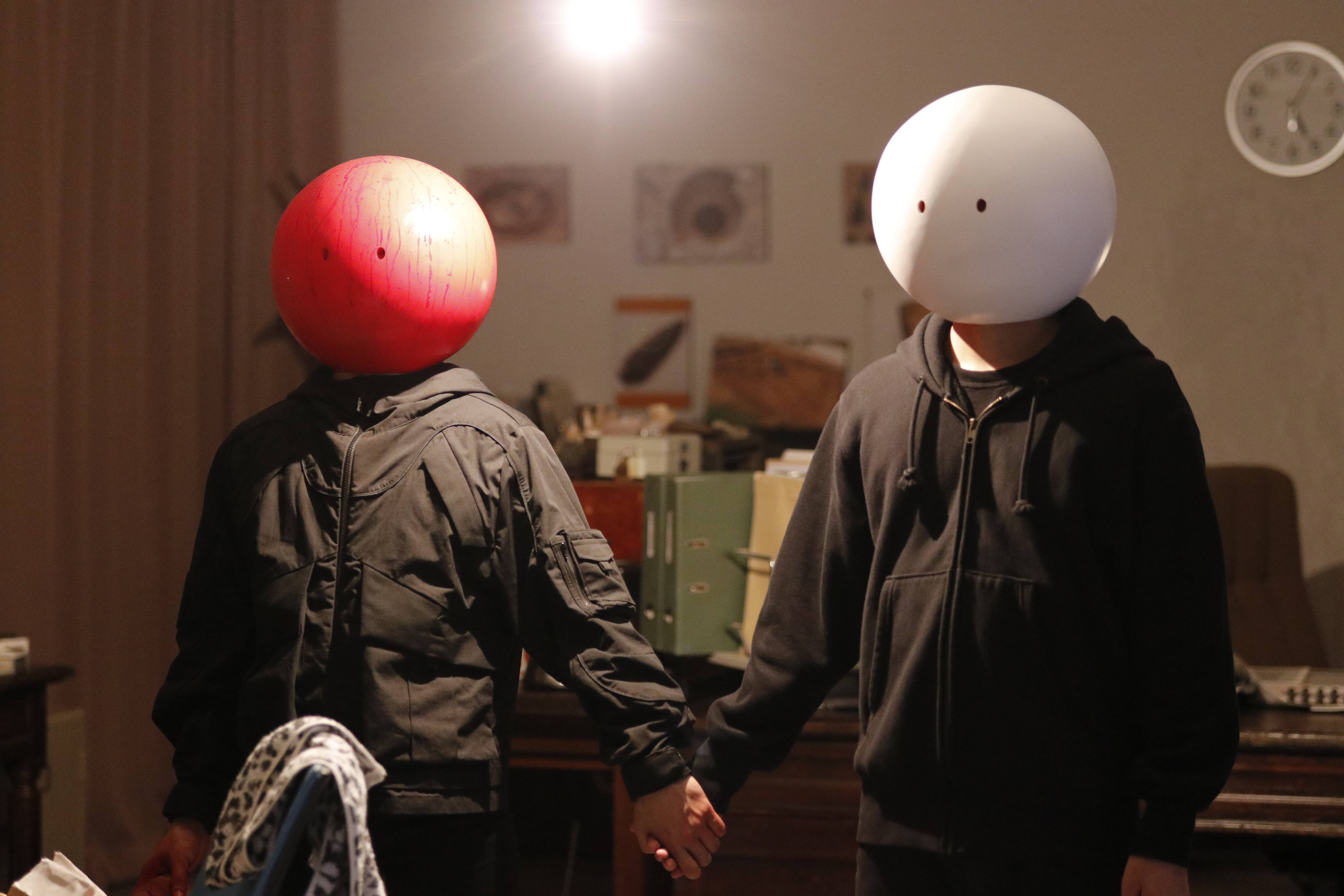
Killer Goldfish, thus, does not merely question the way we treat animals, but also how we, as human subjects, utilize our imperfect tools of communication to treat the Other and the subjective impact of the structural impossibility of establishing true mutual-understanding with the Other (Psycho-note 1).
Killer Goldfish is – and this should be clear – not a finished narrative. The spectator must realize that Tsutsumi’s film merely establishes the various narrative anchors. The ending of the film does not merely hint at the possibility of a sequel, but emphasizes that the resolution to this vengeance narrative lies in a future project. Given the fact that narrative ends with a beginning, it is not surprising that certain narrative threads, like the sudden appearance of long-haired Jizo-statues, who upon making eye-contact explode the sex-drive of the subject, are not fully fleshed-out – they are but hints of what will be developed in a future narrative.
One cannot but fail to describe the eclectic opening of Killer Goldfish – it must be experienced. The energetic blend between live-action and animation does not only catch the spectator’s attention from the get-go, but also signals the absurd flavour of the narrative. To put it differently, the opening sequences re-affirms what is implied by the absurd title of the film. Luckily, these eccentric and evocative animated moments are not confined to the opening of Killer Goldfish. At certain points, an energetic burst of animation penetrates the visual fabric, to deliver a fleeting moment of evocative pleasure.

The integration of animated elements into live-action footage, moreover, allows Tsutsumi to bypass budget-constraints. The energetic animated excess does not merely outshine the few moments of visual effects within the narrative, but elevates the visual fabric by giving it a highly appealing stylistic flavour.
Tsutsumi matches the energy of the animated elements with his composition. The visual fabric is full of dynamism, maintains a swift pace, boasts a rich variety of shots, and is sprinkled light-hearted stylistic decorations (e.g. slow-motion, fast-forward). The energetic dynamism of the composition is further enhanced by streamlining the visual flow with dramatic musical pieces and accompanying certain dynamic shots with sounds that emphasize the motion of the camera.
Killer Goldfish is an absurd brutal supernatural fantasy that has the potential to become a cult-favourite. Tsutsumi’s cop-narrative does not merely pull the spectator in with its dynamic visual composition – blending animation and live-action together, but also with a genre-cocktail that satisfies a variety of the spectator’s pleasures (General-note 1).

Notes
Psycho-note 1: What we, as subject, feel as mutual-understanding is but an imaginary fiction that pacifies our ego and represses our subjectivity, our unconscious. In our view, it is not the fate of great minds to be alone, as Arthur Schopenhauer thinks, but the fate of all to be, at the limit, radically singular.
General-note 1: The fast-pace of the narrative and the absurd narrative elements do undercut some of the more dramatic twists inKiller Goldfish. However, the inability to arouse emotion in the spectator do not mean these moments should be considered as false notes.
{ “@context”: “http://schema.org”, “@type”: “Movie”, “name”: “Killer Goldfish (2025) review”, “datePublished”: “2025-09-26”, “director”: { “@type”: “Person”, “name”: “Yukihiko Tsutsumi” }, “review”: { “@type”: “Review”, “author”: { “@type”: “Person”, “name”: “pvhaecke” }, “reviewBody”: “Killer Goldfish is an absurd brutal supernatural fantasy that has the potential to become a cult-favourite. Tsutsumi’s cop-narrative does not merely pull the spectator in with its dynamic visual composition – blending animation and live-action together, but also with a genre-cocktail that satisfies a variety of the spectator’s pleasures” } } psychocinema