While many would consider Toshiaki Toyoda’s arrest for possessing drugs in 2005 a major setback for the talented director, one cannot disagree with the fact that the way he was treated by the Other after his arrest – his period of alienation from society – has become the impetus for his return to filmmaking.

Transcending Dimensions, the seventh entry into Toyoda’s informal Resurrection series, must be seen as the culmination or elaboration of Toyoda’s clash with the Other of the Law. While Toyoda has always been focused on investigating the irresolvable tension between the subject and the societal field in his oeuvre, themes of rebirth and spirituality only appeared into his oeuvre after his return to filmmaking – The Blood of Rebirth (2009), I’m Flash! (2012). His second arrest, in 2019, for possessing a non-functional antique gun further fuelled his dismissive attitude towards the societal Other and gave birth to his resurrection series – Wolf’s Calling (2019), The Day of Destruction (2020), Go Seppuku Yourselves! (2021).
Toyoda starts Transcending Dimensions by introducing the spectator to Master Hanzo (Chihara Junia), an Shugendō ascetic with otherworldly psychic powers. After a spiritual performance in the temples garden, he grants Yasu (Masahiro Hihashide), a man who has lost his way, a chance to throw away his earthly desires and transcend dimensions by sacrificing a finger.

After the service, Teppei (Kiyohiko Shibukawa), a monk who considers Hanzo a wacko, mysteriously gets into a car crash – a result of Hanzo’s quick exorcism. Rosuke Yamanaka’s girlfriend Nonoka (Haruka Imou) denounces him as scum, intoxicated with the poisons of the world. Before committing suicide on the tracks, she asks Shinno (Ryuhei Matsuda), whom she invited to witness the service, to murder Hanzo and retrieve Rosuke (Yosuke Kubozuka) from his clutches.
Transcending Dimensions opens by introducing the spectator to its main antagonist, Hanzo. Yet, Toshiaki Toyoda smartly takes the opportunity to let Hanzo evokes certain truths about the societal field in the signifiers he addresses to his followers and his enemies. As a matter of fact, Toyoda exploits his antagonist to obliquely critique the Japanese societal field.
In our view, Hanzo introduces the spectator both to the effect of a societal field that is failing its subjects – i.e. the flight into spiritualism and the attraction of spiritual masters on subjects – as well as the personal ravages caused by refusing to adhere to the master’s signifier, to his law. The fact that Hanzo represents both conflicting sides of the societal field gives his signifiers an ironic undertone and ousts him as a hypocrite.
Hanzo divulges to Yasu that the “world is made up of narratives”, that the subject and the Other are, first and foremost, narrative entities, signifier-structures. The master confronts him with the fact that his subjective logic is determined or imprisoned by an imposed narrative and that he must “rewrite [his] own narrative by [him]self”. Yet, by professing this truth, he seduces Yasu to subject himself to his spiritual narrative and the demands that emanate those signifiers – i.e. sacrifice your finger to embark on spiritual training that transcend dimensions.
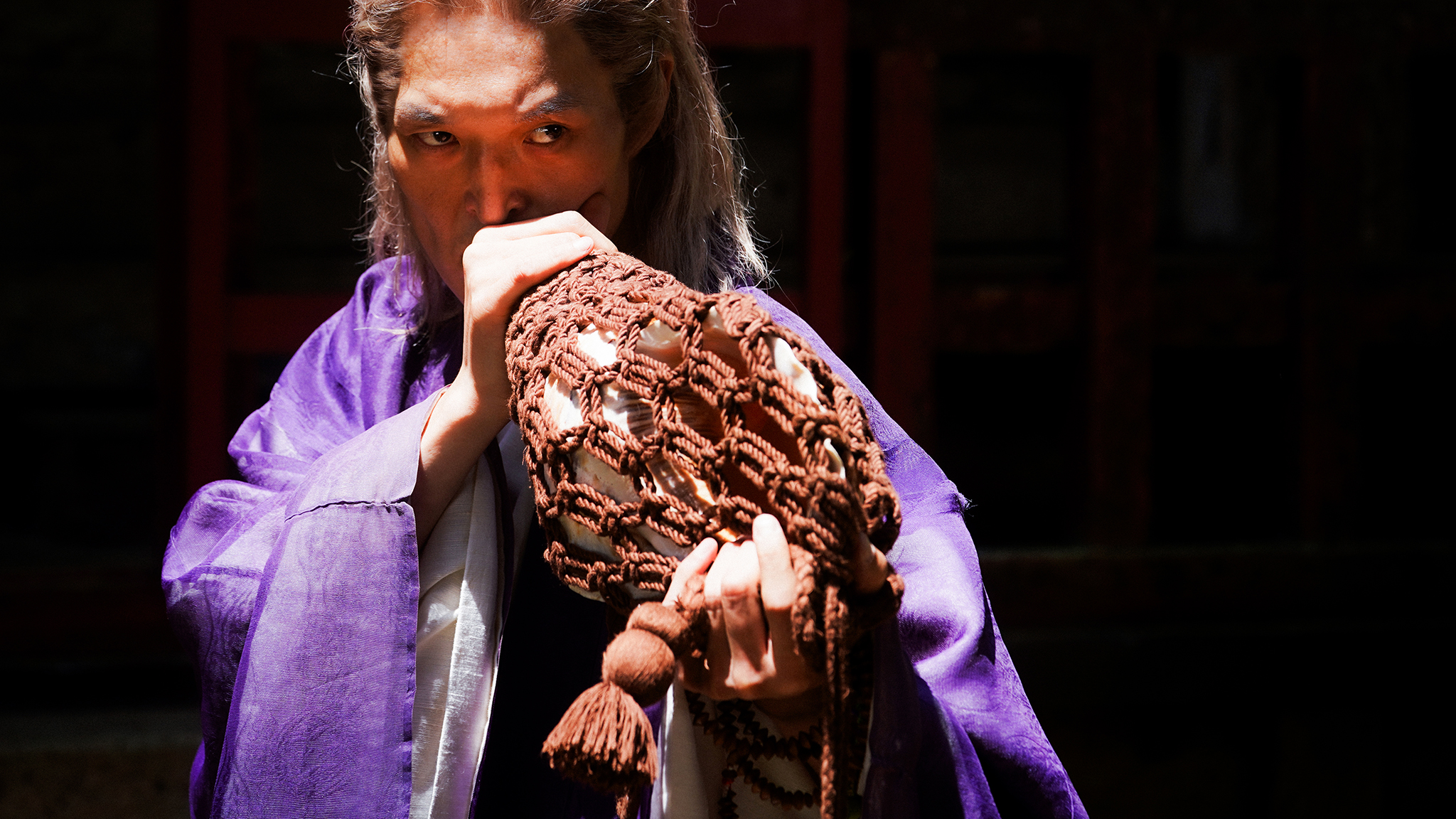
Hanzo, as spiritual master, cannot do without a narrative – the tools of seduction. As a result, it remains, at least in the beginning half of the narrative, unclear as to whether Hanzo truly aims to liberate subjects from the Other to enable them to write their own narrative or if he seeks to imprison frail subjects within his spiritual narrative to rewrite them into obedience to the master’s word – transcend dimension in service of the master’s desire.
As second truth Hanzo articulates is the mendacious nature of the idea that “living together in harmony is possible”. While some spectators might object to such statement, they must try to understand that the idea of harmony (wa) within Japanese society is an ideological structure that demands the erasure of subjective difference. This erasure of differences is hinted at in Hanzo’s statements that“those who believe in that [idea] tend to abandon their souls and freedom [and] enslave themselves (…) their lives become void”.
The flashback where Rosuke talks with his girlfriend Nonoka on the temple stairs further unfurls this theme. After touching upon the transiency of life, he tells her that his dead parents, siblings and friends only exist within him as narratives, that what lives within him are the narrativizations of their outward ego (e.g. their faces) and the signifiers of their demands, desires, values, and ideals (Narra-note 1).
We keep our exploration of the themes of Transcending Dimensions fragmentary on purpose to safeguard the experience for the spectator and enable the twist-rich finale to have its full impact. Toshiaki Toyoda’s film must be experienced – any review of Toyoda’s masterpiece will fall short.
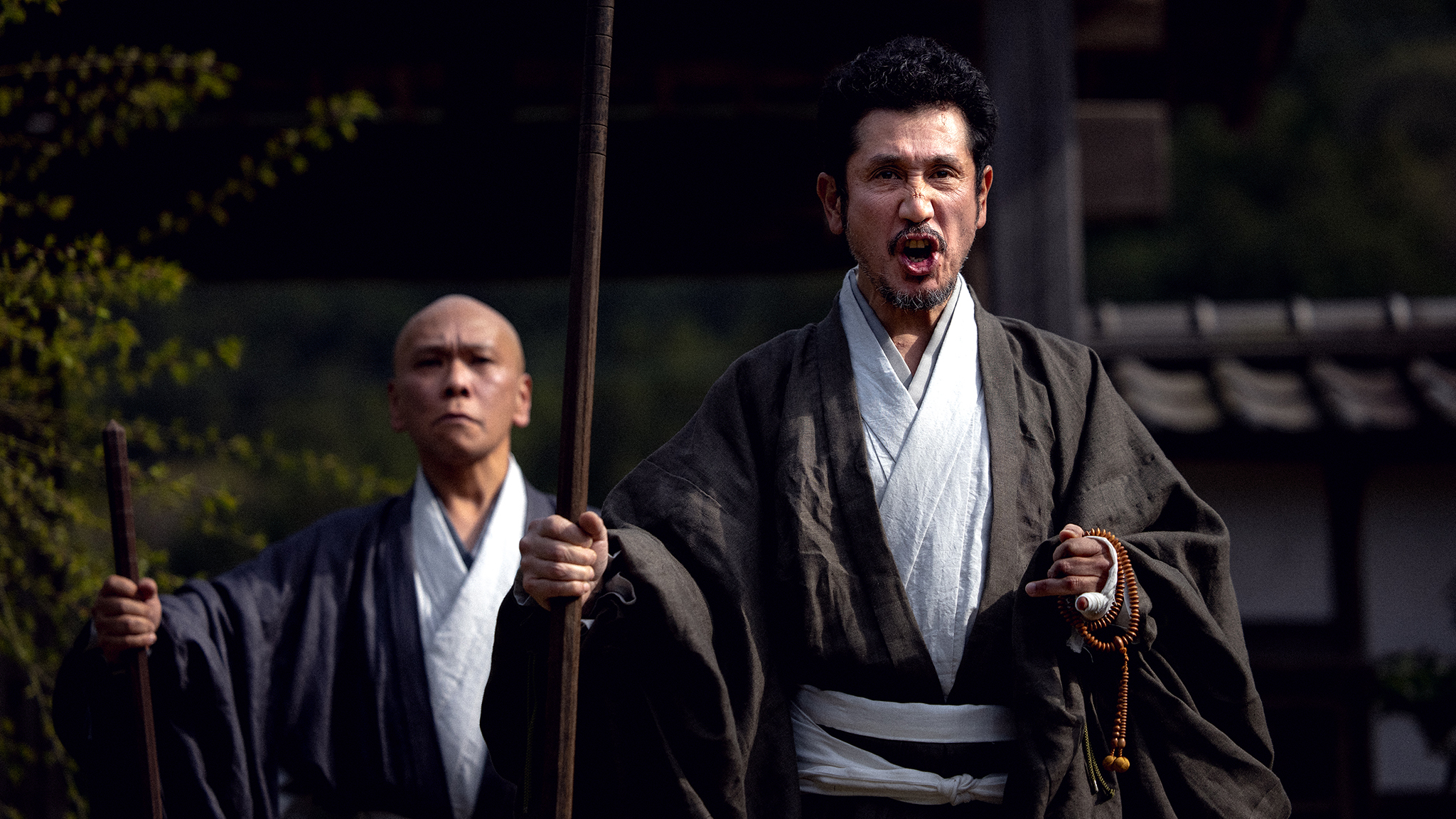
However, we will contend that Toyoda practices in his finale what he lets Hanzo preach – one must rewrite one’s one narrative – in the beginning of his narrative. By offering the spectator an ending that fragments and confuses, he invites the spectator to rewrite the narrative of Transcending Dimension. It is, in other words, up to the spectator to utilize the final signifier to rearrange the signifiers that have already been uttered or to leave the signifiers in a state of contradiction (General-note 1).
Toshiaki Toyoda expertly blends static shots and dynamic shots together to give the composition of Transcending Dimensions an evocative atmosphere. Toyoda’s visual fabric is, as a matter of fact, full of artfully crafted shot-compositions – shots with the potentiality of leaving a lasting impression on the spectator.
Yet, one cannot celebrate Transcending Dimensions for its visuals without praising the musical accompaniment and the sound-design – the film is littered with seductive auditive invitations into his narrative dimensions. Much of the power that emanates from Toyoda’s evocative visual feast is due to the music – Transcending Dimensions is as much an aural as it is a visual experience.
The sense of mystery and the subtly threat that emanates from first musical piece pulls the spectator right into the yet-unknown abyss of Toyoda’s Transcending Dimensions. The music has such effect because it echoes, before anything narratively has materialized, a certain direction for the film’s signified and arouses the spectator’s anticipation. The effect of this musical piece on the spectator is amplified by evocative title of the narrative and the sole image the musical piece decorates: the hermit praying in the dark. Other musical pieces have the same mesmerizing inviting effect, emphasizing the mystical dimension of the visuals while stirring up the spectator’s desire to see more.
Transcending Dimensions is Toyoda’s masterpiece, a culmination of his past disillusionment with the societal Other and his interest in spiritualism and rebirth born from being mistreated by the Other of the law. Toyoda has crafted a visceral, evocative experience which cannot be put into words, but must be experienced. Highly recommended.

Notes:
Narra-note 1: In the same flash-back sequence, Rosuke divulges his reason to walk the spiritual path: his burning passion to find an answer to the questions of the past – Where do we come from, of the future – Where we are going, and the present – Where is my place within the Other.
Nonoka, on the other hand, introduces the question of reincarnation into Transcending Dimension. Later in the narrative, Shinno explains that enlightenment (satori) as the degree of certainty one has about being reborn after dying.
General-note 1: One might be able to decide the final meaning of the film by determining which character represents Toshiaki the most in his film.
 psychocinema
2 Comments Add yours