Godzilla’s Revenge – All Monsters Attack (1969) is not a traditional Godzilla narrative and many fans have viciously attacked Shinichi Sekizawa’s playful infantilisation of the mightiest of kaiju. However, this shift, which was forced by Toho and its desire to turn Godzilla into a children’s property, merely exploits the image of Godzilla, the shape slowly hollowed out over the years by decontextualizing it and emptying it from its political and socially-critical potential.

The tenth film in the Godzilla series tells the tale of Ichiro (Tomonori Yazaki), a boy who lacks confidence to confront his bully Gabara (Junichi Ito) – “I am not strong enough.” – and, instead, flees into the phantasmatic world of kaiju. The whole narrative centres around the question of whether Ichiro can find the key in this phantasmatic world to open the door of his inhibitory cell and discover a way to deal, once and for all, with his bully or not. Ichiro might find his solution by watching how the conflict between Minilla (Marchan The Dwarf; Midori Uchiyama (voice)) and his bully Gabara (Yasuhiko Uchiyama), the phantasmatic externalisation of his own subjective struggle, plays out.

While some spectators might lament the fact that the monster-sequences in Godzilla’s Revenge – All Monster’s attack are but mere dreams and fantastical machinations of a bullied boy, the film makes the symbolic truth of Godzilla as image – of what this monstrous being has turned into by Toho – explicit. Honda’s film stages the result of the gradual disconnection between Godzilla, as monstrous being, and societal frictions and dynamics within the post-war societal field. This fabricated primordial signifier which granted the Japanese spectator a chance to narrativize the traumatic real of the atom-bomb [The 0-stage, the epochal moment of birth], transformed into a signifier of societal discord, warning spectators of the impact of unlimited capitalism and unbridled consumerism [the stage of the vengeful victim], before ultimately attaining its shape of a hollowed-out nationalistic signifier of heroism [The stage of the fearless hero] (General-note 1).
Yet, it is by virtue of becoming hollow, of being robbed of all societal connections and connotations, that Godzilla, as signifier, can be giving a heroic import and be fully integrated within the ideological narrative of the post-war societal Other. The associative network of signifiers that structure the heroic signified of Godzilla creates an imaginary reflective surface that can be inspirational for the ‘castrated’ subject. The heroic figure attains a seductive quality for the subject – child as well as adult – because he cannot escape the echoes of his castration that emanate from the societal field. To put it differently, the popularity of Godzilla among children and adults alike lies in the fact that it offers the spectator an idealized phallic image in support of and supported by the patriarchal ideological discourse.
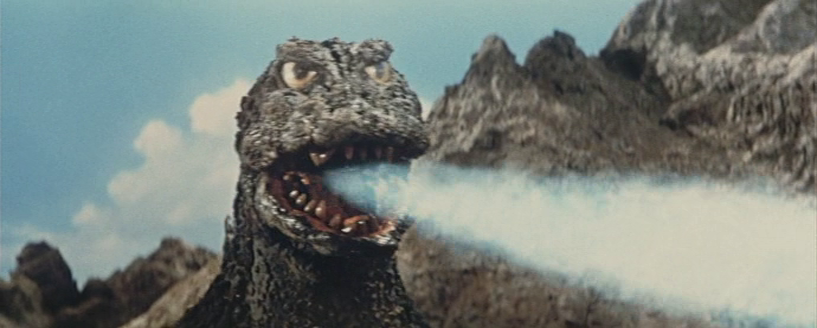
Godzilla’s Revenge – All Monsters Attack is, however, not without some vague social references. Screenwriter Shinichi Sekizawa uses the social issue of latchkey kids (i.e. children who are left to their own devices by their mothers, who feel forced to take on jobs to make ends meet, and by the state, who fails to ensure after-school care) to create a narrative frame structured around financial lack and castration. The social issue of the latchkey kids is, in other words, utilized as a contextual reality that turns the images of Godzilla and Minilla into supports of the conservative societal discourse – boys, be strong! You must fight by yourself! – and not as narrative elements that, by Godzilla’s sudden burst into the post-war world, puts the negative effect of certain societal shifts (e.g. the blossoming of capitalism and consumerism) on subjectivity and social bonds into question. The dynamic between Godzilla and Minilla stages blatantly the fatherly and oedipal bond the conservative societal Other so desires – a strong present phallic father motivating his male offspring to realize a phallic position within the societal field.
The statement that the whole narrative set-up is in support of conservative societal ideals finds support in the supposition that screenwriter Shinichi Sekizawa crafted the name of the two antagonists, both named Gabara, by subtly transforming the signifier Che Guevara and/or the German word Gewalt (violence) – signifiers prevalent among the student protesters in the late sixties (Ryfle and Godziszewski, 2017). By consciously or unconsciously using these signifiers to shape the nemesis of Ichiro and Minilla, Sekizawa elegantly evokes that the imagined threat to the consistence of the Japanese societal field is blood-red communist in nature – “The crazy behaviour of young people […] is creating problems”.

Some spectators will argue that Sekizawa interweaves some ecological commentary in Godzilla’s revenge – All Monster’s attack by letting Honda decorate a song with imagery of heavy industry (i.e. factories, smokestacks, trains and heavy trucks) to underline that smog and pollution the real monsters that destroy everything. However, this ecological dimension remains underutilized within the narrative as the fleeting sketch of the negative societal effect of capitalism and industrialisation merely serves to further contextualize Ichiro’s situation of unintentional parental neglect.
The state of the Japanese post-war society is not put into question – Godzilla is not utilized as a violent question mark to highlight certain destructive tendences within the societal field. The capitalistic-structured societal field is merely utilized as a frame of reality upon which patriarchal ideals can be promoted.
Most spectators will find it difficult to accept how Toho approached the special effects of Godzilla’s revenge – All Monster’s attack. To keep the production costs as low as possible – and rack in a larger margin of profits, Honda was forced to create a fluidly flowing collage of new shots (Ichiro and Minilla, the fight between Minilla, Godzilla and Gabara) and lots of stock footage from King Kong Escapes (1967), Destroy All Monsters (1968), Ebirah, Horror of the Deep (1966), and Son of Godzilla (1967) (General-note 2).While one could argue that this visual recycling stages Ichiro’s phantasmatic bricolage of the kaiju films he has seen and flees into, the Déjà vu effect of this otherwise well-crafted collage will irritate most spectators.
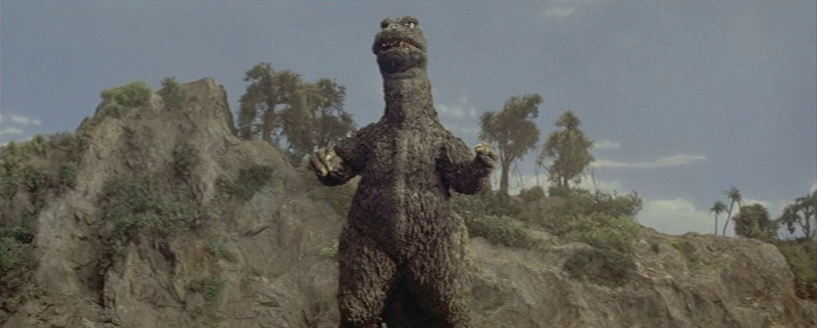
While Honda succeeds in sewing the various images from different sources fluidly together, there are certain instances where the sudden shifts in colour-schemes betray the use of multiple sources to create a ‘continuous’ whole. Another thing that betrays Toho’s unwillingness to invest money into the franchise concerns the lack of composite shots.
Godzilla’s revenge – All Monster’s attack might not deliver what fans want from a Godzilla film, yet Sekizawa’s narrative confronts the spectator light-heartedly with the endpoint of the decontextualizing of Godzilla as signifier. However, Ishiro Honda’s film reaffirms that such decontextualization has a political and ideological effect – Godzilla, as empty signifier, assumes a patriarchal signified in support of the conservative Japanese Other.

Notes:
General-note 1: It should be clear that the first phase, which introduced Godzilla as signifier to denote a yet-to-be fully worked-through societal trauma, can never be replicated. Any other film, by virtue of being a signifier that follows the first, structurally shifts the signified of Godzilla. The signified of Godzilla – what he represents – is determined by how the screenwriter orientates the plane structured by the two subsequent phases – the vengeful victim and the fearless hero.
General-note 2: Eiji Tsuburaya, while being credited as the film’s special effects director, was not involved with the production. Ishirō Honda directed the drama scenes and the special effects scenes. For the latter, he received assistance from Teruyoshi Nakano.
References:
Ryfle S. and Godziszewski E. (2017). Ishiro Honda: A Life in Film, from Godzilla to Kurosawa. Wesleyan University Press.
 psychocinema