What happens when a studio grants one of his directors his wish to remake a foreign film, but subsequently forces him, due to the film’s success, to craft sequels? Any spectator will rightly assume that such forcing douses the director’s flame of creativity. In the case of Ishii, who had to churn out sequels to Abashiri prison (1965), this dousing is mostly felt in the visual department and less in the narrative department.

[Eureka released Abashira Prison (1965) on blu-ray as part of their boxed set Prison Walls : Abashiri Prison 1-3.]
Another Abashiri Prison Story (1965), for example, does little to excite the spectator visually, but still delivers many pleasant narrative moments. The only problem narratively speaking is the thematical inconsistency of the sequel, i.e. the sudden absence of the oedipal dimension. Due to this narrative lack, Ishii delivers a narrative that could have been about any ex-convict. It feels as if Tachibana was forced into a narrative that was not his to begin with.
Will the third film in the series, Abashiri Prison – Saga of Homesickness (1965), continue with his simplification of his main character or will Teruo Ishii return to the oedipal roots of the first film and give him his depth back? Can Ishii utilize the signifier ‘prison’ in a fresh manner or will he merely maintain it as a narrative reference within his character’s journey? Let’s find our in our analysis of the third film in the Abashiri Prison Series.
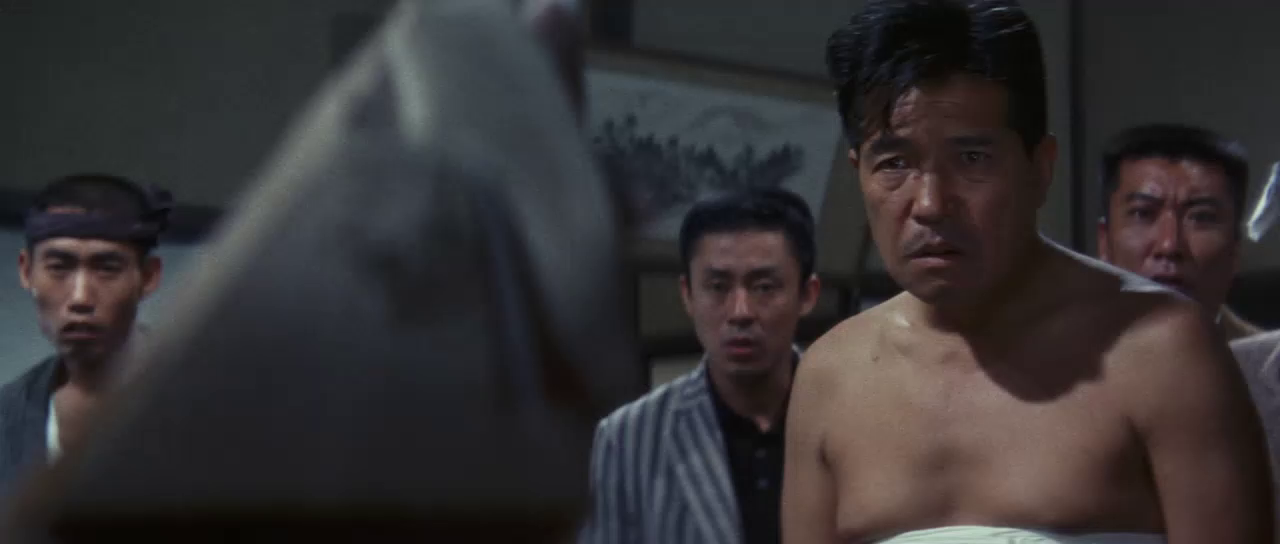
From the very opening, Teruo Ishii underlines that the contrast between the criminal act as born from loyalty to a father figure and the criminality caused by the will to enjoy transgressively and assume the law for one’s own enjoyment, which was radically absent from Ishii’s Another Abashiri Prison Story (1965), structures his third film, Abashiri Prison – Saga of Homesickness, and, thus, guide its denouement. The return of this contrast will persuade some spectators to argue that Ishii’s third narrative must be considered the thematical sequel to his classic Abashiri Prison (1965).
This contrast echoes, first and foremost, in the introductory tale of the conflict between the Asahi-gumi and the Yasui-gumi. The birth of the former is intrinsically linked with the desire of its boss, Junichi Asahi (Kanjûrô Arashi), to help rebuilding the port of Nagasaki, to help the ravaged Other. The (criminal) organisation he founded aims – and this might sound somewhat strange – to serve the shattered societal Other, the societal space ravaged by the atom-bomb. The Yasui-gumi, on the other hand, rose up from these blackened ruins to exploit those who suffer for their own enjoyment. These yakuza smartly utilized the shattered remains of Nagasaki to install a societal facade (i.e. Yasui Marine Land Transportation Company) that allow them to fleetingly assume the law and generate enjoyment.
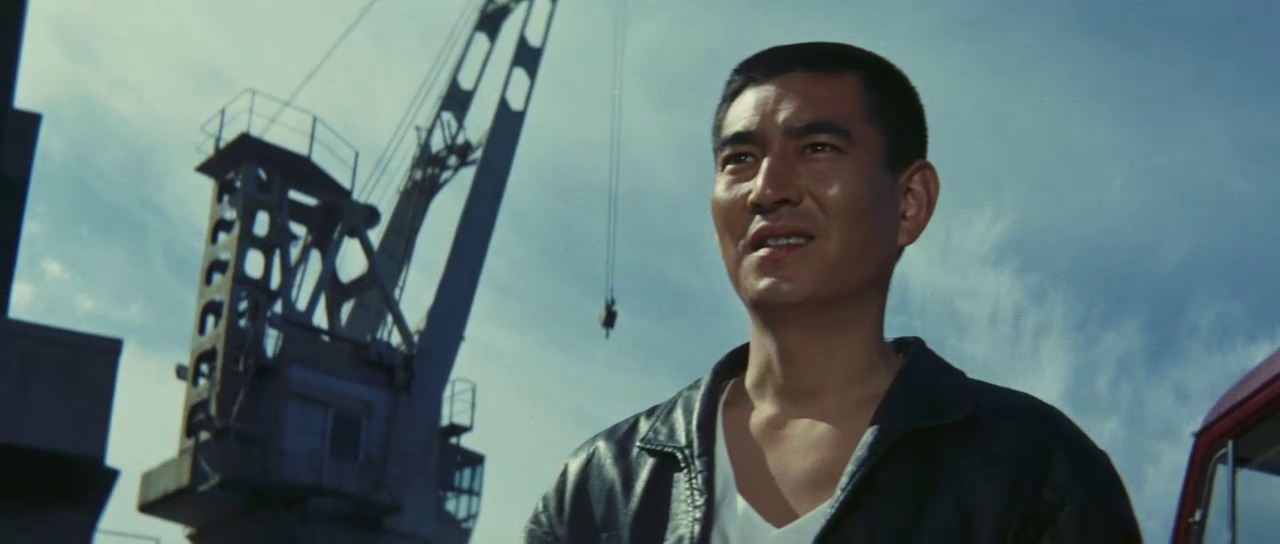
Somewhat later in Abashiri Prison – Saga of Homesickness, this thematical conflict arises in a more subtle manner. During the scene at the harbour, the spectator easily grasps that the Asahi-gumi aims to help the shattered community by offering the people an honest day of work, while the goons of the Yasui-gumi merely turn up to exploit those in need for money, enjoy provoking the members of the Asahi-gumi, and inflict ‘damage’ to their business.
At a more imaginary level, we can say that the Yasui-gumi shows up merely to show off and enjoy their own usurped sense of ‘superiority’. Yet, Tachibana (Ken Takakura) proves, by remaining cool and unfazed while being punched by them, that such fantasy can easily be perforated, giving rise to anxiety and frustration.
Besides utilizing the contrast of different kinds of violences to structure the narrative, Ishii also takes the time to explore the enduring impact of the idealized image of the father more deeply and who how his past haunts his presence. Tachibana’s cool refusal to be provoked by the Yasui-gumi and his youthful attack on Yasui-gumi’s leader, the criminal act that got him into Abashiri prison, might seem dissimilar, both are determined by the internalized fatherly ideal supported by the bodily shape of Junichi Asahi.
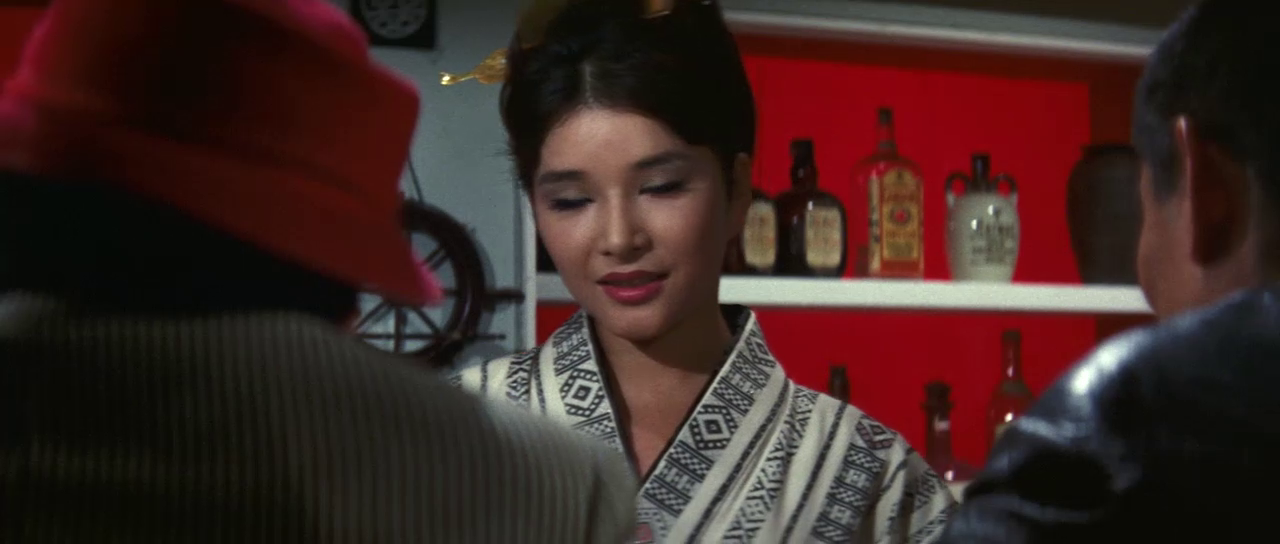
The former presents a Tachibana that radically acts in accordance with the signifier of the ‘father’ – e.g. his ban on fighting and gambling. It is, moreover, due to his obedience to Asahi’s signifiers that Tachibana refuses to visit the criminal father when Takeshi Asahi (Ichiro Nakatani), the boss’ son, proposes it (Language-note 1). Yet, he does not merely refuse to visit the fatherly Asahi because he believes he hasn’t paid his ‘symbolic debt’ to him yet – ‘I haven’t fulfilled my promise of becoming respectable yet’, but because that he will never be able to life up to his demand. The father’s signifiers will forever be a weight on his shoulders (Narra-note 1).
The latter reveals a Tachibana who would do anything to serve the father and prove his loyalty. Junichi Asahi might no have ordered the attack, Tachibana nevertheless did it in the name of the father. Tachibana, the young punk, did not simply act out of line, but desired to give his new-found father a symbolic gift of his love (Narra-note 2).
With the emphasis on the father throughout the narrative, some spectators might wonder what the narrative purpose of the side-narrative with the orphan Emi (Margaret Hayashida) is. In our view, this side-story underlines Tachibana’s inability to assume the position of father himself. Rather than donning a fatherly cape with respect to Emi, Tachibana structures their bond according to the only bond he truly knows: the brotherly bond, the ‘kyodai’ dynamic full of ‘aniki’. Moreover, as their story unfold, their interactions end up echoing the importance of the caring motherly figure – a mother who accepts the path of suffering to try and ensure the well-being of children – for Tachibana’s subjective position.
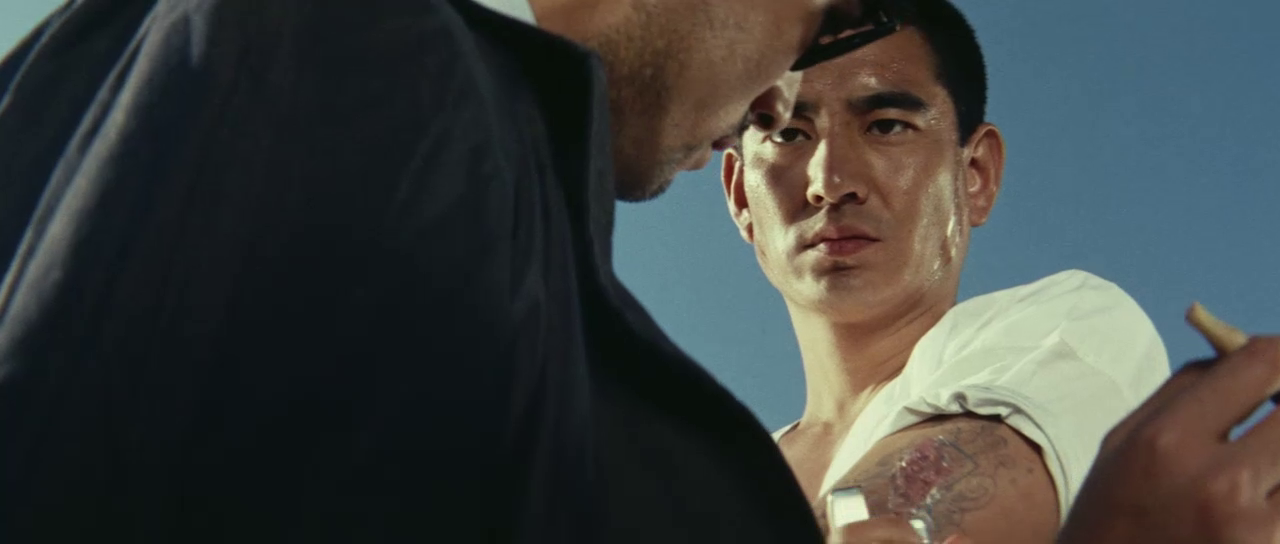
Some spectators might argue that Abashiri Prison – Saga of Homesickness, in contrast to Another Abashiri Prison Story (1965), does not touch upon the idea of prison. While the second film in the series touches upon the effect of prison-like structures – e.g. the boat from Hokkaido to Aomori – and underlines how the desolate cold place called Abashiri prison keeps haunting its ex-convicts, such structures or feelings are not present in Ishii’s third instalment. Yet, is the idea of prison truly absent from the film? In short, no. Ishii does his very best to underline that, for Tachibana, the very figure of the father is imprisoning. He cannot but act and speak in accordance to his signifiers; the transgression of the father’s law is a suicidal act.
While the composition is mostly a straight-forward affair, it is not as simple and uninventive as the composition of Ishii’s Another Abashiri Prison Story (1965). Ishii re-finds, at certain moments in his narrative, his desire to exploit the geometrical dimension to please the spectator with some nicely crafted beautiful shot-compositions. Yet, despite these visual decorations, Ishii’s composition still lacks the atmospheric impact of the monochrome imagery of the first film in the series.
With Abashiri Prison – Saga of Homesickness, Ishii returns to oedipal conflict that animates the dramatic turns of the first narrative. Instead of deflating the psychological dimension of his main character, like he did in Another Abashiri Prison Story (1965), he crafts an engaging narrative that illustrates how the image of the father can imprison the subject – the true prison for the subject is not Abashiri, but the idealized father-figure that anchors him and demands submission.

Notes:
Language-note 1: Tachibana’s use of ‘ojisan’ to Junichi Asahi, the boss, does not contradict our oedipal reading. By utilizing this signifier to address him, he affirms that Junichi is not his father, while echoing his familial function. When no father was around, he took fatherly care of the young Tachibana and his mother, Michiyo.
Narra-note 1: It is quite interesting that the youthful act of violence to please the father sabotaged his romantic relationship with Rumiko (Hiroko Sakuramachi), Takeshi’s wife.
Narra-note 2: This story is, furthermore, utilized to re-affirm the destructive nature of a criminality born from the desire to enjoy transgressively and assume the law for one’s own enjoyment and emphasize the absence of such criminal exploitative tendency in Tachibana.
 psychocinema