The concept of prison, whether literal or metaphorical, has haunted the art of cinema from the time of the early talkies. As with other genres, one can easily pinpoint one narrative that made the genre blossom in popularity and, as a result, shape the genre for decades to come. For the prison genre, George Hill’s The Big House (1930) can be considered such influential narrative.

[Eureka released Abashira Prison (1965) on blu-ray as part of their boxed set Prison Walls : Abashiri Prison 1-3.]
As genres blossom into popularity, sub-genres tend to form. One sub-genre, born out of the prison drama, concerns the prison break. Rather than focusing on the internal struggles of prisoners within their confined spaces, these films focus on the thrill of breaking out of prison and the tense fight to evade re-capturing. In this genre, the 1958 American film The Defiant Ones stands out as a classic. The film, besides earning a lot of awards, impressed many people around the world, like the Japanese director Teruo Ishii. In fact, Ishii loved the film so much upon seeing, he harboured the hope to remake the film for Japanese audiences.
When Toei Company approached Ishii to adapt Hajime Ito’s novel Abashiri Bangaichi, which was based on his own experience of being incarcerated at the real Abashiri Prison in the early 1950s, Ishii succeeded in convincing Toei to let him turn Ito’s off-putting cheesy melodramatic narrative into a remake of The Defiant Ones. However, for his re-working, Ishii had to find a way to formulate the same message – ignorance divides – without relying on Kenracial tension the original so aptly exploited.
Most spectators will praise Abashiri Prison for its exciting, thrilling and even touching escape sequence. Yet, heaping praise on Ishii’s narrative’s finale endangers to overshadow the surprisingly rich exploration of the different facets of criminal subjectivity. To help the spectator fully appreciate Ishii’s kaleidoscopic glance at the complexity of the criminal act and further heighten the finale’s emotional impact, we will analyse various narrative moments through the lens of the psychoanalytic terms of enjoyment (transgressive pleasure) and aggressivity, as that what defines the relationship between the ego and the specular image.
The nodal point in Abashiri Prison that introduces both elements is the conversation early in the narrative between the senior inmates and the newcomers that takes place. This conversation highlights, via the circulation of the signifier, the transgressive quality desire can attain. Yet, what makes desire transgressive is not the search for an excess of enjoyment that violently disturb the social-symbolic fabric, but the subjectification of the law, the seizing of the law as a tool to create enjoyment. Some inmates, who aim to subject the other to their enjoyment, find in the social hierarchy a way to extract some satisfaction, like the senior inmate who demands the stolen cigarette but. He does not only enjoys smoking the cig butt in front of the others, but also gain some pleasure from taking it from the others.
The dimension of aggressivity rears its head, first and foremost, in the act of bragging some inmates turn to. Despite the semi-symbolic quality of boasting, the attempt to prove one’s criminal worth and forcefully gain respect from the criminal Other merely seeks to install imaginary tensions – I have enjoyed more than you; I subjectified the law more radically than you. One can thus argue that the hierarchal relational structure between the inmates, organized by the notion of seniority, finds its support in a highly volatile imaginary cocktail of aggressivity and rivalry.
Given the importance of enjoyment for the criminal subject and the aggressivity that structures interactions, it might come as a surprise that most inmates willingly subject themselves to the rules stipulated by their seniors, to the prison’s code of honour. One can, given the diversity in criminal subjectivity, discern three reasons for such obedience: the desire to return to the societal field, the frustrating inability to satisfy one’s criminal desires, and the fear of becoming the target of the other inmates’ violence.

Yet, despite the role desire, fear, and frustration play in forcing obedience, the intramural social structure remains frail. The situation of imprisonment, determined by its deprivations and frustrations, is a breeding ground for imaginary conflicts – i.e. injuries inflicted by the signifier on the ego – and incites/invites violence. However, the subjects who partake in these violent clashes do not merely seek to alleviate their vexations, but often try to affirm or even change their position within the hierarchy.
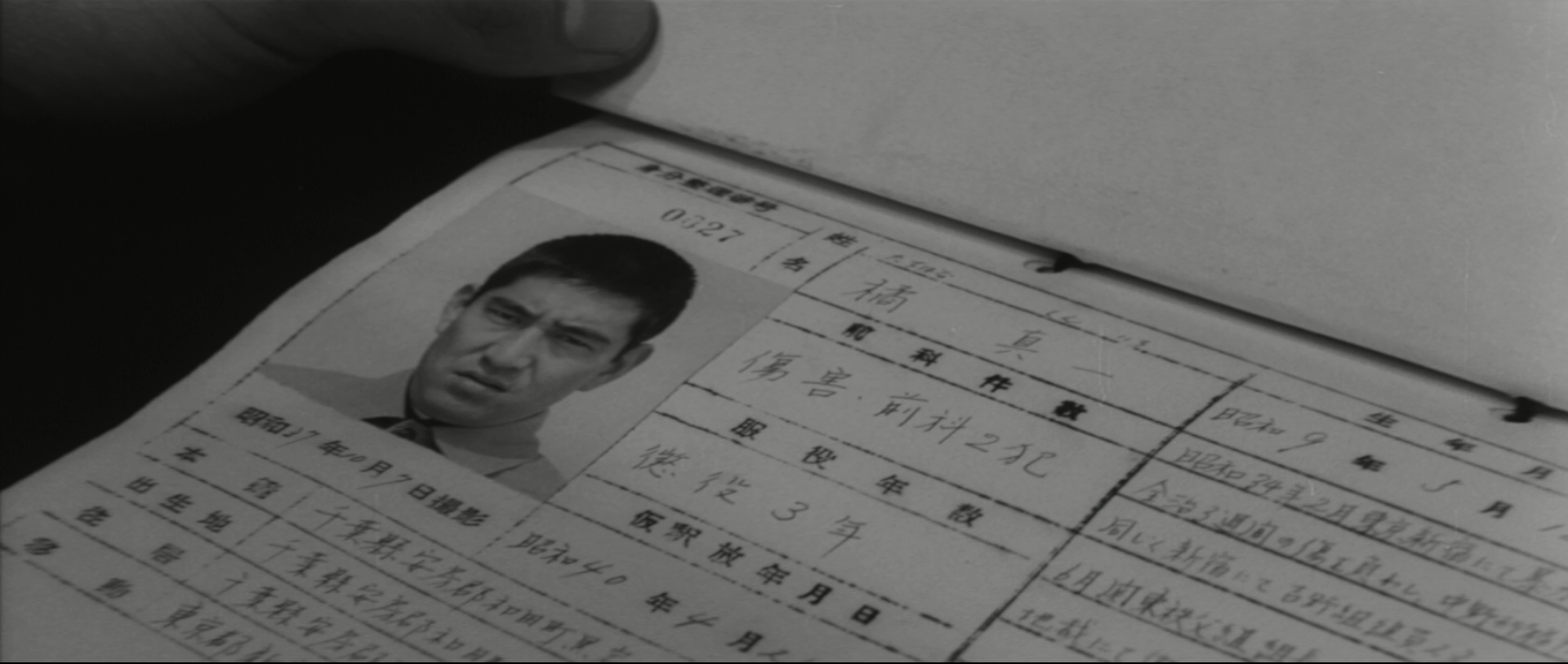
If we analyse Shinichi Tachibana (Ken Takakura) through the lens of enjoyment and aggressivity, we notice that, while he is eager to fall in the trap of aggressivity, his violence is not fuelled by a thirst for enjoyment. The main reason why such thirst is absent from his subjective functioning is the revelation that his turn to organized criminality is determined by the father figures he had to deal with – the absent biological father as well as the violent step-father. What Tachibana found in the arms of the yakuza was, in other words, a family structure led by a father he never had. His violence, his criminal acts, is not enacted to gain enjoyment, but to express his loyalty to the criminal father. The oedipal dimension rears its head again when the spectre of the dying mother comes to haunt the imprisoned Tachibana, causing feelings of guilt to blossom within him and compelling him to go straight.
Tachibana’s subjective functioning is in stark contrast with Gonda (Kōji Nanbara), the inmate that forces him to escape. Gonda merely seems to live to enjoy others, to manipulate them for his pleasure, and incite imaginary conflicts and violence. Yet, with Abashiri Prison, Teruo Ishii invites the spectator to ask whether the dynamic of seeking transgressive pleasure is a mere compensatory facade or a radical logic of perversion? Is he compensating a subjective lack by washing it away with enjoyment or is he perverted to the bone? Is there a common nominator for their turn to the field of criminal transgression?
The composition of Abashiri Prison appears, at first, quite straight-forward – a balanced mix between crude dynamism and static shots. Yet, Teruo Ishii finds a chance to show off his expressive skills in the visual staging of his finale. To push the tension of this sequence to incredible heights – one cannot but sit on the edge of one’s seat, he does not only cut faster, but decorates his fast-paced concatenation with lots of zoom-in movements. While such visual play might feel excessive to modern standards, Ishii proves that he grasps the importance of linguistic elements like punctuation, rhythm, and intensifiers for the cinematic field, the field of the moving-image.

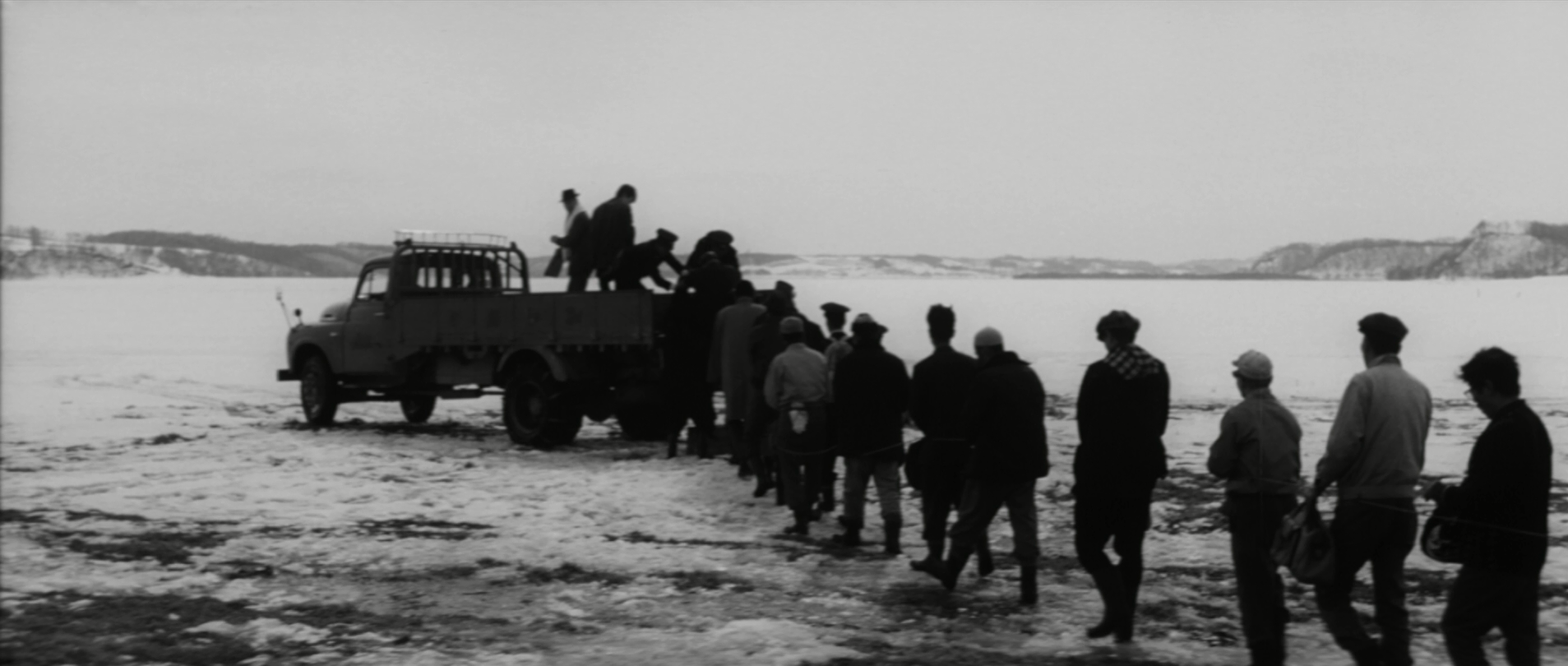
The monochrome colour-palette is put to great use by Ishii and Yoshikazu Yamasawa. By exploiting the whiteness of the snowy environment to turn characters, vehicles, and so on into black silhouettes, they succeed in emphasizing the crafted compositional tensions and heighten the visual pleasure of many shots for the spectator (Cine-note 1).
The traditional folk song sung by Ken Takakura in Abashiri Prison is not merely a decorative element but is an important tool to qualify Tachibana’s mood throughout the narrative. Yet, the nostalgic longing to return to the societal field echoing within the lyrics and the flow of singing reverberates more strongly as the narrative unfolds, as the whole oedipal relation between Tachibana and his mother is laid bare.
With Abashiri Prision, Teruo Ishii delivers a very satisfying experience. Not only does he smartly exploit the wintery landscapes to heighten the spectator’s visual pleasure, utilizing his compositional tools extremely well to create satisfying moments of tension, but he also succeeds in delivering an interesting exploration of the frailty of the social bond between criminals as well as the trauma that, in some cases, animates the criminal reflex.

Notes
Cine-note 1: Sometimes a similar compositional effect is obtained by utilizing the whitish sky or the whiteness of the helmets worn by the inmates.
 psychocinema
2 Comments Add yours