In Japanese cinema, the family is a beloved theme that many directors have explored in one way or another, from world-renowned masters like Yasujiro Ozu, Mikio Naruse, and Hirokaze Kore-eda to less well-known directors like Hiroshi Shimizu (Seven Seas: Virginity and Chasity (1931)), Yuzo Kawashima (Elegant Beast (1962) and Yoshimitsu Morita (The Family Game (1983)).

The continued interest in the theme of family can be explained by the fact that it functions, first and foremost, as a frame that enables the director to question the broader societal field, the Other. In his first feature film, Yuki Saito turns to the genre of the familial drama to explore the encounter between trauma, parental figures (omote) and the societal Other (tatemae). Early on in his narrative, Saito lifts the veil of the central societal dynamic he aims to critique by letting Saku Asakura (Fuga Shibazaki) says that “the adults here are too hung up on appearances”. Adults are, to put it more psychoanalytic words, mainly concerned with protecting the superficial and artificial image of societal harmony (wa). While certain people have an inkling of the traumatic currents swirling below the surface of the local societal field, these truths are refused symbolic ratification as not to compromise the mendacious image of a peaceful community. The whole drama of Sin And Evil turns around the fact that the Other’s silent but oppressive demand to support the fiction of societal harmony and repress trauma and truth has destructive effects on the subject’s logic.
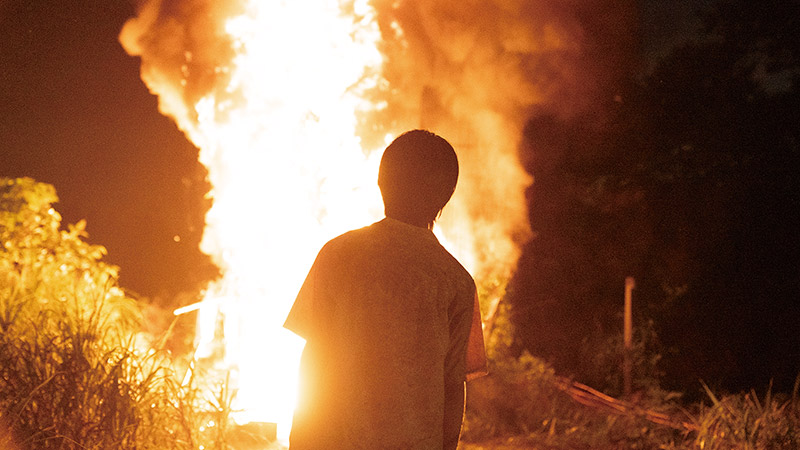
The catalyst of Sin and Evil is the concatenation of two murders – the murder of Masaki Kida (Shuto Ichizawa) and the murder of the loner Fujita (-) by Masaki’s friends Haru Sakamoto (Manato Sakamoto), Saku Asakura, and Akira Yoshida (Hikaru Tashiro), who suspect him of murdering Masaki. Saito utilizes this narrative anchor, which plays an important role in determining the narrative’s ultimate denouement, to explore how the clash between familial (mal)functioning and the societal Other determines a subject’s trajectory.
Yuki Saito traces out the possible determining effects of such clash in Haru Sakamoto and Akira Yoshida, the two main characters of his first feature film. The narrative opens with a sketch of Haru Sakamoto’s familial situation and his subjective position. Haru’s father is caught within a cycle of violence – verbally and aggressive – and radical inhibited passivity. The logic of this imprisoning cycle is quite simple: He tries to maintain his identification with the image of the victim and violently leaches out to anyone who compromises his self-pitying, inhibiting self-satisfying position. Haru’s mother, on the other hand, turns herself into an absence to avoid any confrontation with the fatherly violence and unlovingly reproaches Haru for all the familial troubles. The message his violent father and his distancing mother give him is that he is a nuisance, trash, an object not worthy of his parent’s love (Narra-note 1).
Haru’s attack of Fujita is determined by the subjective unrest caused by the violent familial whirlwind he is subjected to. Haru does not merely attack the shadow of his violent father in Fujita – Fujita transforming into a sack of flesh to unleash his desire to annihilate his father onto, but also to protect his own subjective position and take revenge for the radical shattering of the reflection of his own ego in Masaki Kida. His violence is, in short, a response to the sudden annulment of his pacifying imaginary identification.

In the second half of the narrative, Saito traces out how Haru (Kenga Kora), as an adult, has worked-through his familial past and his collaboration to murder and how this process of subjectification has determined his logic within the Other. Twenty years after the double murder, Haru is introduced to us as the owner of a construction firm called Harutake company and a supermarket that employs local troublemakers.
Saito focuses on the latter in the second part of the narrative to illustrate that Haru, after doing his time at juvie, has forged a sort of fatherly position towards adolescents who feel unwanted by their parental figures within the societal Other – this is his final subjective answer to his familial trauma. While these troublemakers, these victims of the parental Other, harbour a certain disdain and suspicion towards the societal Other, Saito tries to anchor them into the societal field by granting them a function (Narra-note 2).
Saito takes great pains in the latter half of the narrative, even fleetingly transforming his narrative into a violent yakuza-flick, to underline how radical Haru’s subjective answer to his own familial trauma and Masaki Kida’s death are. While many spectators will struggle to see the relevance of the brutal conflict between Haru’s company and the Hakusan-kai at first, the finale delivers a shocking signifier that gives Saito’s violent excursion an appeasing signified, affirming Haru’s radical solution to the failure of the Other – parental as well as societal.
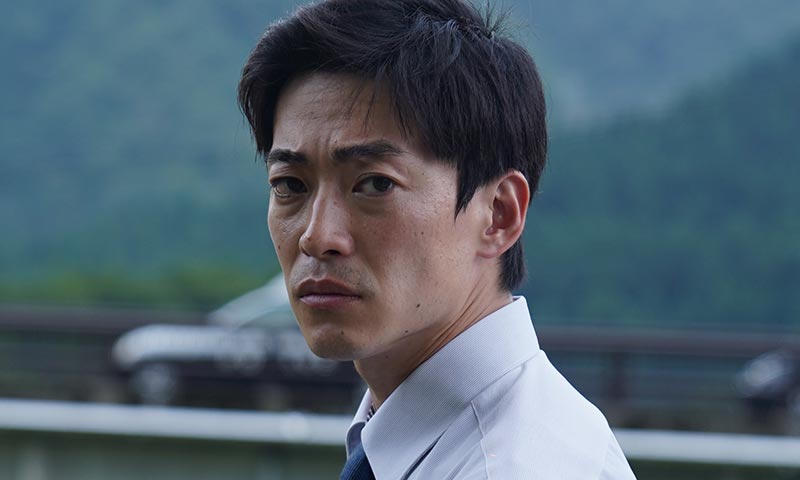
Akira Yoshida (Shunsuke Daito), on the other hand, grew up in a more functional familial environment – in a familial structure where the father is given the right to function as the head by his spouse who holds all the power. It is therefore not surprising that, twenty years later, he has followed his father’s footsteps and became a police officer.
While, at first glance, Akira seems quite stable – he is motivated to find out where Haru’s gang of troublemakers got their money from, his subjective logic has been determined by a never-fading guilt. His guilt is, surprising as it may be, caused by Haru’s act of taking the blame, herebystealing Akira’s chance to inscribe his transgression into the fabric of the societal Other and repent for his crime. Robbed of this chance, Akira finds himself haunted by a guilt-inducing demand to narrativize and resolve the traumatic event, yet he unable to do so (Psycho-note 1). Akira misses the essential objective coordinates – Was Fujita innocent or guilty to murder? – to narrativize the traumatic event and solve the moral riddle it poses. He cannot, to reformulate the signifiers Kentaro (Tomohiro Ichikawa), Haru’s right hand, formulates to two of their troublemakers, stop believing he has sinned, because he has not way to justify his transgression (Narra-note 3). Yet, when Yamato Kobayashi (-), one of Haru’s troublemakers, is found death in the same spot as Masaki, Akira is offered a chance to unravel the truth and better grasp the ‘evil excesses’ that lurk behind the societal facade of peaceful harmony. Can Saku Asakura (Takuya Ishida), who threw himself in farming to deal with the past, be of any aid to Akira’s search for answers?

The composition of Sin And Evil is littered with beautiful and visually pleasing tracking moments and nicely composed shots – the director knows how to fluidly interweave his visual plays with geometry and perspective. Yuki Saito often resorts to subtle shaky framing to reverberate the tension felt by certain characters, to emphasize subjective discordance or to decorate more action-rich moments (e.g. the soccer-game).
Yet, Yuki Saito does not only deliver visual beauty, but also shocks the spectator with his no-nonsense visualisation of brutal violence, confronting and enticing him in a straightforward manner with the destructive consequences of the dual logic of the imaginary – you or me – and the spiralling concatenation of threats, intimidation, and vengeful violence.
What elevates the whole of the composition is Saito’s subtle yet effective colour-grading and the meaningful contrasts he creates. The first contrast Yuki Saito delivers is one internal to the past – between the bright summery atmosphere and the looming darkness that frames the murder on Fujita. The second contrast is between the summery atmosphere and the interplay of faded neon-like shades of the city’s night-life and the dark threatening shadows that pervade certain interiors of the present. The latter contrast does not merely give the summery past a nostalgic quality, but visualizes Saku Asakura’s statement on the importance of appearances and repression. The vibrant yellowness echoes, when read this way, the societal demand to safeguard the false image of harmony and prevent traumatic truths from bursting forth into the societal fabric, while the dark shadows and the different colour-gradings signal the looming presence of refused societal truths and lingering transgressive desires.
With Sin And Evil, Yuki Saito delivers an impressive and heartfelt first-feature debut. Despite feeling somewhat overstuffed at times, Saito does succeed in sketching out the fact that any societal field, any Other, bears some responsibility for the subjective outcomes of dysfunctional familial dynamics and the criminal excesses that plague its mendacious image of peaceful harmony. Recommended.

Notes
Narra-note 1: The act of praying at the Buddhist altar in front of his father is a passive aggressive performance, an acting-out directed at his father and his absent mother. Haru unconsciously sends out these messages to his parental Other, because he has not been given a satisfactorily subjective answer concerning the death of his sister – neither by the parents nor by the societal Other.
The signifiers and acts given to him by parents do not bear any witness to any sadness, guilt, and repentance. Yet, Haru’s acting-outs do not merely aim to question his parent’s subjective position with respect to their deceased daughter but also as crude requests to answer whether he is desired or not.
Narra-note 2: In the second half of the narrative, the director focuses on Yamato Kobayashi to emphasize that Haru’s helps youths who are subjected to similar dysfunctional familial situations. Kobayashi’s familial situation is marked by an absent father and an abusive mother, a prostitute, who takes every chance to confront her son with how undesired he is within her life – he is but an unwanted obstacle causing problem after problem.
Narra-note 3: Kentaro invites Yamato and his friend to justify their act of theft by giving their egoistic impulse (to gain pleasure by partying and boasting) a social goal (i.e. for family and survival).
Psycho-note 1: The wayAkira pacifies his lingering guilt – by taking the path of speech and the signifier – reveals a second source for Akira’s guilt. By being unable to inscribe his transgression into the societal Other, he felt incapable to express his gratitude and regret to Haru, whose act of burdening himself with the responsibility for murdering Fujita, ‘safeguarded’ their future.
 psychocinema