The impact Japanese culture has had on pop-culture cannot be understated. Even people who do not actively seek out Japanese cultural productions can form an image of Godzilla, samurai, and the cat-like ninja. Yet, while the black-clad ninja are heroic in the collective consciousness, it might come as a surprise that first three Shinobi films, which heavily influenced today’s phantasmatic image of the ninja, are so nihilistic in nature and critical of the Japanese society of the sixties.

[Click the banner to go the Radiance website to purchase the Shinobi No Mono trilogy]
Yet, it should not surprise anyone familiar with Japanese cinema. The historical setting of Jidai-geki films has been exploited many times to offer critical allegories of Japan’s pre-war and post-war societal structure and transformations. It is thus a given that left-wing writer Tomoyoshi Maruyama, whose novels formed the basis for these three films, would exploit utilize such frame to denounce certain trends in the post-war societal fabric. Shinobi No Mono: Band Of Assassins, as our in-depth review revealed, explored the bankruptcy of the traditional father for the post-war subject. Yet, with the demise of Sandayu, it seems that the only thing the second shinobi film can delve into is the destructive capitalistic greed, as personified by Oda Nobunaga. Yet, does the death of Sandayu eradicates the shadow of the traditionality that lingers within Goemon’s subject?
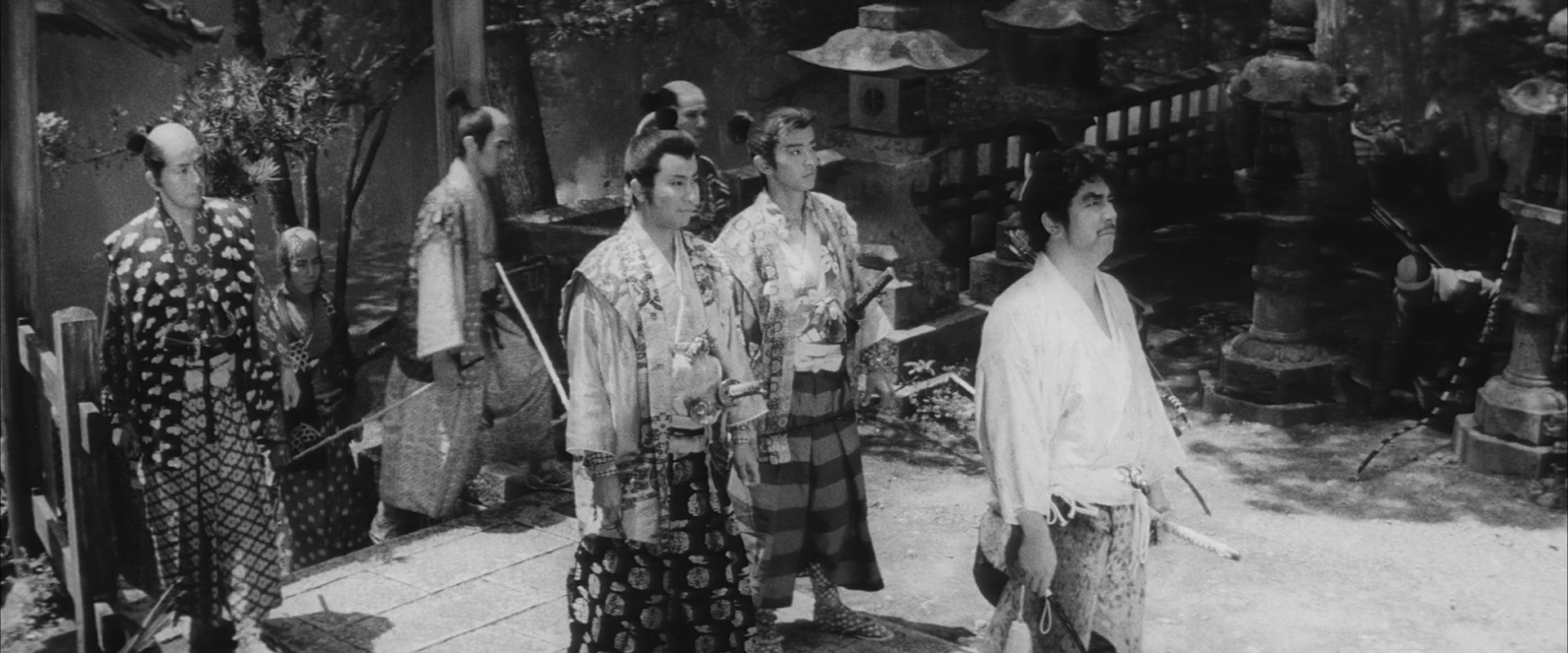
After destroying Momoji fortress and eradicating most of the Iga ninjas, it seems that nothing can stop Nobunaga in realizing his greedy dream of ruling all over Japan. Yet, after just having arrived at the Aenokuni Shrine, where the Iga ninjas’ guardian deity resides, he and his closest allies are ambushed by some rogue ninjas. To warn any rogue ninja and ward off any further attacks, Nobunaga publicly crucifies his attackers and promises rewards for anyone who can reveal a ninja’s hidden residence or capture one.
Before exploring the second narrative of Shinobi no Mono, we need to explore the difference between the deceased Sandayu and the thriving Nobunaga (Tomisaburo Wakayama). While both have a certain ‘corrupted’ fatherly shine, the dynamic by which they arise or arose in the societal field is radically different.
Within the familial frame of the clan, Sandayu instilled obedience in his students because he could ground his master-position in religious tradition. He could function as the signifier that completely defined the purpose of the ninja’s life. His word was law, his word was truth. Nobunaga, on the other hand, cannot rely on the dimension of religion or tradition to realize himself in the societal field and force obedience. He must rely on violence, fear, and pleasure. The capitalistic dimension of Nobunaga’s functioning is, of course, most evident in the place he gives to pleasure. When Nobunaga, having become bored with crucifixions, asks Nobukatsu (-) to find a more interesting way to kill his opponents, he does not simply seek pleasure for himself. The true goal of wanting more spectacle is to please and sedate the common folk through violence while giving those who seek to oppose him a radical warning.
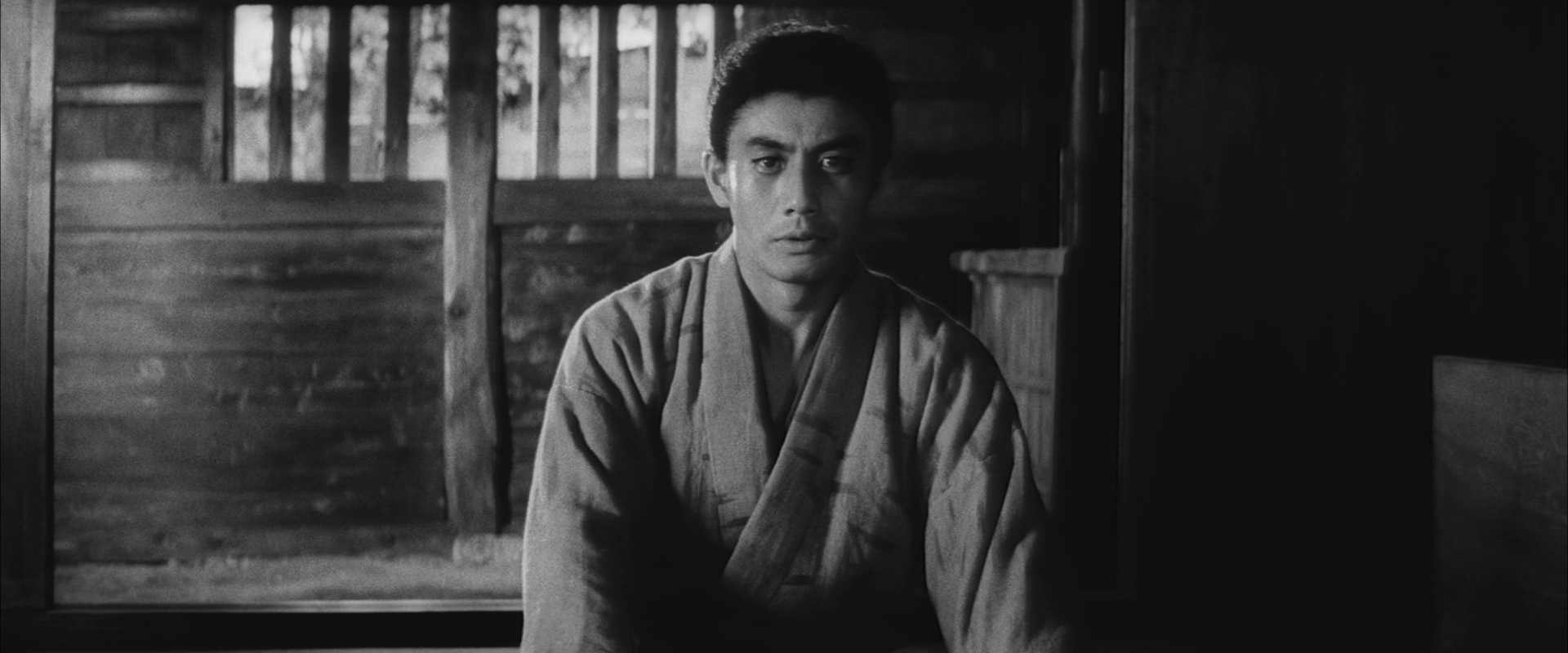
The use on monetary rewards – financial pleasure – to manipulate the poor common folk into aiding him in his quest to eradicate the ninja underlines that Nobunaga’s signifier does not function as the law nor the truth. He can, thus, only rule by seducing the common Other with pleasure while reminding him, through violence, that the refusal of this gift of pleasure ends with death. The importance of materialism for Nobunaga is also evident in the way he binds his followers to his spoken signifier. As the fight between him and Akechi Mitsuhide (Satoshi Yamamura) illustrates, he forces subjects into a debt that can only be repaid by meekly carrying out his orders – from meaning-giving traditionality to debt-inducing ‘kindness’. The main theme that Shinobi no Mono 2: revenge explores is, in fact, nothing other than the frailty of a dynamic that exploits debt to force obedience. Such dynamic is, as the narrative so beautifully illustrates, a breeding ground for imaginary conflicts – I deserve more than him – and imaginary injuries – I do not get what I deserve. Moreover, by relying on gifts instead of a signified, the master can never be sure of the veracity of his allies’ loyalty – he trots along a lingering sense of suspicion.
Despite the evocative question in our introduction, one might be surprised – or disappointed – to learn that the death of Sadayu does not sort any subjective effect on Goemon whatsoever. The main reason why Goemon can avoid the birth of persecutory guilt is because he saw the truth of the traditional father – his corruption – before his demise. He already rid himself of Sandayu’s traditional shackles by choosing his desire – i.e. leading a simple life with Maki (Shiho Fujimura).
So, what forces Goemon to take up the path of the ninja once more? If it is not a sense of unescapable guilt – a debt that he feels needs to be repaid, it can only be a brute confrontation with the sadistic enjoyment of violence, with an excess of pleasure that ravages his peaceful life. It is, in other words, the forced confrontation with the horrifying truth of capitalistic exploitation – use others to produce enjoyment, that makes him take up the shiruken again. He wants revenge. The emphasis on revenge, of course, means that the second narrative has a much simpler structure. It is not about discovering who is pulling the strings from the shadow, but when Goemon can finally rise from the shadows to exact his revenge.

The critical reflection of Buddhism of Shinobi No Mono: Band of Assassins, of course, does not mean that religious tradition is defunct and religiously embedded father-figures have all together disappeared from the societal field. As the Ikko rebels in Saiga prove, their rebellious nature resides in their devoted faith in Amitabha’s compassion. It is precisely because the rebels find the meaning of life in these Buddhist teachings that they cannot accept Nobunaga and his sacrilegious acts of violent pleasure – the excess of destruction and murder he leaves in his wake. Shinobi no Mono 2: Revenge, in fact, underlines that, despite deaths on both sides, the tension between traditionalism and capitalistic modernity does not fade (Narra-note 1).
It will come to no surprise that the composition of Shinobi no Mono 2: revenge is very similar to the way the first film was brought visually to life. Satsuo Yamamoto’s reliance on fluid dynamism helps him, once again, to create a visual rhythm that pulls the spectator into the narrative and keeps him engaged. The second film also exploits monochrome contrasts to deliver many moments of visual pleasure.
However, spectators who desire to see more of therefined cat-like acrobatics of the ninja will feel somewhat disappointed. As this narrative is all about Goemon abiding his time in the shadows to strike when he can attain his revenge, there is simply no need to interweave such elegant actions within the visual fabric. Luckily, the lack of ninja action-moments is completely compensated by the thrilling and explosive finale.
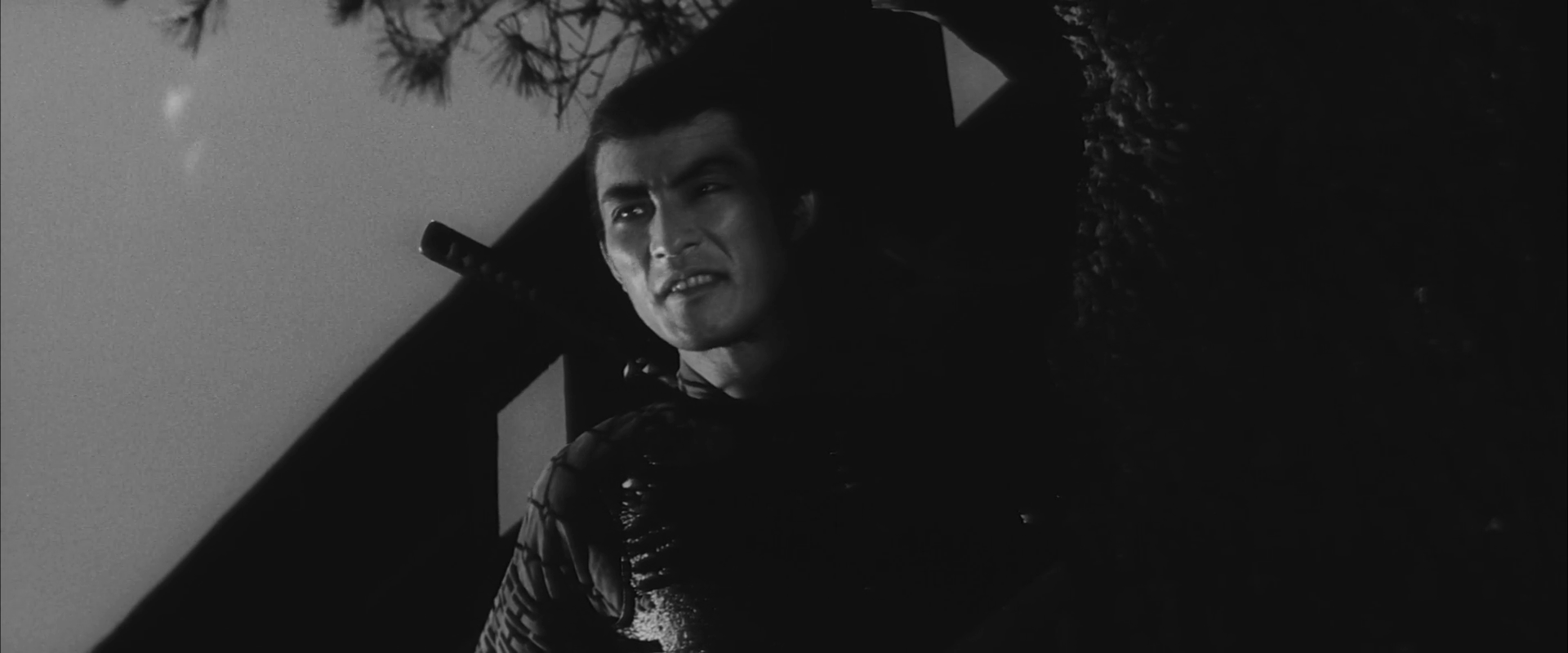
Shinobi no Mono 2: revenge is a great sequel. While the narrative might lack the layered complexity of the first, it offers a satisfying continuation of the thematic conflict between religious traditionalism and capitalistic pleasure. While Shinobi no Mono: Band of Assassins revealed the bankruptcy of the traditional father, Shinobi no Mono 2: revenge shows the frailty and replaceability of the capitalistic father in an engaging way.

Notes
Narra-note 1: Near the end of the narrative, Goemon reveals that, despite throwing off the shackles of the corrupt but fatherly Sandayu, he still relies on Buddhist tradition to give meaning to the necessary of turning to the way of the Ninja.
 psychocinema
One Comment Add yours