Introduction
Spectators will surely remember Keishi Otomo from his highly satisfying series of Rurouni Kenshin movies. With such experience, it thus comes to no surprise that he was asked to helm the fictionalized account of Oda Nobunaga’s marriage with the daughter of Saitō Dōsan, a Sengoku Daimyō of the Mino Province.
Yet, not much is known about this marriage. In fact, the only thing that historians agree on is that she married Oda Nobunaga at an unspecified date. And while accounts differ, it is quite plausible that their marriage remained childless, never produced an heir. Her later life, however, is a complete mystery. And while many theories have been advanced, the unresolvable uncertainty grants Ryôta Kosawa, the screenwriter of The Legend And The Butterfly, freedom to create a narrative as it sees fit.
Thus, while what is offered to the spectator is fiction – all historical narratives are, at their core, fiction, The Legend And The Butterfly remains faithful to the confines traced out by the historical facts (General note 1). Yet, does the care to remain historically accurate result in a satisfying historical period drama?

Review
Spring, 1549. Nagoya Castle, Owari Domain. The sombre outlook of what will happen with the Owari domain once Nobuhide (Hirotaro Honda) dies has led him to force an armistice with the Mino domain. To inaugurate this bond, he demands that his son, Nobunaga Oda (Takuya Kimura), must marry Lady highness No (Haruka Ayase).
Saito Dosan (Kinya Kitaoji) of the Mino Domain quickly agrees with Nobuhide’s request as this bond can save the domain if Lady No’s brother (-) ever decides to revolt. Lady Highness No, reduced to a mere exchange object to quell fears, is forced to silently accept her fate. Yet, during the first night, Nobunaga’s unrefined nature and the way her treats her – i.e. as an object to please him – causes No to confront him.
Some years later, No’s father is murdered by her brother, before Nobunaga can even leave his domain with his army. Not much later, Nobunaga faces a greater problem as the seemingly massive Imagawa army is approaching Owari.
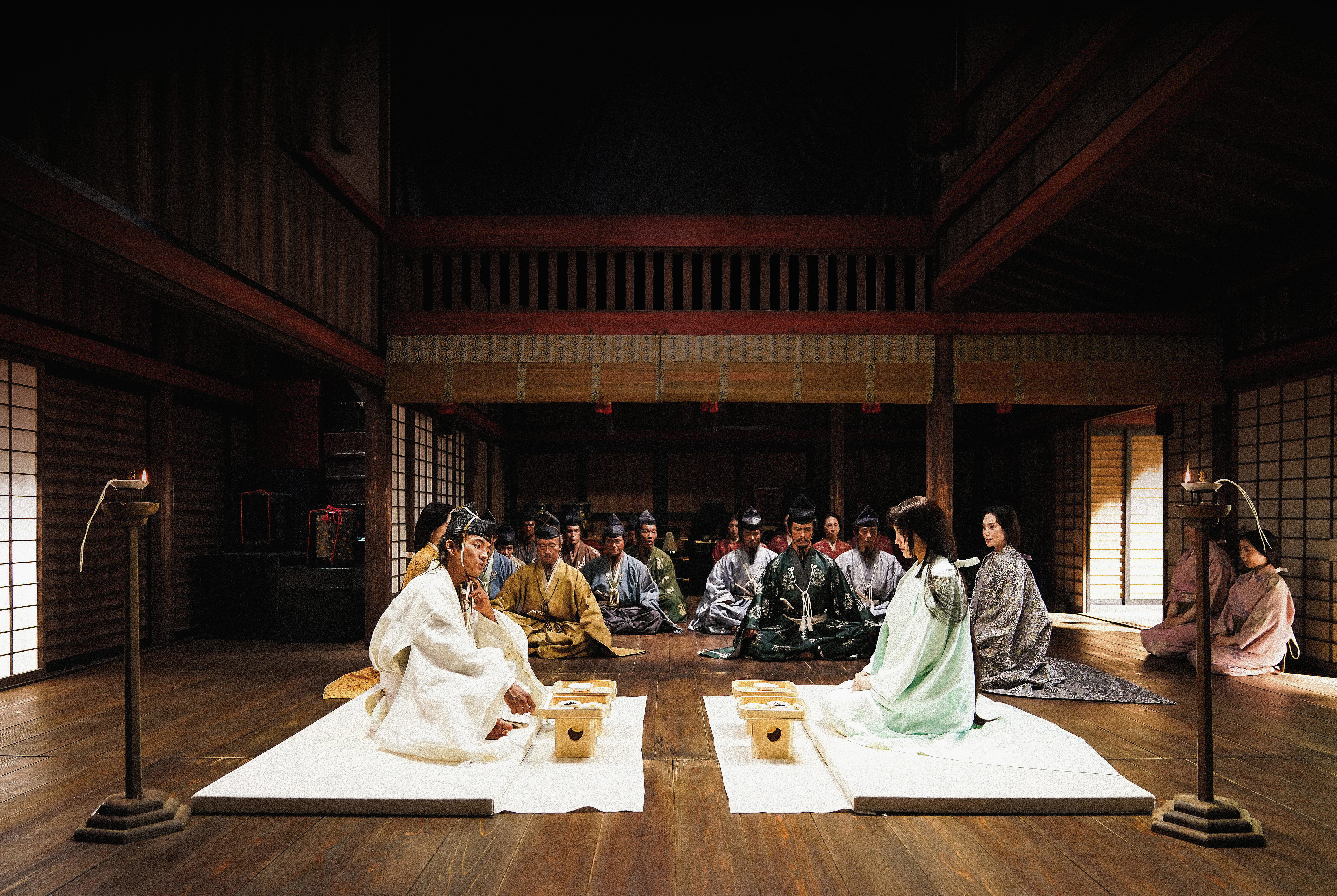
The Legend And The Butterfly is both a historical and a romantic fantasy intertwined, mixed together. While the emphasis on romance will surely put off spectators who desire a more action and conflict driven period drama, the element of romance allows Otomo to deliver a fresh take on a narrative that is well explored in Japanese drama and films.
As the story is deeply embedded in history, some spectators might fear that a decent amount of knowledge of Oda Nobunaga’s life path is necessary prior to watching this film. Yet, while it may be true that those who know the main events of Nobunaga’s life as well as the people who were important to him will be able to appreciate the film more deeply, those spectators who known next to nothing about Japanese history are still able to enjoy Otomo’s narrative.
The Legend Of The Butterfly is not without a pinch of comedy. While such comical elements might have felt misplaced in a historical romantic fantasy, these moments of light-heartedness work well because they are either function of the way the characters interact with each other and the way more brute unsophisticated interactions collide with the overly formal cultural environment. However, in some instances, the light-heartedness has a more situational origin and exploits the dimension of misunderstanding or the rippling effect of a slip-of-the-tongue.
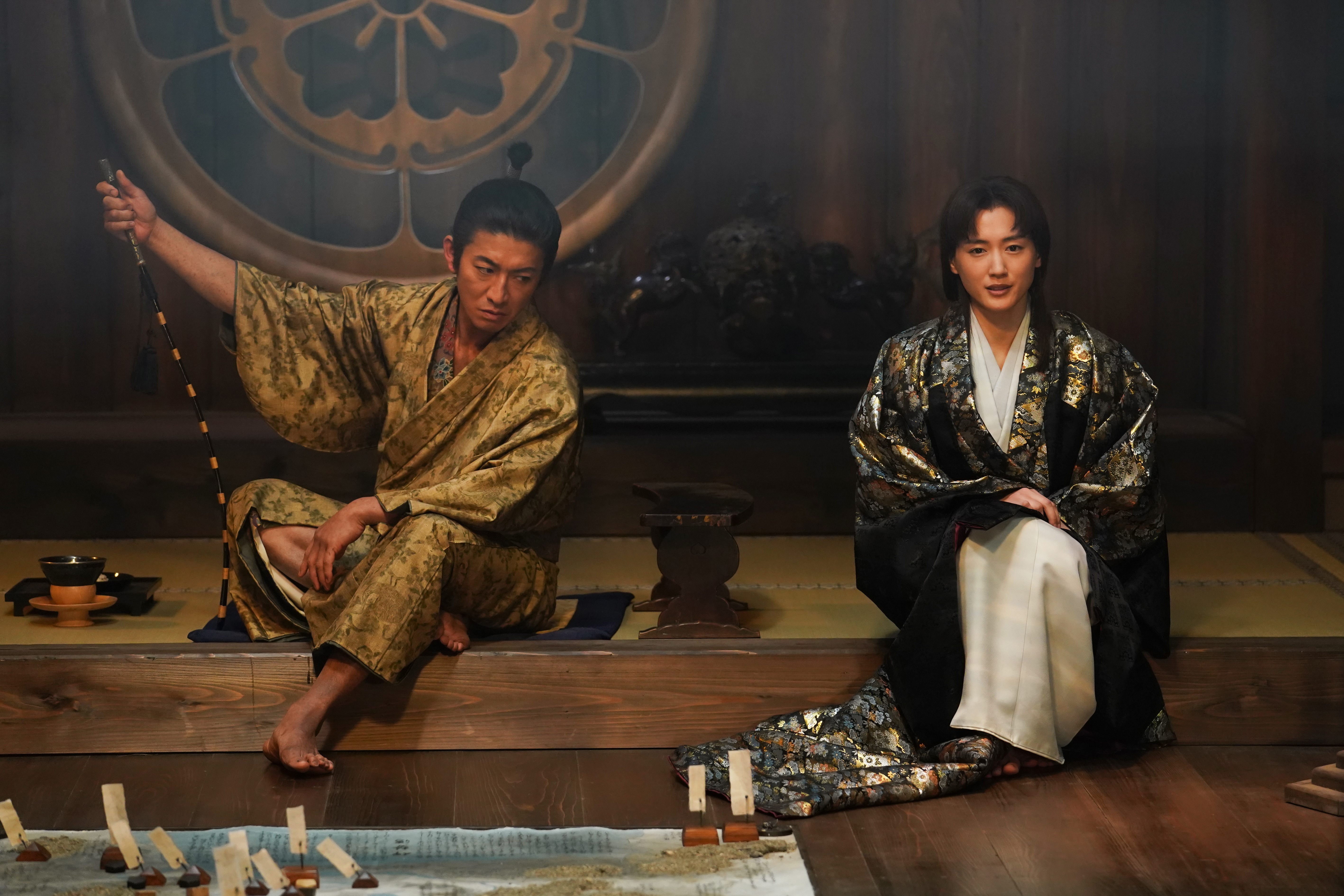
While The Legend And The Butterfly does not stage any great exploits by Obunaga – it takes more than a 2 hour and a half narrative to do justice to those moments, the narrative is not without visual and verbal references to the impact of waging war and bloody sword-fighting. Luckily, for a narrative so light on violence, the few action moments are well choreographed and exciting to watch. Yet, Otomo could have relied a bit more on longer tracking shots to further emphasize the elegance of the swishing and slicing katana.
If we focus on the main thread of the narrative – i.e. the romance between No and Nobunaga, we can promptly state that their tensive marital dynamic turns around castration. While Nobunaga does his best to tame No and prove his phallic worth to her, she leaves no chance unused to confront him, through acts and signifiers, that he is not the phallic image he pretends to be. Or, in other words, she reflects his castration back to her.
It should also be evident that, in the initial stages of their marriage, neither Nobunaga nor No has acceded to the position of lover or beloved. There is, in other words, no desire in play. Yet, due to certain events, things start changing between them and the narrative turns into an exploration of how a butterfly is necessary to make a man a legend. Or, in more psychoanalytic terms, the only subject that can give the man his phantasmatic sense of phallic possession is a female one.
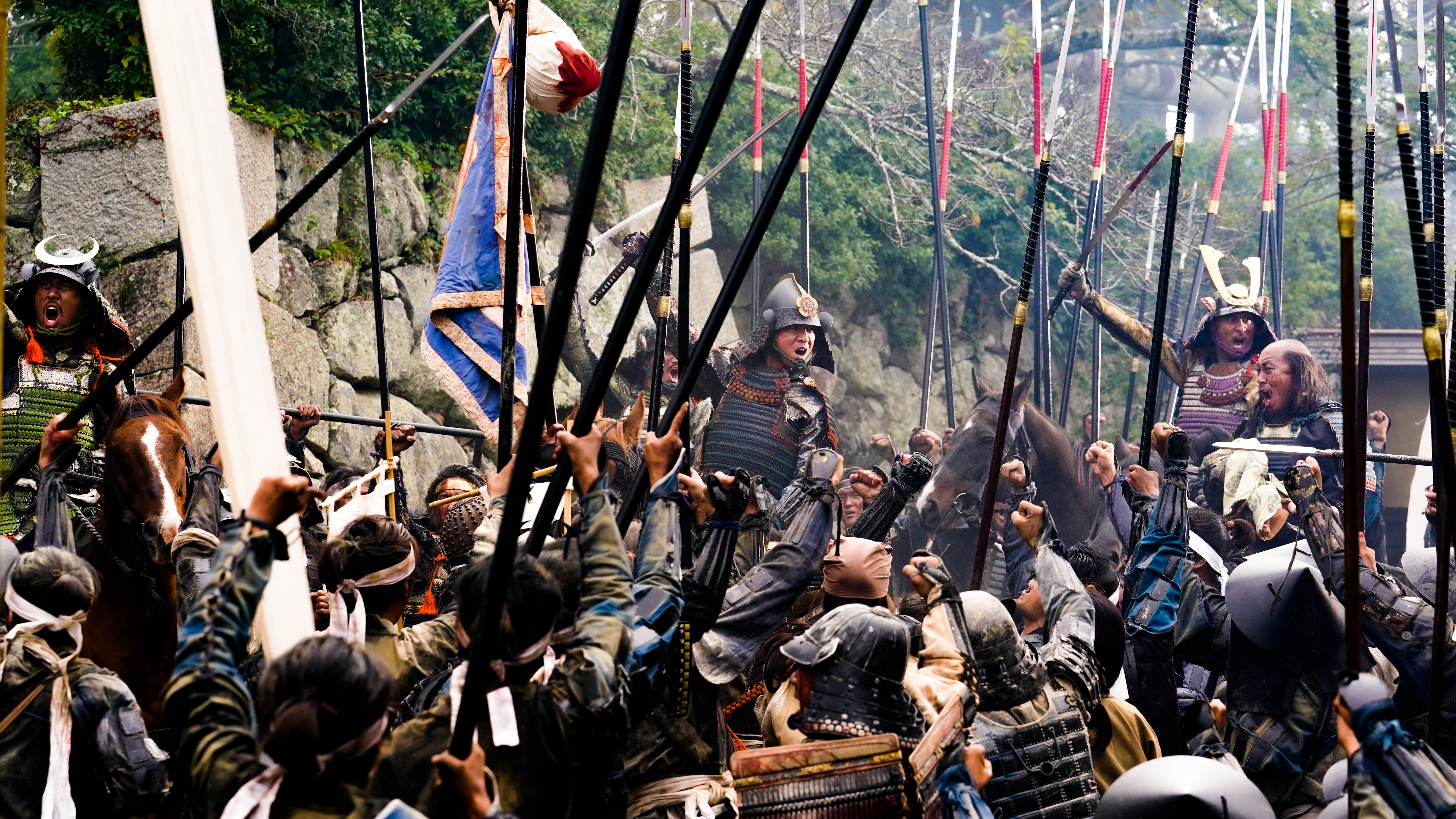
The narrative beautifully traces out how this sense of possession, while false and deceptive, sorts effects for the subject, changing the quality of his presence, the weight of his signifiers and the purposefulness of his acts. Yet, what will happen when Nobunaga, fixated on his false sense of phallic possession, starts acting without any female mediation and feels forced to keep walking the path he chose on No’s suggestion to avoid the brute reveal of his castration (Narra-note 1, Narra-note 2)? And how will this change impact No, who gave Nobunaga her ambition as a guideline?
The Legend and The Butterfly offers visual pleasure at every corner. Not only does Otomo richly utilize nicely-paced and fluid dynamic moments within his composition, but also made sure that, by using geometry in an elegant manner, most of his static moments are visually interesting. The visual pleasure of the composition is further heightened by an elegant use of depth-of-field and the beautiful colour-schemes and great lightning-design.
Yet, the biggest strength of Otomo’s composition is that it allows the spectator to taste the historic atmosphere. Not only is the spectator able to enjoy the exquisite set-designs and the beautiful costumes, but Otomo makes times within his composition to offer him/her fleeting glances at the ins and outs of the way of life within and around Azuchi castle and the nearly ritualistic formal acts and costumes.

While there are many pieces of dramatic musical accompaniment, The Legend And The Butterfly also utilizes subtle music that elegantly dictate the mood or atmosphere of a given scene. While the atmospheric effect of such music is function of its rhythm, the silence that frames the subtle intrusion of sounds strengthens its ability to dictate the atmosphere and allow the spectator to partake in the emotion (e.g. tension) that lingers in the air.
The performance of Haruka Ayase is simply delicious. It is a true joy to watch her bring the outspoken Lady No to life and give body to her initial refusal to be a mere object in support of her husband’s phallic position. With her layered and nuance performance, Ayase also ensures that the shifts in the emotional economy of her character feel genuine.
Takuya Kimura impresses by bringing the multi-dimensionality of Oda Nobunaga convincingly to life. Just like Ayase, he succeeds in portraying the shifts in Nobunaga’s emotional economy as he carves his legendary path with a lot of sensitivity – his performance simply ranks among the best portrayals of Nobunaga in Japanese filmic history.
As both Ayase and Kimura deliver amazing performances, it thus comes to no surprise that what structures the narrative – i.e. the emotional shifts within their relationship as the years go by, pulls the spectator into the narrative and glues him to the screen from start to finish.
The Legend And The Butterfly is an incredible satisfying period drama. While Otomo’s does not offer a traditional jidaigeki by any means, the combination of historical anchor points, a phantasmatic romance to link those points together, and satisfying burst of action will surely be able to satisfy those who thirst for a modern take on the period drama. Highly recommended.

Notes
General-note 1: The film, despite visualizing an imagined romance narrative, is remarkably historically accurate. A lot of attention went into bringing Nobunaga to life according to what is known about him (e.g. the style of his hair, the kind of belt and pants he wore, his love of dance, …etc.).
Narra-note 1: One will eventually realize that the desire to unify the whole of Japan was deeply relational in nature. Nobunaga only assumes the desire of the Other (i.e. No) in order to prove his phallic quality to No. The Legend and The Butterfly beautifully illustrates the Lacanian statement that the desire of the subject is the Other’s desire.
Narra-note 2: The reason why Akechi Jubei or Mitsuhide (Hio Miyazawa) betrays Nobunaga can be understood with the dynamic of phallic possession/castration. What attracted Mitsuhide in Nobunaga was the effect of his assumption of the impossible phallus to become the demon king. Yet, confronted with his ‘humanization’ or, in other words, his castration, he chooses to murder the ‘failed father’.
 psychocinema