Introduction
It is rather uncommon – but not unheard of – that drama-directors to take a leap from drama to cinematic products. Ayuko Tsukahara, a TV drama hitmaker, is one director who tries to take the leap. Is her first feature-film, an adaptation of Agitogi Akumi’s debut novel, worth seeing or should she have given the director’s seat to a different director?
Review
Since ancient times, fear has bred abberations that wrought harm on humankind. Amid such turmoil, one land has been able to supress these demonic beings by being ruled by emperors with the supreme power of future sight and their paranormally powered clans. However, in the fight against the aberrations, certain paranormals who suffer unfortunate deaths or committed treason have their souls sealed in danger-suppressing cocoons and interred in special graves called Sepulchers.
Now that the aberrations have been quelled – a state of peace established, the remaining clans have been focused on protecting the purity of their bloodlines through a constant cycle of mutual cooperation and conflict. One day, Miyo (Imada Misaki), the eldest daughter of the Saimori clan who is plagued by nightmares, if forced to leave her elderly home to marry master Kiyoka Kudo (Meguro Ren), the leader of the counter-aberration paranormal corps.

As Long As We Both Shall Live is, despite the fluid integration of mystery elements and action sequences, a pure romance narrative. Yet, rather than delivering a run-of-the-mill romance, the different genre elements allow Tsukahara’s narrative to become deliciously dramatic.
What also sets As Long As We Both Shall Live apart from other romance films is the fact that the psychological dynamic of Miyo forms the backbone of the narrative. From the very beginning of the narrative, it is made evident that Miyo’s right to have a sexual desire has been radically denied by the familial Other – i.e. her father (Tsutomu Takahashi), her stepmother (Sayaka Yamaguchi), and stepsister Kaya (Akari Takaishi). By being subjected to a familial situation where she is reduced to a mere dirty servant to please the desire of the father’s beloved wife and daughter, Miyo ended up identifying with the position of the unwanted object, a powerless object that does not deserve to symbolically exist. The only thing she can do is breathe, offer up her existence to the fluctuating demands of the Other, and passively wait to join her mother in Heaven.
Yet, even though her desire has been denied and repressed, it is not extinguished. It lingers on in her unconscious and makes itself heard in the sliver of hope that resounds together with the subtle agony that marks her signifiers as she leaves her parental home as well as in her dreams about her mother – yet, not in her nightmares. Yet, the presence of such inhibited desire resounds most clearly in her reluctance to tell Kiyoka that she is powerless.
The first encounter between Miyo and her prospective husband Kiyoka, who demands that she obeys his every word, strongly implies that she will remain reduced to an object-position – a position of submission that leaves no space for any kind of subjective desire. He is furthermore suspicious of her. Will she obey his every word? Can she be trusted? He declines Miyo’s breakfast simply because she refuses to taste it before him to prove that she hasn’t poisoned it. While she fails to heed his demand and the seemingly oppressive rule he imposed on her, Miyo’s refusal is not due to a subtle blossoming of her subjectivity. It is her forced identification with the unworthy object that renders her unable to do something that goes against and disrespects the hierarchy she was radically subjected to in her parental home.
Yet, the interest that Kiyoka starts showing in her (e.g. he compliments her cooking, he invites her to come to town with him, … etc.) and the space he grants her voice does allow the silenced neurotic desire to blossom (Narra-note 1). Her wish not to be disliked by Kiyoka is nothing other than first verbalisation of her budding desire to be desired by the male Other (Narra-note 2).
As Kiyoka starts his investigation into her family, he quickly learns that Miyo’s deceased mother was part of the mysterious Usuba family. This clan, as Arata Tsuruki (Keisuke Watanabe), the boss of a trading company and the secret liaison of the government, tells Kiyoka, is endowed with the power to disrupt and manipulate minds (i.e. hallucinations, clairvoyance, altering senses and memories). Yet, besides Miyo’s existence, there are no traces of any living relatives nor further information about any of her ancestors. Why have they all disappeared? What fate befell this extremely powerful clan? And is Miyo really powerless?

Besides having to deal with his new fiancée at his home and the mystery that surrounds her ancestry, Kiyoka also becomes entangled in the mystery surrounding the appearance of cocoons in the capital. Who forcefully opened various sepulchres and for what purpose?
As Long As We Both Shall Live is framed with a balanced mix between well-paced dynamism and static shots. Ayuko Tsukahara also proves she has a great sense for composition. Not only does she utilizes her dynamism to underline, either directly or indirectly, the beauty of movement, but she composes her static shots in an elegant way, interweaving many subtle moments of visual pleasure into her composition.
Tsukahara’s reliance on slow-motion to frame the more action-driven moments do not only deliver visual pleasure by celebrating the elegance of the moving body, but also ends up littering the second half of the narrative with stylish decorations that heighten the dramatic quality of Kiyoka and Miyo’s romance.

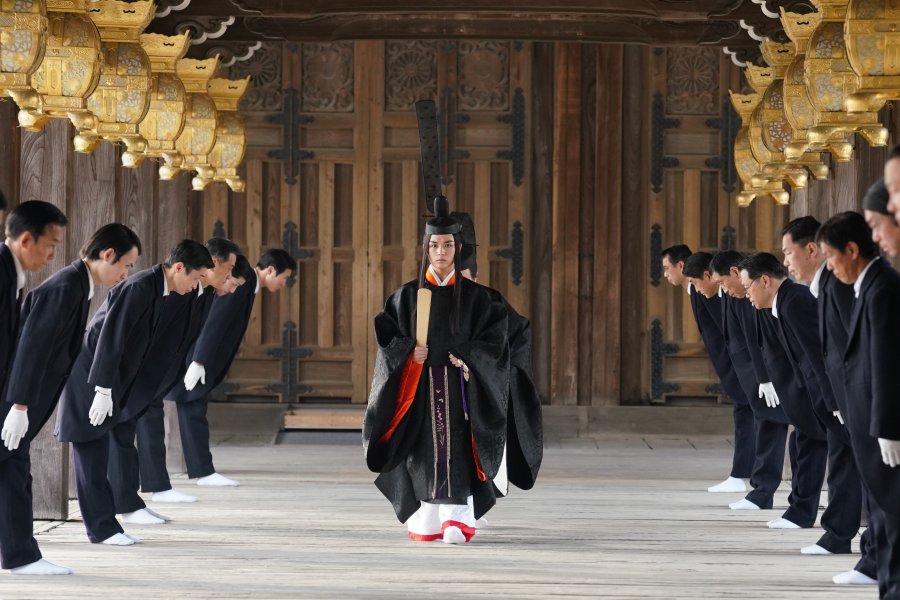
However, the visual pleasure As Long As We Both Shall Live delivers to the spectator is not simply function of Tsukahara’s stylish composition, but also due to the rich set-designs. The blend of samurai Edo, Western Meiji, and European fashion and architecture introduces many appealing visual contrasts into the imagery and ensures the depicted dramatic romance attains a quite unique atmosphere.
As Long As We Both Shall Live is an over-the-top and highly powerful romance narrative. Ayuko Tsukahara does not only deliver visually refined action-sequences with her thoughtful composition, but also smartly utilizes the power of composition to make the emotional turning points of Kiyoka and Miyo’s romance satisfying, creating an emotional rhythm that does not fail to engage the spectator.

Notes
Narra-note 1: The importance of Kiyoka forbidding Kiyo to apologize cannot be understated. While it might not be apparent, his prohibition ultimately means that she shouldn’t apologize for her existence as such. Or, in other words, her presence is appreciated by him.
Narra-note 2: Yet, the appearance of a desire causes a conflict within Kiyo as such desire to be loved by another as subject conflicts with her identification with the position of unworthy trash-object.
Cine-note 1: The visual pleasing nature of the composition is also function of the elegant use of depth-of-field, giving many images in Tsukahara’s composition an elegant softness.
 psychocinema