Introduction
There are many great time-twisting narratives. There are, in fact, so many that to deliver something original has become increasingly difficult. Yet, in 2020, indie-director Junta Yamaguchi and Makoto Ueda proved with Beyond the Infinite Two Minutes that one can still surprise and please the spectator with such a narrative. Now, three years later, they try to deliver a different take on the time-loop. Can he surprise and please the spectator again?
Review
The long-established Japanese Inn Fujiya in Kibune, Kyoto is having a quiet and peaceful winter. Yet, one day, waitress Mikoto (Riko Fujitani) has a rather strange experience. Two minutes after returning to work to clean room Aoi, she suddenly finds herself facing the Kibune river again.
After a few time-warps, other people in the inn, like the chefs, other waitresses like Chino (Saori) and even guests, all begin to realize that the fabric of time is behaving strangely. The only one who remains oblivious to all the time-trouble is Taku (Yuki Torigoe), who is taking a rest while studying French in an somewhat isolated room.
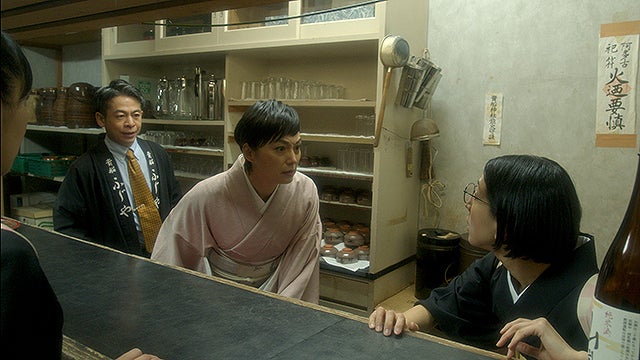
River is another low-budget time-bending narrative by Junta Yamaguchi. His latest film does not only deliver enough funny twists and unexpected turns, but also succeeds in delivering some touching moments and some slightly shocking events.
So how does Yamaguchi approach time in River? This time, his focus lies on playing with the contrast between time as real and the subjective experience of time. While time as something real is radically manipulated and forced into a time-loop, the subjective dimension of time is left undisturbed. Moreover, it is because the temporal dimension of the speaking subject is cut off from the real dimension of time that the time-prison is able to affect our protagonists.
In other words, despite the time-loop – i.e. the endless repetition of two minutes , the symbolic time of the subject retains its chronological unfolding. The subject’s temporal dimension avoids annihilation because the diachrony of the enunciation of the signifier remains intact. So, while the realisation of being imprisoned within a time-loop disturbs and confuses each subject, he/she can, by virtue of the signifier, stabilize his/her symbolic existence.

Many of River’s light-hearted moments are function of the confusion the sudden time-loop causes – e.g. the guests who fear they have to keep eating rice porridge, Obata (Yoshimasa Kondo), the writer of a serial novel who fears he will not make the deadline. These moments do not merely stage the impact of the clash between time-loop event as real and the chronological unfolding of subjective time, but how the subject, to make sense of it all and stabilize his ego, clings on to his subjective experience of time, the time that receives its chronological rhythm by the enunciation of the signifier.
Other moments are light-hearted because they either depict how the staff of the traditional Japanese ryokan tries to keep their guests happy within this time-prison or reveal how the repetition itself creates strange situations of boredom that generate subjective irritation and tragicomical interpersonal frictions. It is quite funny to see how the staff comes to exploit the limit of time as well as the knowledge of its repetition to maintain, for better or worse, the service – omotenashi – their guests expect. Yet, the two-minute limit itself also imposes harsh restriction on what one can do within a given loop. How will this time-prison affect each subject in and around the inn? Can every subject imprisoned within this loop retain his sanity (Narra-note 2)?
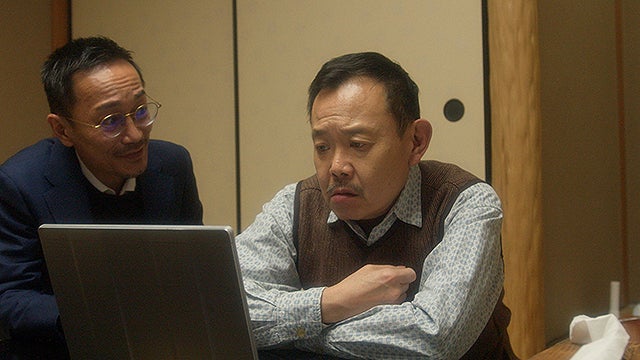
So, what caused the local time-loop (Narra-note 3)? What is so strong that it can call forth the kami and make it bend time? People who watched Beyond the Infinite Two Minutes (2020) do not need to think that long to have an idea. The only thing that, within a fictional space might have the power to change the fabric of time is nothing other than desire, the neurotic desire to be loved and desired. Yet, is it truly desire that has caused this prison of time and, if so, whose?
Yamaguchi brings his narrativeto life with a composition that blends static and dynamic moments (e.g. tracking shots, zoom-ins, … etc.) pleasantly together (Cine-note 1). Yet, what truly stands out in his composition is its fluidity. This fluidity, which gives River its engaging visual flow, is not merely function of Yamaguchi’s reliance on lengthy and fluid dynamic moments – often coinciding with the two-minute time-loop, but also due to his thoughtful use of cutting (Visual-note 1).
For the first few times, Yamaguchi opts for a simple fade-out or cut-to-black to signal the sudden event of the time-warp. Yet, as the two minute time-loop continues, he starts relying on a subtle watery sound-decoration to underline that the coming cut will shift time and the loop will reset itself. It is simple and effective. Yamaguchi also does not forget to play with utilize these decorative elements to deliver some comedy or to surprise the spectator with a twist.
River might not shake up the time-bending narrative too much, but the original setting – i.e. a ryokan in a somewhat desolate area, the effective dynamic composition supporting the staging of the time-loop, and the charm that oozes from the all performances ensures that the spectator remains entertained from start to finish. If you like low-key humour and some time-twisting fun, you should not miss Yamaguchi’s latest.

Notes
Narra-note 1: Due to the time-loop being confined to a local area, various natural disturbances starts happening. Despite time repeating itself, the weather starts shifting wildly.
This revelation demands that we reformulate our statement concerning the time-loop as real. We can only qualify it as real if we associate the real with the something otherworldly – this association is further strengthened by the presence of a Shinto shrine near the inn. Only something not of this time and space can cause the continuation of subjective time – i.e. consciousness – and disturb the natural real of the planet.
Narra-note 2: The main reason why the sanity of some falters is due to being subjected to this endless repetition of time. For some subjects, the boredom that results from this repetition ends up confronting them with a subjective struggle with no way to silence it.Yet, for others, this time-loop offers a some breathing space to escape the pressure of the demand of the Other or a chance to settle inter-subjective differences.
Narra-note 3: The only thing that is difficult to rhyme is the locality of the time-loop and its relation to the outer world. The only solution one can imagine is that those subjected to the local time-loop is that all the loops happen at the same time. Rather than being a concatenation of time-loops, it is either a continued rewriting of the same two minutes or an accumulation of the same two minutes.
Cine-note 1: Many of the static moments in the composition are still marked by a sliver of dynamism. This dynamic remainder is caused by the wish to quickly shift between a static position and dynamic trajectory without cutting.
Visual-note 1: The imagery of River marked by a subtle softness that heighten the visual pleasure of Junta Yamaguchi’s composition.
 psychocinema
2 Comments Add yours