Introduction
The Waxing and Waning of Life is the first directorial collaboration between Shota Koseki and Kentaro Kishi. Yet, while Kishi surely had a great impact on the visual feel of the narrative, the creation of this film was way more personal for Koseki. He did not only write the script, a script dedicated to his dear friend who committed suicide, but also took on the main lead to try, within a fictive structure, to re-experience the subjective despair his friend felt and pushed him to erase himself from the societal field.
Review
One day, Shota (Takeshi Uehara), a screenwriter, turns up at the rehabilitation centre to take his younger brother Yusaku (Shota Koseki), who has been struggling with a drug addiction, back home. Once at home, his brother starts asking questions about his time in rehab.
His brother does not realize that his continued questioning causes visual as well as auditive memory fragments to burst forth in his mind. Yusaku, on the other hand, does not know that Shota is using this information to improve the movie script he is writing.

The Waxing and Waning of Life explores the mental/societal context that underpins the push to abuse substances. Due to this focus, Koseki’s narrative does not visualize any withdrawal symptoms, but merely evokes the mental remainder of an episode of drug addiction – the subjective structure that led to substance abuse as well as structure damaged by such abuse.
It is not difficult for the spectator to realize that Shota, who is driven by a desire to write a script based on his brother’s situation, is the opposite of Yusaku, who due to his past addiction, has no desire whatsoever. While Shota‘s acts and signifiers have a purpose, Yusaku’s presence is defined by prolonged silences and a lack of facial expressions, both echoing the empty and effaced nature of his subject. The few empty signifiers that do escape his mouth do not contradict the fact that he is nothing but a dead subject walking within the societal field.
Yusaku’s speech concerning his time at the rehabilitation centre unearths a quite problematic moralistic dynamic. It is quite evident that, from the eye and the voice of the ‘therapeutic’ Other, embodied by Matsunaga (Masahiro Umeda), a former addict, the addicted subject is merely a failure, someone who, due to his various shortcomings, is to solely blame for his addicted state. The therapeutic Other, as echo of the moralistic discourses within societal Other, remains blind for the irresolvable tension between the subject and the societal field and the destructive impact this field can have on the path of the subject (Psycho-note 1).

The signifiers that he does succeed to formulate concerning his subject affirm that he has not been able to avoid the impact of the moralistic discourses concerning normality and mental health. In this sense, we can even say that his position of a corpse walking visualizes his identification with being societal trash, an insect-like object of filth that no one wants (Psycho-note 2). The veritable problem Yusaku is faced with is the suffocating and abusive Other he is thrown back into, a fabric of the societal field that violently reaffirms his identification with the object of trash – i.e. his work-situation.
While he could protect himself for being violently erased as subject within the confines of the moralistic rehabilitation centre, such defensive stance, one that is not strengthened by desire, is to weak to deal with the vile signifier and violent act of the Other. Why? In short, because he lacks an address to verbalize his anger and frustration with the signifier. He does not only fail to talk to his brother about his struggle, but, as he is blinded by the imposed belief that he is trash for everyone, he also violently pushes away Misato (Saki Kato), who is genuinely interested in him. On the other hand, Shota does not offer himself as an address for Yusaku’s subject. His interest in his brother is solely driven by the desire to complete and improve his script. Without realizing it, he effaces his brother as subject and exploits him as an object to extract information from (Narra-note 1).
Can Yusaku, within the violent Other, succeed in verbalizing something of his subject to his brother? Can Shota hear the subjective nature of these signifiers and safeguard enough space so that more of each other’s subjectivity can be vocalized within their tensive relationship? Can a bond come to existence outside the circuit of substance-enjoyment or will Yusaku become one with the object he has been forced to identified with?
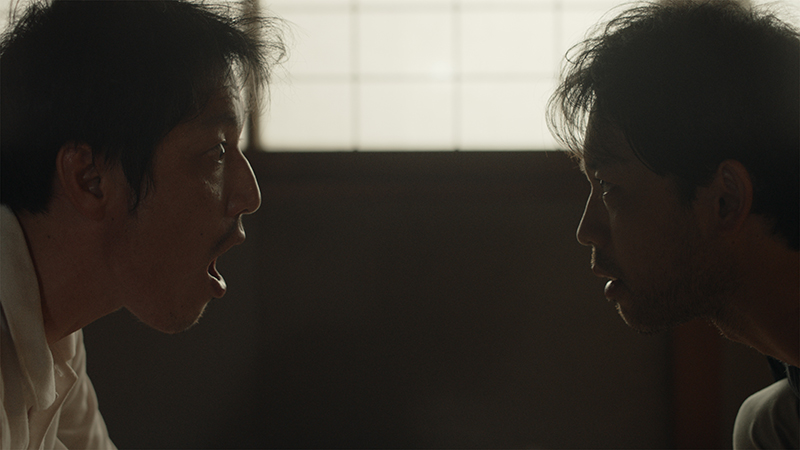
The subtle tremble that marks Kentaro Kishi and Shota Koseki’s composition makes it clear that the visual fabric is utilized to increase the naturalistic feel of the narrative. The subtle documentary-like flavour does not merely reverberate the realism or naturalism of the fictional narrative but also comes to function as a frame that amplifies emotions, either expressed via acts or signifiers, as well as the lack thereof – i.e. silence, as the echo of subjective emptiness. The visual amplifying of the emotional flow results in a narrative that is more engaging and more impactful for the spectator. The various static moments, utilized here and there within the visual composition, do not diminish the sense of realism nor short-circuit the visual tremble to amplify the emotional expressions.
While there is not that much musical accompaniment within the composition, the few times that music adorns the imagery creates moments that are truly emotionally impactful. It is by virtue of not over-utilizing music as well as by only adorning more evocative sequences with music that Kishi and Koseki that these moments attain their power. Rather than the music artificially heightening the emotions expressed by the cast – as often happens in films, the powerful and layered performances fuel the music and heightens the impact of the imagery.
The Waxing and Waning of Life is a powerful emotional experience that shows that only a social bond where there is place for subjective speech can help the formerly addicted subject to avoid getting caught up again in the circuit of substance-enjoyment. What makes this narrative so impactful is not merely Kishi’s impressive cinematography, but the very combination of powerful performances, evocative imagery and signifiers, and musical pieces that allows the very theme of the narrative reverberate within the mind of the spectator.

Notes
Psycho-note 1: Matsunaga’s abusive behaviour at rehab is instigated by his mistaken belief that he is ‘normal’, that he has follow all the moralistic precepts espoused by the societal Other. It is this belief that ‘perverts’ the way the treat the societal failures.
Psycho-note 2: As the narrative unfolds, we soon discover that the idea of being unwanted was drummed into Yusaku from an early age on. This revelation is the first indication that his alcohol addiction was a medicative response to resolve this forced identification with the trash, the object called nothing.
Narra-note 1: The fact that he does not open any space for anything subjective to appear also causes Shota’s anger upon discovering Yusaku has drunk alcohol to miss its effects. Within this anger no genuine concern resounds, only the echo of the moralistic and judgmental Other.
 psychocinema