Introduction
Katsuhito Ishii is a celebrated director among Japanese cinephiles and international festival goers, yet his somewhat eccentric and creative style has remained largely unnoticed by the larger cinema-loving public. Yet, Third Windows Films is trying to change that by releasing the Katsuhito Ishii Collection, a 3-disc digipack Blu-ray set that contains six films, Promise of August (1995), Shark Skin Man & Peach Hip Girl (1998), Party 7 (2000), Sorasoi (2008), Hello Junichi (2014) and Norioka Workshop (2022). This time, we shine our light on Shark Skin Man & Peach Hip Girl which was based on an original story by Minetaro Mochizuki.

Review
One day, Toshiko Momojiri (Sie Kohinata), who has just ran away from her uncle Michio Sonezaki (Yohachi Shimida), the manager of Hotel Symphony, drives past a nearly-naked Kuroo Samehada (Tadanobu Asano). Distracted by this strange sight, she rams another car. Due to the crash, she loses her consciousness.
After waking up a few hours later, she realizes that Kuroo, who is on the run from Tanuki Fukada (Ittoku Kishide) after stealing a large sum of cash from him, took the liberty to use her damaged car to escape his pursuers. Seeing the muscled body of after he took a shower, she cannot help but feeling attracted to him. Michio believing that Toshiko ran off with another man, decides to hire amateur assassin Yamada (Tatsuya Gashuin) to murder the man and force Toshiko back into his controlling hands.
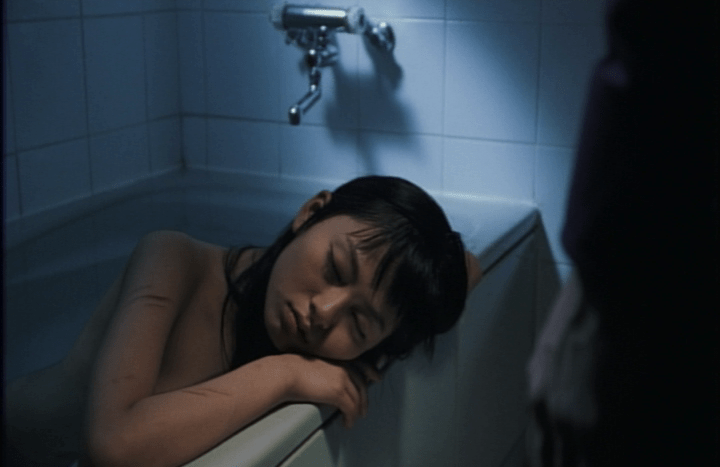
Shark Skin Man and Peach Hip Girl is a narrative whose unfolding is determined by the accidental encounter and the power of the spark of love to alter the trajectory of the subject. It would not be wrong to call Ishii’s narrative a romance narrative.
Of course, Shark Skin Man and Peach Hip Girl is far from an ordinary romance narrative. The quirky moments (e.g. yakuza sharing their problematic familial past with each other, the awkward and tensive exchange between Tanuki Fukuda (Ittoku Kishibe) who collects enamal posters, and his driver, a yakuza who shows a lot of interest in the titles of the yoga-books found next to a body, …etc) that litter the unfolding of the narrative transform the narrative into a light-hearted genre-blend. What makes these moments so engaging is how Ishii utilizes them to echo different genres (e.g. drama, thriller, crime, action, western,…) within his narrative. By elegantly and fluidly juggling various genres, Ishii delivers a rich narrative tapestry that succeeds in evoking a myriad of different emotions within the spectator.
The comical dimension of Ishii’s Shark Skin Man and Peach Hip Girl is mainly function of the way conversations unfold – i.e. the impact of certain signifiers on the conversational flow. The effectivity of these moments to put a smile on the spectator’s face lies in the fact that Ishii does not forcefully seek to deliver comedy, but allows it to naturally blossoms from the conversational flow as such. That this works so well is, of course, because he can rely on a talented cast.
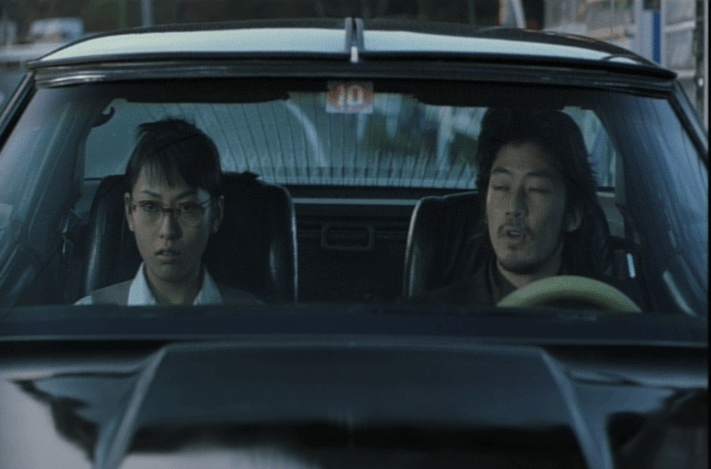
While there are many characters in Shark Skin Man and Peach Hip Girl, the narrative is structures around the figure of the uncle and his sexual obsession. Toshiko’s desire to escape the forlorn hotel has everything to do with him and the suffocating and oppressive atmosphere he creates with his constant phone-calling and controlling corrections. As the narrative unfolds, the erotic dimension that marks his controlling is highlighted – e.g. he sniffs her lingerie, wears it under his clothes, …etc. The obsessional hold he keeps over Toshiko thus aims to reduce her to an object enslaved to please his incestuous fantasies. In this sense, Toshiko’s decision to escape her prison is not merely to escape her uncle’s presence, but the very jouissance that speaks through his acts of controlling. Yet, what will happen if he gets her back? Will the mere absence of her not push him to subject her physically to his sexual desire?
The erotic/sexual dimension marks other characters as well. Sawada’s acts and signifiers have a certain homo-erotic flavour. Certain sounds he makes resembles groans that evoke the sexual pleasure one has during the sexual act. The way Inuzaki (Keisuke Horibe) is ordered around by one of the others is, despite having no clear erotic overtones, marked by a pleasure that cannot be called anything other than sexual. What allows these interactions to attain a sexually flavour is the fact that he is reduced as an object that can be fleetingly enjoyed.
In many cases, the opening minutes of the film determine whether a spectator will continue watching the narrative or not. With the twist-rich opening of Shark Skin Man and Peach Hip Girl, a mere couple of minutes that both confuses and intrigues the spectator, one cannot but keep on watching. While one has not yet an inkling of which path the narrative will take – a feeling further intensified by the introduction of the cast in the visually appealing and energetic opening credits, the opening instils a desire in the spectator to know.
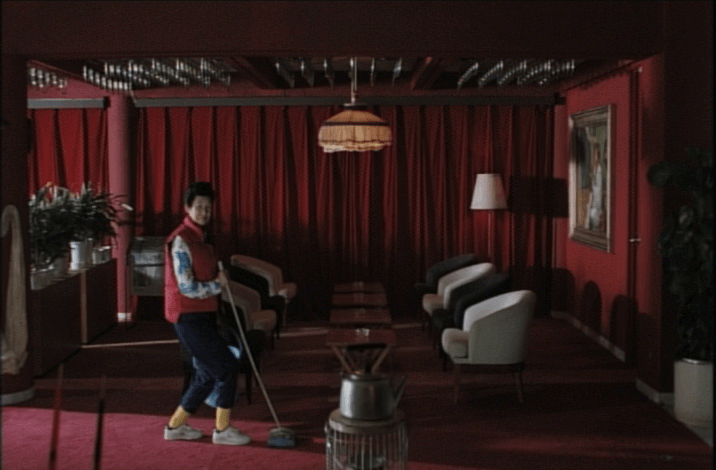
Ishii keeps this sense of mystery lingering within Shark Skin Man and Peach Hip Girl for a while by switching energetically between different narrative strands. By blending different narratives fluidly together, Ishii does not merely create a patchwork of narrative fragments that unfold at the same time, but enables the cut that separates the various narratives to further nourish the spectator’s desire.
The desire to know more is also supported by the fragmentary nature of the different narratives as such. Ishii allows the various acts and signifiers staged within these fragments to raise various questions (e.g. Why does Toshiko want to escape Hotel Symphonia? Why is Kuroo Samahada on the run?) and effectively postpones their unveiling of the answers by Ishii’s effective narrative cutting. It is quite clear that Ishii seeks to make his shifts as effective as possible by creating elegant teasers with his cutting and ensure that the spectator remains engaged by the tinge of mystery that marks the acts and signifiers of our characters.
Even when Shark Skin Man and Peach Hip Girl reveals its main dynamic and narrative backbone – i.e. Kuroo and Toshiko running away from blood-thirsty Yakuza, Ishii ensures that the spectator keeps anticipating twists and turns by subtly highlighting the seemingly impossible nature of Kuroo’s endeavour, i.e. to steal from his boss and successfully get away with it. He also effectively utilizes the spectator’s anticipation to, again and again, subvert his expectations, to great comical effect.
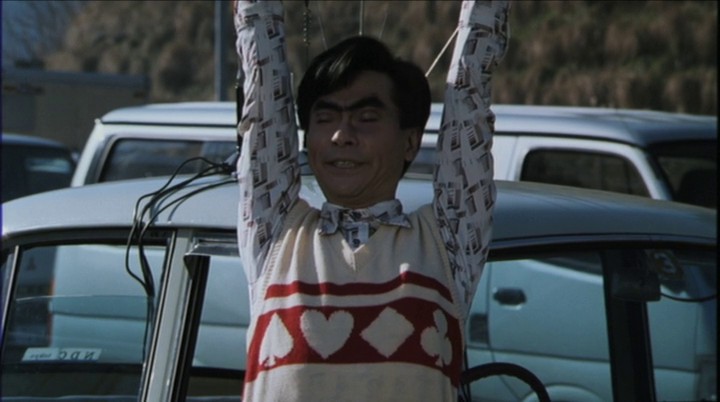
Katsuhito Ishii’s composition proves that he has a sense for shot-composition and that he is not afraid to utilize decorations (jump-cuts, slow-motion, flash-forwards) to further heighten his narrative’s visual appeal. Yet, what proves his skill and talent the most is the fluid way by which he utilizes the same ‘techniques’ – i.e. geometrical play and visual decorations – to interweave comical and light-hearted moments within the visual fabric.
Shark Skin Man and Peach Hip Girl is a blast from start to finish and might very well be one of the best idiosyncratic romance narratives from the late nineties. Ishii does not only showcase his skill of juggling different genres together to create a rich and engaging whole, but also proves his mastery over the visual medium – utilizing the same techniques to either deliver moments of visual pleasure or create a comical effect.

 psychocinema