For Hirokazu Kore-eda, the creative trigger to start developing his sci-fi family drama was a chance encounter with an article about a Chinese company who sought to wield generative AI to ‘resurrect’ deceased loved ones. This article did not only spark interest in thinking through how such endeavour would re-shape the process of grief and human desire but also resulted in the film’s central question: “Who do the dead really belong to?”.
The encounter with this article, thus, allowed Kore-eda to re-approach his interest in how the dead continue to exist for the living from a different perspective, a theme he touched in Maborosi (1995), Still Walking (2008), Our little Sister (2015). However, what allowed Kore-eda to give his film its final shape is his realization of the value of the metaphoric image of the Sheep In The Box, featured in Antoine de Saint-Exupéry’s The Little Prince. The humanoid as a box, the house as a box, the family as a box, the subject as a box.

Kore-eda’s narrative commences when Otone Komoto (Haruka Ayase) addresses her husband, Kensuke Komoto (Daigo), and tells him about Rebirth, a company that has started offering a rental service of life-like humanoids – the product of advancement in generative AI and the latest robotics engineering – for families who loved lost ones to accidents or crimes. While her husband responds somewhat dismissively – They merely seek to cash in on other people’s misfortune; What matters is that we, as parents, keep remembering him, he agrees to hear them out. And before long, Otone, full of hope, and Kensuke, still wary, welcome a humanoid copy of their deceased son, Kakeru (Rimu Kuwaki), into their home.
The imagery that Kore-eda utilizes to introduce his audiences to Sheep In the Box is a fleeting sketch that shows how technology seeks to make the life of human subjects more convenient – e.g. drone-deliveries, electronic step bikes, robots guiding elementary school students, AI-assistants. The humanoid concept of Rebirth, however, resists such simply qualification; we cannot consider its function as technological tool the mere improvement of the convenience or efficiency of the subject’s daily life. The technological ‘replication’ of a deceased loved one radically interacts with the subject’s mental position and re-organizes his interpersonal dynamics. The spectator easily feels that the ethical reverberations of said technology and is led, quite naturally, to formulate a variety of provocative questions: Can a loved one be truly replicated? How does the divergence between the deceased subject and his technological replica impact the subject? Is the subject merely seeking to erase his loss with this ‘medicative’ technological tool and re-install his former role (i.e. mother) with respect to the Other? Can the technological replica, by mitigating the feared consequences of working-through one’s grief – the slow retraction of one’s libidinal investment in the deceased as image, help the subject to give his loss its definite space within their subjectivity?

In the conversation Otone has with Itsuki’s mother at the Rebirth facility, the spectator can easily discern that the humanoid does not erase the loss that befell the subject, but that it, by resembling the deceased person in speech and comportment, allows the subject to continue to play the role, a specific shape of their ego, they are not (yet) willing to give up (Narra-note 1). Kore-eda signals, in other words, that what the subject cannot accept is not simply the loss as such, but the investment in the role that found in the deceased subject its primary fundament (Narra-note 2). The presence of a humanoid child seemingly enables the bereaved subject to continue his performance as parent for himself as well as for the Other – the performance is the investment in the parental role and the medicative way to silence the lingering appeal of one’s loss.
The humanoid, moreover, becomes the physical support for the subject’s memories of his deceased loved one. The humanoid, however, does not merely become a stand-in that, by being programmed by material memories (video, pictures, … etc,), slows down the subject’s libidinal disinvestment in his deceased loved one, but a support that, by being able to the support of or be dressed up with memories, smoothens the subject’s ability to perform his (former) parental role – “It is no more than a product of your own past”.
In the case of Otone, the mere arrival of her humanoid son, Kakeru, causes her to over-invest in the motherly image – in what she could not ‘perform’ for the last two years. What is interesting is not that her sudden over-investment as mother in her humanoid son strains her relationship with her husband – he sees the humanoid as merely a piece of technology, but that she embraces the signs of his humanoid reality into her motherly performance (e.g. “Don’t say dinner now! Kakeru can’t eat”).
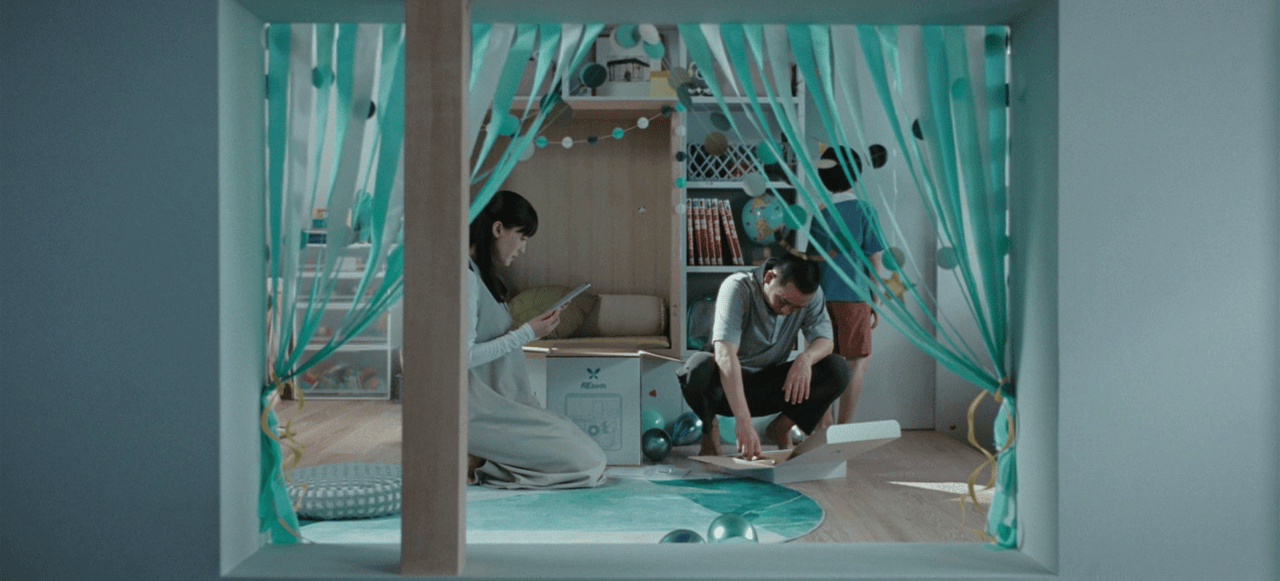
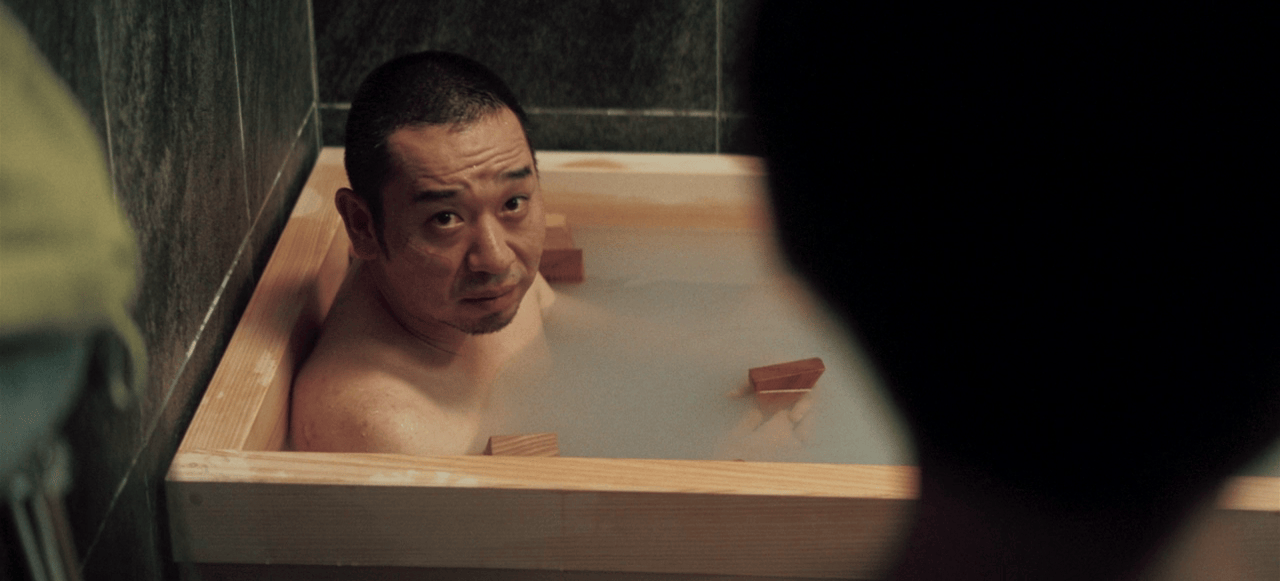
The technological emulation of Kakeru, however, realizes itself as an imaginary ‘trap’ that continuously seeks to ensnare the subject by re-igniting or re-awakening his past libidinal investment in the relational couple child-parent. Kensuke flees from the house after sharing an intimate parental moment with Kakeru because, in this moment, the reality of the machine disappeared behind the internalized and ‘enshrined’ image of his deceased son.
So, what can the function of such imaginary ‘trap’ be? As Kore-eda shows, this vague technological echo might not only enable the subject to skirt around his own implication in the trauma that befell him, but also give the subject a change to exploit this conversational semblance to commence the working-through of his own unresolved feelings of guilt. The physical presence of the humanoid semblance offers the subject an address to verbalize, within a relational context, what could not yet be said – the act of verbally expressing feelings of guilt to a semblance of the deceased that appeasing responds sorts pacifying effects. In this sense, the way Kensuke ends up utilizing the humanoid does not simply constitute a flight from his guilt, but also a minimal yet fundamental step on the difficult path of accepting his own responsibility within the familial drama.
Kore-eda, of course, utilizes Antoine de Saint-Exupery’s image of the Sheep In The Box to highlight that the human subject utilizes the android to project an inside on its box-like surface. This use of this image, moreover, enables him to critique this kind of projective imagination, the forcing of a self-fulfilling ‘image’ upon a box, this self-serving erasure of the other’s Otherness, his difference. Does the coldness that echoes through the box-like narrative spaces not underline that such protective refusal to engage with the Other’s signifiers is one of the main causes that subjects fail to participate, through ‘imagination’, with each other’s subjectivity? Is the lack of relational warmth within the narrative not due to Otone and Kensuke’s failure to talk to each other ‘imitatively’, in using their acts and signifiers to ‘imagine’ the other subject’s struggle? Notice that their interactions either consist of speech that avoids subjectivity or conflicts that push the subjectivity of the other away.
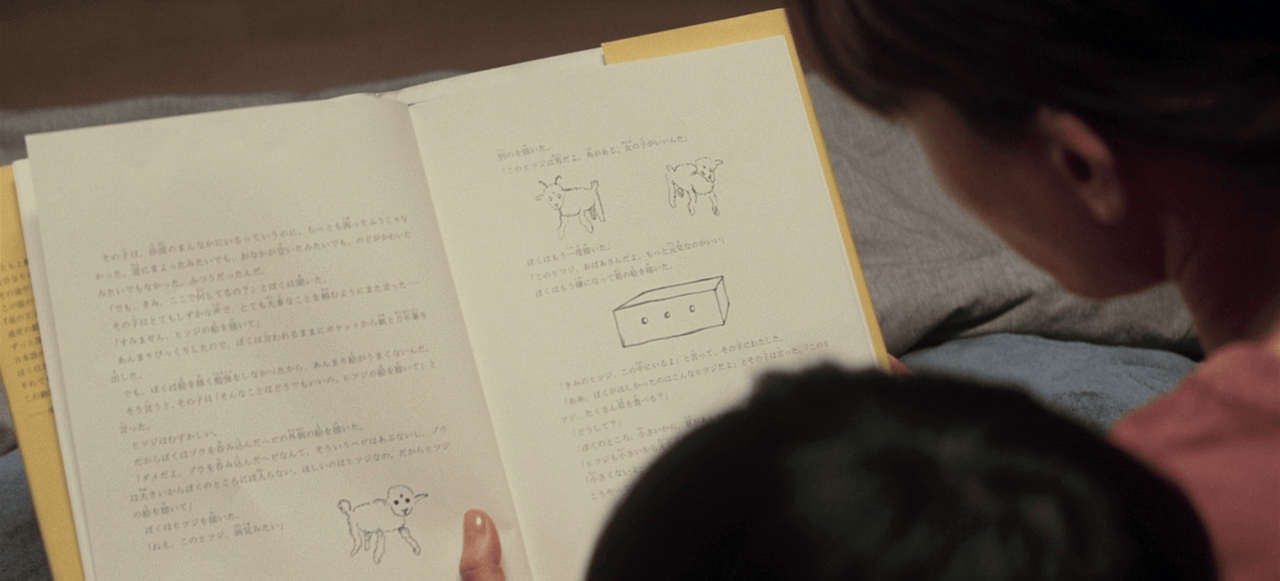
Kore-eda, moreover, allows the spectator to take his metaphor even further and confront or unsettle himself with the idea that we, in relation to the Other, always appear as a symbolic-imaginary box – a tangle of images and signifiers – and that subjective sheep we hide within our box-like ego is, due to our radical reliance on signifiers, without substance. In the field of symbolic-imaginary boxes, we can only ‘image’ or ‘interpret’ the ‘insubstantial’ subjectivity of the Other – be it ourself or the other. Kore-eda, by structuring his narrative around this metaphor, also invites the spectator to ponder about what truly separates us from the humanoid (Narra-note 3).
While we have sketched out the main thematical thread, Sheep In The Box has many thematical sides, so much so that Kore-eda’s narrative seemingly presents itself as thematically fragmented. He touches upon the senselessness of death and the subjective push to signify it, to give it, within the narrative of the bereaved subject, a purpose, a sense, the radical impossibility to replace a living, breathing subject – a subject divided by language – with an AI-driven program animating a robotic body, the equivocal relation between technology, culture, and nature, and the function imaginary sameness plays in the establishment of social bonds.
Kore-eda also stages the commodified reality of the humanoid, the reality of this technological semblance as a product, which exposes the humanoid as a mere object to be ‘subjectively’ exploited and thrown away after it served its ‘therapeutic’ function. The human subject only embraces the humanoid in so far it rigidly performs its phantasmatic function. At the level of the family, he touches upon the role of separation in the process of growing up and offers a re-affirmation of his idea that the child – whether humanoid or human – retains the ability to symbolically nominate his ‘home’, his ‘family’.

Hirokazu Kore-eda brings the narrative of Sheep In The Box to life in his familiar compositional style, richly utilizing fluid dynamism to make the flow of his composition evocative of the unhurried passing of time – a feeling amplified by the softness that marks the colour and the lighting-design. Kore-eda’s film plays out like slowly-bubbling river, giving the spectator the chance to carefully read the various currents and undercurrents that make up the various relational dynamics on display.
Kore-eda re-affirms his refined sense for shot-composition, of staging the familial in a visually elegant manner. Yet, what makes compositional work so satisfying is not simply the way he approaches compositional lines (e.g. frame-within-frames), but how this play serves the sketching out the space of the familial interactions and the establishing of his thematical playing-field – i.e. the intersection between familial life, subjective equilibrium, and technology. One could, in our view, describe Kore-eda’s style as stylized naturalism – his stylistic sensitivity serves his humanism, his continuous attempt to capture something of life as it naturally unfolds, to frame the subject’s turmoil and how it affects his relations in an ‘organic’ and ‘genuine’ way. Kore-eda’s stylized naturalism is, in this sense, also very apt at breathing life into what ripples and disrupts the quiet atmosphere and gentle flow of the relational surface – the stones of frictions, conflicts, trauma within the river that fleetingly dramatize its flow.
The restrained visual rhythm is supported by airy and somewhat playful classical musical accompaniment. Yet, as the narrative unfolds, Kore-eda also starts utilizing musical decorations – string-pieces – to amplify the drama of certain narrative turns and signal how the Kotone’s traumatic past has transformed her performance as mother. Many musical decorations function as musical translations of the unvocalized turmoil of the subject, translations that invite the spectator to fill in goes on in the subject’s mind.
Sheep In the Box offers, at the level of the familial, a mere confirmation of a conclusion concerning symbolic nomination that Hirokazu Kore-eda elaborated more profoundly in his earlier work – Like Father, Like Son (2013), After The Storm (2016), and a rather straightforward exploration of guilt and grief. However, Kore-eda succeeds in utilizing this rather well-trodden thematical path to raise some pertinent questions concerning humanoids, humanity, utility, and commodity. While some will spectators will argue that his ‘human’ drama is too subdued – too delicate – and his ending too wholesome, the cerebral stillness of the film and the thematical fragmentation nevertheless constitutes an inviting call for audiences to ponder over its obliquely-raised questions.

Notes
Narra-note 1: The subject is always able to perceive the very reality that the humanoid is a mere semblance of one’s lost one because it has technological needs (e.g. the humanoid, unlike a subject from flesh and blood, needs regular maintenance, it cannot eat, it cannot have any contact with water, needs to be charged) and functions (e.g. GPS, a button to turn it on or off, …). Yet, at the same time, its life-like presence allows the subject to evade that reality even when it is staring right in his/her face.
Narra-note 2: That Otone has not given up her investment in the image of the mother is, first, highlighted in the narrative by the revelation that she, despite her son’s death, continued to buy new clothes for him.
Narra-note 3: Many people will think that the answer to this question must be sought at the level of the ability to invent, in the possibility to produce something new, to imagine something new. One could, in this case, even state that it is via ‘invention’ that the supposedly-present sheep can escape the boundaries of his programmed box.
Others will state that Kore-eda shows that the prerequisite of invention, of producing something new, is refusal. It is the act of refusal, of saying ‘no’, that enables the supposedly-present sheep to transform his box from a programmed prison into a programmed support to manifest itself as an insubstantial ‘subjective’ sheep.
However, in our view, the true difference between the human animal and the humanoid lies in the fact that only the former is truly divided by his introduction into the field of language. Or to put it differently, only the human animal can be disrupted by his unconscious, by his own bodily jouissance.
This reading also allows us to see that the evacuation of humanist drama is in part due to the fact that humanoid Kakeru, beyond being cut off from jouissance and emotions, has no ability to be ‘mentally’ troubled by his own signifiers and signifiers of the Other (e.g. Kotone’s worry).