There is a world of film that only certain people in Japan can get into touch with – the jishu-eiga, the ultra-independent scene of filmmaking. To get a glance at what these directors create one must visit one of mini-theatres, theatres often hidden within alley-ways in big sprawling cities like Tokyo and Osaka.
However, thanks to Third Windows Films, film-lovers can finally have taste of this vibrant scene from the comfort of their own home. The first director to have his work presented to the world in the New Directors From Japan series is none other than Takashi Ono (General-note 1). Who? Takashi Ono? After watching I Am Baseball, his name will be firmly etched in your mind – we promise.

[Click the banner for more information about the blu-ray release.]
One day, Natsuko Mizuhara (Mitsuki Moriyama), to confront her non-pro baseball-playing husband Ken (Shuto) with his neglect of her, runs off with his bible, a book written by Susumu Shigeno (Takehiko Fujita). After closes the sliding door of the closet in which she has taken refuge, Ken provocatively reaffirms her complaint – “Baseball outweighs a wife on a man’s scale”. The fight is promptly ended when Susumu Shigeno shows up to give her husband his latest book, Baseball Lunatic, Phantom in the Wind, and take him to baseball practice.
Yet, things take a strange turn, when Shigeno, after seeing her playfully practice with her husband, approaches her to convince her to let him train her and ensure her talent for the sport can truly blossom. She refuses and asks him to give her husband back. Yet, the following day, Shigeno’s baseball kills Ken. He turns up a few days later to extort her: play baseball or pay the debts of her late husband. She rightly chooses baseball.

I Am Baseball is the product of a director who embraces his freedom as an independent creator and knows how to play with the limitations (financial, …etc) he is faced with. Ono’s narrative goes beyond the confines of a mere sports-narrative to deliver a strangely intimate, brutally shocking, deadpan comical-drama that oozes with charm.
Part 1: Love and Hate introduce the spectator to the importance a sport can attain for a subject. While it is not difficult for audiences to believe that Shigeno’s poetic and philosophic descriptions of the game of ball reignited Natsuko’s husband’s love for the sport, some spectators will wonder why he lets baseball come between him and his wife, why he invests more libido in baseball – in this “man’s world that [he believes] women can’t understand”- than his marital bond.
The way Ken talks about baseball and how he lets his rejuvenated enthusiasm for the sport dictate his daily rhythm leaves no doubt concerning the fact that this investment functions as a defence against the Other – the corporate Other as well as the marital Other. His fixation on the ball does not only help him cope with the corporate demands he is day in and day out subjected to, but also aids him in keeping his wife’s desire at bay (Narra-note 1).
It comes to no surprise that I am Baseball resorts to the notions of lack, castration and phallus to fuel its light-heartedness and expose the way male subjects subjectively invest in sports. The way Shigeno answers the question of beating a male player as a female player exposes the phantasmatic dimension of playing sports in a beautiful way. To beat a male player, a female player must become so monstrous with her throws that the male player starts to fear that his symbol(ic phallus), which grounds his fantasy of capability, can be destroyed at any moment, that the male player realizes that the phallic bat is not enough to prevent his lack, his fundamental castration, from being exposed for all to see.
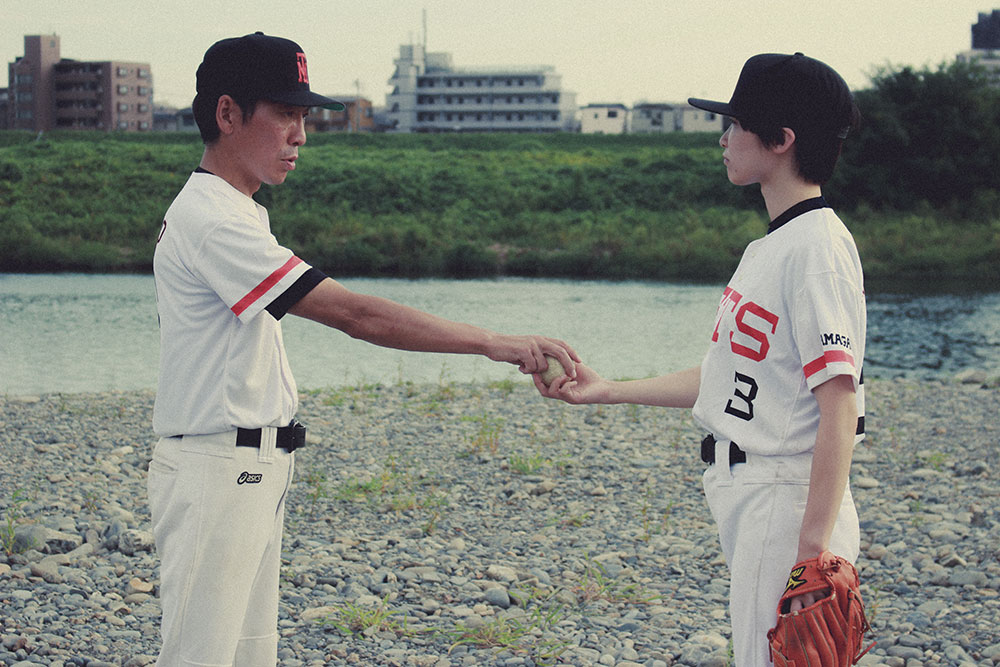
The finale of the first part provides an evocative answer to the question of why Shigeno went so far to gain the privilege to train Natsuko. While making the answer explicit would ruin the spectator’s joy, we can, however, reveal that a deeper darker desire animates his wish to hone her skills to perfection.
Part 2 Revenge stages the way Natsuko, physically and mentally marked by said desire, chooses to position herself with regards to his teacher’s aim, an aim concerning lack, castration, and phallus. Will she exploit the desire of her baseball teacher to take revenge for the losses he inflicted – her husband to baseball, her husband to death – or will she utilize baseball to go beyond mere revenge? Her choice ultimately depends on the function baseball has attained for her – Is it a mere way of coping or has it become a veritable way of living?
The finale of I am Baseball, which unfolds in two parts, is organized around the dimension of phallic parading – of utilizing one’s presence and one’s signifiers to cause defeat at a mental ‘imaginary’ level, to perforate the phantasmatic phallic protection that covers up the opponent’s structural lack of castration (Narra-note 2, Narra-note 3). Victory reaffirms one’s phantasmatic investment in one’s phallic power and defeat temporarily punctures one’s phallic fantasy. Yet, for some subjects, defeat might have a completely different signified.
The composition of I Am Baseball consists almost entirely out of static shots. Yet, it would be wrong to call Ono’s composition, based on this observation, simple and straightforward. Ono utilizes this simple frame to deliver compositional beauty, give space to the performances of his cast, and accentuate his many unconventional stylistic experiments.
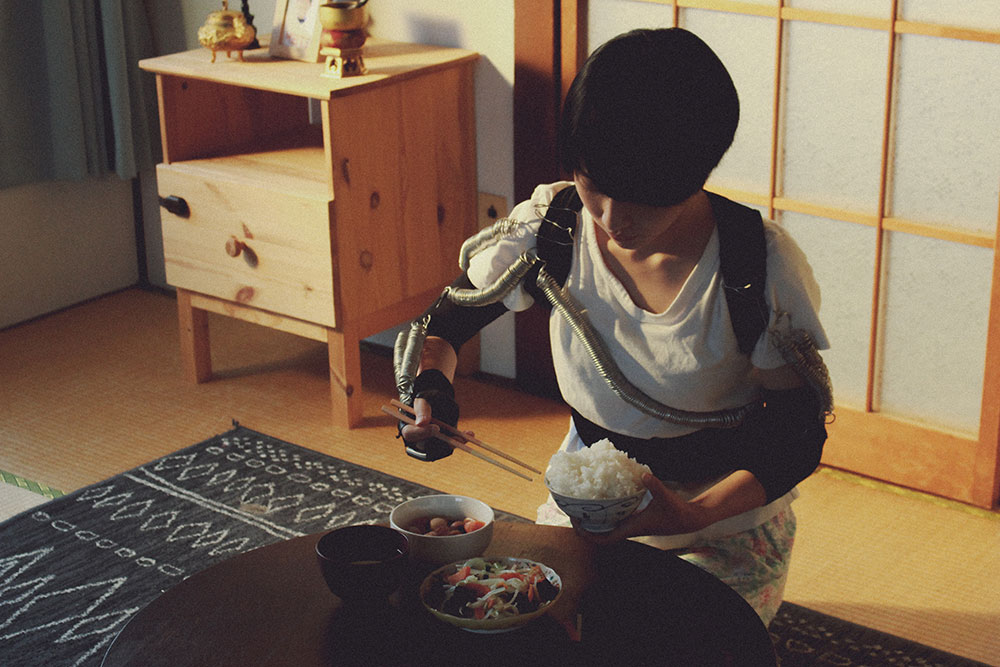
What stands out in Ono’s creation of moments of visual beauty, in his exploitation of the geometrical dimension of his narrative spaces (e.g. frame within frame, puddle reflections), is the non-intrusive way these moments interweave in the composition. Moments of compositional beauty are, in a certain sense, the result of a director who knows how to do the most with the spatial limits of the spaces he chose.
The simplicity of the composition, moreover, creates an uncomplicated space for the performances to shine, for the cast to breathe life into the dramatic and light-hearted flow of the narrative. Mitsuki Moriyama takes full advantage of the space given by Ono to charm the spectator with her naturalism, a naturalism that makes the light-hearted interactional moments feel that much more genuine.
The rhythm of Ono’s composition is structured around compositional decorations and visual punctuations. The director does not merely utilize compositional decorations (e.g. freezes, fast cutting, reverse-shots, slow-motion, visual repetition) to support the light-heartedness of his narrative, but also to introduce certain narrative elements (e.g. the book Baseball Lunatic, All’s Well by Susumu Shigeno) (Sound-note 1).
Takashi Ono takes the spectator by surprise with his eccentric I Am Baseball. Whether you like baseball or not, his absurd love-letter to women who love baseball will shock and charm you. Ono exploits, like all great comedies, with the fraudulent nature of the phallus – the signifier of desirability and power – to show that what unites us all, in sport, is our state of castration.

Notes
General-note 1: I Am Baseball was a big hit in Japan and played in Japanese cinemas for more than over a year, which is an incredible feat. It, thus, forced itself in the category of rongu-ran films, films who due to their popularity have a long run in the cinema.
Narra-note 1: Ken’s statement of a man’s world no woman can understand aims to deflect Natsuko’s continuous attempts to force him to take her Otherness into account.
Narra-note 2: The importance of the dimension of phallic parading – of presenting one in a phallic way – is light-heartedly affirmed through the multiple ambiguous references to ‘balls’ and the various special attacks, e.g. The Grand Razor Ball Smasher, Lightning Gonad crusher.
Narra-note 3: The dynamic between the female pitcher and the male batter proves one fundamental truth: the phallus is fraudulent, a mere fantasy. Natsuko proves with her iron balls that even holding the phallic bat does not erase the structural castration that founds the subject – the golden balls are never safe.
Sound-note 1: The compositional decorations are, in general, accompanied by baseball-inspired sounds (e.g. the sound of a bat hitting the ball).
 psychocinema