Yudai Yamaguchi might not be a director that is well-known among the general public, but anyone who jumped into the rabbit hole of weird Japanese films will have encountered one or two movies made by him, be it Battlefield Baseball (2003), Cromartie High – The Movie (2005), Meatball Machine (2006), Yakuza Weapon (2011), or Deadball (2011).

For One Percenter, Yamaguchi dispenses the weirdness and the goofy splatter of his earlier work to deliver a more grounded action-flick. Yet, with an action power-house as Tak Sakaguchi in the starring role and Kensuke Sonomura in the seat to direct the action, Yamaguchi has all the right ingredients to craft a film that scratches the action-itch of many.
One percenter starts with a faux-documentary sequence which does, thus, not only function as an introduction of the fictional action film actor Takuma Toshiro Takuma (Tak Sakaguchi), but to make the philosophy of real action explicit and whet the spectator’s appetite for a “100 percent pure action film”, for a film where coolness is generated by the physical quality of the action as such (General-note 1).
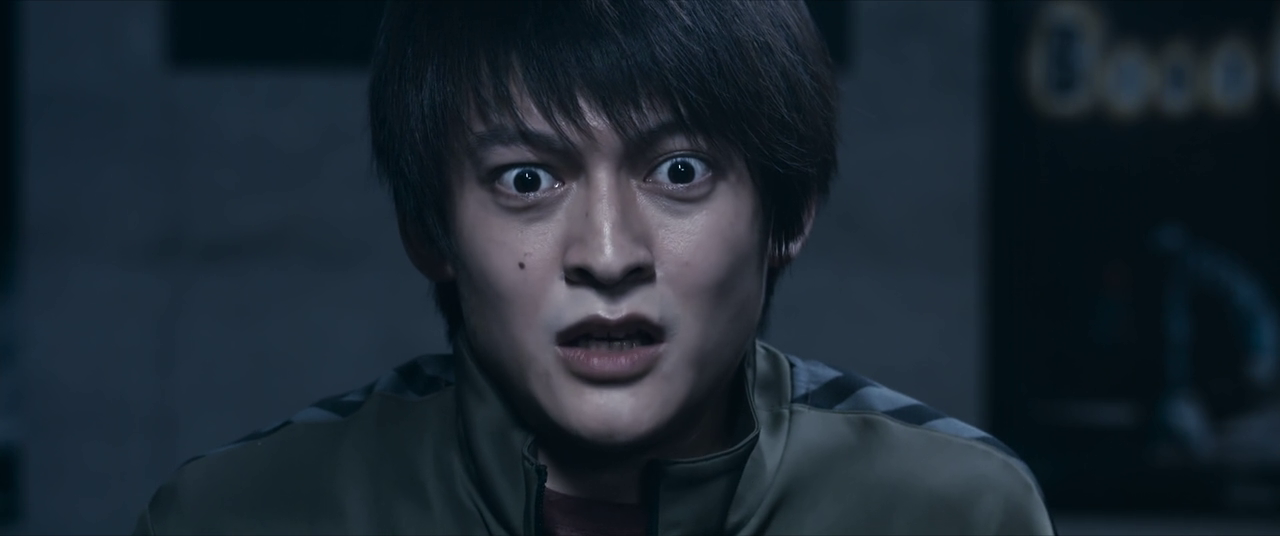
Ten years after the documentary to celebrate his feature film Birth and his promise to make a pure action film, we are re-introduced to Toshiro Takuma. Sadly, he has failed to realize his promise and finds himself on a film-set that radically contradict his action-philosophy. This film-set, a film-set highly reminiscent of Runouni Kenshin, re-affirms the fact that, in many cases, editing is the primary tool used to ensure that the dance-like fighting choreographies attains some shade of coolness.
Yet, this experience, rather than humbling him, ignites his fire: he decides that, if he desires to master the Way of Real Action, he must do it now by reviving One Percenter, the film he could never make. Together with Akira (Kohei Fukuyama), his sole apprentice – he chased the others away with his overly harsh training regimes, he sets out to make an authentic action film, a film where the action performances as such creates the dramatic flow. However, things do not go as planned, as the abandoned island introduced as a possible film-location by Kanda (Itsuji Itao), their broker, is home to two tons of cocaine yakuza are about to fight over. Yet, for Takuma Toshiro, this unforeseen criminal presence on the island is but a mere opportunity to put his philosophy radically into action.
The faux documentary sequence, beyond making the philosophy of Yamaguchi’s film explicit, also serves to introduce his playful play between making fiction and catching reality that structures the film. Yamaguchi does not simply put both in opposition within his fictional frame – real versus simulated action, but utilizes this opposition to evoke that, within the filmic frame, nothing can ever be real – filming is fictionalizing. This narrative play ultimately culminates in a rather surprising twist in the film’s finale, in the faux-interview sequence that brings the narrative to a close.
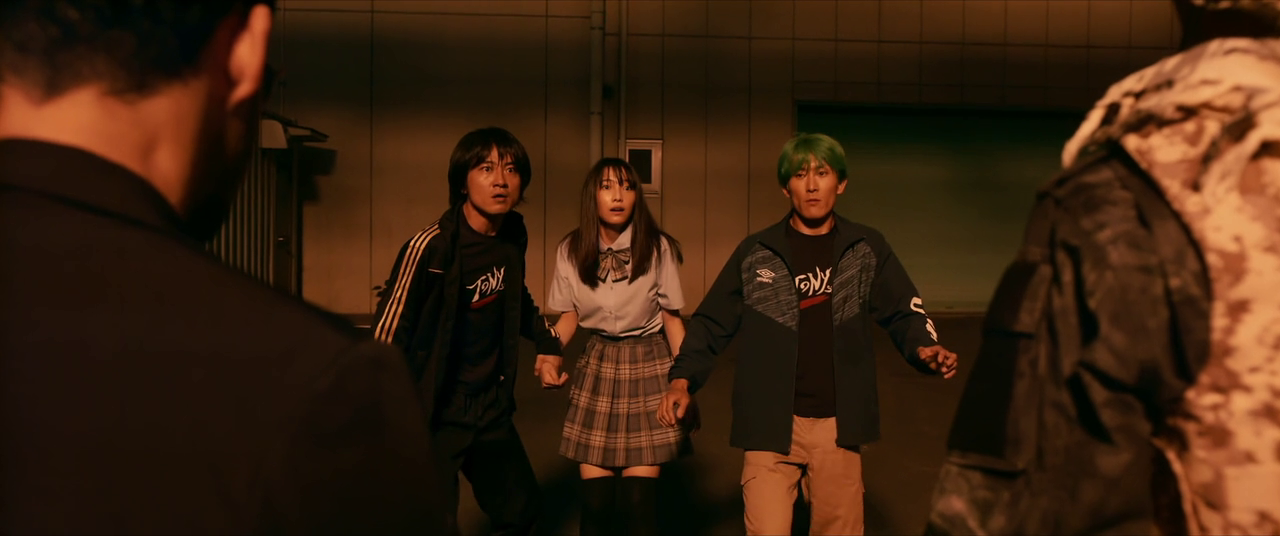
This playful opposition, moreover, also touches upon the following truth: if a director can persuade the spectator to attribute, at the level of his own fantasy, some form of ‘reality’ to the framed fiction, said spectator is able to enjoy what is framed more deeply and thoroughly. To put it in concrete terms, if the spectator can let himself be temporarily duped by Yamaguchi’s introduction of the yakuza ‘reality’, the pleasure the spectator derives from seeing Tak(uma)’s Zero range combat will increase (Narra-note 1).
While the set-up and the conclusion of One Percenter introduce some refreshing elements into the narrative, Yamaguchi’s film does not seek to subvert the well-established dramatic flow of action-films. The threading of such a familiar path could easily would have resulted in a dull and uninspiring affair in lesser capable hands, but Yamaguchi, who is more than capable, hits all the notes of the genre with such precision (e.g. the introduction of a formidable enemy called Arachnid, the assassination squad led by Shishido (Norihisa Hiranuma)) that the spectator cannot but feel invested in how Takuma Toshiro, as foreign element, violently resolves the ‘inheritance’ conflict and goes up against a foe called sensei (Togo Ishii).
The composition of One Percenter does not appear to offer anything that special at first glance – a mix of dynamic and static shots and a nicely composed shots thrown in here and there. However, Yamaguchi does prove that he knows how to bring the action-sequences to life in a very engaging and appealing manner. He strikes a perfect visual balance between letting Tak Sakaguchi’s swift fighting-style speak for itself and elevate the staged brutality of the action via cutting, dynamism, or via visual decorations like slow-motion (Cine-note 1).
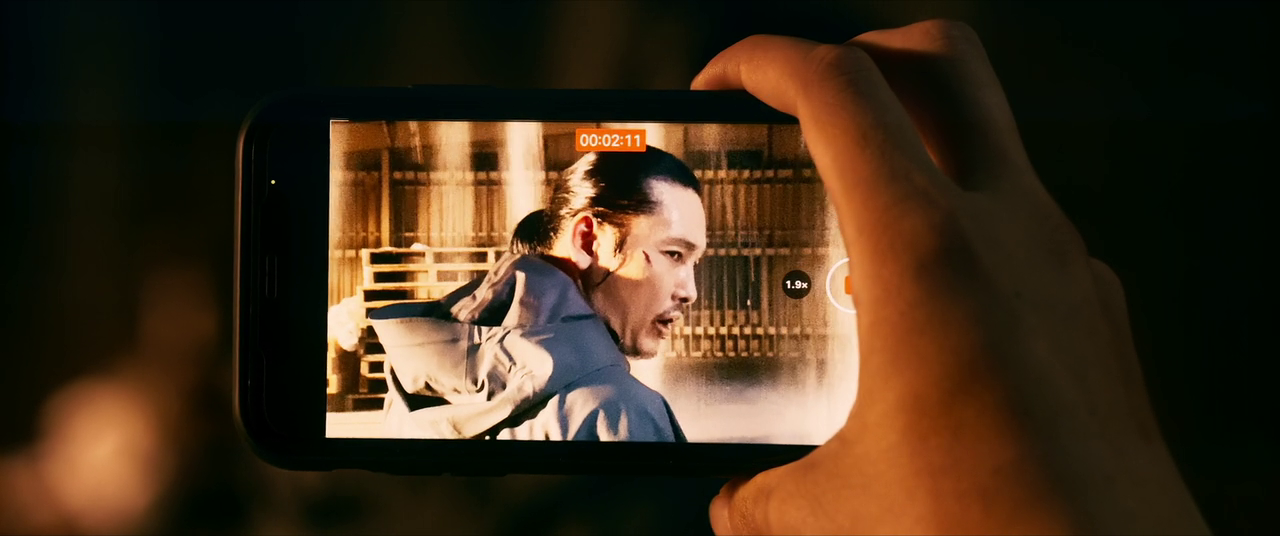
The narrative spaces of One Percenter are brought to life with dull colours and subdued lightning. This stylistic choice, which results in a rather bleak atmosphere, does not aim to induce a depressed mood – making a film is not depressing at all – but to create an effective frame that amplifies the crude viscerality and the coolness of the ‘real action’ moments. The interweaving of moments of brutality, implied via disconcerting sounds (e.g. Ami (Kanon Narumi), Shishido’s daughter, slicing her ice-pick into uncle Takenouchi (Sho Aoyagi)) and evocative imagery (e.g. blood gushing out of director Sunao Kinameri (-), further amplify the brutal feel of violent confrontations.
The dramatic musical accompaniment of One Percenter is highly effective, creating aural frames of tension that makes it extremely easy for the spectator to invest into the on-screen action. Yamaguchi, however, does not only utilize music to slowly increasing the tension within the film’s atmosphere and prepare the spectator for the action-moments, but also to underline the cool flavour of Tak Sakaguchi’s fighting moves and, in some rare instances, even heighten the impact of certain deadpan comical moments.
With One percenter, Yamaguchi delivers a love-letter to down-to-earth action that proves that there is plenty of poetry to be found in the physical action-performances. If you are fan of the action-genre, you should not miss this one. And if you are not a fan, Yamaguchi’s engaging experience might well convert you.

Notes
Narra-note 1: The emphasis on filmmaking in the beginning of thenarrative will lead most spectators to think that the whole affair with the yakuza is part of Takuma’s film. Such thoughts do not only emphasize that the spectator knows that he is watching fiction, but that he intuitively grasps that filming is an act of fictionalization and editing an act of narrativization.
What Yamaguchi thus plays with is the fact that there can only be a simulacrum of reality within film, on the silver screen.
General-note 1: Many things Tak Sakaguchi introduces within this faux-documentary sequence are factually true. His fighting style is centred on Zero Range Combat (Rei kyori sentō-jutsu). A fighting style developed by Yoshitaka Inagawa, and his signature wave-technique.
Yudai Yamaguchi’s One Percenter functions, in this sense, as a fictive vehicle where Tak Sakaguchi is allowed to play himself and freely play to his strengths.
Cine-note 1: While Yamaguchi does not only cut to segment the action-sequences but also to shift the emphasis from Sakaguchi’s moves to the brutal effect it sorts on his rivals.
Cine-note 2: Yamaguchi utilizes shaky framing thoughtfully throughout his composition to ensure that a quantum of tension remains lingering within moments of pause.
 psychocinema