Nowadays, it is not uncommon for directors to challenge themselves at different genres. Takashi Miike, for instance, has dabbled in almost every genre thinkable. Last year, Shinobu Yaguchi, known for his uplifting films like Swing Girls (2004), surprised audiences with his own horror-film, Dollhouse (2025). For Yu Irie, on the other hand, 2025 became the year he tried his hand at delivering a historical period drama film (General-note 1). He brings Ryosuke Kakine’s historical novel Muromachi Outsiders, a novel inspired by real events in 15th century Japan, to life on the silver screen, offering a reminder that the hope for political and social justice is of all times.
In the second year of the Kansho era (1461), the construction of a magnificent seven-story pagoda in Kyoto, the capital, is underway. At the same time the Ashikaga shogunate and the Tendai clergy indulge in cultural excess, an unprecedented famine ravishes the land of the commoners, causing epidemics to spread which take many lives. Rather than seeking solutions, the ruling class, the shogunate, merely exploit the suffering commoners – excessively taxing them and forcing them to retrieve, transport and burn bodies (Narra-note 1). The ronin wandering the land, on the other hand, utilize their sword to ensure their subsistence – food, money, and sexual desire.
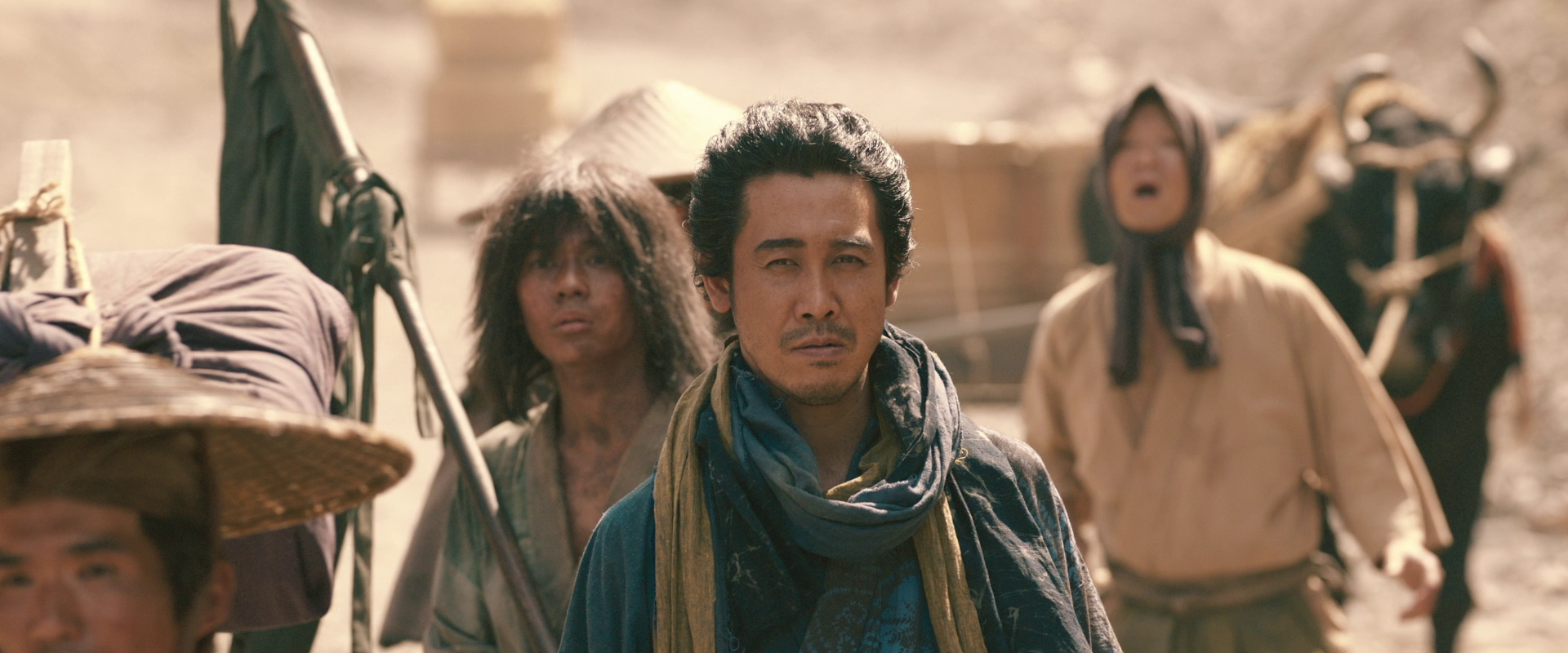
One day, Doken Honekawa (Shinichi Tsutsumi), the leader of governmental police organization of the Shogunate, calls Hyoe Hasuda (Yo Ozumi), a ronin, to ask him to put a stop to the planned uprising by the carters of Kawachi province. Doken, fearing that too much unrest will jeopardize his rise in the ranks, eventually agrees to pay Hyoe 600 mon and give him their prisoner, Saizo (Kento Nagao). After seeing how Hyoe deals with the situation, Saizo wants nothing more than follow in his footsteps and become a warrior. Hyoe accepts, on the condition that he gives him one year of his life, and introduces him to Goro (Akira Emoto), on old man who will train him.
One problem many narratives based on historical events struggle with is to strike a perfect balance between offering the spectator a simple but inviting narrative backbone and introducing him to the more complex elements of the historical context. Yu Irie does remarkable well in striking such balance with his ensemble period drama Samurai Fury. The spectator can easily orient himself in the narrative via trajectory of Hyoe and Saizo in this period of social unrest and exploitation. And while the spectator might feel somewhat at a loss about the role certain characters play and the nature of some relationships, merely paying attention to subtle visual indications and the signifiers enunciated by the various characters will allow him – irrespective is he has prior knowledge or not concerning Japanese history – to piece the contextual frame together.
In the opening stages of Samurai Fury, the spectator is introduced to an oppressive and exploitative societal system, a system that radically dehumanizes and exploits the farmers and the carters. The violence the commoners are subjected to does not only signal the unwillingness of the shogunate to reevaluate their life-style in times of famine and epidemics, but also reiterates the fact that these commoners, deemed beyond Buddhistic liberation, are merely seen as insect-like objects that (financially and physically) support their cultural and religious extravagance.
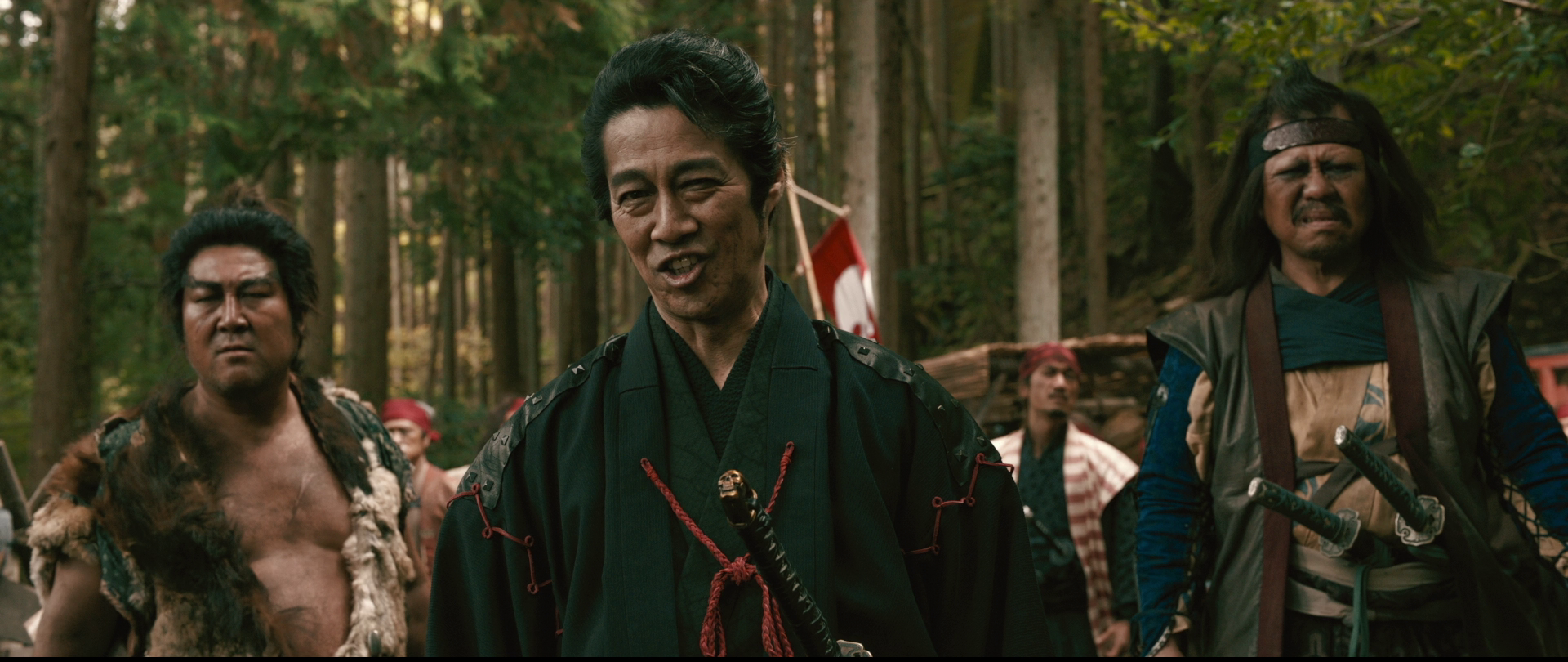
The discussion at the shogun’s court illustrates this point beautifully. Not only is there a misplaced focus on cultural and esthetical creation – i.e. the shogun Ashikaga Yoshimasa (Aoi Nakamura) wants flowers instead of a large stone in the pond – but the plea to do something about the famine is brushed off by emphasizing that the exploited object, the object that forms the foundation of their cultural life-style, is not exploited enough – “We will simply demand new taxes.” – and will, without any political intervention, continue to reproduce “(…) like little insects; even when you step on them, they still release fat”. The emphasis on cultural productions functions as a disavowing defence against the brutal reality of the commoner and the search for aesthetic beauty a self-indulgent attempt to dehumanize the lower castes and avoid (dealing with) the ugliness that supports their culturally refined life-style.
As the shogunate – lord Nawa (Kazuki Kitamura) included – continues to squeeze the farmers, blindly imposing their taxes and tariffs, the poor people are pushed into the ‘compassionate’ hands of the Buddhist monks who willingly lend them money. Sadly, those compassionate hands are also out to take advantage of the farmer’s radical dependency – “To pay [the borrowed] back, we would have to sell our daughters”.
The installation of a radical dynamic of financial dependency corrupts the monks; the guardians of the merciful Enryaku-ji monastery, led by pawn-broker Monk Gyoshin (Hiroki Miyake), betray and pervert the Tendai-Buddhistic path to salvation –Parinirvana is far away – to seek pleasure and moral gratification in exploiting the poor (General-note 1, Narra-note 2). However, make no mistake, what intoxicates them and leads them astray is the simple fact that they have some political power under the Ashikaga Shogunate.
Doken’s attack on the ‘perverted blood-sucking’ monks might be interpreted by some spectators as a sign of his desire to uphold the law of the shogunate – to reign in the perverted desire of the monks, but the covert way the attack is carried out – they are masked – and Doken’s emphasis on his personal ambition in his conversation with Hyoe underlines that he merely seeks to utilize the law to exploit the ‘exploiting transgressors’ for his own personal gain.
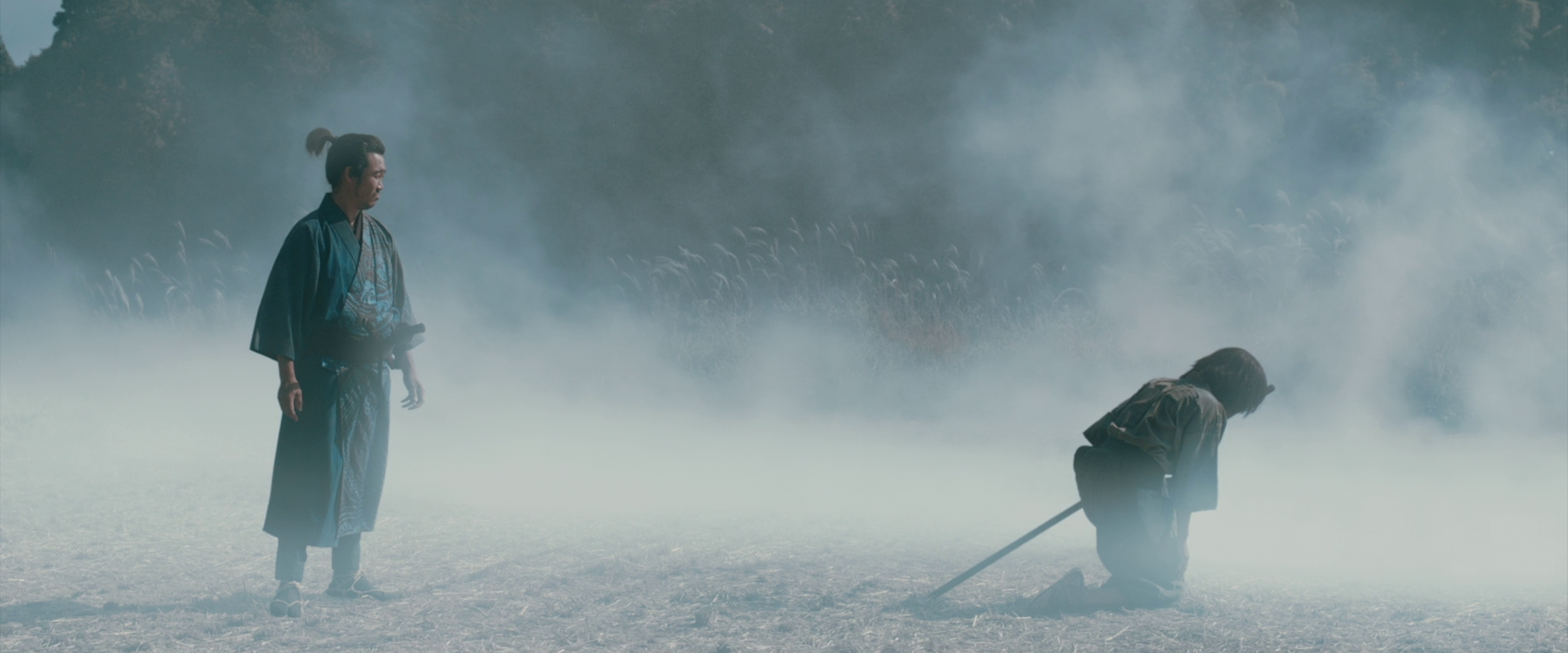
Hyoe is introduced, from the get-go, as someone who refuses to play the game of exploitation nor gambles with the lives of others to re-inscribe himself in a position of power within the social order. This refusal is evident in his acts of compassionate kindness – i.e. giving food and some of his clothes to a mother and her child, giving the money he robbed from the tariff station to the poor farmers, giving jewels from Kyoto to the women of the village – and his supportive signifiers he grants the farmers. What sets him apart from the rest is not merely that he acknowledges the suffering of farmers, but that he refuses to accept this suffering as their societal duty nor as the materialisation of their religious destiny.
Yu Irie offers the spectator an engaging composition not only crafting a pleasing and fluid blend of static and dynamics shots, but also because he interweaves moments of compositional beauty into his visual fabric. While some of these moments are due to his use of tracking shots, others are born from the encounter between the act of composing and natural landscapes these compositions seek to frame.
Irie frames his action-sequences in a rather detached way, relying on restrained dynamism and favouring wide and medium shots. By opting for such kind of framing, he does not only turn the spectator into a passive witness of the on-screen violence, but enables him to follow the action-choreographies with ease.
However, Yu Irie often seeks to overturn the spectator’s passive position by inserting fleeting moments of shaky framing within his sword-fighting sequences. The first time that Irie lets shakiness enter the frame, fleetingly implicating the spectator in the on-screen action, is to signal the appearance of one of the main characters, Saizo, and to invite the spectator to sympathize with his acts and signifiers. The second time he turns to shakiness has a similar aim: to invite the spectator to sympathize with Hyoe’s righteous violence and the stylish way he cuts-down the pions of the corrupt governmental system (Cine-note 1).
Yu Irie also utilizes different compositional techniques to invite the spectator to assume, in a phantasmatic way, the position of Saizo within the narrative – from imprisoned zero to a hero equal to Hyoe. During Saizo’s training-sequence, for instance, Irie does not merely harmonize the compositional flow with the rhythm of the action, but also features many close-ups to pull the spectator into the action and strengthen his agreement with violence as tool to instigate social change. Later in the narrative, he interweaves displaced POV-shots to fleetingly align the spectator with the movement of Saizo’s hands and the impact of the Bo-staff on his adversaries.
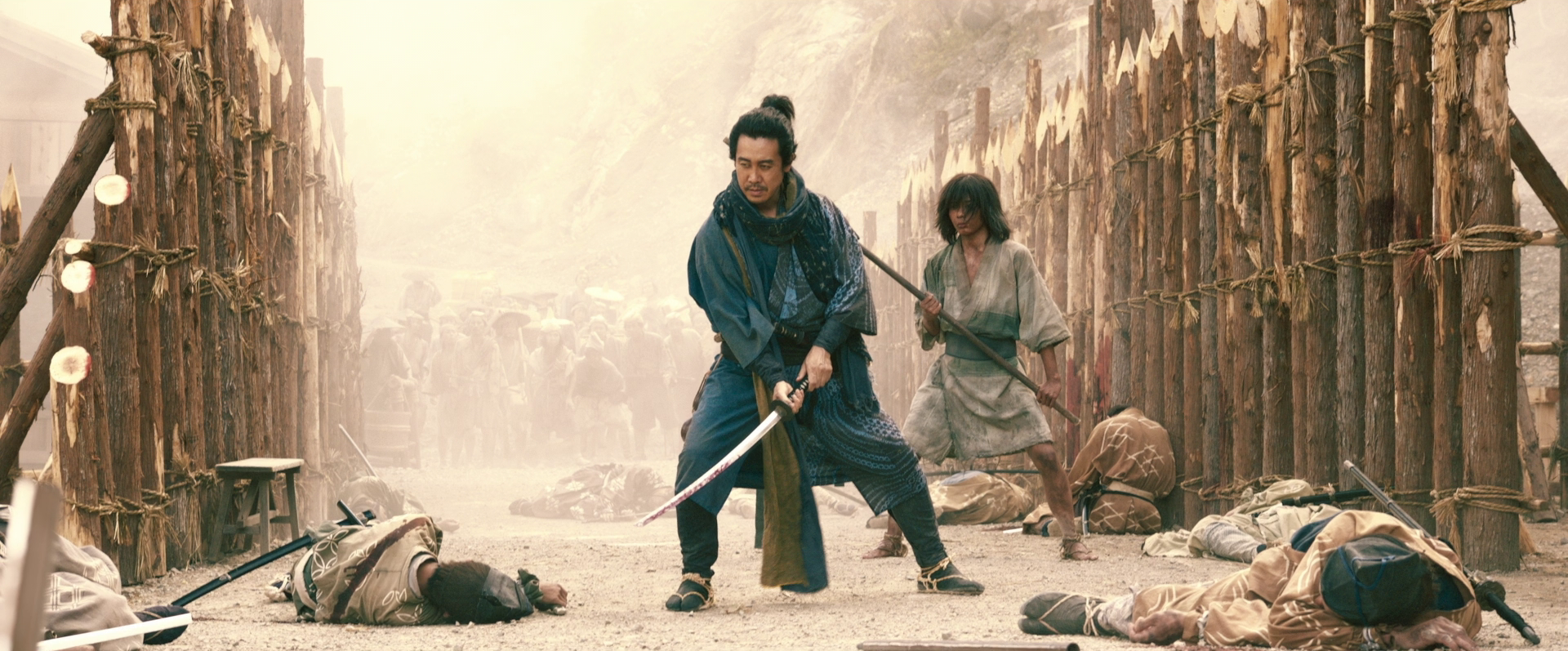
We also want to commend Yu Irie for taking the time to add ‘cool’ decorative elements within the action choreographies – e.g. the diagonally sliced bamboo, Hyoe’s reflection in a broken katana, Saizo’s jump (Cine-note 2). Many directors nowadays forget that, when integrated well into the flow of action, these moments elevate the overall impact of the action by giving (male) spectators visual fragments to satisfy their unconscious ‘phallic-heroic’ fantasy.
Yo Oizumi might, at first glance, not seem like the best choice to portray a character like Hyoe, but Oizumi dispels any initial misgivings with his performance. He surprises the spectator with his commanding presence, which gives his character’s moral integrity real gravitas, and delivers the charisma necessary for a figure to be able to function as the leader of a rebellion.
The character that might cause some irritation for some spectators is Saizo. It is not that Kento Nagao gives a bad performance – far from it, but his childish deference and comical eagerness towards Hyoe – the truth of owning him his life echoes constantly throughout his signifiers – might not sit well with some spectators and hinder their attempt to engage with the narrative. Luckily, any annoyance the spectator might have is washed away by Irie’s satisfying staging of his action-sequences.
Another element that some spectators might struggle with is the eclectic selection of music. Within the first half of the narrative, Yu Irie echoes the western-trope-like opposition between a (lone) ‘righteous’ wanderer and a ‘corrupt’ law enforcer with various pieces of western-like music. While the spectator can accept these musical pieces, as they echo the fact the structure of Samurai Fury resembles a common narrative opposition of Western films, he might struggle to accept Irie’s other musical choices, e.g. the electronic musical pieces that aim to underline the cool heroism that marks those who take part in the uprising. As Irie’s musical experimenting births a cacophony that sabotages rather than enhances the emotional flow of the finale, a more streamlined and consistent approach to music would have improved the finale’s impact.
With Samurai Fury, Yu Irie delivers a samurai narrative that, while not able to match the masterpieces of the genre, offers everything fans have come to expect from the genre. While the narrative set-up might be tad too familiar and the staging a little bit too emotionally flat, Irie’s choice to echo the Western narrative trope that structures his historically inspired fantasy through western musical pieces gives the unfolding of Hyoe and Saizo’s heroic resistance a refreshing tinge. For spectators who prefer their period drama to colour within the well-established contours of the genre, on the other hand, this unconventional choice of music will leave a bad taste in their mouth.

Notes
General-note 1: While Samurai Fury is Yu Irie’s firstperiod drama film, it is not his first try in the genre.In 2015, he directed the mini-series Futagashira (2015) and, in 2016, with the help of Ryo Yoshida its follow-up Futagashira 2 (2016). It will not come as a surprise that both the series and his first period film have some thematical overlap.
Narra-note 1: Honekawa underlines that the monks entrap commoners into a prison of exploitation by lending them money. Their inability to repay said loan with coin is then exploited to seize their property or take their wives and daughters.
The shogunate, on the other hand, exploits the commoners’ inability to pay their taxes to force them to pay with their ‘labour’, their body, and, if things go wrong, even with their life. They also prey on the common folk – exploiting the law to squeeze them dry in support of their life-style – by installing an excess of customs-duty stations.
General-note 1: One of the core tenets of Tendai Buddhism is called the Ekayāna, the teaching that all beings possess Buddha-nature and that the true path to enlightenment is open to everyone regardless of status.
Narra-note 2: The later revelation that the monks resorted to money-lending to be able to pay the tribute to the shogunate is but a frail excuse and does not explain the pleasure the monks sought by exploiting the poor commoners.
Cine-note 1: In the finale, Irie utilizes shaky framing to emphasize the chaotic way of the clash between the commoners, the monks, and the samurai.
Cine-note 2: In some cases, Irie heightens the coolness of certain action-movies by utilizing slow motion.
 psychocinema