Political cinema has a long history in Japan. In the period leading up the second-world war, cinema was utilized to support and propagate the Nationalistic-imperialistic narrative. In the late fifties, certain directors transformed the more socially conscious post-war cinema in a true political and confrontational tool – exploring state oppression, nationalism and sexuality as a radical political force (e.g. Nagisa Oshima’s Diary of a Shinjuku Thief (1968) and Death By Hanging (1968), and Susume Hani’s Happy End (1967)).
After the wave of explicit political cinema subsided, director started to deal with political themes in a more implicit way. Rather than crafting filmic attacks in form and content, directors signalled societal and political problems by exploring the disruptive effects of certain societal dynamics on the subject and his relationships with others. In contemporary cinema, directors continue to prefer this implicit style – delivering precise yet roundabout attacks on the societal and political system (e.g. Hirokazu Kore-eda‘s Shoplifters (2018)).
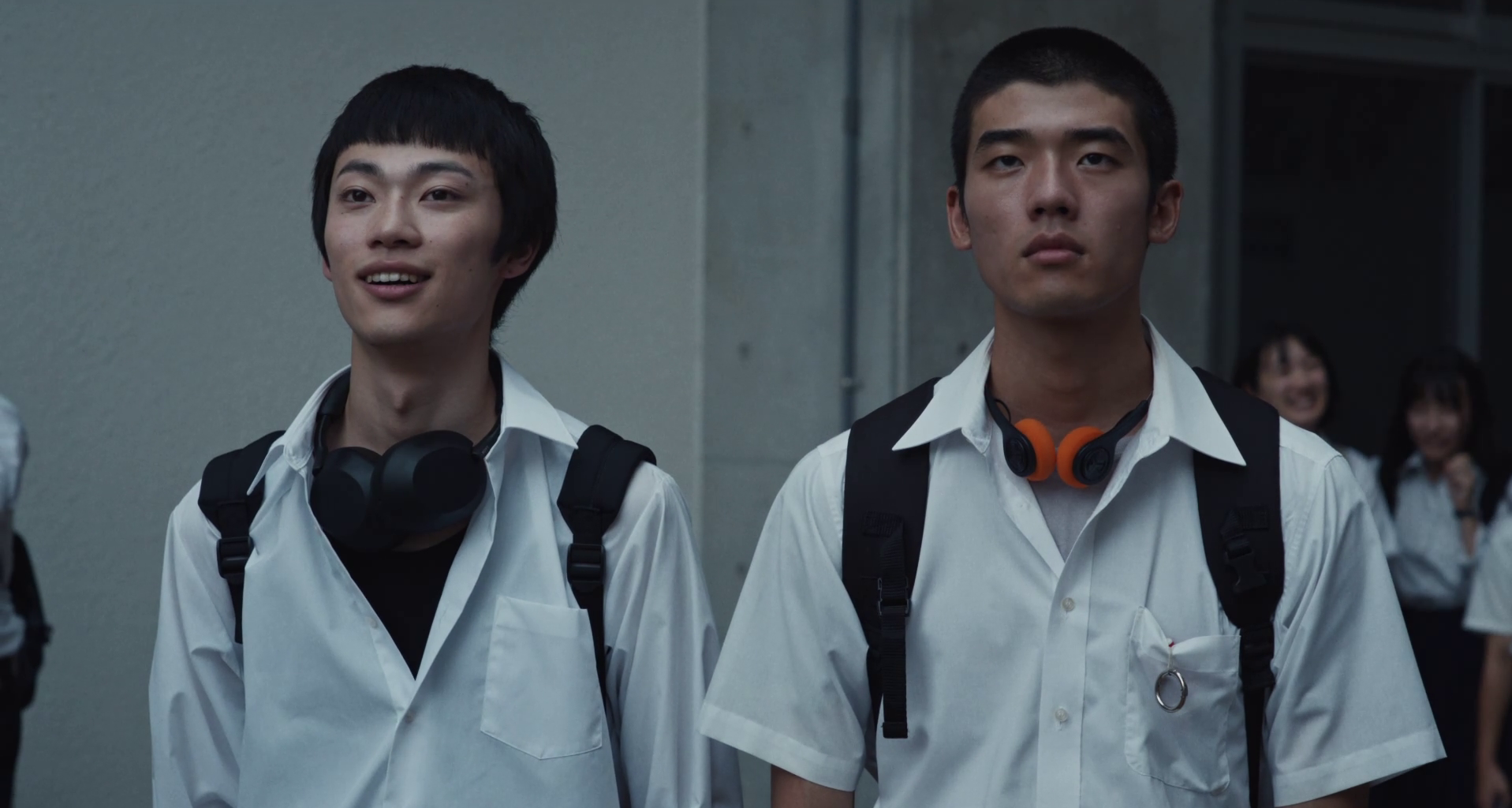
Neo Sora, however, seeks to deliver a more politically explicit narrative with HappyEnd, his first feature film. Yet, rather than emulating the formal and narrative radicality of the Japanese New Wave, he opts to explore his themes – the tension between safety, law, and freedom – by explicitly staging the political shift and, then, trace out its effects – the concrete effects of political discourses. Neo Sora, by exploring the concrete effects of political statements and decisions, delivers an accessible yet confrontational film, a film that, given the recent shifts in Japanese politics, became even more pertinent.
Neo Sora’s narrative takes place in the near future. A widespread fear of a devastating earthquake has the nation in its grip. In part to assuage the public’s lingering fear, Prime minister Kito (Shunsaku Yajima) announces the acceptance of the emergency decree, a decree that would expand the direct power of the governmental body in case of emergencies.
One night, Tomu (ARAZI), Kou (Yukito Hidaka), Yuta (Hayato Kurihara), Ata-chan (Yuta Hayashi) and Ming (Shina Peng), the five members of the music research club, sneak into the school building to have a party in their club-room. Later that night, Yuta convinces Kou to prank the principal (Shiro Sano) by doing something with his car, his phallic status symbol.

Neo Sora opens his HappyEnd with an evocative epigraph – “Getting annoyed with the enforcers of old frameworks. Weathered buildings creak louder. A Japan were the systems that categorize people are crumbling down. Something big is going to change”. The director does not only make his position towards the Japanese political Other explicit from the get-go, but also invites the spectator to view the unfolding of the narrative in light of these politically-charged signifiers.
The first task Neo Sora throws at the spectator concerns the interpretation of the act that, de facto, sets the narrative in motion: the vertical balancing of the principal’s car by Kou and Yuta. While our friends merely seek to commit a bit of frivolous mischief, their act, unintentionally, sorts a political effect. Their artful intervention is, from the perspective of the Other, a distasteful attack on authority, on those who represent the Other and the specific set of societal ideals, norms, and values that guides the currents of the societal field.
To put it somewhat differently, while Kou and Yuta sought but mere pleasure – a kind of circle-jerking between friends, the exhibitory quality of their stunt has profound symbolic ramifications. Their attack does not only subvert the symbolic couple student – teacher in a playful way, but confronts the principal with his own castration. The vertically-erected car, exhibited as stain within the Other, signals that the principal, as subject, merely dons the garment of authority. Despite being granted the signifier of authority – principal – by the governmental body, he can only truly accede to his symbolic function if the students allow him to designate himself with said-signifier and act in accordance with it (Societal-note 1).
The scene where Ata-chan and Ming voice-over a conversation between Kou and the principal re-affirms their playful refusal/ridiculing of authority and their pleasure in exploiting his position of being, as subject, castrated. Moreover, the sexual signified our witty couple puts in the mouth of the principal exposes the fact that the logic of castration is linked with the complex field of desire and sexuality.

However, their fun little political act has profound consequences. The figure of authority brutally bites back by installing a surveillance system called panopty. This system does not merely turn the principal and his body of teachers into an ever-present oppressive gaze that constantly tracks whether students adhere to societal rules and scores them accordingly, but also attempts to erase the castration that marks those donning the garments of authority. The tightening of control, beyond producing pleasure for those in control, strangles subjective freedom and imposes a strict straight-jacket concerning how one can enjoy. Yet, despite the attempt to totalize control with a strict calculation of obedience, the technological gaze of authority is still marked by blind spots and flaws that can be playfully exploited.
The second bone Neo Sora throws the spectator to chew on concerns the dynamic of racism. In HappyEnd, racism is presented as the dismissive attitude among the public to every subject that does not neatly fit the imaginary ideal of Japaneseness. Anyone who reeks a little bit foreign becomes suspect, suspect of enjoying differently and threatening the societal ‘nationalistic’ fantasy with his Otherness.
Neo Sora exposes the absurd character such racism can attain via the clashes between Kou, a fourth-generation zainichi, and the figures of authority. He is not only immediately classified as a foreigner by a police officer, but the principal exploits the mere idea of him being from “a different demographic [than] a normal Japanese person” to support his conviction that he is involved in the attack on his car (General-note 1). With his retort ‘What is normal?’, Kou does not only expose that normality does not exist, but also shows that the idea of normality is deeply ideological, structured by the set of values, ideals, and norms valued by the cultural Other (Narra-note 1).
Neo Sora also takes the time to shows that Kou is the victim of the xenophobic and nationalistic discourse of the political Other (Narra-note 2). Prime minister Kito does not merely exploit the real threat of a devastating earthquake to reenforce his position of power but also guides the lingering discontent among the people towards the theme of immigration and foreignness. Kito and his army of lawmakers seek to subdue the indeterminate anxiety among the people concerning the threat of the natural Real by granting it a localizable physical object: the foreign element which threatens, with its mere presence, the consistence of the Japanese cultural sphere – “We must take Japan back” (Narra-note 3). However, it must evident that, while certain factual elements are utilized, the image the politicians construct is nothing other than an exaggerated nightmarish fantasy.

HappyEnd shows that this fantasy, assumed by those who believe they fit the tight ideal of Japanese normality, allows these people to enjoy the threatening Otherness within the societal field through discriminatory acts and signifiers. The racist discourse, thus, does not merely produce a localizable object-of-fear for the subject – an object that moors his discontent, but also grants him an object-to-enjoy, a tool to strengthen the consistency of his ego and solidify his belief in the nationalistic fantasy.
So, how should we respond to such oppressive pedagogic and political Other? Neo Sora starts unfolding his answer by introducing the spectator to Fumi (Kilala Inori). She makes herself heard early in the narrative by stating that “The cops are bureaucrats with weapons who protect the [hierarchal structure of the] country and the fortune of wealthy people”. With one swift remark, she exposes the uncomfortable fact that police officers, whose function is to protect citizens and ensure societal order, are sometimes reduced to mere tools to enforce the law of the political Other – the lawmakers – to protect the hierarchal structure and those in power.
Later in the narrative, she laments the fact that people nowadays lack imagination and are consequently unwilling to critically assess the intentions of those in power. While Neo Sora does not explore what causes such luck in imagination in the contemporary subject, we argue that the capitalistic success of giving each his own gadget-of-pleasure is detrimental to the birth of imagination and subdues the subject’s possibility to think about societal change. Capitalism keeps us drunk on consumptive pleasure while aiming to protect and profit from the flows of capital and the capitalistic logic (Narra-note 4).
Through Fumi, Kou is introduced to a group of people, his homeroom teacher Okada (Ayumu Nakajima) included, who fully understand the political quality certain performative acts can attain within the societal field (e.g. protests, … etc.). Inspired by their dismissive attitude towards authority and their blindness to societal injustice, he riles up his friends to defy the rules – the imposed ideal – and the restrictions imposed on producing pleasure (Narra-note 5).

Yet, at the same time, Kou’s attempt to arouse a political consciousness in his friends creates a schism between them. Kou quickly comes to realize that his friends – and especially Yuta – are more firmly stuck within the logic of capitalistic pleasure. They remain wilfully blind to social injustice because they, shaped by capitalistic logic, are concerned with safeguarding their own little pool of pleasure.
Like mentioned in our introduction, Neo Sora’s Happy End is all about the loosening of relational threads arising from the clash between the increased societal control – the increased oppression of the radicalized societal gaze – and the need to choose a path for one’s future, a choice determined by the way one is led to see himself through the lens of the societal Other – the way the societal and the familial Other respond to their given socio-economical reality.
Confronted with these largely unvocalized tensions, the spectator cannot but wonder what the title of the narrative refers to. The strength of HappyEnd lies in the fact that, as the narrative unfolds, the spectator hears the title echo clearer, confronting the spectator with a riddle – What kind of happy end can materialize? – that keeps him glued to his screen.
Despite opting for a straightforward blend between dynamism and static shots, Neo Sora does succeed in satisfying the spectator with a composition that boasts many beautiful visual moments. He does not only put his talent for composition on display – putting the camera where geometrical lines create the most satisfying tensions, but also proves that he has put thought in what kind of shot serves the impact of the narrative best (Colour-note 1).
Neo Sora’s straightforward composition, rather than putting the emphasis on the signifier, invites the spectator to trace the effect of the signifier on the way the subject makes himself present within the societal field. The drama of HappyEnd is, therefore, quite silent, speaking powerfully through the way bodies and subjectivities relate to each other – the flow of distance and closeness.
HappyEnd is an incredible tour-de-force that hits home – confronting the spectator with the threat of the right-wing political Other – (my) safety first, while also sketching the societal dynamic that, in all probability, structures his presence within the societal field (Societal-note 2). Neo Sora’s subdued drama must be seen, now more than ever, as recent political shifts signal that the future is nearer than we think.

Notes:
Societal-note 1: The signifier ‘principal’ denotes a place within a hierarchically-structured network. This network, which we are subjected to, organizes and structures societal bonds. However, at the same time, the distribution of power instigated by signifier-oppositions gives birth to a field of interpersonal abuse – those who assume a function of authority can also abuse their power to manipulate the subjects below him.
Theme-Note 1: that the increased interconnection of subjects through mobile phones, internet, and apps generates data – our digital footprint – that the police can utilize to extract and scrutinize to further their investigation…
General-note 1: Anyone who desires to know more abouthow we understandthe dynamic of discrimination, we gladly refer to our review of The Harbour Lights (2025)
Narra-note 1: The unintended laughter of Koe’s homeroom-teacher in response to his witty remark concerning normality does not only reverberate the fundamental difference between subject, ego, and social function but also emphasizes that anyone who assumes the signifier teacher must also perform this function as an image – an image overlaying the ego – within the network of symbolic couples (teacher-student, teacher-principal, teacher-parent) this assumption inaugurates.
Narra-note 2: The defiant yet artful intervention by Kou and Yuta forms an unintentional echo of the protests that sweep the land, of those who come together to voice their refusal of the autocratic tendencies of the political Other.
Narra-note 3: Kito introduces this association also explicitly on television by stating that history has taught that whenever an earthquake happens illegal foreigners and anti-Japanese groups conduct vicious crimes.
The associative chain of signifiers he introduces – i.e. earthquake – foreigners – Anti-Japanese – crime – does not merely criminalize that what does not fit the Japanese ideal fantasy, but offers an object to the people to moor their floating disquietedness concerning the earthquake and the devastation it will bring.
He transforms, with his xenophobic discourse, vague uneasiness into fear, strengthening social cohesion with fiction while erecting a pretext to grab more power.
Narra-note 4: By approaching the xenophobic right-wing discourse from the perspective of consumptive pleasure and capitalistic logic, we can easily understand that the protection of Japanese culture concerns, first and foremost, the protection of the flows of pleasure the Japanese subject engages in.
However, the emphasis on the threat the foreigner poses to the established ways of enjoyment detracts from the fact that the right-wing Other seeks to profit from the capitalistic system. In other words, the right-wing Other seeks, by proffering such discourses, to obfuscate his own (excessive) enjoyment.
Narra-note 5: However, because their act of thievery happens outside the societal and pedagogic gaze and merely serves to safeguard their own ‘musical’ pleasure, their act lacks any political effect.
Colour-note 1: The film boasts a darkish lightning and colour-design. While this stylistic choice, of course, aims to evoke a certain pessimism concerning the political Other, Neo Sora also utilizes lightning-contrasts to amplify the visual impact of many of his shot-compositions.
Societal-note 2: Neo Sora shows that the contemporary subject is more concerned with safeguarding the little bit of pleasure he is granted by the societal Other. The capitalistic machine douses the subject’s discontent with producing a flood of gadgets and sabotages his ability to transform his dissatisfaction into true political action. The subject finds himself entrapped into a submissive prison of complaining, unable to break out and risk his pleasure for societal justice.
Luckily, some subjects succeed in breaking out of this prison, trying to instigate change that will benefit those who remain wilfully blind or unwilling to accede to an activist position that puts their little pool of pleasure at risk. They realize the hope incapsulated in the film’s epigraph.
 psychocinema
One Comment Add yours