“You have to protect your space from all the violence of this world”
In 2020, Takuya Uchiyama succeeded in impressing audiences all around the world with Sasaki in My Mind. With this film, he offered the spectator a touching account of the importance of the signifier and its nachträglich effects. With his third feature film, he returns to the importance of the signifier to show, with heart rendering precision, how the subjective acceptance of a single signifier can save the subject from succumbing to the tragedies that befall him and the people dear to him.

Uchiyama’s narrative focuses on two brothers: Sohei (Shodai Fukuyama) and Ayato (Hayato Isomura). Ayato, the older brother, is silently struggling to keep the family-owned Karaoke bar open while taking care of their severely-ill mother Asami (Reika Kirishima). While Hinata (Yukino Kishii), his girlfriend, helps whenever she can, her kindness does little to diminish his mental burden. Sohei, on the other hand, has an all-important mixed-martial arts title-match coming up. However, around the time of the wedding party of Yamato (Shota Sometani), a brutal act of violence threatens to change everything.
The Young Strangers opens with a quite evocative concatenation of narrative fragments. Rather than revealing the direction his narrative will take, Uchiyama opts to offer an atmospheric introduction of the characters and their respective subjective position as well as an evocative reveal of the frail nature of the subject’s ego and the relationally supports image of societal harmony. Concerning the latter, Uchiyama shows that, at any given time, the fiction of harmony can be perforated by the bursting forth of subjective frustration – e.g. Ayato lashing out to his ill mother, his clash with police officers.
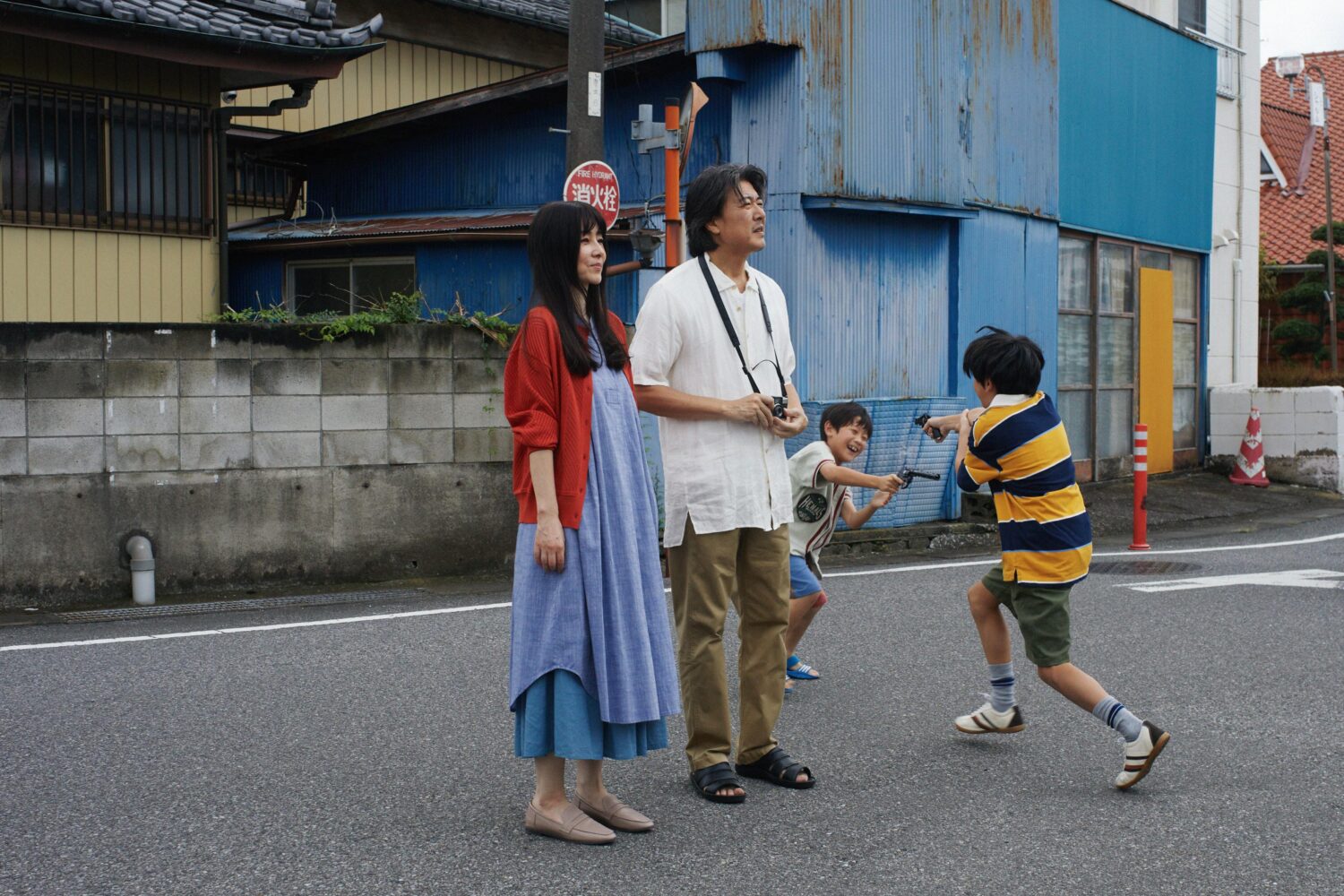
However, the opening sequence culminates in one simple question: Why does Ayato holds feelings of anger towards the Other? Yes, in our view, the clash with the police-officers is not a simply refusal of the law, but an expression of a more general frustration with the societal field he wanders in – for him, the police-officers represent nothing other than the Other who, in a certain sense, refuses him.
With fluidly integrated flashbacks, Uchiyama sketches out the uncomfortable truth with painful precision, bathing the spectator in the sudden change in the familial atmosphere – from sunny familial times to accumulation of dark suffocating financial clouds called forth by the behaviour of their father (Kosuke Toyohara). The flashbacks give the spectator an evocative taste of the subjective impact conflictual parental relations and traumatic familial events can have on subjectivity and how such destabilizing familial typhoon affects the way subjects seek to give their life some kind of meaning.
The emphasis on police misconduct – the way in which representatives of the law can subtly abuse their power – signals that, at some level, Uchiyama’s narrative deals with the way the Japanese Other fails its subjects. In this sense, The Young Strangers is not merely a familial drama but a drama of the Other who keeps its subjects strangers, of the failure of the Other (e.g. police officers, doctors, … etc.) to acknowledge the inner turmoil of subjects and provide mooring sites to guide the subject’s troubled wandering within his field.
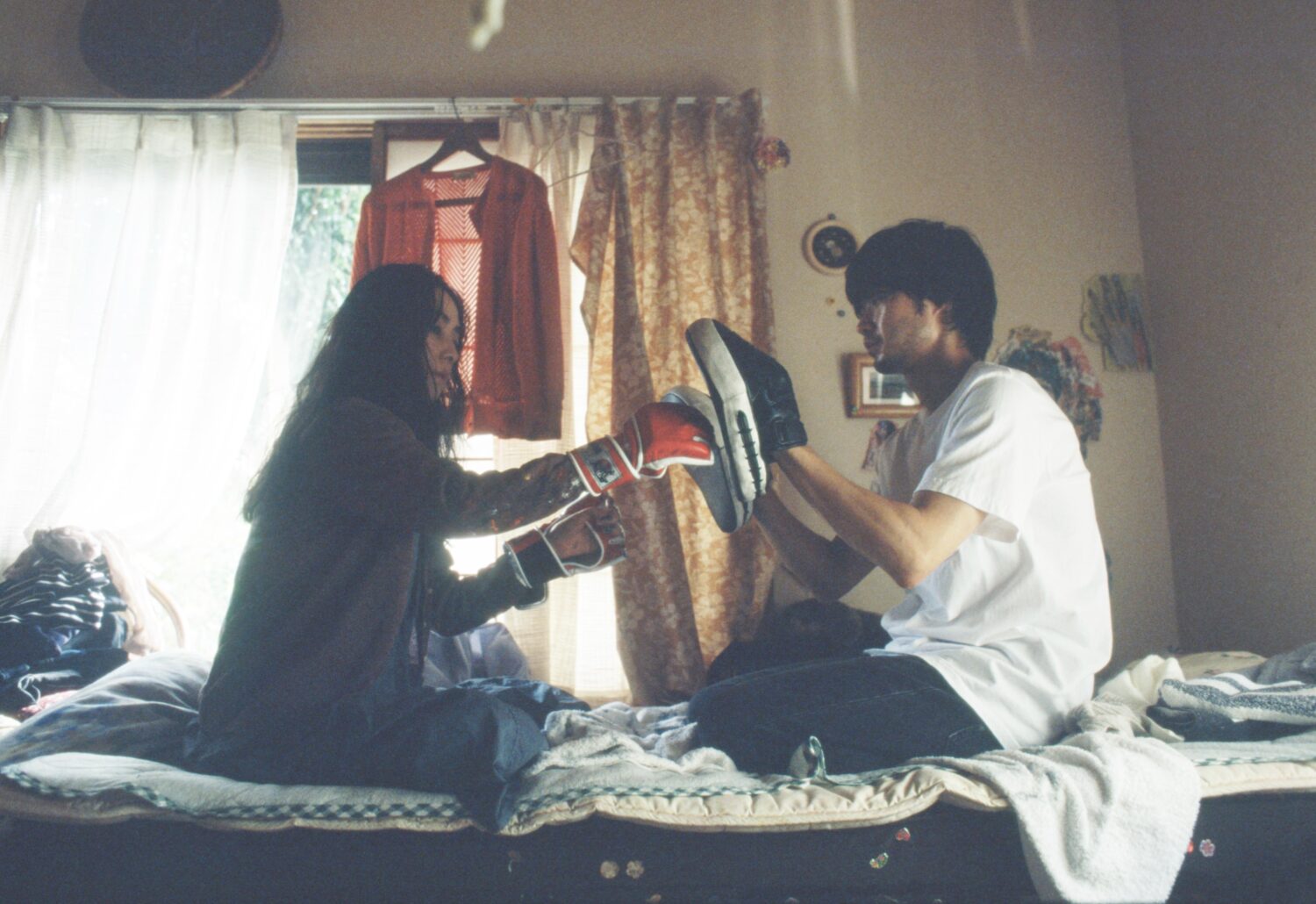
However, via the trajectory of Sohei, The Young Strangers also offers a touching account of how a subject, despite all the setbacks, can still find an aim for himself, hold on to a light – a tangle of signifiers – that organizes what has been disorganized by the (familial) Other. To put it differently, Uchiyama corroborates the fact that even a failed parental Other can grant the subject the necessary signifiers to avoid succumbing to his failure and its disruptive repercussions (Narra-note 1).
Uchiyama utilizes dynamism in a truly effective manner in his composition. He often lets his camera slowly linger throughout the narrative space – circling around his characters, or zoom in or out at a measured pace. With this creative choice, which decreases the need for cutting, he invites the spectator to inhale the atmosphere of the given space – to take all the visual peculiarities of the narrative space that envelops the characters in and grasp something of the relational dynamics on display.
This kind of lingering, moreover, infuses a subtle sense of ‘reality’ into the fiction, tasking the cast to continue to stay in character even when the cinematic gaze is gone. In other words, by utilizing such dynamism the spectator is made aware that, even when the cinematic gaze moves away, the unseen characters remain present and the spatial dimension of the narrative space does not collapse.

Uchiyama, of course, interweaves static shots within his composition. While the short snapshot-like static shots merely aim to add some variety to the measured visual flow, Uchiyama also utilizes static long takes to invite the spectator to breath in the presence of certain characters – to read the rhythm of his emotional expressions, acts, and signifiers (Cine-note 1). Later, in the narrative, shaky shots appear within the visual flow to support the dramatic turns and amplify the impact of the emotions pouring out as signifier are enunciated and acts are performed.
The emotional potency of Uchiyama’s narrative is also function of the way the narrative unfolds, via the concatenation of naturally flowing conversations. Conversations within The Young Strangers unravel via an ebb and flow of pauses, hesitations, and forcefully elided signifiers. The talented cast, by bringing this troubled conversational flow genuinely to life, allow Uchiyama to confront the spectator with the fact that the field of speech is both a place where eruptions of subjective frustration happen and a space where subjects continually seek to level the bumps that signal the imminent disruption of the frail imaginary sense of relational and societal harmony.
The Young Strangers does not merely live up to the promise the director showed with Sasaki in My Mind (2020), but surpasses it. Uchiyama delivers a masterpiece that does not merely grab the spectator by his throat, but confronts him with the fundamental importance of the signifier in a heartrending way.

Notes
Narra-note 1: The spectator should read The Young Strangers as an elaboration of the various waysin which one can fail or succeed in “protect[ing one’s] space from all the violence of this world”. Yet, as Uchiyama evocatively shows with his narrative, the dimension of violence is not limited to the external world, but extends the psyche – the way subjects react with the disturbances in the Other and deal with its effects subjectively.
Cine-note 1: In some cases, the static long take is not entirely static. To shift perspectives, from one character to another, Uchiyama often introduces a fleeting moment of dynamism.
This stylistic choice reaffirms Uchiyama’s attempt to keep the spectator conscious of the physical spaces where our characters wander in, where they interact with each other, where they exchange signifiers and perform acts.
Cine-note 2: There are also some fluidly integrated moments of fantasy that echo the given subjective state of the subject who imagines them – i.e. the state of depression and the turmoil caused by guilt.
 psychocinema
One Comment Add yours