While Director Hideo Jojo might not be that well-known among film-fans, there is high possibility that one has seen a movie of his. Since his debut in 2003 – the pink film Married Women Who Want a Taste – he has written and director over 100 films in a variety of genres. Spectators might know him from his two masterpieces On the Edge of Their Seats (2020) and Love Nonetheless (2022) or some of his other narratives To Be Killed by a High School Girl (2022), Twilight Cinema Blues (2023) or Thorns of Beauty (2023).

Given the fact that he dappled in many different genres (e.g. erotic cinema, youth drama, romance narratives, humanist drama), it is quite difficult to determine a thematical line that gives his oeuvre a certain consistency. In his latest film, an adaptation of Tamehito Somei’s novel Warui Natsu, he takes on a social theme – i.e. the state of social welfare within Japanese society, but with a twisted twist.
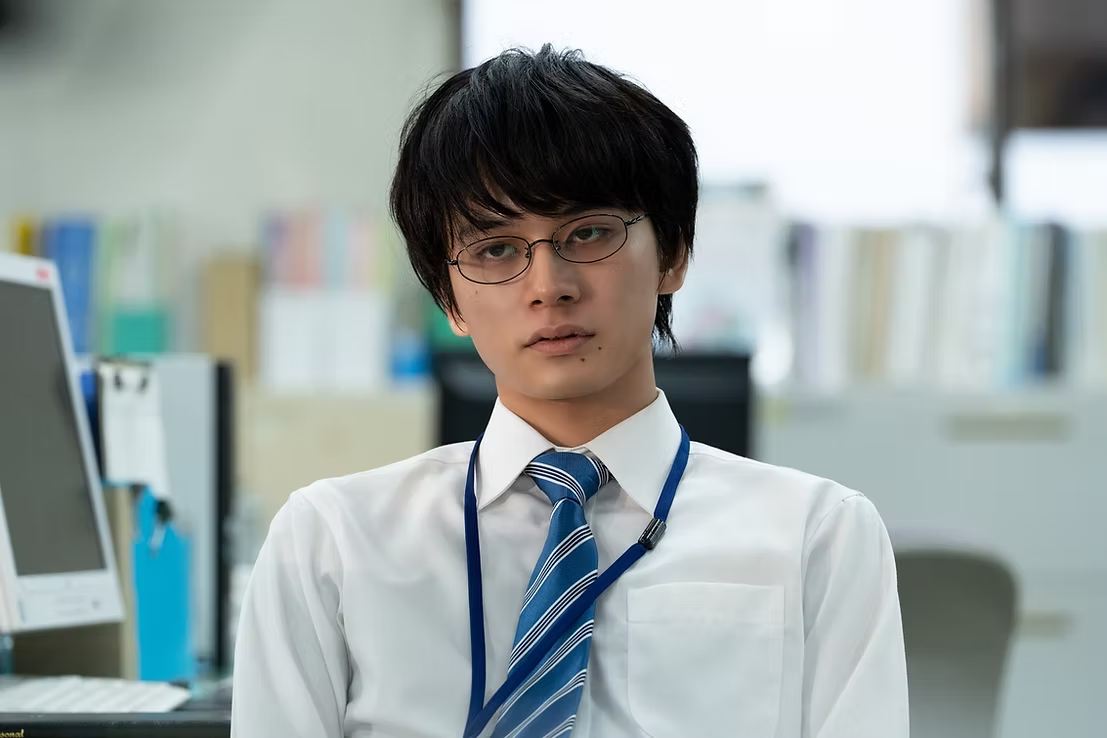
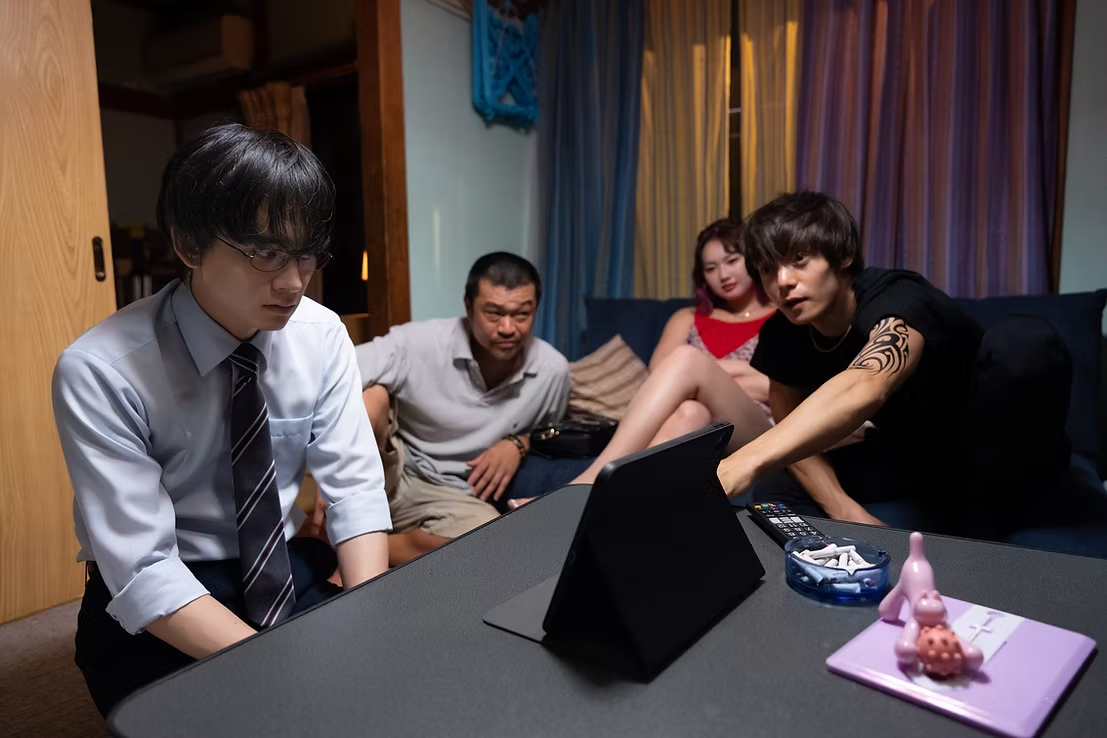
Jojo’s narrative focuses on Mamoru Sasaki (Takumi Kitamura), a case-worker for the life and welfare division of Funaoka City Hall. One of his clients is Yamada (Pistol Takehara), a man who is faking his hernia to stay on welfare while working as a pusher for Ryu Kanemoto (Masataka Kubota), the shady owner of an adult establishment.
Yoji Takano (Katsuya Maiguma), Sasaki’s colleague, exploits his position and power to force single mother Aimi Hayashino (Yuumi Kawai), one of his clients, into giving him sexual favours. Yet, unbeknownst to him, a phone call about his transgressions has reached his colleague Miyata (Mariko Ito), who is adamant in investigating the accusations and make them public once she has enough proof. To make a case against him, she asks Sasaki to help her in her investigation.
Aimi, on the other hand, finally decides to confide in her friend Rika (Yumena Yanai). She forces her to tell Ryu, her boss, about Takano’s exploiting her transgression – working at Ryu’s establishment while being on welfare – for sex and profit.
The opening of A Bad Summer provides the spectator not only a beautiful illustration of the lie, but also a revealing glance at how Freud’s verneinung (i.e. of telling the truth in a negated form) works. By suddenly standing up in fear of the cockroach, Yamada does not only perforate his own lie – I still suffer from a hernia, but also reveals that his explanation as to why he cannot work is but built around two negated subjective truths – It’s not like I enjoy living on welfare; I’m not drinking this ‘cause I want to.
How can we understand Sasaki’s naivety? In more psychoanalytic terms, we can say that Sasaki lets himself be duped by the signifier of the other too easily. He finds himself trapped in the imaginary spiderweb spun by the other subject’s signifiers and is unable or unwilling to perforate this imprisoning image to reach the other as subject. He takes the signifiers of the Other as truth not merely because he is afraid of the Other’s subjectivity, but also because he hesitates to make himself present, a subject, within his interactions with others and take responsibility for his acts and signifiers.
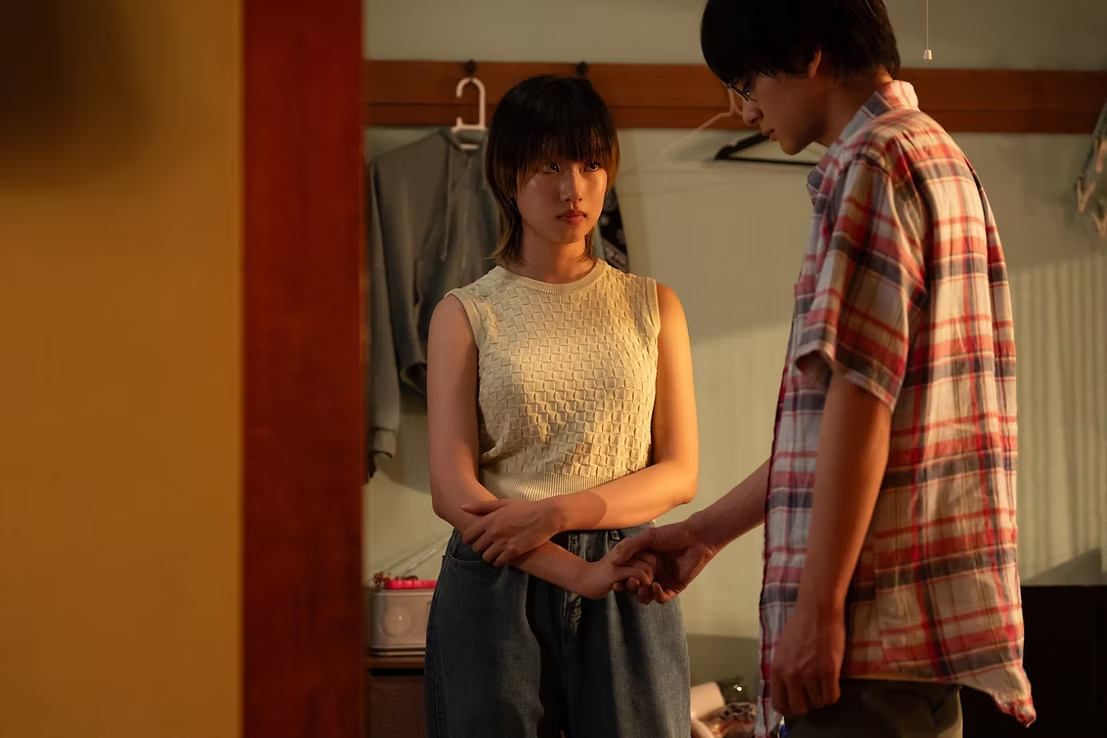
It is important to highlight that Sasaki, as subject, is not a void; he has moments where fragments of his subjectivity burst forth. Yet, in line with his stance as case-worker – with his work-ego, he generally tries his best to immediately diminish the possible impact his subjective signifier might have (Narra-note 1). In other cases, however, he puts his full subject behind his statements, refusing to back down.
Sasaki’s particular stance fits within the general inclination of subjects to remain wilfully blind to certain societal dynamics. People do not want to see the fictive image of a perfectly functioning societal machine perforated, they do not want to accept that all societal systems generate errors and produces exploits. Or, to put it into the words of A Bad Summer, the case workers cannot image – a structural refusal – that people like Ryu would purposefully try to deceive others, concoct a scheme to exploit the welfare system and try to utilize others for their own financial gain. The ultimate point of the narrative is nothing other than the following: the societal field who grants subjects their desire – désir de l’homme est le désir de l’autre – gives the subject a tool to pervert this Other.
It is with such kind of blindness that A Bad Summer plays with, putting Sasaki into a situation where he might or might not fall victim to deception. The two narrative contrasts that result from this play – one between the spectator, who knows what might happen, and Sasaki, who remains blind, and a contrast between Yamada, who wants to profit from the welfare system, and Aimi, who is torn between love and following Yamada’s plan – infuses a subtle yet palpable tension in the interactions between Sasaki and Aimi. It is this tension, which instrumentalizes the opposition between ‘good’ Sasaki and ‘conflicted’ Aimi, that compels the spectator, inducing a fearful anticipation that glues him to the screen. A Bad Summer capitalizing on this narrative tension by delivering a deliciously dramatic finale. However, whether the resolution will satisfy the spectator or not depends heavily on his ability to savour the tinge of theatrical farcicality that slips into the finale.
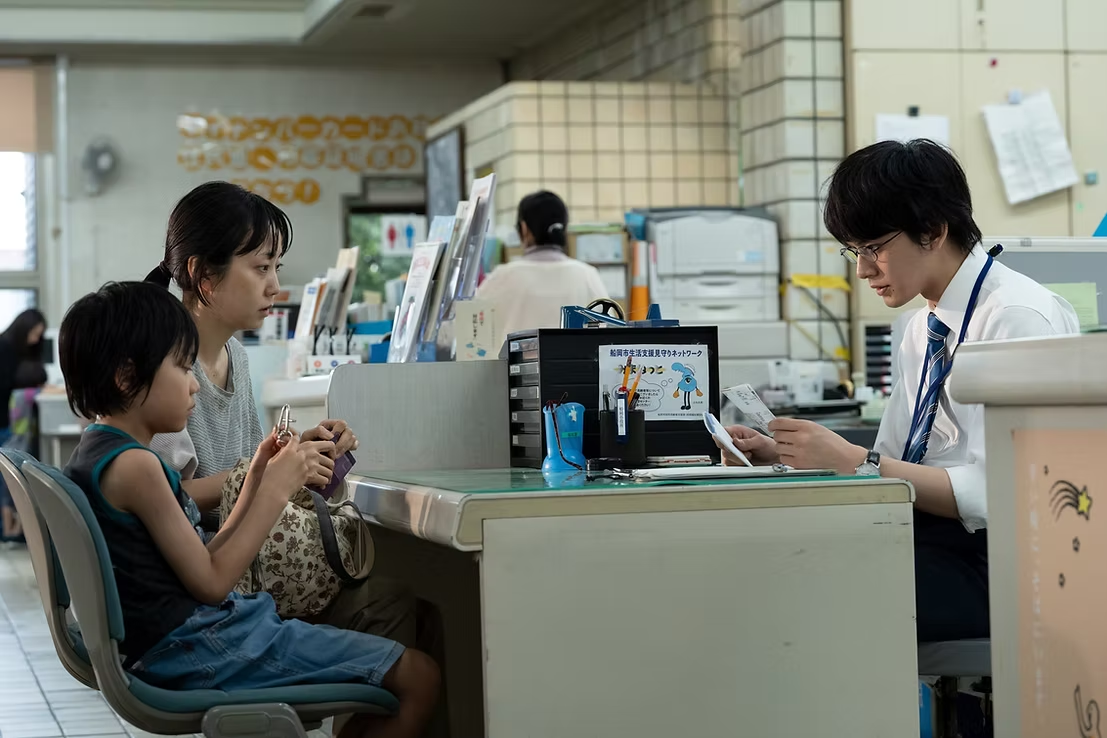
While A Bad Summer is structured around exploiting of the welfare system, Hideo Jojo’s film also offers a chilling glance at what poverty looks like within the Japanese societal field. The narrative threads of Aimi and Kasumi Furukawa (Haruka Kinami), a widow and mother, do not only offer the spectator a glance at pauperized living conditions in Japan and the struggle – and the failure – to make ends meet, but also highlights the fact that, within a conservative capitalistic societal system, women are most vulnerable (Narra-note 2).
The composition of A Bad Summer relies heavily on dynamism – from subtle floating dynamism, tracking movements, to crude framing – to add a dash of realism to the fictional narrative. The camera movement signals, in a certain sense, that some of the narrative fragments have a basis in reality – e.g. subjects hiding their physical recovery to stay on welfare, the continuous fight against the biases against honest welfare recipients among the public (Cine-note 1).
Yet, dynamism is not only utilized to echo the social reality that is touched upon in this fiction, but also to amplify the relational drama, support the rise of tension due to sudden narrative turns, and mirror the crudeness of the language and the acts of violence.
Hideo Jojo also succeeds in bringing the atmosphere of a scorching Japanese summer believable to life via a combination of stylistic choices. He utilizes a yellowish overlay to evoke the persisting heat, decorates his visuals with summer-sounds (e.g. cicada) and interweaves imagery evocative of the season (Sasaki stepping on an empty cicada shell, sweat dripping of his forehead) fluidly into his composition (Cine-note 1, cine-note 2).
What gives A Bad Summer its power to engage the spectator are the performances of Takumi Kitamura and Yuumi Kawai. Kitamura impresses with his convincing portrayal of a subject who desires the good for the other – the spectator feeling genuine sympathy for him – and Yuumi Kawai reaffirms her acting-prowess by staging Aimi’s inner struggle in a very corporeal way.
A Bad Summer offers a compelling exploration of poverty within the Japanese societal field as well as the the structural possibility of exploiting the welfare system for one’s own gain. However, given the serious tone of the narrative, the sudden surge of theatrical farcicality in the finale will be considered by some as a false note that derails the emotional flow and pay-off. Yet, by the same virtue, the finale will linger in many spectators’ mind long after the credits have faded.

Notes
Narra-note 1: In his encounter with Yamada, for instance, Sasaki suddenly lets something of his subjectivity slip – Any job’s better than no job, yet he immediately backs down, refusing to take responsibility for his enunciation and the possible effects it might have on the Other.
In a later encounter with Aimo, he waters down his subjective statement – Please show more affection to Misora – by transforming it into a concatenation of facts, this slowly diminishing the possible effect of his words on Aimi.
Narra-note 2: Jojo also shows that impoverished subjects sometimes utilize their money for their own pleasure or take recourse to stealing to obtain some pleasure. Yet, rather than seeing these as merely irresponsible, we must consider these acts as a direct result of the way their socio-economical situation effects them as subject.
Cine-note 1: There are, of course, static shots within the composition. Yet, there does not seem to be any particular reason why Jojo utilizes static shots, beyond introducing some variety in his concatenation.
Cine-note 2: The various close-ups also help evoking the oppressive quality of the heat and the humidity of a Japanese summer.
Cine-note 3: The yellowish overlay, it must be said, constitutes a stylistic twist of fictionalisation that helps evoke the truth of Japanese summers.
 psychocinema