After impressing audience with his debut, the crime-narrative Joint (2021), Oudai Kojima is finally back to deliver his second feature film. With Flames of The Flower, he does not only zoom in on the relation between subject and Other, but shows how the infraction of the Real uncovers the conflictual dynamic of said relationship.

To embark on this exploration, Kojima and his co-writer Ikken Yamato took the way the Japanese government reported concerning the employment of SDF Forces in South-Sudan as it starting point. Flames of the Flower traces out the trajectory of Tosuke Shimada (Ikken Yamato), a former SDF-soldier who got caught up in a life-threatening incident in South-Sudan during the civil war. While he seemingly has found a certain peace, combining his work at a welding company with dabbling in illegal arms trade, he is still haunted by trauma – intrusive imagery ever ready to invade and destabilize his mind. Things take a turn for the worse, when a sudden association between the present and the past – the welding together of two images of a hammer – compels him to attack one of his colleagues. Some time later, while overseeing an illegal transaction of guns, Shimada happens to see Tadanori Ito (Yohei Matsukado), the captain they left behind while escaping the bullets of the rebels.
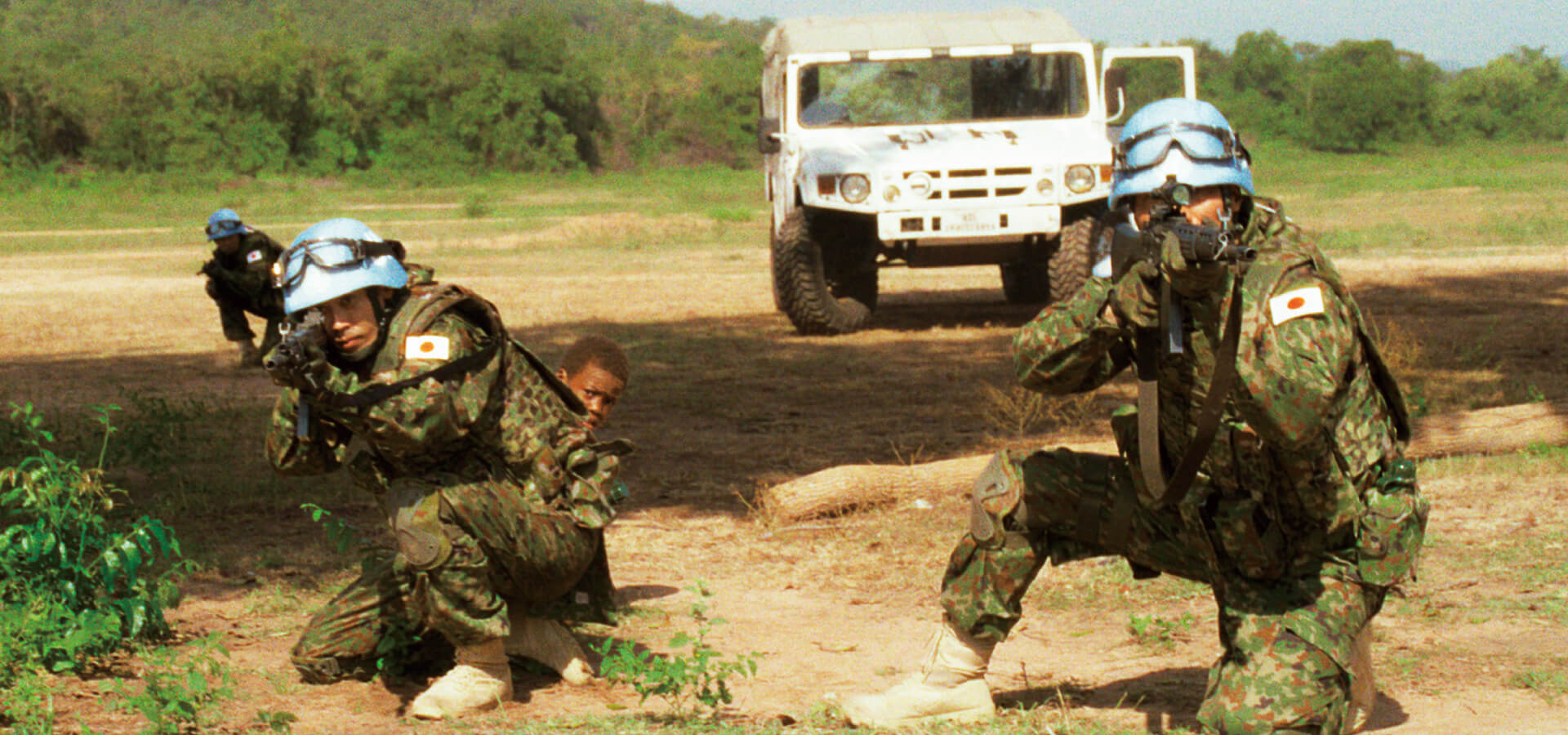
With Flames of the Flower, Oudai Kojima does not merely offer the spectator an intimate portrait of a traumatized subject – someone who has PTSD, but also delivers a biting critique of the political system and its fixation on creating a fiction of harmony, a fiction that serves those in power.
Before delving into the latter, it is necessary that we analyse the subjective backbone of the narrative. To do so, it is first important to explore what caused Shimada’s traumatized state. It is not, as some might assume, the whistling of bullets, the blood splatter, or the sight of a collapsing friend, but the infraction of a real – death – that cracks the ego and plunges him in a radical state of helplessness (general-note 1, Psycho-note 1).
The presence of PTSD is not simply a destabilizing infraction of loosely associated image-fragments, but an internal demand to narrativize what cannot be narrativized – i.e. the intimate presence of death and the associated state of helplessness. However, the fact that the intrusion of certain fragments forces Shimada, as subject, to act is not simply an attempt to master the traumatic real, but a brutal sign that narrativization has radically failed and the traumatic event remains too real within the psyche of the subject.

Via Tanaka (Ippei Tanaka), one of Shimada’s former squad-members, Oudai Kojima signals the presence of another dimension within the psyche of the traumatized: the continued presence of unresolved guilt. While Kojima does not delve deeply into the dynamic of guilt, he nevertheless allows the spectator to perceive that guilt is closely linked with the inability to act.
By following Shimada’s trajectory and his interactions with fireworks craftsman Yoichi Fujii (Masato Ibu), his daughter Akiko (Yurino Yanagi), the florist, and co-worker Yasuda (Yuta Koga), Flames of the Flower emphasizes the importance of social bonds and the advantageous impact of the signifier and transformative potential of the act.
The critique on the (political) Other enters the narrative frame of Flames of A Flower via the character of Captain Tadanori Ito. Via this character, Kojima highlights the simple fact that rebellious thought is function of a growing discontent with the functioning of the governmental apparatus, with the way the government treats its subjects. However, one can also easily perceive that these thoughts of fighting corruption and stopping the capitalistic greed offers subjects, whose purpose has been short-circuited, a renewed direction for their life, a hope-giving chance at attacking what has abandoned them – the political Other. The subject’s turn to such hopeful yet violent rhetoric of changing the country obviously serves to cover up his own unresolved subjective struggle, the void activated by the trauma of the past.

With this narrative thread, Kojima re-affirms that the failure of the Other to deal with trauma and subjectivity leads to tragic consequences. The director, moreover, asks the spectator to reflect on the following questions: What good is a society to its subjects if it propagates peaceful harmony and international stability at all costs? What good is a society that refuses to take the mental well-being of its subjects – e.g. the members of the self-defence-forces – seriously?
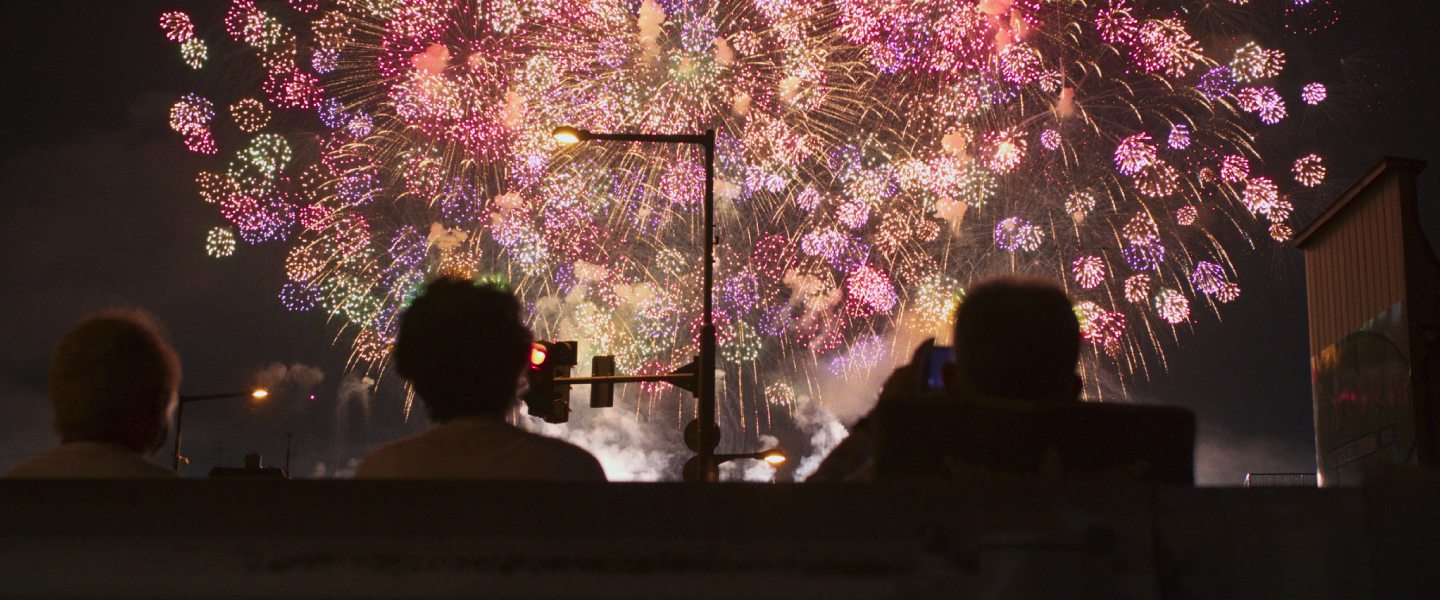
The element of gun-powder functions a powerful signifier within Flames Of The Flower. Gun-powder is not only utilized to contrast conflict and connection – the use gun-powder within the societal field, but also to evoke the choice Shimada must make between keeping the trauma untouched (i.e. the illegal arms business) and embarking on the path of sublimation (i.e. the firework business).
The composition of Flames of A Flower offers a pleasing balance between ‘fictionalizing’ and documentary-styled shots. The former – the static shots as well as the fluid dynamic shots – gives certain moments in the narrative a poetic quality, while the latter is utilized to stage the crude dangerous reality of a country torn by civil war and to reverberate the frail mental state of Shimada who suffers from PTSD after experienced the traumatic event (Cine-note 1).
The darkish lightning-design and the many shots where Shimada’s face is draped in shadows signals the presence of a subject who has not been able to deal with his traumatic past. However, one can also think of this intrusive darkness as evocative of the subjective weight of being forced to be an accomplice to the erasure of the truth within the societal field and to a government who keeps the peace by putting fiction and political relationships first. It is obvious that such order radically hinders the narrativization of the trauma or, as Shimada puts it, the ability to atone.
Flames of The Flower offers a compelling exploration of the divergent ways subjects deal with trauma and the Other that fails to respond adequately. While Oudai Kojima’s narrative is hopeful – highlighting the importance of social bonds for working-through traumatic experiences, it also shows that the way the Other makes itself present can have disastrous consequences. Highly recommended.

Notes:
General-note 1: We want to underline that what we call the “whistling” of bullets is but a dramatic audio effect and not the actual sound of a bullet passing by.
Psycho-note 1: Lacan, in his eleventh seminar, argues that the traumatic is a missed encounter with the real. It is because this encounter is missed that the subject fails to represent the real and can only repeat it, be subjected to compulsion to repeat.
Cine-note 1: While Oudai Kojima utilizes dull non-diegetic sounds to emphasize the presence of danger, he also turns to slow-motion and brisk camera movements to allow the spectator to truly partake in the danger that led to the incident that inaugurates the film’s narrative.
 psychocinema
One Comment Add yours