Isao Yukisada, known from films like Go (2001), Crying Out Love, In the Center of the World (2004) and River’s Edge (2018), is not a director that many would associate with the action genre. Yet, for some reason, Isao took the chance to bring Kyo Nagaura’s hard-boiled novel Revolver Lily (2016) to life on the silver screen.
The narrative takes place in the beginning years of the Taisho period. A group of men forcefully enter the Hosomi family house in search of Kinja Hosomi (Etsushi Toyokawa), an investor. After gaining info concerning his whereabouts from the people present in the house, the boss orders his underlings to murder them and search for his son Shinta (Jinsei Hamura), who managed to elude their grasp.
Upon reading the news of the gruesome murders, Yuri Ozone (Haruka Ayase), a spy who disappeared many years ago to evade those who were after her head, promptly asks attorney Iwami (Hiroki Hasegawa) to help her investigate. She is determined to visit Chichibu; she knows that Tsutsui Kunimatsu (Renji Ishibashi), the deceased man who is framed as the murderer, cannot have done it. By mere chance, Yuri crosses paths with Shinta on the train to Tokyo, rescuing him from the suited-men who were searching for him.

Isao Yukisada’s Revolver Lily is roughly split in two parts, the intensification of the dimension of mystery and the staging of the violent consequences that follow from resolving the initial riddles. The mystery that surrounds the Hosomi murders can be split in two interlocking riddles: the question of what made Kinja Hosomi into a target and his connection with Kunimatsu.
Elements pertaining to the mystery are introduced in such a way that the spectator is slowly pulled into the narrative. First, the spectator is confronted with the improbability of Kunimatsu being a murderer and the erasure of Shinta’s escape in the media. Not much later, it is revealed that Shinta’s pursuers are military personnel and that he has bank-information on his body.
The concatenation of these narrative elements does not entice the spectator with a mystery yet to be solved, but also sketch out the formidable threat Yuri must face and overcome. While the destination to the truth of the mystery remains opaque, the spectator knows that the path to it will be littered with violence. The spectator, confronted with the contrast between Yuri, the lone ex-agent, and her well-organized and well-equipped opponents, cannot but expect an action-rich ride full of thrills and chills.
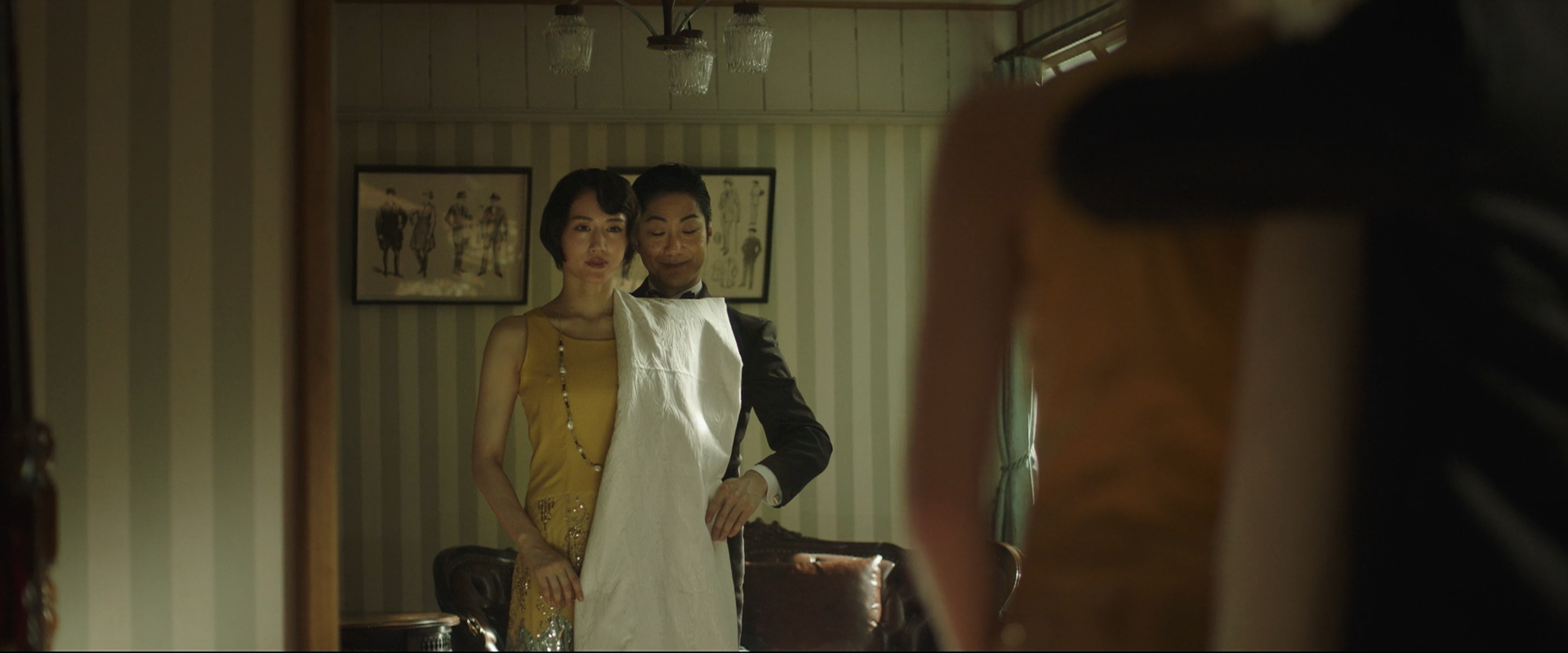
While the first riddle is solved in the first hour of the Revolver Lily, this revelation does not dissipate the tension lingering in the narrative. On the contrary, the reason why Hosomi and his son are targeted by the army and the navy rises the stakes of the narrative and inflame the tension – Yuri finds herself, accidently, caught in a high-stake chase where time is of the essence.
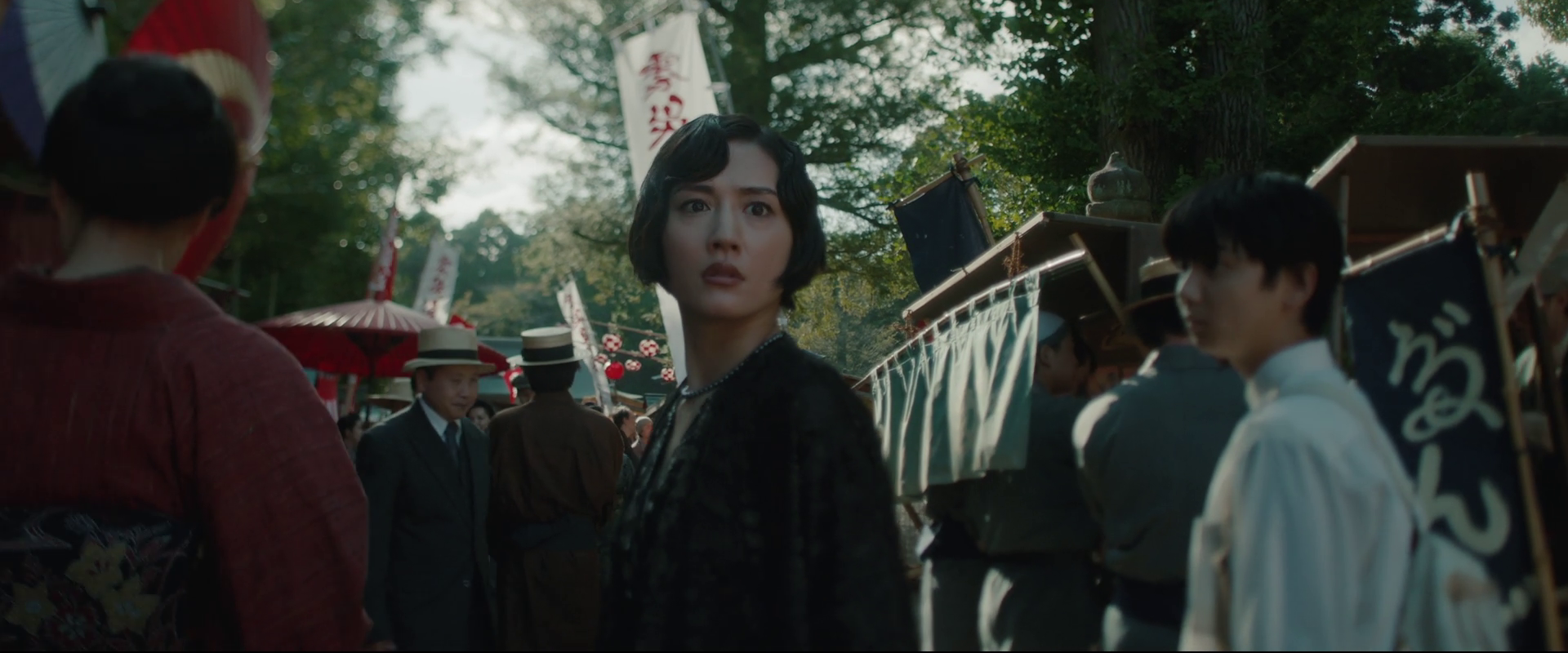
Revolver Lily offers spectators an atmospheric glance at the pre-war societal field – the ‘democratic’ Taisho period. He does not only touch upon the tensive coexistence between western modernity (e.g. suits, trains, cars, western-styled spaces, …) and the ‘fading’ traditionality (e.g. kimono, traditional farming, traditional rooms, …), but also evokes, with subtlety, how traditional ways of interacting structure the assumption of the western image, its cultural elements, and its technology.
Yet, what lingers unverbalized in the background of the narrative is the nationalistic sentiment that was fostered in the Meiji Period to support the first Sino-Japanese War (1894-1895) and the Russo-Japanese War (1904-1905) and would ultimately blossom into the second Sino-Japanese war (1937-1945) and the pacific war (1941-1945).
It is this sentiment that Revolver Lily brutally attacks. Despite all the violence, Yukisada’s film delivers a heartfelt anti-war message – if the desire of the military to invade other countries “continues, Japan will destroy itself”. By inviting the spectator to associate the hypothetical reference to the nation’s destruction with the horrors of Nagasaki and Hiroshima, Yukisada re-affirms the central opposition that organizes his narrative – thirsty imperialism versus economical pacifism – and convinces the spectator to root for those who do not utilize violence to conquer others and to seize their objects, but to pacify the blind thirst for phallic superiority.
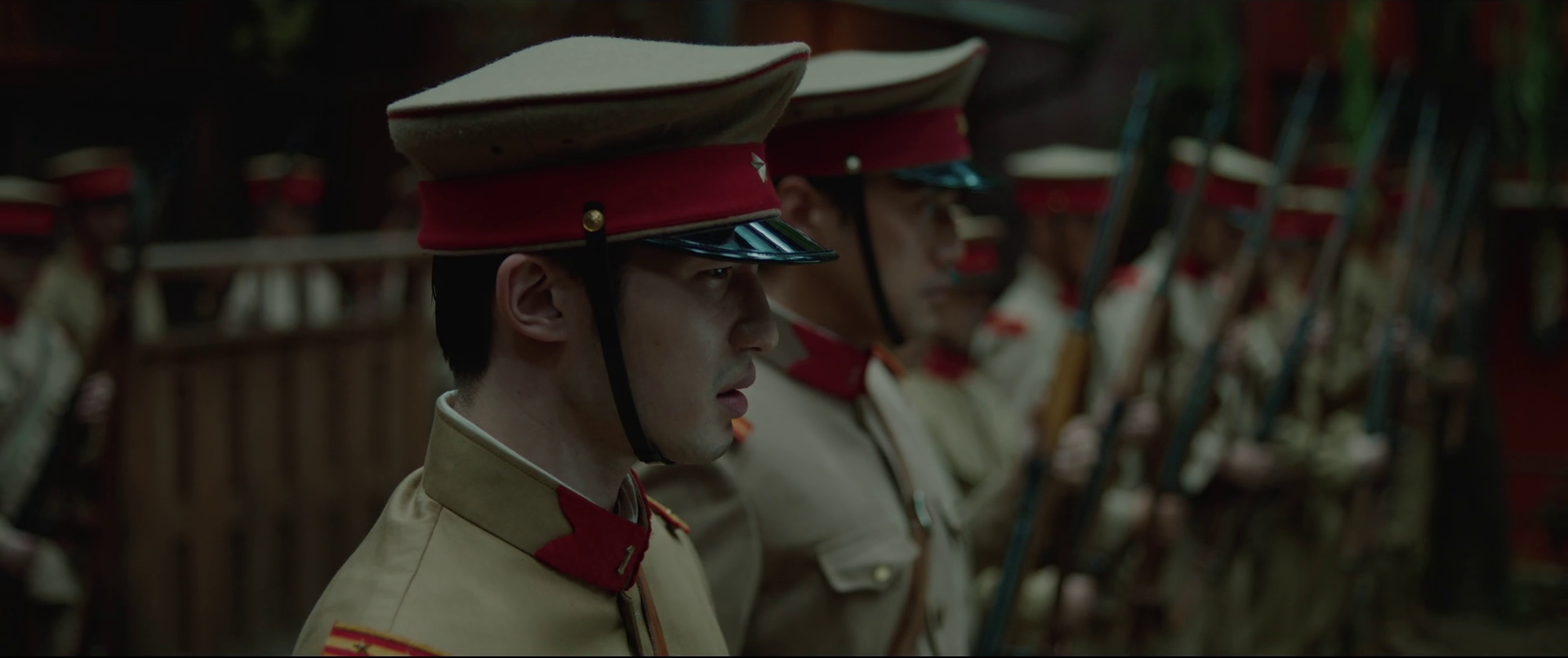
The resolution of the narrative racks up the body-count spectacularly but also delivers a sardonic promise of pacifism. Whatever colonel Yamamoto (Sadao Abe) promises at the end, the spectator knows that he will fail to uphold it – the pacific war will burst forth. Nevertheless, Yukisada’s finale cannot fully satisfy the spectator as the signifiers that bring the narrative to a close will raise more questions than answers. Revolver Lily is, in other words, a fantasy that must be taken at face value – digging deeper will result in questions and force the spectator to enter the rabbit hole of Japanese politics to investigate the dynamic between the military and the government before the second-world war broke out.
The composition of Revolver Lily retains a sense of dynamism throughout. Yukisada offers, as a baseline, a blend of static and slow-moving dynamism. While the latter is utilized to give the composition a minimum quantum of compositional energy, the former is generally used as a form of punctuation – emphasizing certain enunciations, interactions, or emotional expressions – or to grant the spectator a moment of rest by offering him a glance at the visual context – the beauty of the historical narrative space.
Sometimes, the dynamism abates, transforming into a more static concatenation, to stage more tensive sequences, as if to echo the paralysing effects of the sudden intrusion of tension. The compositional stillness is, moreover, exploited to heighten the impact of sudden violent outbursts or its bloody effects.
The framing of the violent encounters blends the best of both worlds, utilizing fluid as well as shaky dynamism to enhance the energy of the choreographed clashes and the shoot-outs and static moments or subtle camera movement to add a delicious dramatic flair to the face-offs and to emphasize violence’s deadly result. In some cases, Yukisada turns the slow-motion decorations to further heighten the drama and accentuate certain unexpected turns in the action-sequences and in the unfolding of the narrative.
The music that accompanies action-sequences does not seek to glorify the action, but to infuse the many moments of violence with a palpable sense of dramatic tension. While the musical pieces as such are impactful, their effectivity is enhanced by the base tension created by the dull threatening pieces that decorate certain ‘ominous’ narrative moments. In fact, the visual unfolding of the narrative is enhanced by an auditive flow where moments of ‘rest’ fuel the anticipation of action and the moments of action offer fleeting moments of abreaction.
The sound-design is utilized in a similar way, as a tool to elegantly support the tension lingering within the atmosphere or to crudely heighten the tension. The brutally loud sound of gun-fire that resounds during Yuri and Shinta’s attempt to escape their pursuers does not merely echo the deadly quality of the bullet, but brutally establishes that the unfolding of Yuri’s story will be fraught with danger and violence – peace is over. The dull sounds of punches as well as the sonorous gun-shooting also elevates the framing of the action. While the violence within Revolver Lily is visually ‘clean’ – only clouds of blood signal the penetration of bullets, the sounds echo the deadly brutality of the skirmishes and the face-offs (Cine-note 1).
Revolver Lily is a very enjoyable action-thriller that succeeds in satisfying the spectator thirsting for exciting action-pieces. However, while Isao Yukisada delivers a consistent and easy-to-understand narrative, spectators who are not well-versed in pre-war politics and the dynamic between the military and the government might feel a bit let down by the film’s resolution (General-note 1).

Notes:
Cine-note 1: There is a bit more effort done to accentuate the impact of violence on characters important to the narrative – e.g. blood on the face, blood spreading on clothes.
General-note 1: The problem Isao Yukisada’s finale runs up against is structural. There is simply no time and space to delve into and explore such difficult and complex matter.
 psychocinema