It does not take long for someone, who searches for interesting manga, to realize that Japan offers an incredible variety of themes and settings. It is thus not surprising that certain writers have turned to the art of manga to fictionalize certain periods of their own life. Tezuka Osamu offered a glimpse into his life as a manga creator with I am a Manga Artist, Kabi Nagata drew her personal struggle with her own sexuality in My Lesbian Experience with Loneliness, and Mariko Kikuchi explored the subjective impact of her alcoholic father in A Life Turned Upside Down: My Dad’s An Alcoholic – her manga was adapted to the silver screen in 2019.

Akiko Higashimura, on the other hand, turned to the autobiographical genre with Blank Canvas (2012-2015) to offer her readers a glance at the formative events that helped her become a professional manga artist. Now, with Kazuaki Seki’s adaptation, Higashimura’s narrative can be enjoyed in a different visual form by audiences (General-note 1).
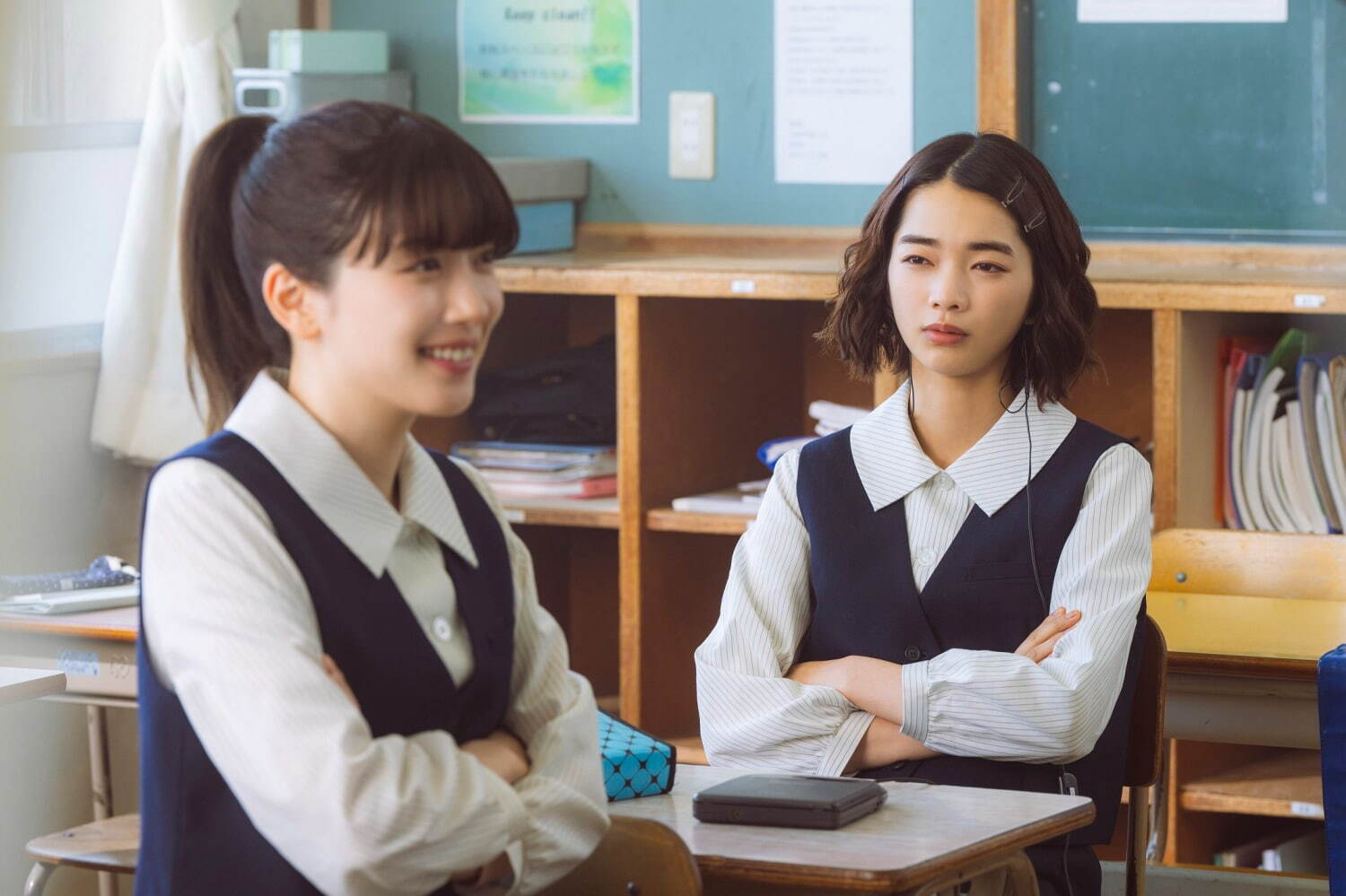
The narrative starts in 2015. Akiko Hayashi (Mei Nagano), a manga artist, has managed to win the grand prize at the 2015 Cartoon Grand Prize with her autobiographical account of her relationship with her mentor Kenzo Hidaka (Yo Oizumi). Yet, the path to become a manga artist was littered with mental and relational obstacles. In her third year of high school, Akiko, fuelled by her childhood dream to become a mangaka, aims to enter an art university. While she wrongly believes she’ll be able to choose which university to enter, she accepts the recommendation by her art club friend Kitami (Mei Hata) to prepare for the entrance exams by taking private lessons with Mr. Hidaka.
Before delving into Blank Canvas: My So-Called Artist’s Journey, we want to emphasize that the act of writing or drawing an autobiography is an act of fictionalization. An autobiography is a fiction because of the simple fact that the writer must twist and cut time, force signifiers to associatively rhyme, and erase what does not fit to create a consistent narrative – the conclusion determines the preceding signifiers. What the writer fictionalizes and simplifies is not, as some might assume, one’s subjective truth, but one’s ego – the consistent image the subject keeps fabricating about oneself (Psycho-note 1).
In this sense, the main character within an autobiographical work does not offer a truthful depiction of the writer’s subjectivity, but a mere beautified reflection of how the writer wants to be seen by the other. However, the subjectivity of the writer does echo itself within the very act of streamlining the trajectory of the ‘beautified’ ego – what is shown and what isn’t – and in fictionalizing significant others into consistent images and simple signifiers (General-note 2).

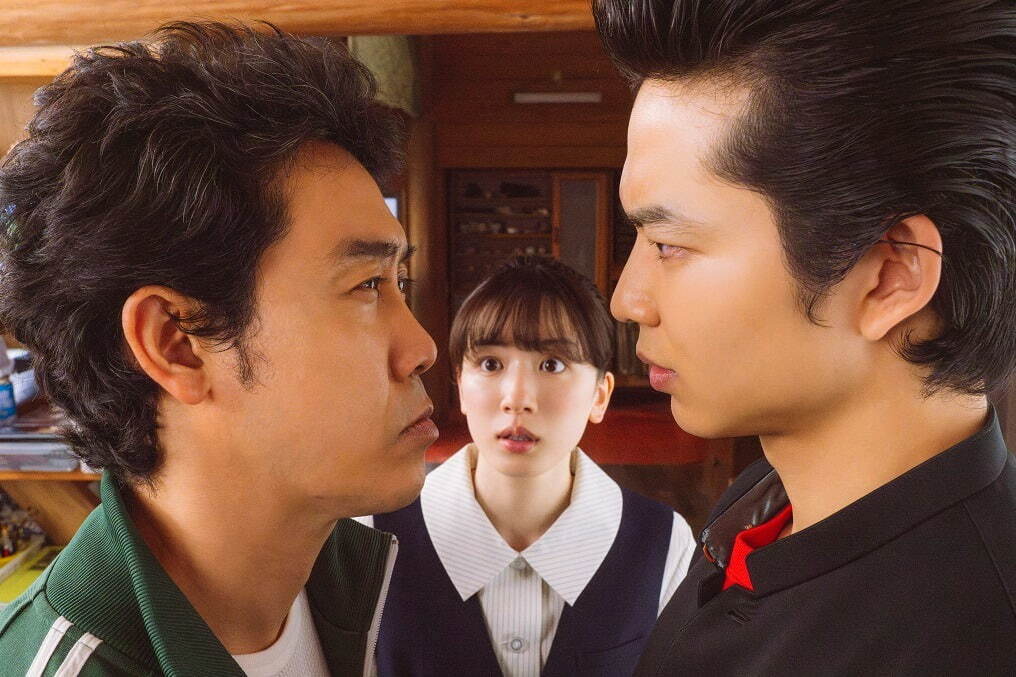
In the case of Blank Canvas: My So-Called Artist’s Journey, the narrative is not only structured around exploring her path of realizing her dream to become a mangaka, but is ordered and organized by the fact that she ultimate became a mangaka. One effect of the final signifier – the determinant – is the reductive framing of the people (e.g. father (Nao Omori), mother (MEGUMI), her art-teacher (Teppei Arita), … etc.) of Miyazaki as happy-go-lucky, as unable to put the desire of the other into question. This light-hearted generalisation is, furthermore, utilized to intensify the presence of Kitami, who is not afraid to question the other, and Hidaka, who is not afraid to confront the other with his honest opinion.
This simple opposition sets the stage for the true subject of this light-hearted autobiographical fantasy: the highly formative yet conflicted encounter between Akiko, who lives happily in a dream concerning his artistic ability, and Hidaka, the brutal art teacher who shatters this happy-go-lucky fantasy with his bamboo sword – shinai. Along the way, Akiko’s formative journey, we meet other characters (e.g. Ima-chan (Jin Suzuki)) that enrich the narrative and echo, in their own way, the effect of Hidaka’s presence on Akiko (Narra-note 1).
The necessary simplification and reduction might damage the truthfulness of Akiko’s autobiographical account, yet it sharpens the emotional backbone of Blank Canvas: My So-Called Artist’s Journey. By associative rhyming signifiers, playing with visual repetition, and adding signifiers who have been left unsaid, Akiko crafted a fiction that, while mutilating factual truth, evokes an emotional truth – one that will resonate with spectators. The phantasmatic finale, which will leave no spectator untouched, proves that the subject can only formulate his half-truth in a fictional form.
The composition of Blank Canvas: My So-Called Artist’s Journey is quite dynamic – dynamism is utilized by Seki to smoothen the flow of the narrative. Seki often exploits static shots to frame the more comical ‘manga’ moments, yet to bring more outlandish comical moments to life the director utilizes decorative tools like slow-motion.
Seki has, moreover, taken the effort to decorate the composition with various visual frills and furbelows. These decorations, while thematically meaningless, support the light-hearted mood of the narrative – matching the spirit of Akiko Higashimura’s autobiographical fantasy, but also pay tribute to the original medium of the narrative.
The inclusion of musical accompaniment, either to support light-hearted moments or to evoke Akiko’s mood, also sorts a fictionalizing effect. The music does not merely sharpen the narrative simplification of the figures around her, but re-emphasizes that, from the perspective of the ego, every other being is but an image – a construct by interpretation. The use of a militaristic drums in the musical pieces in the sequences featuring Mr. Hidaka and his style of teaching, for example, fixes him into the image of a strict yet caring drill-master (Narra-note 2).
Blank Canvas: My So-Called Artist offers audiences a touching fictionaled account of Akiko Higashimura’s relationship with her mentor Kenzo Hidaka. The touching quality of the film is function of the fruitful interaction between the well-crafted structure of signifiers and the effective performances of the cast. While the film does not offer anything new or extraordinary, Seki’s adaptation is nevertheless worth checking out.

Notes:
General-note 1: The screenplay for this adaptation was written by Akiko Higashimura and Date-san. The adaptation of the biographical manga for the silver screen, moreover, constitutes a secondary process of fictionalization.
Psycho-note 1: In this sense, we might even argue that the act of writing an autobiography is a fictionalisation of a personal fiction for the other.
General-note 2: Even though we utilize the signifier ‘beautify’, this does not mean that the subject effaces blemishes to present oneself better than one is. Rather, with this signifier we aim to highlight that the subject creates a consistent image of oneself – beautifying the good as well as the blemishes for the purpose of being able to formulate the final signifier.
Narra-note 1: WhatAkiko introduces as her flaw is the very fact of lacking motivation, an internal pressure that pushes her to draw. She needs an external force to keep her from slacking and force her to draw. Hidaka, in this sense, becomes a sort of externalized super-ego for Akiko – a presence pushing to be internalized.
Yet, behind this flaw lies a different struggle: the abyss of her own creativity, of not knowing what to work-through through art. Yet, for Akiko, the solution lies in exploiting the art of manga to escape the daily grind, the routine that drains her physically and attacks her mental defences. Yet, even so, Hidaka as internalized presence – as a kind of super-ego – still lingers within her mind.
Narra-note 2: Later in the narrative, musical pieces are utilized to explicitly evoke his softer caring side – a care that underpins his strictness, as well as his fixation on seeing the other in his own image.
 psychocinema