Many spectators love a good romance narrative, yet in the last few years these spectators have been left somewhat empty-handed by Japanese cinema. The genre has turned somewhat stale in Japan, revisiting the same tearjerking plot-twists over and over again. While the recycling of these predictable patterns is motivated by the need to evoke the fantasy of the possibility to write the sexual relation for audiences, little has been done to refresh these patterns.

Michihito Fujii, however, has shown that, even by playing with the conventions of the genre, one can offer the fantasy audiences crave for. In The Last Ten Years (2022), he utilizes the incurable disease not as a forced plot-twist but as a truth that radically determines Matsuri Takabayashi’s position with respect to romance. With 18×2 Beyond Youthful Days (2024), on the other hand, Fujii utilizes the dimension of remembrance to touchingly evoke what has never been and never will be.
Another director that is trying to revitalize the ailing romance genre is Satoshi Kimura (Clingy Girlfriend (2018), There Is a Landing on the Stairs (2022), Take Me To Another Planet (2023), This Hamburger Has No Pickles (2024)). With his latest narrative, Yoyogi Johnny, Kimura blends romance with deadpan comedy and character-driven story to offer the spectator a poignant exploration of the difficulty of going for one’s own desire – and, thus, vocalize it to another subject.

Kimura’s narrative commences with Johnny Yoyogi (Kanon) trying to break up with Atsuko (Mio Matsuda). His girlfriend demands an explanation and, through the multiple logical comparisons, he formulates to her that he has not truly worked out what love means and, thus, does not know if what he feels for her can be considered love. Atsuko, however, does not accept his explanation and ultimately refuses to break up.
Around the same time, Mochida (Yoshii Shieru) enters the Squash club in the hope to be able to play with Onodera-senpai (-), yet Batako (Ayano Kato), Father (Rio Takahashi), and Yoyogi Johnny do not know anyone with that name. They, eventually, surmise that Onodera could be Button, who established the squash club two years ago. While talking Mochida realizes that none of members hanging out in the club-room has any inkling on how to play squash – they are merely, to use Father’s words, Squash club room members. Mochida decides to exploit the prolonged absence of Onodera to take charge of the club and force the club-hanging trio to play squash.
Yoyogi Johnny approaches, as the title of Kimura’s narrative underlines, the dimension of love and desire from a character-driven perspective. By approaching romance in this manner, Kimura is not only able to freshen the genre somewhat up, but offer the spectator a glance at the difficulties young subjects struggle with within the current societal field.

Johnny Yoyogi is, as the opening of the narrative sketches out, marked by a subjective emptiness as well as a fear of desire. This emptiness lies at the origin of his struggle to give sense to signifiers like ‘like’ and ‘love’ and live the signified of those signifiers. While he tries to resolve this void of desire by taking recourse to logic – the calculation of meaning, he often runs aground on what does not make sense – the real of the body, the hidden calculus of the unconscious.
The lack of logic and reason within the Other coupled with his barren emotional inner-life turns our protagonist into an indecisive and uncommitted presence within the societal field. Johnny’s indecisiveness is, we would argue, the scansion that structures the entire narrative – e.g. he is unable to decide whether he likes or doesn’t like school, he cannot decide, by himself, which Jelly to buy for Kagura (Runa Ichinose), his shut-in friend, … etc.
Johnny’s problem of desire is cheekily echoed within the revelation that he, before entering the squash club, wanted to establish a fire club, which is, due to safety concerns, impossible. While his idea is outrageous – a dash of absurdity, this fantasy reveals the very thing that he lacks: a spark that would enflame his romantic desire and activate his subjective presence within the societal field.
It is because Johnny is afraid of such a spark that he, as subject, tries to avoid bringing his subjectivity into play. It is not that difficult to perceive that Johnny utilizes demand, apology, agreement, and logic in a way that enables him to avoid being caught within the net of responsibility and remain absent as subject within the signifiers he vocalizes.
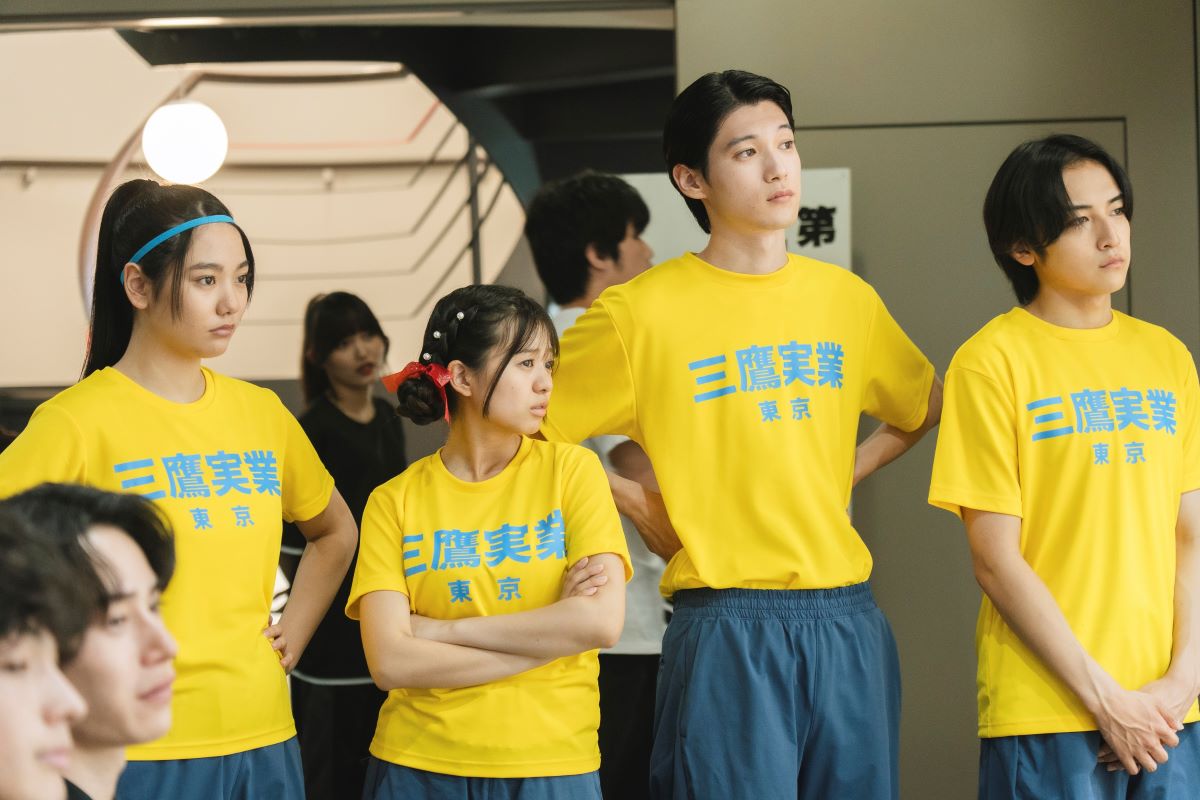
Johnny’s strained relationship with his own subjectivity gives his conversations with others an absurdist twist. While Johnny interacts with others, he never tries to reach the Other’s subjectivity – “If I say they are my friends, it doesn’t matter what they say.” – and, thus, fails to imaginarily bridge the radical misunderstanding that divides the conversing subjects. Even so, the sudden intrusion of Deko, a passionate squash player, and Izumo (Maya Imamori), who has fear of social interactions and physical contact, effects Johnny’s subjectivity. Yet, will it provide him with the necessary spark to restructure his subjective position?
However, Yoyogi Johnny is not simply a narrative that explores the importance of enflaming the fire of one’s desire, but one that underlines the very difficulty of taking one’s desire seriously and breaking out of the safe a-subjective prison one has constructed for oneself. One can only reach the Other if one succeeds in addressing one’s own Otherness, one’s own subjectivity, to this Other. If Johnny succeeds in enflaming his desire, can he utilize its hot breath the break his passive position?
The composition of Yoyogi Johnny is constructed in service of framing conversations. While Satoshi Kimura utilizes some fluid dynamism, he mainly relies on concatenations of static shots. By doing so, Kimura invites the spectator to let himself drift on the conversational flow and enables the subtle conversational comedy – the many subtle and less-subtle absurd twists and clashes that structure all of Johnny’s conversations – to successfully put smiles on the spectator’s face.
While Satoshi Kimura does not venture out of the common romantic frame with Yoyogi Johnny, his choice to give the tragical dimension of love a deadpan comical twist pays off, creating a unique narrative that will resonate with youth and those who have kept in touch with their younger self.

 psychocinema
One Comment Add yours