The riddle of what happens to people after they pass away has puzzled people since time immemorial. One idea developed over the centuries to answer this riddle is the concept of reincarnation. While most people will know this concept from Buddhist and Hinduist tradition, similar thoughts were formulated by Plato (427 – 348 BC) – his cosmological theory of rebirth -and the Flemish esotericist Franciscus Mercurius van Helmont (1614-1698). In early Christianity, at least until the Fifth Ecumenical Council (553), Greco-Roman theories of rebirth were accepted.

The inability to offer a definite answer of what lies beyond death ensures that the riddle of the beyond continues to perplex people. While one can resolve this impossible puzzle for oneself via an act of believing, the beyond always retains its enigmatic quality. It is thus not surprising that filmmakers have exploiting the irreducible enigmatic quality of what lies beyond death and utilized ideas like reincarnation to create filmic narratives – from thought-provoking experiences like Cloud Atlas (2012), The Reincarnation of Peter Proud (1975) and Medem’s Caótica Ana (2007) to romantic stories like What Dreams May Come (1998) and Om Shanti Om (2007) and even horror films like Audrey Rose (1977).
In Japan, Takashi Shimizu utilized the idea to create a horror film called Reincarnation (2005). Ryuichi Hiroki, on the other hand, brought Shogo Sato’s beloved novel on love and reincarnation to life on the silver screen with his Phases of the Moon (2022). The latest filmic experience concerning reincarnation to come the big screen is Kaori Higashi’s adaptation of her mother’s novel, Naoko Higashi’s Toritsukushima. Yet, this film, part of the ENBU Seminar Cinema Project, offers the spectator a rather unique take on the concept of reincarnation. Within Belonging, certain people who passed away are called to a place called Toritsukushima by its guardian (Kyoko Koizumi) and given the chance to experience the world of the living for a little while longer as an object. Higashi evokes Freud’s notion of libido to illustrate the dynamic of libidinal investments, the mediating function of the object – mediating between subject and Other, as well as the ‘signifierness’ of objects within the field of subjectivity.
Before delving into the four segments that make up Belonging, we need to sketch out the impact someone’s death has on the fabric of object-relations and how this intertwines with the narrative twist of being temporary reincarnated in an inanimate object. When one day, one becomes unable to invest one’s libido in various objects, yet one unquestionably leaves an imprint of one’s libidinal investments behind in another subject. The image of the deceased – i.e. the memory of the deceased in the other subject’s mind – is reconstructed and safeguarded by the subject by momentarily investing more libido into the objects the deceased held dear and by raising these special objects to the status of signifiers (Psycho-note 1). The love of the subject for the deceased is, in a certain way, expressed by the temporary increase in the overlap between the faded libidinal investments of the deceased and the investments of the mourning subject.
The guardian of Toritsukushima gives the deceased the chance to temporarily embody an object libidinally invested by oneself and those others whom one loved. The deceased, by inhabiting an object, can stay the passive receiver of the other’s love for a little while longer. This momentary inhabitation, moreover, allows the deceased to check up on their loved one before departing and observe the subjective impact of one’s passing – the mourning process. Or, to put it differently, the deceased subject becomes enable, by his fleeting stay, to perceive the specific pattern of intensities of the mourning subject’s libidinal investment and grasp the way the subject ‘imaginarized’ and ‘imaginarizes’ the deceased. Yet, the beauty of Belonging does not lie in the echoing repetition of the above sketched-out ideal situation, but in Kaori Higashi’s touching exploration of the permutations, distortions and corruptions that disturb this ideal process, this fantasy.

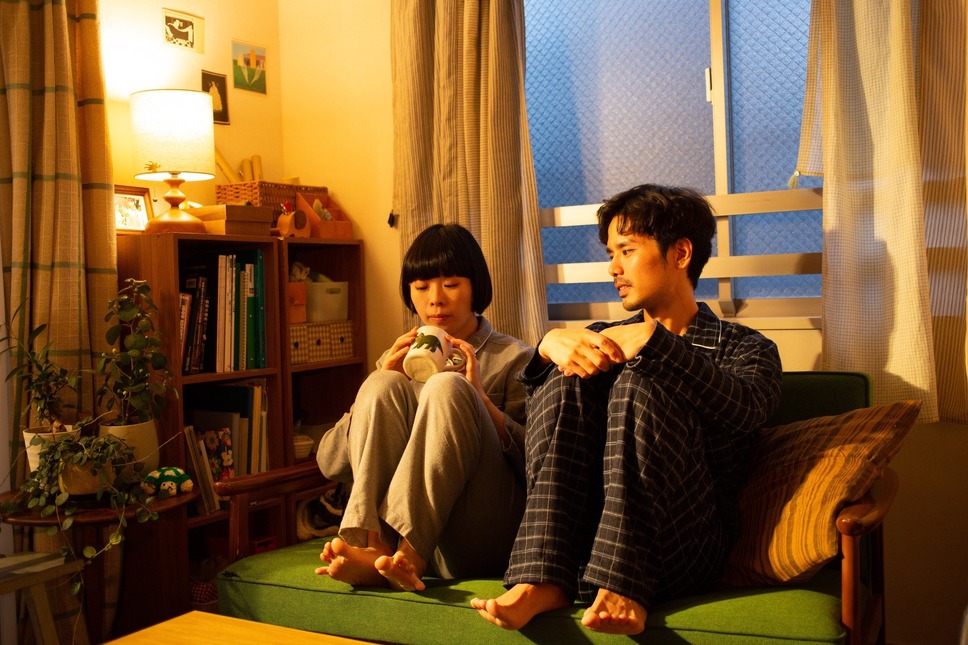
In the first sequence called Triceratops, Koharu Saeki (Tsumugi Hashimoto) chooses to become a triceratops mug she and Wataru (Soushi Kushijima), her husband, bought at the museum. Yet, while the mug receives his intimate affection, he primarily tries to deal with his loss by humanizing a small cactus in their apartment. By treating this cactus as if it was Koharu – he calls it Koharu, he turns this object into a phantasmatic support that helps him partially close off the impact of the real of her untimely death – the cactus becomes the phantasmatic anchor that keeps Koharu, in a certain way, alive (Narra-note 1).
Yet, one day, the cup cannot but witness the playful approaches Rio (Mio Ogawa) makes towards her beloved Wataru. What she must observe is the fact that, as time passes and the mourning fades out, new libidinal investments are bound to be made. Yet, do new libidinal investments override the old or are they destined to continue their existence?
In the second segment, called The Blue One, the spectator is confronted with a riddle: why does Itsuki (Yuuto Kusuda) choose to infuse his soul into the blue jungle gym in the park, a public object quite unsuited to be deeply invested libidinally by others? Pretty soon, the spectator realizes that Itsuki’s choice is not determined by a need to mourn his own death by perceiving the mourning process of his mother (Azusa Nakazawa) but by a simple infantile desire: he wants to play on his favourite park-equipment with his friends.

Yet, as a public object, he cannot but becomes a witness to a variety of social interactions, to a mix of people trying to give a place to their own loss. The blue jungle gym, static within the park, observes youthful romantic approaches, the ripened love of an elderly couple, the practice sessions of two young women who aim to become a manzai-duo, … etc.
In lens, Sayuri (Maki Isonishi), the deceased grandmother, promptly realizes that the object, the camera, she thought was libidinally invested by her grandson Shota was not so deeply invested after all. She sits on a shelf in a second-hand camera shop, sold of by her grandson for money. Of course, by being sold off, Sayuri’s wish to check up on her loved one and fleetingly see the subjective impact of her passing is radically short-circuited. Moreover, the confrontation with his absence takes away her chance to see how he ‘imaginarized’ and ‘imaginarizes’ her after her passing (Narra-note 2). The only thing she can do is utilize her own libidinal attachment to the camera to reminisce about her interactions with her grandson. As inanimate object, she cannot but accept this fate and embark on an unexpected and unwished for adventure of being libidinally invested by a stranger (Yoshiyuki Shibata) (Narra-note 3).
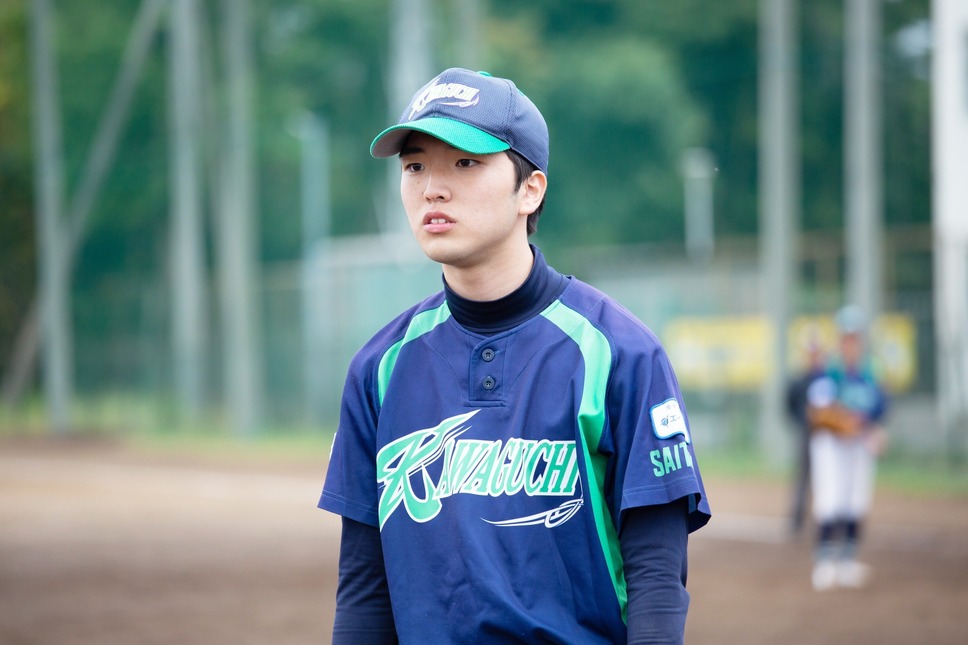
In the final segment called Rosin, Tamaki Koyabashi (Youko Yasumi) chooses to become the rosin that her son Yoichi (Kai Shimura) is going to use in his last official junior high-school baseball game. She is warned by the guardian that if the bag of rosin decreases to less than half, it’ll become unable to hold her soul and cause her expulsion. Yet, Tamaki is sure that such fleeting moment of togetherness will make is easier for her to move on and accept her own absence from his life.
These four segments illustrate in their own way that we, as speaking beings, connect ourselves with the other and create our reality by libidinally investing in objects and establishing each a particular pattern of investments. Yet, the true moving power of Belonging does not lie in illustrating how libido works, but in showing, for better or worse, that every subject gives a somewhat different signified to the abstract signifier love. The four poignant vignettes, which traverse ‘matured’ love, infantile love, and familial love, sketch out in a touching way the various subjective ramifications of seeing the overlap or divergence between the Other’s signified for love and the one the subject, in relation to the loved other, constructed.
The composition of Belonging offers a pleasing mix between dynamic and static shots – a visual mixture that supports and amplifies the emotional flow of the narrative (Cine-note 1). Higashi, moreover, proves that she can use close-ups and zoom-ins and zoom-outs in an emotionally effective way. Fish-eye perspectives are sporadically utilized to evoke the gazing object, as embodied by the deceased subjectivity, and align the perspective of the deceased and the spectator.
To separate the present from the flash-back moments, Kaori Higashi chose to frame these fleeting patchworks of fragmentary recollections, with somewhat more different colour-schemes. The primary aim of giving these moments a different quality is to elegantly emphasize the deceased’s radical inability to re-experience these memories. Moreover, by integrating such flash-back moments within the unfolding of Belonging, Higashi infuses a touching tinge of melancholy into the speech and gaze of the subjects featured in the four vignettes.
With Belonging, Kaori Higashi delivers a touching exploration of love after death, of the impact death has on the subject’s network of libidinal investments and how he utilizes these libidinally invested objects to remember the image of one’s deceased loved one. Higashi perfectly balances bursts of light-hearted with heartfelt drama to deliver one of the most poignant and heartwarming narratives of this year.

Psycho-note 1: By raising these special objects to the status of signifiers, the subject creates a substructure of verbal anchors that fixate the image the subject constructed after the death of a loved one.
Narra-note 1: While the cactus, as external object, allows Wataru to keep Koharu alive within his subject, this libidinally invested object also indicates her death, her radically absence as body and subject.
Narra-note 2: She is not merely unable to perceive how the intensities within his network of libidinal investments have changed, but must accept that the camera, her gift of love, is not libidinally invested by him.
Narra-note 3: After a fleeting moment of anger, she rationalizes her fate – blaming Shota’s blindness for the true value of her gift of love on his youthfulness.
Cine-note 1: Besides utilizing tracking dynamic movement throughout her composition, Higashi also relies, for certain moments, on shaky framing to reverberate the subject’s trembling emotional state.
 psychocinema
One Comment Add yours