The impact Japanese culture has had on pop-culture cannot be understated. Even people who do not actively seek out Japanese cultural productions can form an image of Godzilla, samurai, and the cat-like ninja. Yet, while the black-clad ninja are heroic in the collective consciousness, it might come as a surprise that first three Shinobi films, which heavily influenced today’s phantasmatic image of the ninja, are so nihilistic in nature and critical of the Japanese society of the sixties.

[Click the banner to go the Radiance website to purchase the Shinobi No Mono trilogy.]
Yet, it should not surprise anyone familiar with Japanese cinema. The historical setting of Jidai-geki films has been exploited many times to offer critical allegories of Japan’s pre-war and post-war societal structure and transformations. It is thus a given that left-wing writer Tomoyoshi Maruyama, whose novels formed the basis for these three films, would exploit utilize such frame to denounce certain trends in the post-war societal fabric. Shinobi No Mono: Band Of Assassins explored the bankruptcy of the traditional ‘father’ for the post-war subject and Shinobi no Mono: Revenge the inability to halt the capitalistic conquest of post-war Japan. What can the third film add to the thematical exploration of the post-war clash between traditionalism and capitalism?
The third film starts with a shocking revelation: Goemon (Raizo Ichikawa) has failed to assassinate Toyotomi Hideyoshi (Eijiro Higashino) and is going to be boiled alive. Luckily, due to the timely intervention of Hanzo Hattori (Saburo Date), Goemon is switched and a different person is thrown into the boiling pot. Shinobi no mono: Resurrection thus merely continues the previous film’s exploration of the threat the capitalistic dynamic poses for the ‘traditional’ societal field by staging Goemon’s heroic refusal of letting himself become the subject of the capitalistic excesses of pleasure.

While Goemon discarded the way of the ninja to dedicate his desire to his wife and child, to give purpose to his life by assuming the mundane position of husband/father [Shinobi No Mono: Band Of Assassins], the excess of violent pleasure ultimately robs him both of his child and wife [Shinobi no Mono: Revenge]. With his own solution to the structural void of his being radically annihilated, he has no other choice than to reshape himself in accordance with the religiously-grounded prescriptions of the ninja and acceptingly walk the path of death.
Shinobi no Mono: Revenge (1963) underlined that Goemon’s re-assumption of the ninja’s way of life is unrelated to the fatherly spectre who demands obedience. Goemon’s re-assumption is an immediate defence against the subjective void caused by the two traumatic events, a teaching that allows him to give his own subjective trajectory a vengeful sense: he gives himself the task to murder the fatherly figures who personify the capitalistic excesses of violence – Oda Nobunaga [Shinobi no Mono: Revenge] and Toyotomi Hideyoshi.
With the public execution of the fake Goemon, Goemon can finally realize the ninja’s paradigm: to live and die in darkness. He is suddenly inscribed in the Other – the capitalistic as well as mundane one, as a non-existence; he is reduced to a single signifier to be exchanged when people gather around to tell fantastical tales about him. While the Other’s mistaken belief in his physical annihilation aids him in working from the shadows, the survival of his name in the societal field allows him to instil fear in the same Other. Yet, despite all Goemon’s effort to enflame the mythical dimension of his name among the common folk, the news of Goemon’s instigated societal frictions does not reach Toyotomi Hideyoshi’s ears. Goemon must be bolder and reveal that he is still alive to truly instil some fear in this capitalistic Other.
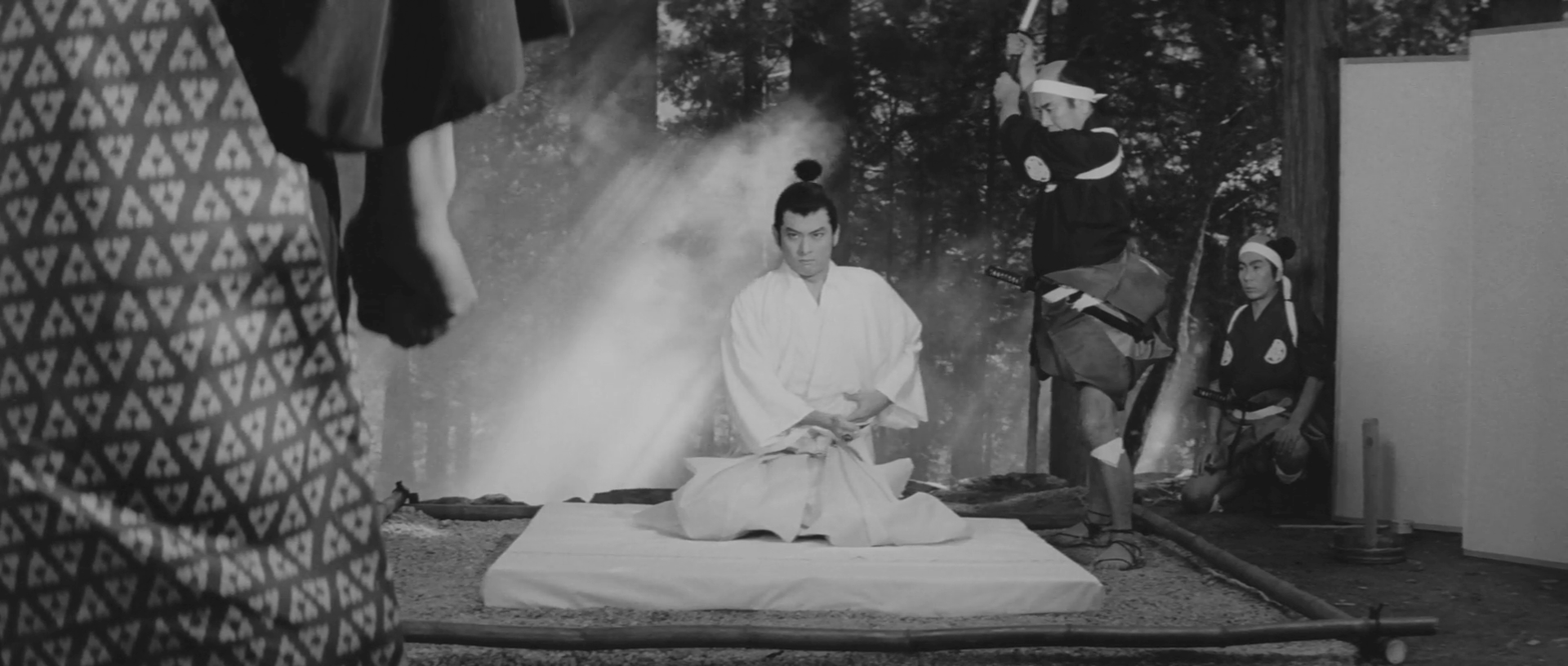
Goemon’s singular fixation on Toyotomi Hideyoshi underlines that his aim is not to destroy the dynamic of capitalistic pleasure as such but to merely murder its human supports, those who are at the root of the trauma he was subjected to. Goemon might get his revenge, but he has no intention to change the societal fabric.
Nevertheless, in his attempts to unnerve Hideyoshi and get under his skin, Goemon does emphasize how his enjoyment – i.e. of trying to conquer Korea and Ming – comes at a heavy cost: the deaths of many low-ranked samurai and the exploitation of the common folk (Narra-note 1, narra-note 2). In other words, he confronts him with the fact that his pleasure is built upon the exploitation of others. While the absence of any revolutionary sentiment in Goemon’s subject introduced a quantum of fatalism into the narrative, there is nevertheless a change that his acts will allow a more balanced father to take hold of the nation (Narra-note 3).
Some spectators might argue that our interpretation of Shinobi No Mono is far-fetched and that the narrative merely utilizes historical reality to structure the heroic fictionalisation of Goemon. Yet, in our view, the continued appeal of these historical figures and their political conflicts lies in their use value to explore currents of subjectivity (e.g. the thirst for power, the clinging to religion, …) and visualize, from the perspective of the post-war spectator, societal conflicts. The fictionalisation of the historical past functions as a frame that offers audiences a glance at the societal field that surrounds them in the present.
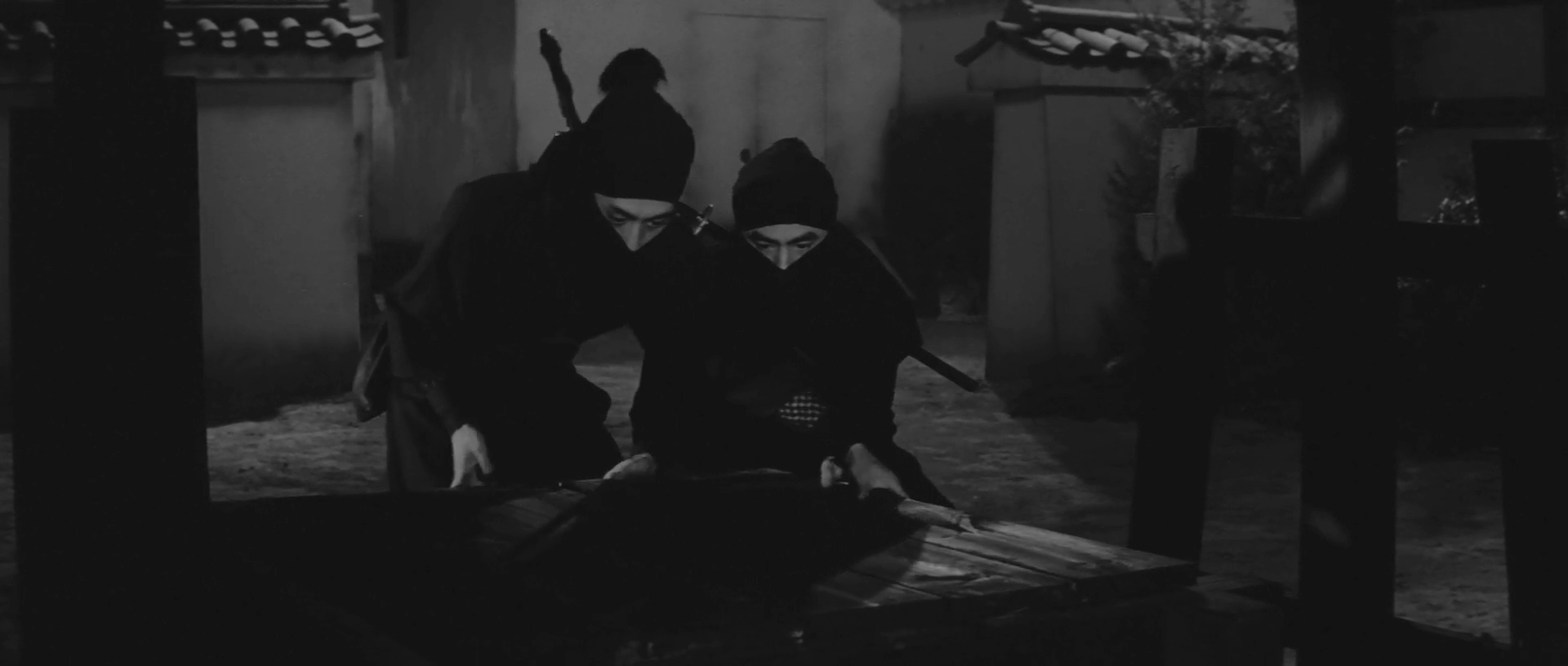
Despite the change in director – Satsuo Yamamoto gives the reins to Kazuo Mori, the composition of Shinobi no mono: Resurrection is quite like the first two narratives. The fluid dynamism smoothens the flow of the narrative and helps keeping the spectator engaged throughout the entire narrative. Kazuo Mori also relies onmonochrome contrasts and the geometry of traditional Japanese interiors to craft fleeting moments of visual beauty.
In contrast to Shinobi no mono: Revenge, Resurrection delivers plenty of cat-like ninja action. The visual fabric is littered with acrobatic acts thatspeak to the imagination of the spectator. While thesevisual moments might not appear that impressive for contemporary audiences, the spectator is still able to grasp how these moments came to define the heroic image of the ninja.
Shinobi no mono: Resurrection offers a satisfying conclusion to Goemon’s narrative. Mori’s narrative offers plenty of action and succeeds in resolving the thematical exploration of destructive capitalistic pleasure in a satisfactorily yet maybe somewhat naive way.

Notes
Narra-note 1: The third film also highlights that those who hold a position of power remain blind for the devastating effects of their own violence. They do no merely view their violence as necessary, but also refuse to acknowledge the satisfaction they or their jouissance finds in these excesses.
Narra-note 2: While Hideyoshi illustrates the unquenchable thirst for more (e.g. land, power, …etc.), Hidetsugu (Jun’ichiro Narita) evokes the blind indulgence in pleasure and violence. Both sides highlight different aspects of the capitalistic dynamic.
Narra-note 3: In this light,we should underline that Tokugawa (Masao Mishima) is staged as someone who refuses to be seduced by his own ambition and enjoyment. He is, in fact, introduced as a fatherly figure who brings balance to the societal fabric, who respects the dimension of ailing religious tradition and can curb the excesses originating from the capitalistic and phallic tendencies.
 psychocinema