Introduction
Death is a part of life and the funeral rite, a fundamental cultural accomplishment of the speaking being, tries to inscribe loss into the symbolic fabric. While this rite takes on many forms, its shape has always been determined by religious theories and beliefs.

In Japan, the funeral rite is shaped by Buddhist teachings. Many fans of Japanese cinema have, one way or another, glanced at what makes the Japanese funeral similar as well as different from their own culture’s funeral practices. Films like Departures (2008) and Juzo Itami’s The Funeral (1984) are films that any cinephile will surely know and have savoured.
Director Noriko Yuasa and writer Takato Nishi delivers a new movie to add to the list of Japanese ‘funeral’ films. What sets their narrative apart from others is the fact that the focus lies on the ungraspable truth of the deceased subject. One can, in fact, argue that Performing Kaoru’s Funeral delivers an unpredictable dramatic character-mystery. While Jun Yokotani (Koji Seki) cannot refuse his ex-wife’s last wish for him to be the chief-mourner at her funeral, it is obvious that he does not really know how to act around the people (e.g. Screenwriter Takako Mukojima (Asuka Kurosawa), her manager Tomozawa (Megumi Takizawa), …etc.) who knew Kaoru Washizu (Kano Ichiki) after their divorce.

As the narrative is structured around the question of who Kaoru Washizu was as subject, it is not surprising that the spectator, not unlike Yokotani, feels out of place in this countryside environment. The spectator is surrounded by evocative enunciations, emotions that spill over in enunciations, strange acts that cannot be placed, and interpersonal tensions whose origin are not known.
Yet, it should be obvious that the spectator is not going to learn who Kaoru was by watching how the highly ritualized funeral rites play out. While Kaoru’s funeral is full of frictions and drama, this religious event is still a symbolic performance where the image of Kaoru is re-adjusted and celebrated. A funeral is, as Noriko Yuasa’s narrative elegantly illustrates, not merely about sending a body off.
Performing Kaoru’s funeral also evokes that a funeral is not merely a social event, but a subjective event. A funeral grants each subject place and time to work-through a collection of memory fragments related to the deceased. Yet, the concatenation of flashbacks that is fluidly interweaved into the proceedings of the funeral does not simply function as a recollection of memories of the attendees.

The flashbacks present, first and foremost, a glance at those moments important to Kaoru until her untimely death; the various anchor-points that held her ego together and the imaginary injuries that radically changed her trajectory. These moments, thus, offer the spectator a glance at Kaoru’s subject (i.e. her signifiers, her acts, and peculiarities) and what kind of past she had. Moreover, these glances also elegantly underline the subjectivity that escaped those who have come together to commemorate her – she eludes all the signifiers vocalized about her. Yet, in certain instances, one can argue that Yokotani’s memories fuse with Kaoru’s already evaporated memories – the confrontation with his ex-wife’s body and the signifiers that swirl around him forces moments of their shared past to burst forth into his mind (Narra-note 1).
Yet, while Performing Kaoru’s Funeral shows that a funeral is a social event to remember one’s image of the deceased, Yuasa’s narrative also reveals that the confrontation with the silent presence of death invites the subject to question his own subjective path: Am I living in accordance with my desire or will I, if death seeks me out, die plagued with regrets?
The composition of Performing Kaoru’s Funeral is full of dynamism and shaky framing. Yuasa exploits slow-motion decorations in a pleasing way and utilizes the dimension of symmetry elegantly to stuff her composition with many visually pleasing moments.
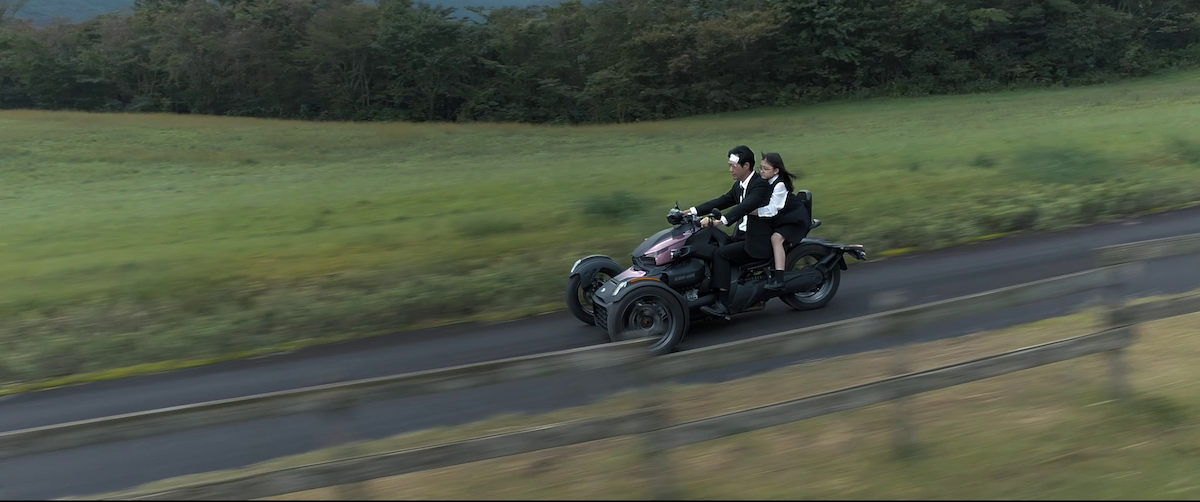
While the visual composition skirts away from more experimental compositions, the interweaving of rhythmic music with the visuals is quite refreshing and give the compositional whole a distinct flavour. The musical rhythm does not merely smoothen the flow of the visuals but also allows a certain quantum of tension and mystery to echo within certain narrative moments. What makes this mysterious tension so engaging is that it confronts the spectator with what he does not know – i.e. the signified that explains the connection between the death bruised body of the opening sequence and the subsequent scene with the blond soap-land girl – and what escapes the subjects present at the funeral.
Performing Kaoru’s Funeral, Noriko Yuasa’s second feature film, proves that she is a talented film-director. Her narrative does not only beautifully show that the true subject escapes our memories of the deceased, but also proves that the unavoidable presence of death during a funeral can allow a subject to re-route his own trajectory.

Notes
Narra-note 1: Other flashbacks allow the spectator to understand the appearance of certain characters at the funeral and better understand the bond between her and her daughter (Chise Nitsu).
Some spectators might feel that the rhythm of the flashbacks is independent from the dramatic unfolding of the funeral performance and argue that their juxtaposition is merely a play by the screenwriter to heighten the effect of certain dramatic moments. In our view, the often-loose associative place obfuscates the exploration of the very essence of the funeral practice.
 psychocinema