Introduction
While narratives exploring the intricacies of vision or hearing can easily manipulate the visual or auditive dimension to deliver an engaging filmic experience, it is much more difficult to create such kind of experience when focusing on smelling and scents. While experiments have been conducted in the past to introduce smells in the cinema (Smell-o-vision and Aromarama) and 4DX cinemas currently utilize various scents to elevate the cinematic experience, the appeal of smelling the ‘film’ remains limited.

So, how does one evoke scents and smells in the audience without any technological devices or gimmicks? Director Kahori Higashi tries to bring the world of fragrances closer to her audience by structuring her narrative around scents that can easily be evoked (i.e. coffee) and smells that an arthouse loving audience can promptly imagine.

The main character of Higashi’s coming-of-age narrative is the high schooler Hinoki (Reira Ikeda) who, after getting hold of her late father’s notebook with all the arthouse cinemas he visited to deliver coffee jotted down, decides to go on a road trip to visit all those places and trace down the puzzling entry about an unnamed cinema with a tall dripper and the scent that made him sleepy.
While it is not said with many words in the narrative, it is evident that Hinoki struggles with the radical absence of her beloved father. Her trip, which is determined by the entries in her father’s notebook, is thus not simply about follow his fading footsteps throughout Japan, but to attain a fleeting feeling of imaginary closeness to him by replicating his experiences, by breathing in the same scents as he did and embracing herself with the same atmosphere. Or, to put it differently, Hinoki tries to exploit his written signifiers to create a situation where she can fleetingly erase his absence with her own presence. This ephemeral erasure creates the equally brief sense of closeness.
It is therefore not surprising that the scent that Hinoki actually desires to preserve is nothing other than her father’s. Hinoki is not merely searching for scents her father smelled and objects he touched to slow down the unreversible fading of the image of her father in her psyche, but to capture her father’s complex fragrance. She hopes that the successful recreation of his fragrance can put a stop to the fading of her father’s presence in her mind (Narra-note 1).
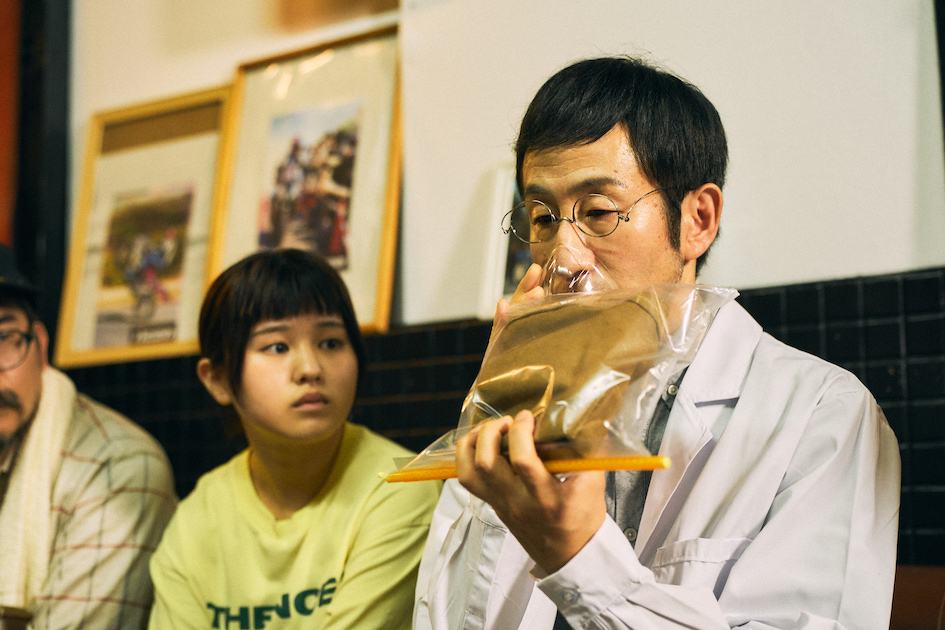
Besides tracing out Hinoki’s attempt to quell her fear of forgetting her father, Memories of his Scent also functions as a celebration of arthouse cinemas and of the encounter. Kahori Higashi highlights arthouse cinemas that try to survive within a societal field whose dynamics of consumption have radically changed (i.e. Onariza in Odate and Cinekoya in Fujisawa) (General-note 1). Just like bath-houses, these cinemas, which used to bind people together due to their deep integration within the temporal and spatial fabric of the local community, need to be treasured and, if possible, protected. Yet, the decreasing appeal of these cinemas, whose charm is often interlocked with clear signs of decay, endangers the existence of these places. The owners of these arthouse treasures do not only fight against closing down but also against the radical effacement of their buildings from the spatial societal field. And some institutions, sadly, lose the fight and end up being demolished to be either turned into an apartment block or worse into a parking lot (Narra-note 2).
Higashi celebrates the encounter by tracing out the subtle subjective effects encounters can have. On her trip, Hinoki does not only interact with the owners of the arthouse cinemas – receiving their stories and helping them out, but also meets peculiar people, like the socially-inhibited perfumer, a travelling family, and a young girl who loves her father, that do not only help her on her way but also impact her as a subject.
Yet, despite the celebratory dimension of Memories of His Scent, Hinoki’s trip is a trip of subjective conflict – a conflict that inhibits her. While she learns more about her father from the cinema owners, these vocalized memories cannot but emphasize his radical absence. The subtle tinge of forlorn sadness that marks Hinoki’s presence, effectively brough to life by Reira Ikeda, marks every interaction and adorns each pause and each hesitation in her speech. Yet, with Minoru (Shun Aoi), her best friend, suddenly joining on her adventure, Hinoki unexpectedly receives as different demand: a demand for romance. In this sense, the true question Higashi’s narrative formulates an answer to is not only whether she can recreate her father’s fragrance, but if she, fixated on preventing the fading of the image of her late father within her psyche, can make place in her psyche for Minoru’s feelings.
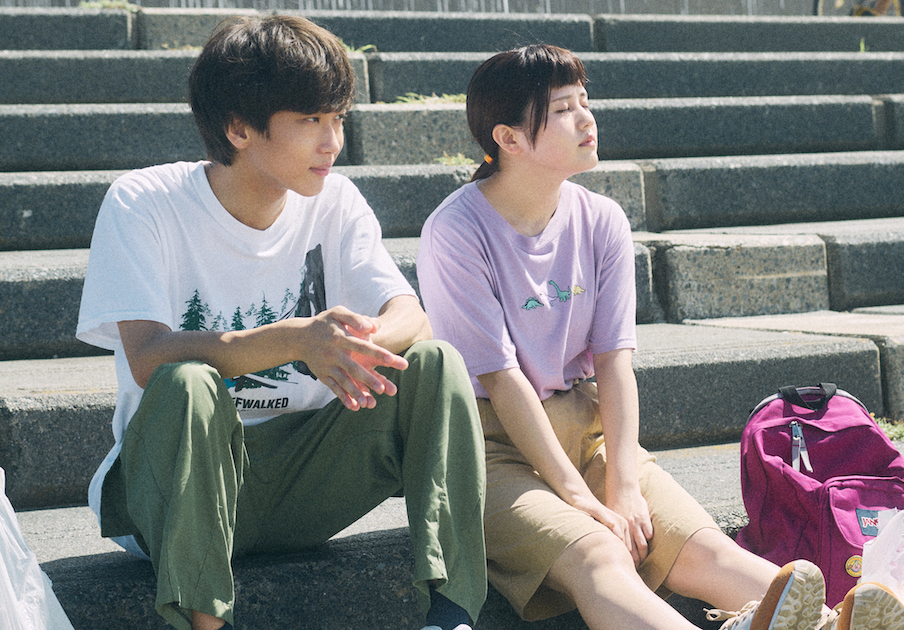
Higashi fluidly sews static and dynamic shots together to create an engaging and visually pleasing compositional fabric. Moreover, by thoughtfully utilizing shaky framing in her composition, Higashi succeeds in reverberating the guilt and fear that linger within Hinoko as subject. The visual tremble either reveals the importance of a certain image, atmosphere, or signifier for Hinoki as subject or evokes the uneasiness that slips within her interactions with others. By establishing Hinoki’s fear of having her father evaporate from her psyche through the visual tremble, Higashi succeeds in letting this fear and guilt reverberate in all of Hinoki’s acts and signifiers (Lightning-note 1).
Memories of his Scent is a pleasant narrative that does not only succeed in making the spectator recall or imagine certain scents and fragrances, but utilizes the olfactory dimension satisfactorily to create an engaging and endearing tale of subjective change. Cinephiles and coffee-lovers, be sure to give Higashi’s film a watch when you have a chance.

[Trailer not yet available]
Notes
Narra-note 1: Hinoki’s acts and signifiers are determined by the fear of having her father fade from her psyche.Yet, Hinoki has, in fact, nothing to fear. While the fatherly image will fade due to his radical absence, there will always be a rest-image that can be re-animated by associated objects, acts, and signifiers. The fatherly scent she want to recreate will, ultimately function as an object that breathes life in the rest-image and its associated memories.
General-note 1: Despite emphasizing that both cinemas are in danger of closing, both cinemas are still open, welcoming audiences to discover the rich world of arthouse cinema.Be sure to visit these places of visual culture when you have a chance.
Narra-note 2: The discovery of the demolished cinema echoes the radical absence of her father. The emptiness of the parking lot confronts her with the absence of her father’s presence.
Lightning-note 1: What heightens the visual pleasure of Higashi’s composition are the soft but natural lighting-design and the resulting colour-schemes. Yet, in one case, the consistency of the visual fabric is rippled by inserting a shot with a completely different brightness. While the shot supports the consistency of the narrative space, the difference in lightning disturbs the temporal dimension.
 psychocinema