Introduction
One of the most famous Japanese ghost stories is, without a doubt, Yotsuya Kaidan. It has been adapted to the silver screen and the small screen numerous times. Such popularity, of course, invites the critic to compare the different versions made of the famous Kabuki play.
To start our comparative exploration of this vengeful ghost story, we choose – for no reason – Masaki Mori’s version, which was based on a screenplay by Hideo Oguni and Tarao Tanabe.
Review
Ume Ito (Akimi Tsukushi) hopes to marry the ronin Iemon Tamiya (Tomisaburo Wakayama), but is highly insecure about her chances. Ume’s mother appeases her anguish by telling her that Iemon will surely listen to his mother Maki (Choko Iida), whom she asked to invite her son to meet her daughter. While Iemon expresses his distaste for his mother’s proposal to meet Ume, he still agrees to spend the evening with her.
Yet, later that night, when Maki broaches the topic of marrying Ume and gaining more wealth and standing, Iemon promptly refuses. He will not leave his current wife Iwa (Chieko Soma), who works at a tea-house to support him. Around the same time, Iwa learns from Naosuke (Haruo Tanaka), a man who knows Iemon’s dark secret, that her beloved might marry into the wealthy Ito family.

Ghosts of Yotsuya is structured around a conflict of desire, around a clash between the subject’s desire and the desire of the (m)Other. The desire of the Other takes, within this narrative, the shape of an order, a demand to subject himself to the familial duty (of increasing one’s status and wealth). The motherly command, which he despite crude protests still follows, forces Iemon to make an impossible decision: to leave Iwa, the woman that grants him some form of subjective happiness.
Due to his loyalty to Iwa, Iemon ultimately ridicules his mother and affronts Ume’s father (-) by declining the marriage proposal. Spectators will easily realize that, for Iemon, his refusal is not only about protecting his relationship with Iwa, but also about refusing to inscribe himself into the motherly wish for more wealth. What he refuses is thus not so much Ume – he wants to keep her as mistress, but the very demand to erase his subjectivity to please his motherly thirst.
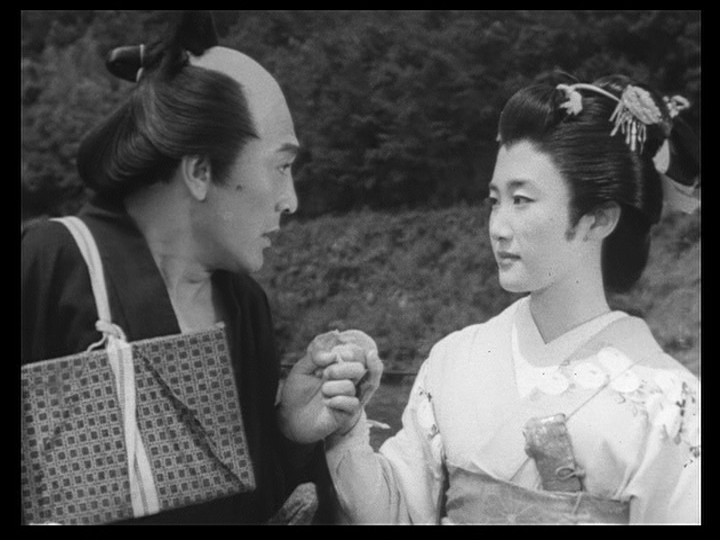
Of course, Ume’s father, who desires to pass on the Ito name and secure the family’s succession, is not willing to reduce his daughter to the mere position of mistress. If he were to part with his daughter in such way, Ume would not even be an exchange object, but a mere trash-like object.
Iemon’s dark secret concerns nothing other than the act of murder. During one of his attempts to win the hand of his lover Iwa, he ended up murdering her father, Samon (-), who was vehemently against their marriage. The strike of the sword was, as the narrative shows, not merely a calculated attempt at erasing the obstacle to his desire, but a burst of anger to erase the imaginary injury Samon inflicted, to mend the crack in his ego of honourable samurai by the sharp edge of the signifier, and violently assert his phallic worth. Yet, he promptly exploits his murderous act to frame himself as the phallic answer to Iwa’s lack and loss – I’ll take revenge for Samon, your father. And he succeeds, Iwa, as lover, hangs around him like the erected phallic presence he pretends to be.
Iemon’s romantic trajectory is, nevertheless, radically disturbed by the wandering presence of Naosuke, who witnessed his unknown crime. The mere fact that someone knows about his crime endangers his phallic ego, his facade of being an honourable samurai (Narra-note 1). How far will he go to protect his deeply deceptive image and keep his despicable crime hidden?

Ghosts of Yotsuya does not merely highlight the perverting effect money has on the subject, but also highlight how the promise of gaining riches invites the subject to become cruel. The seductive glint of coins subtly disturbs the symbolic Other and the social bond and pushes the subject to manipulate the Other of the law – i.e. the magistrate. One can, in fact, read The Ghosts of Yotsuya as a fantastical warning against blind materialism and capitalism.
The monochrome visual composition of Ghosts of Yotsuya pleases the spectator with its rich use of dynamism. The way Mori uses dynamism within his composition does not only smoothen the flow of the narrative, the rhythm by which the narrative unfolds, but also delivers many surges of visual pleasure.
Of course, static shots are present within the visual fabric as well. These shots are, generally, utilized to frame conversational scenes and highlight the exchange of signifiers. To emphasize changing facial expressions within such scenes, Mori often resort to static close-up shots. Of course, Mori also utilizes static shots and the dimension of geometry to deliver some nicely composed visual moments, to create some visually unforgettable moments (e.g. Iwa discovering her facial transition in the mirror) and let the practical effects that bring the intrusion of a vengeful ghostly presence come to their full right.

The influence of Kabuki is evident in Tomisaburo Wakayama’s manner of acting. While some spectators might feel his performance feels too acted at times, his often highly calculated style gives his movements as well as his facial expressions a highly satisfying dramatic flavour. In fact, Wakayama’s presence imprisons the spectator’s look – he commands the screen and carries the narrative on his highly stylistic shoulders.
Yet, while Wakayama’s performance stands out – and even overshadows many of the other performances, the other cast-members, in their own way, heighten the sense of drama that marks the unfolding of the narrative. With their performances, Akimi Tsukushi and Chieko Soma prove that they, just like Wakayama, have great control over their body and are highly able in utilizing their body to create dramatic tensions and evoke meaning without signifiers.
Musical accompaniment is lavishly utilized in this ghostly narrative. While such rich use runs the risk of overpowering the performances, the music perfectly amplifies the drama evoked by the act and the signifier. The music does not merely emphasize the dramatic turns the narrative takes, but enables the dramatic feel created by the performances come to its full right. The more ghostly musical pieces, however, are utilized to accompany the sudden intrusion of vengeful spirits and dramatize the otherworldly disturbance of the societal fabric.
The Ghosts of Yotsuya is an incredible horror film that retains its power to engage and thrill the spectator due to Tomisabura Wakayama’s outstanding performance. Hideo Oguni and Tarao Tanabe approach the classic ghostly narrative to show the spectator the very destructive dangers of becoming intoxicated with materialism.

Notes
Narra-note 1: As becomes evident as the narrative progresses, Naosuke is not the only one who knows about Iemon’s crime.
 psychocinema
2 Comments Add yours