Introduction
It must come to a surprise to many that a director known for action-oriented narratives like Versus (2000), Azumi (2003) and Godzilla: Final Wars (2004) would agree to bring Tsutomu Takahashi’s one-shot manga Tenmasou no Sanshimai: Sky High to life. Yet, Ryuhei Kitamura, for some reason, felt the time was right to try something different. Is his attempt at a tearjerking narrative a success? Or should the spectator seek out the two Hollywood action narratives – The Price We Pay (2022) and The Doorman (2022) – he directed in the same year?

Review
One day, in the backseat of a taxi going to the long-established Tenmasou inn, Tamae Ogawa (Non) discovers that she was nearly killed in a traffic accident. In order to decide whether to return to her body or move on to the next world, she is asked to stay at the inn and its surroundings – an idyllic place for lost souls that is neither heaven nor earth – to refresh her soul.
At the entrance of the inn, Tamae is awaited by Nozomi (Yuko Oshima), the proprietress, and Kanae (Mugi Kadowaki). Izuko (Ko Shibasaki), the woman who accompanied her in the taxi, then tells her that she is biologically related to both. After Keiko Tenma (Shinobu Terajima), Nozomi and Kanae’s mother, tells her she should not expect any hospitality from her, Tamae proposes to Nozomi to help at the inn.

The Three Sisters Of Tenmasou Inn is a narrative that explores the impact of ‘loss’ from a variety of perspectives. While highlighting each perspective would deconstruct the whole narrative and deflate any emotional enjoyment the spectator might have, we are going to focus on the perspective that structures the narrative, the one of Tamae.
To explore Tamae’s logic, we need to qualify what the narrative means with the signifier troubled soul. It short, the state of being a troubled soul is another word for a subject that has not satisfactorily dealt with the impact of his/her past loss. The presence of such unresolved subjective obstacle is the main requirement for arriving at the Tenmasou Inn as guest. The ability to choose between either moving on to heaven or returning to the world of living depends on the ability to confront one’s own troubled past and to discover something – a desire or any other thing – that can counteract the myriad of losses that one has had to endure.

The dimension of loss is introduced to Tamae by her interactions with two guests, Reiko Zaizen (Mita Yoshiko) and Yuuna Ashizaki (Kasumi Yamaya). Reiko’s inability to confront her loss is expressed by her overly-critical stance. Early on in the narrative, she blames Nozomi for being shallow and superficial, for greeting the guests with empty smiles and offering a kind of service that, by being inadequate, betrays her insincerity. Yet, as Tamae’s bubbliness cracks her protective ego structured by complaints, what appears are not merely some smiles on her face – a sign that she has once again allows herself to feel some fleeting happiness, but the very presence of an imprisoning fear to glance at her traumatic past and her current life as a comatose patient. Yuuna Ashizaki presents a similar protective facade – keeping everyone at a distance with her demands. Yet, as Tamae interacts with her, we are offered a glance at an artist whose life was destroyed by charges of plagiarism during her high-school years.
The dimension of loss also characterizes the way Keiko Tenma treats Tamae. Her sudden alcoholic phase is not merely to combat her shyness, but to sedate the confrontation with the very traumatic loss that she has not yet fully worked through – i.e. the sudden disappearance of Tamae’s father. This sedation helps Tenma to express herself her more brutely and crudely towards Tamae and channel her unreleased anger to her ex-husband by injuring her.
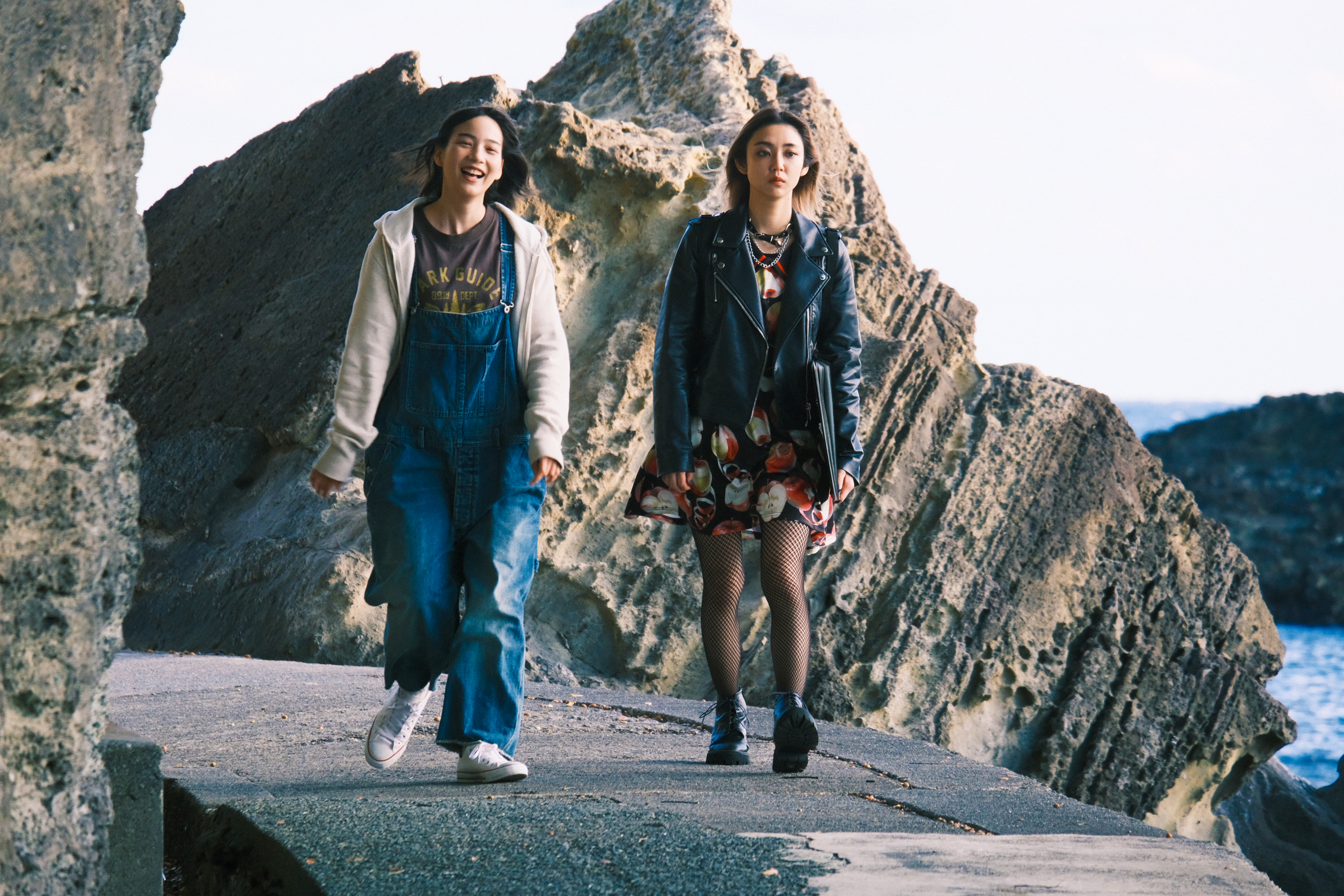
Yet, the violent remarks she subjects Tamae to are problematic. While she readily attacks Tamae for putting the blame on others for her own misfortune, she fails to realize that the grudge towards her ex-husband enables her to avoid to question her own role in the familial drama. Can she find a way to overcome her own loss?
The continued recourse Tamae takes to the act of the apology is – as should be evident – not to shift the blame on to the Other, but to excuse herself for her own existence. To put it differently, with her apology she fluidly evacuates herself from the societal field before the question of the Other’s love – Am I worthy to be loved? – can burst forth in her subject.
Non’s performance as Tamae will surely charms many spectators. Yet, some spectators might have some problems with the more over-acted moments that aim to vividly stage the bubbly facade she constructed to protect herself from the tragedy of love that befell her – i.e. her mother’s death and her father’s disappearance. Such facade, as Tamae’s energetic enunciations further prove, is far from dishonest. The naive honesty that Non so charmingly brings to life constitutes the very fabric of Tamae’s defence, structures her ego-protection against the traumatic riddle of the Other’s love. Yet, can such defensive facade positively influence the troubled souls that stay at the inn and those who wander around the village? Can it change Keiko‘s opinion of her? And can it change herself by granting her an answer to the riddle that plagues her but is avoid by her bubbliness?

As the narrative unfolds and our sisters bond, the spectator gets naturally starts to ask a variety of similar questions: if the guests at the inn are spirits wandering between life and death, what kind of spirits are the locals of Mitsuse? If Mitsuse is neither heaven nor the physical earth, how did it come into being? The answer to these questions fuels the emotional unfolding of the second half of the narrative, a final that – without spoiling too much – turns around the truth that one only dies when all the signifiers that support one’s presence in the symbolic – i.e. memory – have vanished.
While the composition of The Three sisters of Tenmasou Inn boasts many pleasantly composed static shots and some beautiful shots of natural scenery, its visual pleasure is mainly delivered by the elegant and often floaty dynamic moments.
The composition is richly decorated with dramatic musical accompaniment. Yet, rather than the music dictating the emotions the spectator should feel, the musical accompaniment reverberates the emotions expressed by the cast and amplifies the implication of certain images and signifiers so that the spectator is able to pleasantly drift on the narrative’s melo-dramatic flow – an emotional flow that turns around the dynamic of traumatic loss. The fluid and combination of such dramatic music with the power of the signifier and the image turns The Three sisters of Tenmasou Inn into a highly satisfying emotional – or tearjerking – ride.
While anyone who dislikes tearjerkers should stay far away from The Three sisters of Tenmasou Inn, those spectators that love to release their stress by releasing tears will be very satisfied by Kitamura’s narrative. What makes The Three sisters of Tenmasou Inn great – and sets it somewhat apart from other similar tearjerkers – is that it avoids creating disingenuous moments and refuses to take overly-manipulative turns to force tears from its audiences.

 psychocinema