Introduction
While not many spectators will know Chihiro Ikeda, their is a chance that they have seen one of the films she worked on as a screenwriter – Kurosawa’s Creepy (2016) and Mishima’s Red (2020). Besides working as a screenwriter, she also directed a few films, either bringing stories she wrote herself (i.e. Yuyami Daria (2011)) to life or adapting manga-narratives (Memory’s Technique (2020)).
This time, she oversees the adaptation of Makoto Ojiro’s popular manga Kimi wa Hokago Insomnia. Can she do right by the manga or will her adaptation struggle to move the spectator?

Review
Despite his desperate wish to sleep, the negative thoughts that wash over Ganta Nakami (Daiken Okudaira), when he turns off his bedside lamp makes it impossible for him to close his eyes. Yet, due to a lack of sleep, he often ends up dozing off at school.
One day, after being rudely awakened during the cleaning of the school, he is asked by some girls to fetch a stepladder from the observatory to clean the windows of the courtyard. At the top of the observatory, he finds a cosy place – easy to get some sleep away from prying eyes – and much to his surprise Isaki Magari (Nana Mori), one of his classmates. After realizing that Ganta accidently locked them up, she confesses that she struggle to sleep at night.
Not much later, their secret hiding spot is found out by Usako Kurashiki (Yuki Sakurai). When Ganta confesses his insomnia and his need for that space, she proposes to revive the astronomy club. Yet, that turns out to be more challenging than expected.
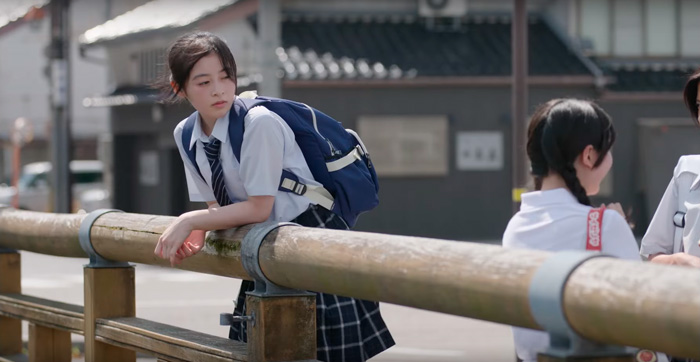
Insomniacs After School offers a blend between school-drama (i.e. the revival of the astronomy club) and romance (i.e. Ganta and Isaki falling in love). Ikeda’s narrative blend, in fact, illustrates one way a romantic bond can be initiated: by sharing a secret, by sharing a subjective truth (i.e. their insomnia) hidden from the Other.
At the level of the imaginary, the existence of such a shared secret engenders feelings of closeness. Even if they do not know anything about each other as subject, this imaginary and, thus, deceptive feeling of sameness – you and me are alike, but different from the Other – forms a minimal bond between them.
The establishment of the Fun Night Club by Isaki can be understood as the formalisation or symbolisation of this bond, but it is, first and foremost, a symbolic structure that allows pleasure to be shared between her and Ganta. The club’s aim is to annihilate the boredom of lying awake in one’s bed and substitute it with shared pleasure. Yet, the very formation of such a structure, nevertheless, creates the opportunity for both to reveal a sliver of their subjectivity to the other.

While Insomniacs After School introduces some of the psychology of insomnia – i.e. the brain of insomniacs associates the space of their bedroom with discomfort and tension, It is nevertheless a missed opportunity that the narrative does not explore how such association came about for our two insomniacs more deeply (Psycho-note 1). While the psychological source of their sleep-deprived state is touched upon – Ganta’s insomnia is function of the motherly absence and Isaki’s is linked with the death of friend and her congenital heart disease, these moments are not utilized well enough to make the staging of the state of the insomniac subject more impactful and the unfolding of the romance more satisfying.
Insomniacs After School does, albeit indirectly and maybe unintended, reveal how difficult it is for the suffering Japanese subject to speak about his suffering and to end up in treatment with a psychologist. Due to the specific nature of the Japanese societal fabric, our subjects do not only feel forced to accept their insomnia as irresolvable, but also fail to be introduced to the healing effect of free association by the other who has come to learn their insomniac truth (i.e. Ganda’s father (Masato Hagiwara) and Usako Kurashiki). In fact, our subjects, who are forced to hide their truths from the Other, wander around in a societal field with a repressed hope for an encounter that might allow them to address subjective speech to an other that can and wants to receive it.

The composition of Insomniacs After School has, due to its thoughtful cutting and its combination of subtle dynamic shots with static moments, a rather contemplative rhythm (Cine-note 1, music-note 1). Ikeda also thoughtfully uses subtle shaky framing. Yet, while this shakiness elegantly signals the subjective impact of a certain situation, such shakiness is, when all is said and done, unable to touch the spectator (Cine-note 2). Moreover, while the deliberate pace of the composition creates a pleasant atmosphere, Ikeda forgets to exploits the visual pace to give space to her cast and to make sure the more emotional moments to hit the right notes.
Despite being unable to support the emotional moments in the narrative with her composition, Ikeda’s use of a somewhat washed-out colour and lighting design film does ensure that her narrative is visually pleasant.
Insomniacs After School contains all the right ingredients, but the final mixture is not able to give the narrative the emotional impact it looks for. Ikeda’s romance narrative is not bad by any means, but her reluctance to lean more into staging subjectivity with her composition creates a narrative with a rather flat emotional flow. Fans of the manga and the anime will surely enjoy it and be able to infuse the missing emotionality into those moments that yearn for it.

Notes
Psycho-note 1: One could argue that Ikeda’s narrative touches upon the destructive impact the lack on speech can have on a subject and the bonding power of exchanging subjective speech.
Cine-note 1: In one sequence, to keep the visual rhythm peaceful, Ikeda employs slowly paced jump-cuts within the same static shot.
Music-note 1: The contemplative atmosphere of the narrative is further supported by the measured musical pieces.
Cine-note 2: It is a case of we know but we don’t feel. For example, we know, due to the shakiness, that confessing her insomnia is difficultfor her, but we do not truly feel it – the shakiness does not amplify the subjective difficulty that underpins her enunciation so that it can impact the spectator.
 psychocinema