Introduction
Hideaki Anno is, of course, most well-known for the incredible Evangelion series. Yet, in recent years, he has pleased and irritated fans with his reimaginations of Godzilla – Shin-Godzilla (2016) and Ultraman – the emotionally sterile Shin-Ultraman (2022).
Now, two years after trying to revive interest in Ultraman by re-introducing the original series in film-form, Hideaki Anno now attempts to reboot the Kamen Rider series by turning the original series into an feature-length film. Yet, will the end result of Shin Kamen Rider be any better than his failed attempt to introduce Ultraman to new audiences?

Review
After a high speed chase, Takeshi Hongo (Sosuke Ikematsu) and Ruriko Midorikawa (Minami Hamabe) cannot avoid crashing with their motorcycle. Ruriko is soon surrounded by the goons of the illegal organisation called S.H.O.C.K.E.R (Sustainable Happiness Organisation with Computational Knowledge Embedded Remodelling. Yet, before Spider-Aug (Nao Omori) can incapacitate her and capture her, a masked figure appears. He violently takes out the Shocker’s goons and rescues her.
Not much later, in a desolate building, Takeshi, who starts to realize what he has done and discovers the physical transformation the mask has caused, is overcome by confusion. Professor Hiroshi Midorikawa (Shinya Tsukamoto) explains to him that Shocker, led by Mr. Ichiro (Mirai Moriyama), has been developing Synthetic Insect Hybrid Augmentation and that he is the project’s masterpiece. To ensure the future of Prana, i.e. the source of energy that supports his life and allows him to become superhuman, he needs to destroy Shocker at their violent attempt to make all of humanity happy.

Just like Shin–Ultraman, Shin Kamen Rider condenses a whole series into a two-hour feature length movie. While such condensation caused Shin-Ultraman to have no functional emotional unfolding and thus no effective pay-off, Anno has succeeded in creating a narrative that will please fan and non-fan alike. While Anno’s latest condensation is not without some ‘injuries’ – e.g. certain violent show-downs unfold too fast and end up lacking some dramatic catharsis, the fact that the Takeshi’s goal is known from the beginning – i.e. destroying S.H.O.C.K.E.R – gives the rapidly unfolding narrative with its quick succession of opponents a firm frame. This frame, which Shin-Ultraman lacked, allows Anno to infuse a bit more emotionality and drama into the rhythm of his narrative (Structure-note 1).
Like most superhero narratives, Shin Kamen Rider touches upon the ethical dimension of violence. The evilness in violence lies in the way it is utilized. For the Aug’s of S.H.O.C.K.E.R, the evilness is not simply because it is a tool to feed their own ego, their own happiness, but because their violence is enacted as if they embody the law as such – violence is enacted in name of the happiness of all. Those who obtain such criminal position ultimately turn the law into a violent way to fill oneself with jouissance.

How can this criminal position co-exists with Shocker’s ‘humanistic’ goal to make all of humanity happy and saving them from experiencing the deepest despair? In short, because the idea of happiness constructed by S.H.O.C.K.E.R is a perverted construct. The organisation does not only seek to give humanity its righteous happiness by annihilating those who experience the greatest despair – instead of solving hunger, dissolve the hungry, but is also structured in such a way that the Aug’s are able to self-satisfy the animal instinct that drives them and thus obtain their scripted happiness.
Moreover, K (Tori Matsuzaka), the AI that created S.H.O.C.K.E.R, rightly surmised that the path to happiness for all mankind lies in erasing subjectivity as such, in eradicating the lack that animates the subject’s desire and dooms him to never feel fully satisfied. It should be evident that the whole project to deliver happiness to the world is constructed on the fictional and false belief that such wholesome happiness exist and can be obtained for the speaking subject (Narra-note 1, Narra-note 2).

As Shin Kamen Rider quite touchingly illustrates in its finale, ‘happiness’ can only painted by the subject on a societal fabric of despair and injury. Happiness lies in changing yourself – reframing one’s subject – rather than changing the societal fabric by erasing subjectivity and thus the source of human absurdity. Kamen Rider’s desire to protect with violence is thus not merely aimed at protecting the symbolic castration that marks every speaking subject, but to safeguard the very right for the subject to be in despair, the right to be lacking and as such desiring.
As should be evident, Takeshi Hongo is both marked by castration – his despair and struggle to accept his deadly phallic power are only possible in a state of radically not-having – and phallic-possession, i.e. that state where the Prana turns him into a masked phallic a-human superhero. Such alternation is, as a matter of fact, central to any kind of superhero. By offering the character’s lack to the spectator, one can more easily identify with the main character – both are, when all is said and done, castrated beings – and more deeply enjoy, by sharing such lack, the staging of the power-fantasy.
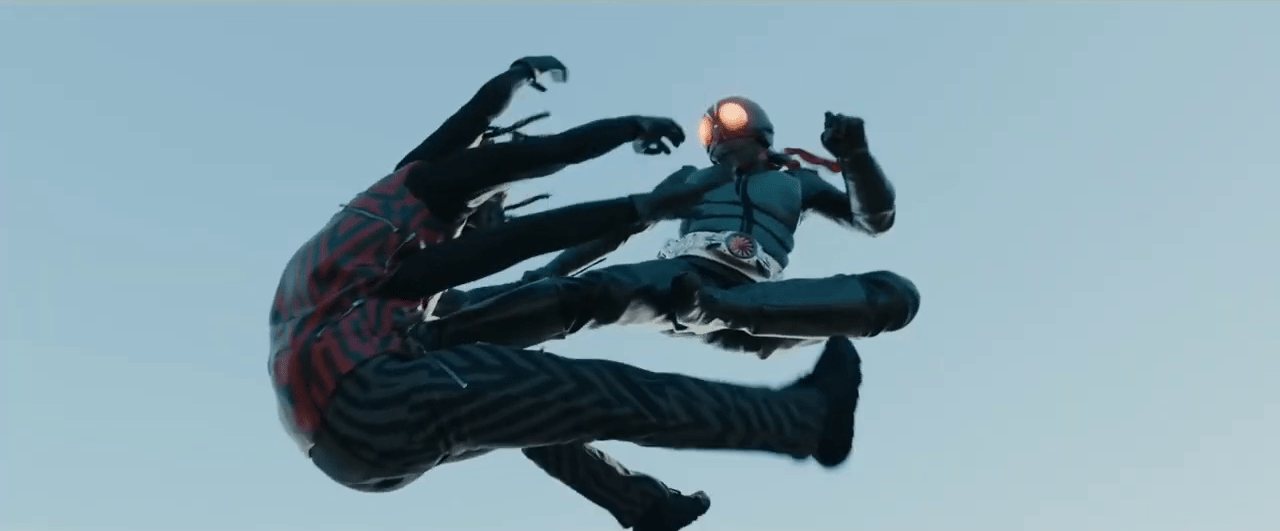
The composition of Shin-Kamen Rider is not only highly dynamic, but also has an engaging visual rhythm. Anno fluidly combines a wide variety of dynamic and static shots and uses the cut quite frantically to keep the visual rhythm in line with the narrative flow.
By combining rapid cutting with a rich variety of dynamic shots (i.e. shots that are dynamic as such or static shots that emphasize the dynamism of movement), Anno succeeds in creating highly enjoyable action set-pieces. Yet, Anno does not only frame the fighting sequences with an exciting and fast-paced dynamism, but he also elevates them by fluidly integrating splashes of gore and splotches of blood. Moreover, the action-moves (i.e. the jumps, the flying, … etc.) that are littered throughout the action sequences, while improbable and highly unrealistic, ensure that the action channels the quirkiness of the original series and maintains, at all times, its fun campiness (Cine-note 1).
The action-sequences are, in most cases, decorated by musical accompaniment. The music either adds a bombastic quality to a given scene or stimulates the campiness of the fighting-choreographies and the often quite silly special effects (Design-note 1, SFX-note 1).

Anno also utilizes POV-shots well in his composition. While these kind of shots are utilized for various characters, those used to stage Hongo’s perspective are most effective – they impact the spectator the most. This stylistic choice subtly invites the male spectator, who is more often than not driven by a desire to be desirable for the female Other, to identify with his position and makes it easier for him to enjoy the fantasy of being such phallic being for the female Other, embodied in this narrative by Ruriko.
With Shin Kamen Rider, Anno delivers an action-hero experience that is both incredibly fun and emotionally touching. While Anno’s tribute to Kamen Rider will never be considered a classic, his well-constructed blend of visual and narrative campiness, splurges of bloody gore, and emotional punches will satisfy fans as well as non-fans alike.

Notes
Structure-note 1: Some spectators will feel that there is too much exposition in the narrative. While this did not bother us that much, it is also an effect of Anno’s attempt to cram an entire series into a two hour movie.
Narra-note 1: The habitat Realmforces inter-subjective understanding on souls. It is a place where everyone’s subjective truth, conscious as well as unconscious, is laid bare. It does not take much time – just think about your fantasies, dreams and secrets – to realize the horrifying quality of such a realm. Moreover, the blending of all subjectivities, due to the lack of any boundaries, ultimately causes the coalescing and erasure of any kind of particularity whatsoever.
Narra-note 2: While the dynamic of mind control is only fleetingly touched upon, one can surmise that there is a certain addictive element to it. It is not only about overwriting sad memories with fake constructed euphoria, but by only granting euphoria by giving up one own’s will and desire.
Cine-note 1: Yet, while the visual flow is pleasant and engaging, Anno’s composition is littered with confusing cuts and continuity-problems. If the spectator can empty his/her mind, these strange jumps and gaps can be easily overlooked, but, for those who are looking for a bit more continuity and visual sense, these moments stick out like sore thumb. For a deeper look at some of the compositional problems, I glade refer to Patrick Galvan’s review: https://ourculturemag.com/2023/07/25/review-shin-kamen-rider-2023/
Design-note 1: The designs of the Aug’s are visually appealing. The designs and make-up do not only successfully echo the campiness of the original series but are also updating to fit better with the current visual and production standards.
SFX-note 1: Some action-sequences will surely feel too game-like for many spectator. Yet, in our view, Anno opted for this exaggerated style to pay tribute to the campy silliness of the action-sequences in the original series. This injection of visual silliness can, for some spectators, be a somewhat off-putting.
 psychocinema