Introduction
Conflagration (1958), adapted by Natto Wada and Keiji Hasebe from Yukio Mishima’s novel The Temple of the Golden Pavilion [kingakuji] (1956), is still considered by many to be one of the best literary adaptations Kon Ichikawa ever did.
While many things have been said about Mishima’s novel, the incident that inspired the novel and Kon Ichikawa’s film, a psychoanalytic analysis of Ichikawa’s narrative might offer a somewhat different perspective to revisit this culturally traumatic event.
Review
Not long after Shukaku Pavilion burns to the ground, the authorities discover a young apprentice monk in a comatose state in the hills behind the remains of the temple. The monk, Goichi Mizuguchi (Raizo Ichikawa), is immediately apprehended.
During the police interrogation, Goichi remains silent and stoic. The officers start wondering whether he is mentally ill – there is a possibility that he is schizophrenic – or just merely another post-war kid.

Conflagration is a narrative that, by tracing Goichi Mizuguchi’s breakdown, explores the subjective impact of the increasing malfunctioning of the Name-Of-The-Father within post-war Japanese society. Ichikawa’s film, adapted from Yukio Mishima’s novel, elegantly sketches out how the destruction that led to the end of imperialistic Japan complicates the position of the father for the post-war subject. How can the subject make use of the father after its position has been disfigured by the mushroom clouds?
To explore the struggle that Goichi has to find a support for the function of the father, Natto Wada and Keiji Hasebe created an elegant narrative structure that intertwines the present with subjective flashbacks. By following the rhythm of these flashbacks, it quickly becomes evident that they are function of signifiers that circle around the kernel of his struggle (General-note 1). What triggers the first flashback, for instance, is the police officer mentioning his familial history.

Yet, the inspector’s signifiers do not immediately lead to the uncovering of Goichi’s subjective logic. As the kernel of his struggle is something he tries to avoid and repress, the flashback that arises following the inspector’s signifiers skirts his subjective difficulty. Instead, the memory (flashback) that arises from his unconsciousness – i.e. his arrival at Soenji temple, is only vaguely connected to his essentially symbolic struggle.
The elegant play with signifiers continues within the flashbacks. The repetition of certain signifiers (e.g. father) heightens their ‘subjective’ importance and the linking of signifiers (e.g. father-Shukaku pavilion-beauty) slowly sketches out the symbolic field Goichi’s grew up in (Narra-note 1). Moreover, by utilizing the image as a signifier (e.g. Goichi’s facial expression of wonder while watching the roof of the pavilion), Ichikawa elegantly shows that his late father’s words impacted his son as subject.
The flashbacks within flashback that are so beautifully utilized within Conflagration follow the meandering of the signifier within Goichi’s mind – the second flashback, for instance, is caused by the signifier stutter. This signifier does not form the kernel of his subjective conflict, but it lies, from a topological perspective, closer to his subjective struggle than the moment of arriving at Goenji.
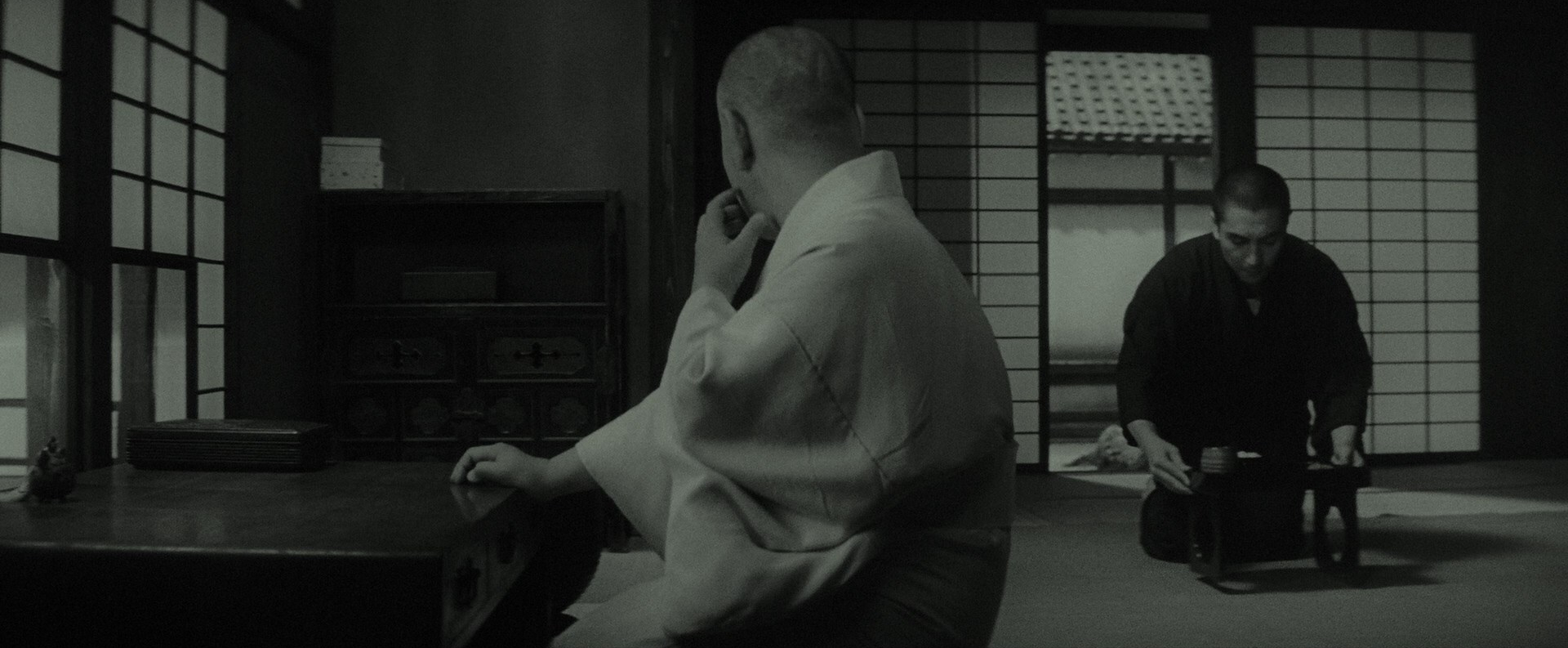
The sudden appearance of his mother (Tanie Kitabayashi) does lead to the introduction of the traumatic event that awaked his simmering subjective conflict – the discovery of her sexual infidelity. This discovery, which immediately precedes his father’s sudden deterioration and death, complicates Goichi’s attempt to idealize his frail father and force him into his function as Name-Of-The-Father (Narra-note 2, psycho-note 1). Yet, the impact of this event is not evident on Goichi’s subject as he succeeds in retaining a certain subjective stability by clinging to the idealized beauty of the Shukaku pavilion, a pavilion that due to his father’s signifiers has been raised to the status of the symbolic phallus. Goichi’s attraction to the beautifully erected temple and his singular dedication to its phallic heavenliness should thus be read as an attempt to safeguard the idealized image of the father and to ensure his function as Name-of-The-Father (Narra-note 3).
By then, it is quite evident that head priest Gosen (Ganjiro Nakamura), due to his similarities with the position of Goichi’s father, is burdened by him with the demand to support his idealised image of the father and fulfill the function of the name-of-the-father. Yet, as the narrative unfolds, it becomes clear that Gosen is unable to satisfy Goichi’s demand. Not only his enterprising attitude that causes him turn Shukaku pavilion into a tourist attraction after the war conflicts with the ideal Goichi wants to clothe him with, but also the revelation that he has a liaison with a Gion geisha called Somehachi is incompatible with who he needs to be.
The moment that truly instigate the crumbling of Goichi’s subjective position is the moment that he cannot but accept Gosen’s failure as an ideal father-figure – he cannot keep the monstrous mother away nor fulfill his fatherly duty. Due to this, Gosen, who is Goichi’s chosen object to perform and support the ideal image of the father, cannot hold the threads of our young monk’s subjectivity together anymore and the rhythm of his life goes astray. While he tries to call upon the symbolic father – “Tell me what you see in me”, the field of imaginary deceit and blindness that structures interactions exclude his appearance – the Other does not answer. This symbolic lack reverberates within Goichi’s inability to denominate himself.

So, how can we read Goichi’s act of arson? How can we understand his choice to burn down the architectural representation of the symbolic phallus? Goichi’s crime functions both as an acting-out, a message to the Other, and as a passage-a-l’acte, an attempt to radically disappear from the symbolic field. It is an act of castration, a violent creation of a lack in the symbolic, to confront the monks with their fatherly failure and their deceit and hypocrisy, as well as an attempt to cut the only tie he has with the societal field and fully become the subjective emptiness that the imaginary other refuses to see. Goichi’s act can, ultimately, also be read as a radical act of finding a kind of nomination, a last attempt to receive a signifier (e.g. felon) from the Other to qualify this emptiness he is without the symbolic father.
Ichikawa’s composition is quite simple and straightforward – a concatenation of static shots with, here and there, a fleeting spatial moment thrown into the mix. The strength of Ichikawa’s composition lies, nevertheless, in its subtle dynamic rhythm. By elegantly playing with the cut, Ichikawa does not merely emphasize certain moments of ‘geometrical ’beauty – e.g. the serene beauty of the temple architecture, but allows Goichi’s facial expression and his prolonged silence (i.e. his safely guarded unsaid) to not merely puzzle the spectator or signal a flashback, but also pull him into the narrative.
Conflagration depicts, quite serenely, the possible outcome of a subject’s failure to find, in a post-war landscape marked by the rise of capitalism, someone to carry the Name-Of-The-Father. With a thoughtfully structured narrative, one that relies on the concatenation of the signifier to sketch out the subjective logic of the protagonist, Ichikawa succeeds in echoing how the crumbling of the imperialistic dream played its role in making the father – imaginary as well as symbolically – malfunction for many subjects.

Notes
General-note 1: Even though the image of the onion implies that we are getting deeper and deeper into the subjective logic as the narrative progresses, the reliance on the associative nature of the signifier illustrates that the excavation of the logic of Goichi’s criminal act happens at the surface of language, according to the diachronic and synchronic dimensions of speech.
Narra-note 1: In the first flashback, Gosen recounts that Goichi’s father said that there is nothing more beautiful on earth than Shukaku pavilion.
Narra-note 2: The attempt to idealize his father is also, indirectly, highlighted by Goichi’s statement that he was sent by his father to Soenji to live his dream.
Psycho-note 1: Yet, all attempts to find an ideal father and a phallic rock to guide him end in failure. In this respect, the failure of his biological father to fulfill his function can be seen as the cause of Goichi’s stuttering. Due to father’s failure to deal with the (m)Otherly monster led to his inbality to find a safe space to speak from – the Other is always too close and too persecutory in nature.
Narra-note 3: The fact that the temple has the status of the symbolic phallus for Goichi is the very reason why it cannot be defiled by a woman and especially a woman marked by sexuality – be it his unfaithful mother or a passing pregnant Japanese woman.
 psychocinema