Introduction
With so many Japanese feature-length movies coming out, one would easily forget there is a very active short-film circuit in Japan. Every year, the Japanese Film Festival in Hamburg grants audiences a taste of the creativity of these short-film directors. This time, we have the honour to introduce one of Shunsuke Ishida’s latest works: Glitch.

Review
One night, Nozomi (Mao), a high school student who struggles with depression and an inferiority complex, suddenly finds herself in a desolate high-school. A bug-like monster (Maito Kudo) lurks around. Luckily, she can count on an armoured man (Tomonori Muraoka) to protect her.

Glitch is a sci-fi horror-action short that examines the often antagonistic relationship between the subject and the Other – the overpowering effect of the societal field on a subject that wants to secure his/her own place.
Ishida’s narrativeelegantly shows that the inner struggle of the subject is determined by the signifiers of the Other. The structure of the Other – its discourses, values, demands, norms, … etc. – creates a suffocating situation that forces the subject to internalize those negative signifiers and hinders him/her to attain a secure place within the societal fabric.
Such complex, determined by the signifiers in the field of the Other, is eventually revealed as monstrous. Yet, the monster does not represent the subject as such, but the mental infestation those external signifiers cause within the subject once they have become internalized. The strange voice that haunts our high-school girl is radically Other. As a result, the battle that unfolds between the man and the monster is a battle to eradicate this enjoying Otherness that poisons her subjectivity.
The composition of Glitch is highly dynamic. Due to its initial reliance on POV shots, the spectator is put in the shoes of the main protagonist. By forcing such identification, by letting the spectator’s gaze coincide with the subjective gaze of the main character, Shunsuke Ishida makes the various visual horror-elements (e.g. the sudden movement of desks, …etc.) more effective. With the dynamic action-sequence – the sixth minutes-long finale not framed in a POV perspective, Ishida proves that he has the skill to stage a fighting-choreography in an engaging and exhilarating way.
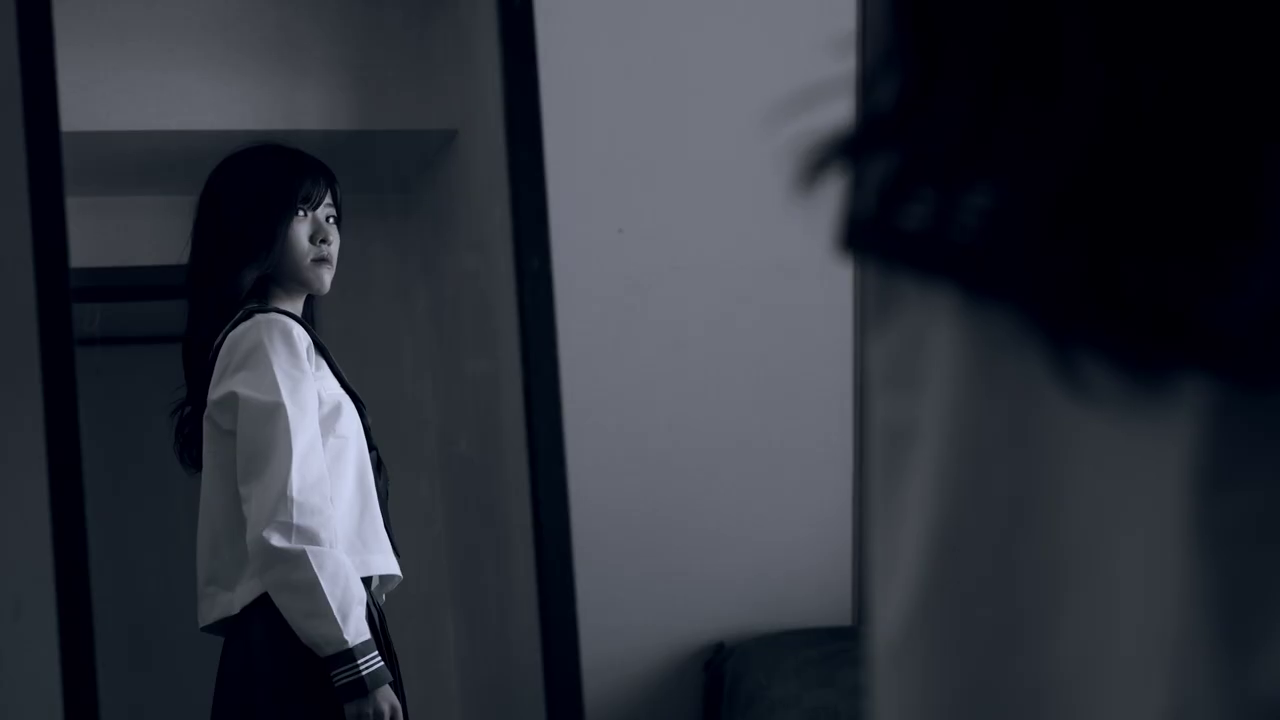
Of course, the effectivity of the visual horror does not only merely depend on the use of pov-shot, but also on the grainy darkness that marks most of the imagery. Ishida’s use of this commonly used visual element stands out due to its great compositional balance. His shots do not only allow the spectator to visualize the space to a certain extent, but also allows the darkness to attain its ominous character.
The third element that supports the horror-atmosphere is the effective sound-design. The ability of the spectator to hear the absence of sounds (i.e. the subtle rustle) does not only has an ominous flavour as such but makes the sudden bursting forth of sounds (e.g. the sound of moving desk, a door that suddenly closes, …etc.) more disturbing.
The CG elements are well-integrated into the visual fabric. While some moments are obviously computer-generated, their visual quality is good enough and their integration in the visual fabric fluid to allow the spectator to suspend his disbelief.
Glitch is a pleasant horror-action that beautifully shows that what can poison the subject is the Other he is subjected to. While the narrative element of the bug/glitch implies that mental suffering has merely an external cause – something that can be eradicated, Ishida’s short also visually echoes that this Otherness is the subject as such and that the subject has the power to rewrite the Other he has internalized.
 psychocinema