Introduction
2021 was the year that Yugo Sakamoto impressed international audiences with two action-narratives: Yellow Dragon’s Village (2021) and Baby Assassins (2021) . Of course, many fans he made with these narratives were eagerly awaiting what he would do next. With his sequel to Baby Assassins (2021) – which stars a guest-appearance of the quite popular girls-band group Atarashii Gakko!, the wait is finally over.

Review
One night, at a cheap restaurant, Yuri (Joey Iwanaga) and Makoto (Tatsuomi Hamada), two assassins, viciously complain to their manager Mr. Akagi (-) when they hear that they won’t receive any pay for their hard work due to a mistake from one of the higher-ups. As they are but mere sub-contractors, part-timers not part of the assassin’s guild, they cannot expect to be treated better.
Then, suddenly, Mr. Akagi proposes to murder two full-time assassins so that they can seize their positions. While Makoto is reluctant to the idea of murdering professional assassins, Yuri is immediately on board with Akagi’s plan. Their targets are Chisato Sugimoto (Akari Takaishi) and Mahiro Fukugawa (Saori Izawa), two assassins who have just heard they need to pay an enormous amount of outstanding fees for their gym membership and their insurance.
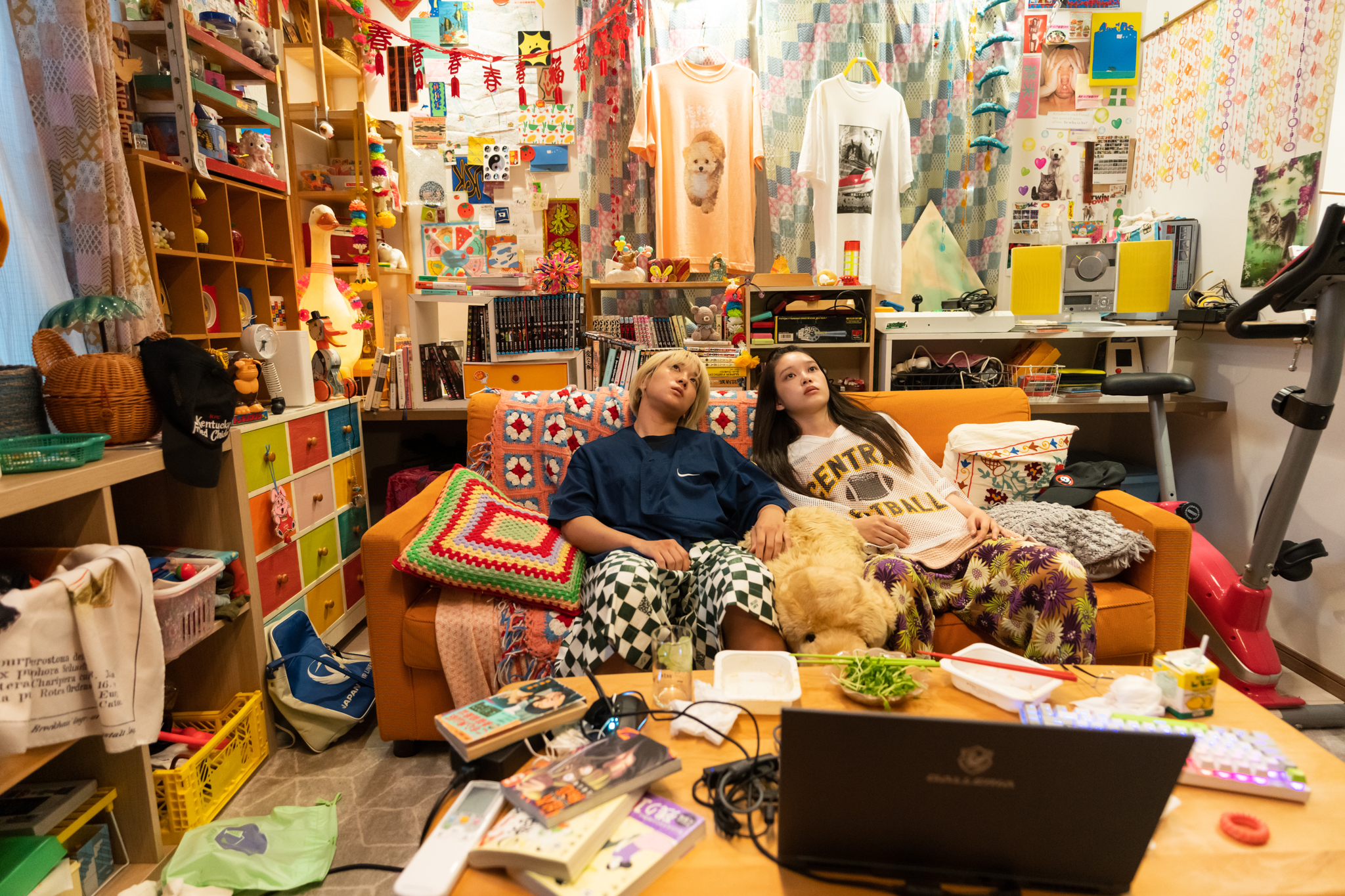
Baby Assassins: 2 Babies is the kind of sequel that does not seek to make things bigger, but merely doubles down on what made the first narrative so enjoyable: the fight choreographies and the relational or ‘buddy’ comedy. Due to the emphasis on comedy, it is not surprising that Sakamoto’s film, once again, avoids depicting both assassins in their usual habitat, i.e. working together to complete contracts. He re-utilizes this kind of situation to highlight, once again, that an amical bond is not without tensions and frustrations and to reveal how two friends resolve such relational tensions with ease.
So, how do they end up in a situation that forbids them to act in accordance to their assassin-ego? It is the need to level their debts that leads to their suspension form the assassin’s guild. Despite arriving on time at the bank, their attempt to pay their insurance fees is thwarted by a bank robbery. The result of their violent intervention: a fearful reaction of the hostages that prevents them from paying and a temporarily suspension. To makes ends meet, they are, once again, forced to find a part-time job.

The inclusion of another pair of assassins is not only utilized to structure the narrative, but also to be able to explore two different relational dynamics. Rather than emphasizing the contrast between the two teams, Baby Assassins: 2 babies reveals Makoto and Yuri as being a mirror-image of Chisato and Mahiro. Were it not for blindly following their phallic desire to make it as professional assassins – a desire that instigates violent rivalry, the four of them could have easily established a more amical relationship.
The comedy in Baby Assassins: 2 babies is mainly function of speech-interactions. While most comical moments are born from the interactions between Chisato and Mahiro, some light-hearted moments are due to the characters our baby assassins encounter. In the former case, Sakamoto exploits the conversational flow and the emotional rhythm of their speech to deliver punchlines and certain twists, while in the latter case Sakamoto playfully subverts the spectator’s expectations, contrasting the characters’ appearance with their peculiar subjective logic, to deliver light-hearted situations and pun-like moments.

Just like Sakamoto’s Baby Assassins,the composition of his sequel has a dynamic visual rhythm. This dynamic rhythm, function of Sakamoto’s rich use of dynamic shots and his effective cutting, does not only merely engage the spectator in the narrative, but allows Sakamoto to frame his meticulously choreographed action-sequences in a delightful dynamic way, a way that strengthens the impact of the punches and kicks and allows the beautiful choreographies to fully shine. The decorative use of slow-motion is another way Sakamoto utilizes to heighten the impact of certain kicks and to punctuate certain dramatic moments within the fight.
Luckily, Baby Assassins: 2 babies does not offer a mere repetition at the level of its action sequences. For his sequel, Sakamoto explores other action-dynamics, like the grittier brawl that opens the narrative or the integration of more comical moments in the action-choreographies. Yet, even with these fluidly integrated comical flourishes, the pleasing sound-effects (e.g., the gunshots, the dull sounds of the kicks and punches, the swishing sounds, … etc.) and the presence of blood emphasize the vicious and energetic nature of the brawls.

The performances of Akari Takaishi and Saori Izawa are, just like in Baby Assassins, pitch-perfect. Akari charms the spectator with her child-like bubbly kawaii-ness and Saori Izawa delights with her dry aloofness and dead-pan way of talking. Yet, what makes the light-hearted moments and the comical punch-lines truly put a smile on the face of the spectator is their highly effective on-screen chemistry – the effective clashing of their personalities. Yet, only emphasizing the performance of our two leads would be unfair to the quality of acting the other members of the cast display. While Akari Takaishi and Saori Izawa are, of course, the driving force of the narrative, carrying the many conversational comical moments, the pleasure delivered by the situational comedy (e.g. the bank-robbery, …) as well as impact of the fighting-sequences is also supported by the great performances of the other actors (Acting-note 1).
Baby Assassins: 2 babies delivers everything that the spectator would want from a sequel to Sakamoto’s buddy-comedy: satisfying action-choreographies and a bloody great relational-comedy about the bumps that mark any amical relationship. Sakamoto’s latest film has such a irresistible charm, thanks to Akari Takaishi and Saori Izawa’s pitch-perfect performances, that even those who normally shy away of action or comedy narratives will leave satisfied.

Notes
Acting-note 1: Tatsuomi Hanada, who plays the awkwardly-in-love and childishly insecure Makoto, and Joey Iwanaga, who plays the cool-headed Yuri, also do their part atdelivering light-hearted moments and comical punchlinesin an effective way.
 psychocinema
3 Comments Add yours