In the late sixties, the ninkyo genre began losing its appeal for audiences as the political turmoil that swept the world problematized the nostalgic idealization of patriarchal values. Audiences began to see the patriarchal ideals – e.g. giri and inase – staged within these films for what they truly were: nostalgic fantasies that never existed. Luckily, in the weaning days of the ninkyo genre, Toei succeeded in delivering the genre’s carmen cygni with the Red Peony Gambler series.

Be sure to also read our review of Red Peony Gambler (1968) and Red Peony Gambler: Flower Cards Game (1969).
Each film in this series stages in their own way the triumph of a fictional constellation of patriarchal values over the capitalistic reflex that was secretly perverting the old ways. Yet, the latent conflict between traditionalism and capitalism featured in these films can easily be reformulated in terms that reveals the subtle political conservatism of the Ninkyo genre, a conservatism that ultimately led to the genre’s demise in the early seventies. What the Ninkyo genre warns against is nothing other than perceived danger of individualism and subjectivity – i.e. desiring on and for one’s own – by celebrating the victory of a subject whose logic is strictly determined by a romanticized version of traditional ethical Other.
In Yamashita’s Red Peony Gambler, Oryu, the a-subjective instrument of the traditional Other, seeks to put a stop to Koso Kakuai and his capitalistic desire. In Norifumi Suzuki’s sequel, Red Peony Gambler: Gambler’s Obligation, Oyru ultimately takes on the task to defeat not one but three representations of such disruptive capitalistic desire: the loan shark, the ethically corrupt yakuza, and a fraudulent gambler (General-note 1).
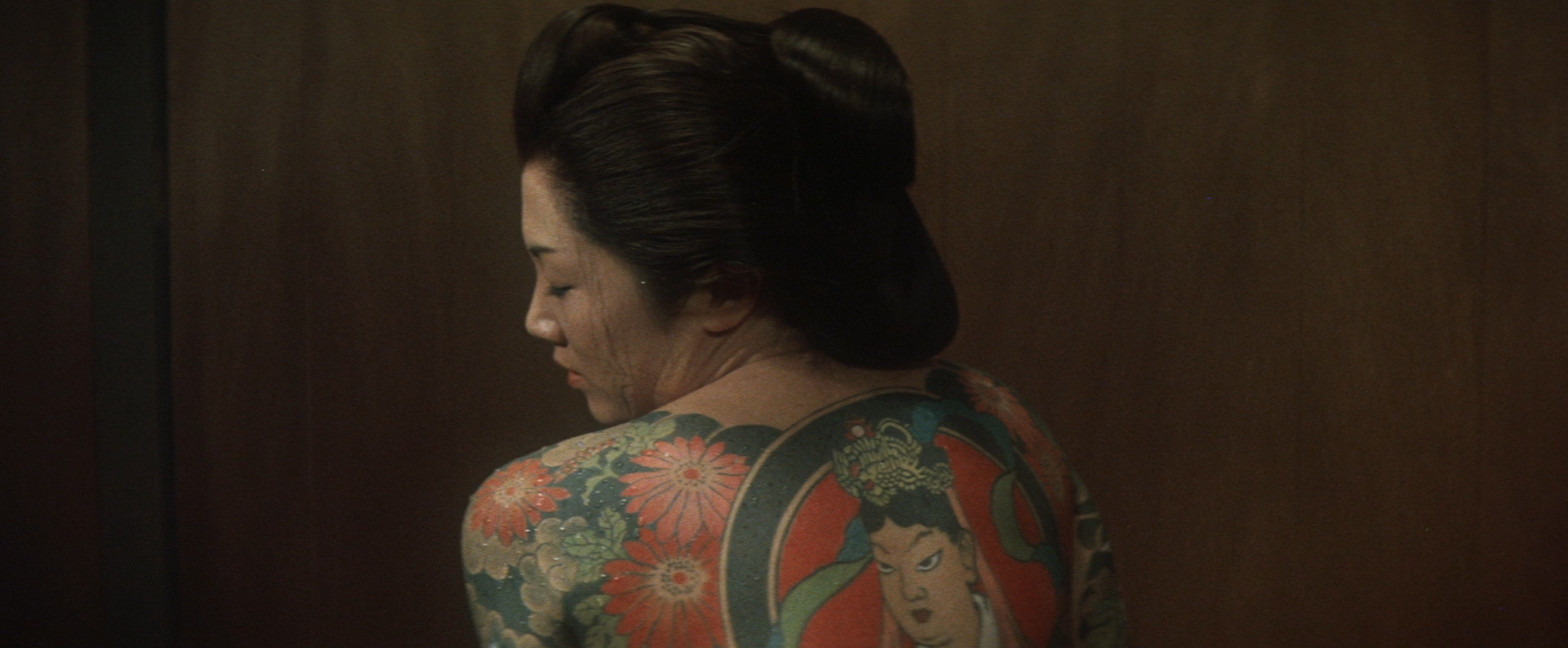
Before delving into the various personifications of the capitalistic desire, as that which disturbs the social equilibrium, it is important to analyse the differences between the structure of Yamashita’s and Suzuki’s narrative and grasp the different way they seek to engage the spectator in Oryu’s trajectory. In Red Peony Gambler, the director establishes a relation of similarity between the spectator and Oryu and synchronises, as much as possible, the emotional trajectory of the spectator and the narrative’s lead. The spectator invests in Oryu’s narrative because he accepts Yamashita’s invitation to identify with her position.
Suzuki, however, exploits the contrast between the spectator’s knowing and Oryu’s ignorance to introduce an emotional distance between the spectator and Oryu, a difference of perspective (Narra-note 1). He invites the spectator to instrumentalize this gap and invest in Oryu’s trajectory of uncovering the rotting influence of capitalistic desire from a different emotional place, from the place of being disgusted with the ravage caused by capitalistic desire. However, the effectivity of this structural gap to engage the spectator heavily relies on his pre-existing identification with Oryu. Suzuki, in other words, structures his sequel around the spectator’s acceptance of Yamashita’s invitation and aims to leverage the spectator’s pre-existing identification with the red peony gambler.
From this slightly more oblique perspective, the spectator is introduced to the three personifications of capitalistic desire. The spectator is, first and foremost, confronted with the figure of the loan-shark – e.g. Gisuke Kuramochi (-). The disruptive presence of this figure is highlighted in the scene where the silk-farmerscomplain to the Eisuke Togasaki (Michitaro Mizushima), the oyabun, about the way these thirsting shadows operate. Their singular focus on exploiting the misfortune of the common folk (i.e. their financial lack) and their brutal schemes to keep the festering financial gash wide open to be able to keep profiting and enjoying puts them radically beyond the field of ninjo (human emotion) and giri (socialized duty).
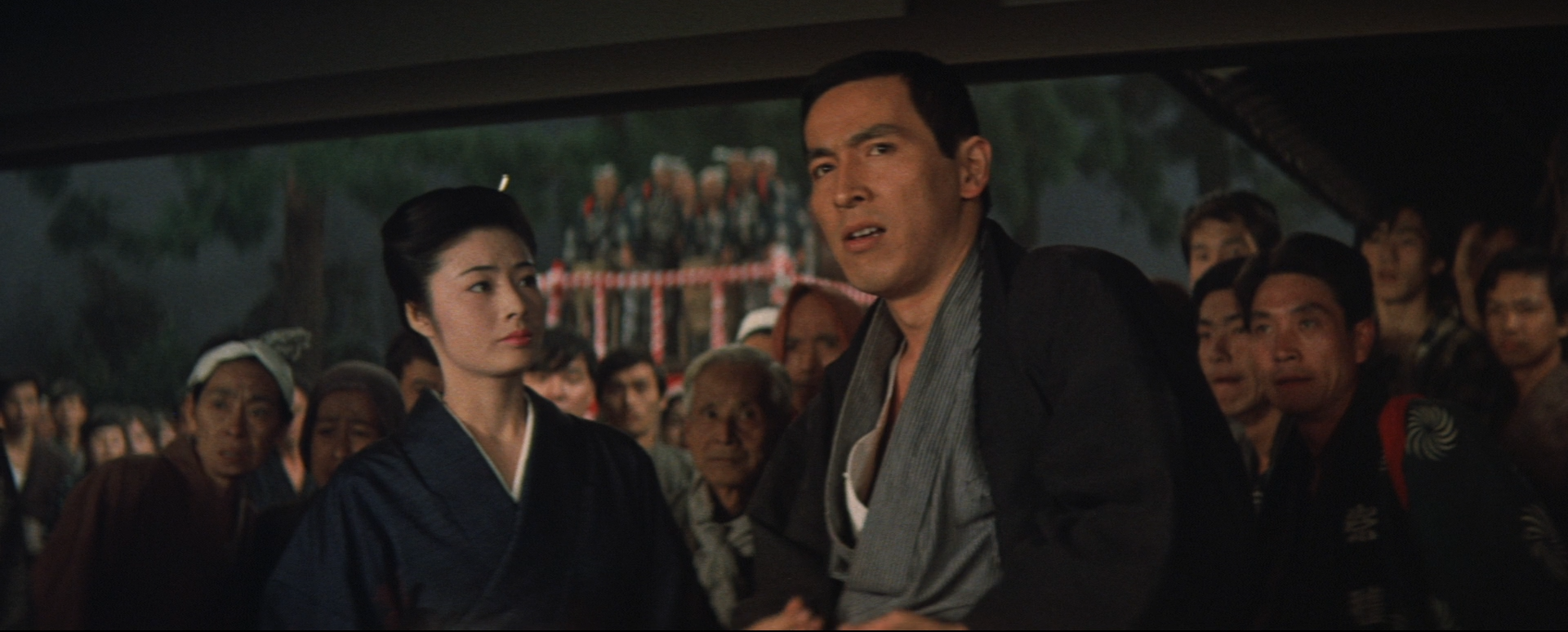
That these subjects, despite their suitable societal facade and embedment within the social field, poison the traditional Other is emphasized by the signifier that one of the silk farmers enunciate to denote them: oni (i.e. the cruel and malicious creatures that traditionally feed on people in Japanese folklore). It should be evident that what invites the loan-shark to violate and pervert the law of the traditional Other is nothing other than seductive nature of capitalism. The whole money-lending business thrives on a distorted desire for objects (e.g. money) that merely aims at satisfying one’s selfish need for pleasure and, by giving rise to an obsession with possessing excremental objects, renounces and refuses desire’s ultimate aim: the Other’s love.
The second figure, the ethically corrupt yakuza, appears somewhat later in the narrative. To amplify his violent appearance within the traditional Other, Suzuki first accentuates the chivalrous nature of the yakuza. In the scene following the silk farmers’ lament to the oyabun, Yukichi Togasaki (Kunio Murai) tries to convince his father to act against the societal leeches. Yukichi’s plea has no other aim than to frame yakuza as Ninkyo Dantai, as conservative brotherhoods who grant their members a codified signified – jingi, the moral code, organizes and stuffs the ego – and justify their symbolic existence by fighting societal wrongs and protecting victims of transgressive desires.
Yet, the idealized image of chivalry is nearly immediately punctured within the narrative by revealing that Yaichiro Kasamatsu (Bin Amatsu), an ambitious member of the Togasaki family, devised a scheme to exploit the farmers’ debts to violently enslave their children in a big silk factory, destroy the Togasaki family, and take hold of their territory. Of course, he hides this crude exploitative scheme to make profit and gain enjoyment by reflecting within the societal field, an image of chivalrous generosity – i.e. the helping hand that rescues that poor.
The third image of capitalistic desire is the minor character Oren (Mari Shiraki), a gambler, and her demasculinised husband Yasu (Eriko Nishioka). After her cheating ways to gain access to pleasure are exposed, her character transforms into an illustration that, within a system dictated by corrupted desire, the one who holds most power can obtain, by force, the most enjoyment and violently exploit the other as he sees fit.
Yet, Suzuki’s Red Peony Gambler: A Gambler’s Obligation does more than merely framing capitalistic desire as evil and destructive with respect to the patriarchal Other. By adjusting the dramatic and the comical dimensions of his narrative, he ultimately succeeds in staging the truth of desire.
Suzuki does not, like Yamashita, utilize his narrative to reiterate how suffocating the traditional Other for the female subject can be, but to underlines how different societal discourses split the subject (Narra-note 2). The dramatic turns within Red Peony Gambler: A Gambler’s Obligation introduce Oryu as a subject split between her lost female past, the subjective logic of lack and desire she left behind (ninjo), and her radical inscription, via the Red Peony tattoo, into the moral code that expels all lack and desire (giri). By emphasizing this subjective split, which ripples her emotional stability, Suzuki succeeds in reveals that no symbolic system, no programmed moralistic code, can silence or repress desire or desire for desire as such.
Instead of using the comical dimension to stage the clash between a female subject, who assumes the logic of the inhibiting instance, and this restrictive patriarchal Other, Suzuki uses bursts of light-heartedness to investigate the farcical quality of sexual desire. The duo Roku (Ryôichi Tamagawa) and Shichi (Shingo Nishimura) offer the spectator comical relief by the way they chase their desire for the ‘phallic’ Oryu. Kumatora (Tomisaburo Wakayama), on the other hand, offers the spectator a comical representation of the castrated position that animates a subject’s desire. It is the assumption of a lack that compels the subject to seek an image that sparkles, an image that, by glittering in the subject’s eye, signals his/her phallic quality.
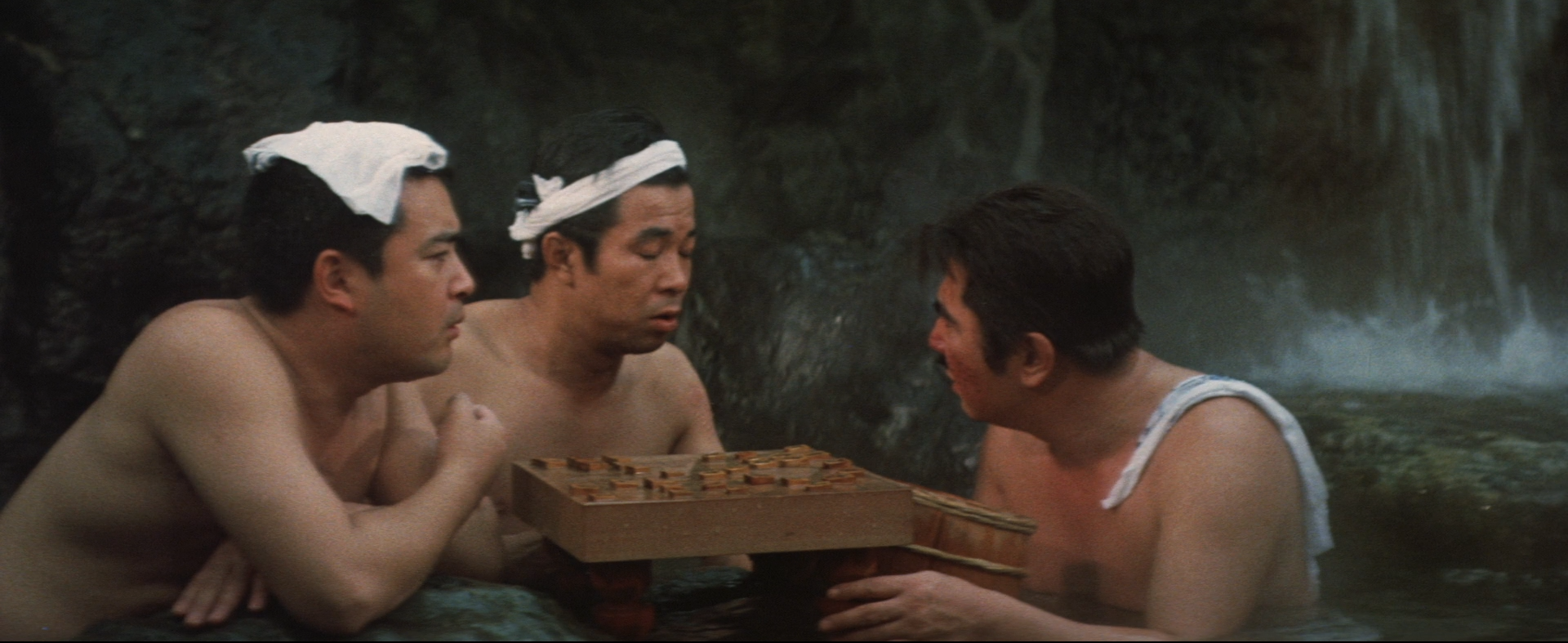
Suzuki’s comical investigation of desire allows him to underline the exact point where every societal system fails. All three figures emphasize in their own comical way that what fundamentally perverts the symbolic network of ethical rules is nothing other than sexual desire as such. The chivalrous dictates of the traditional conservative Other aim to suppress sexual pleasure, yet structurally fails to do so.
The three different versions of desire staged within Red Peony Gambler: A Gambler’s Obligation all point to the same truth: the societal Other, which gave birth to the subject’s desire, ultimately cannot contain desire nor rob it from its rippling agency. Whatever shape desire takes – a perverted capitalistic desire, a nostalgic desire for desire, or an overt sexual desire, it will always be at odds with the ethical demands of the societal system and initiate transgressions, harmless as well as harmful ones.
Norifumi Suzuki’s composition shares a lot of similarities with Kosaku Yamashita’s composition for Red Peony Gambler. Just like Yamashita, Suzuki utilizes simple colour-schemes and leverages the simplicity of traditional Japanese interiors to purify the geometrical dimension. By simplifying the spatial dimension and subtle flattening it, Suzuki does not merely seek to accentuate the principal compositional lines that structure the shots, but to emphasize the elegance of Oryu’s presence, the beauty of her facial lines, within the narrative frame.
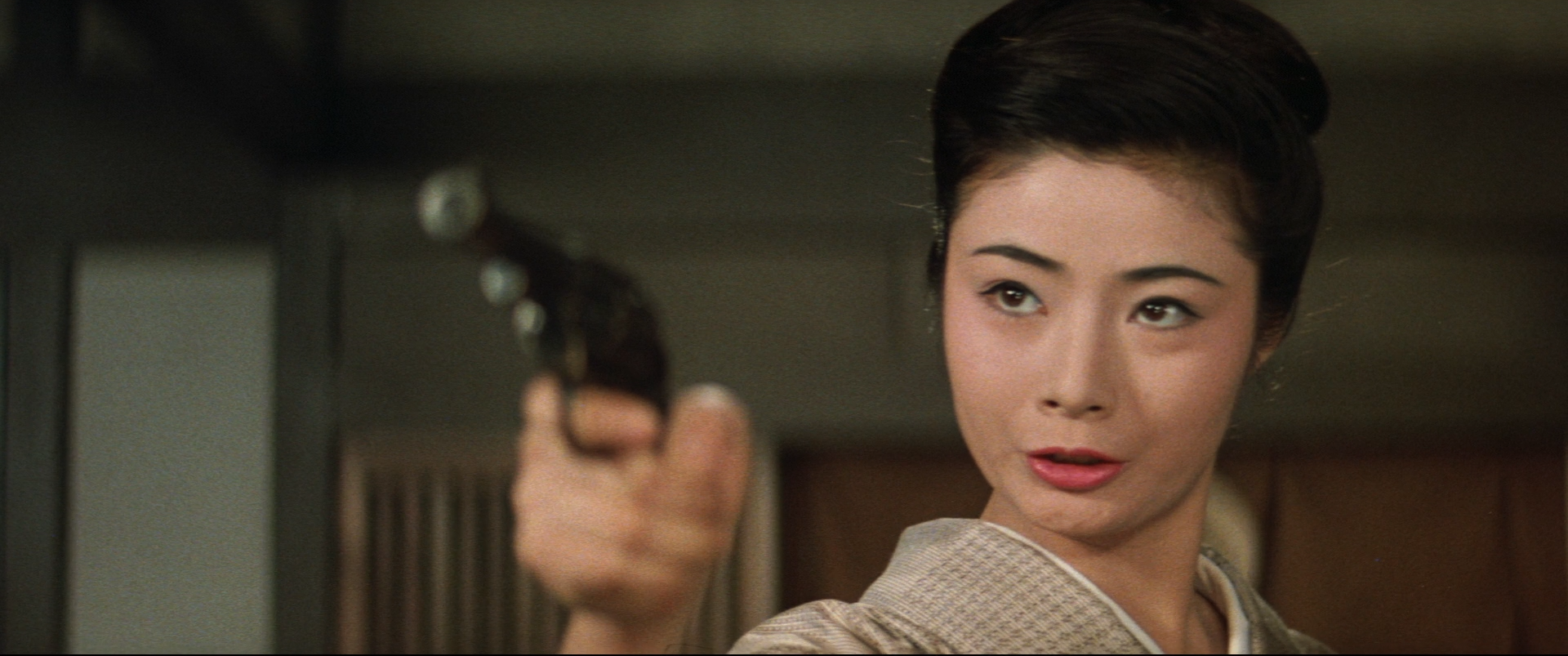
Suzuki cheekily reveals his compositional aim as well as the truth of Junko Fuji’s attraction via Roku and Shichi’s enunciations – “She’ll be my boss”; “Yeah, super pretty (beppin)”. The many close-ups of Oryu do not only invite the spectator to visually ravish Fuji’s facial lines, but the very manner by which she embodies the impossible phantasmatic patriarchal ideal and subjects herself to the mathematical functioning of the jingi. The composition, by emphasizing her a-subjective presence as well as her faltering subjection to the male logic of the chivalrous code, enables the spectator to visually enjoy the ideal image of patriarchal female beauty and her ninjo (emotional expressions), but also nostalgically long for a patriarchal past of ninkyo and giri that never was.
Yet, despite the compositional similarities, Suzuki also infused his own artistic sensibilities into the visual fabric. The main difference between both directors is their approach to framing cruelty. While Yamashita prefers a more indirect framing of the impact of violence, Suzuki tries, as much as possible, to frame the cruelty caused by capitalistic desire (torture, rape, … etc.) and the enjoyment it generates in a confronting and direct manner. Suzuki exploits this more explicit framing of violence to evoke the spectator’s disgust and his support for Oryu’s righteous vengeance.
Norifumi Suzuki delivers with Red Peony Gambler: Gambler’s Obligation another Ninkyo classic. Yet, what invites us to qualify Suzuki’s narrative as a classic is not simply his continuation of Yamashita’s visual adoration of Junko Fuji, but his effective transformation of the Ninkyo thread into an exploration of the transgressive nature of desire as such.

Notes:
General-note 1: In this regard, it is not unimportant to underline that all the films in the series are written by Norifumi Suzuki.
Narra-note 1: While Yamashita eventually introduces a similar gap between knowing and ignorance in his narrative, he mainly relies on the dynamic of identification to engage the spectator. Suzuki, on the other hand, instrumentalizes such gap from the start and convinces the spectator to root for Oryu by confronting him directly with the destructive impact of an unchained capitalistic desire.
Narra-note 2: In the narrative, ‘happiness’ is revealed as lying between capitalistic perversion and the radical subjection to de-subjectifying logic of jingi, the moral code of the yakuza. Yet, for the patriarchal Other, for the female subject happiness cannot but have a motherly shape.
Oryu encounters the discourse of the motherly ideal as the form of female happiness when Shiraishi (Bunta Sugawara) tells her that he thinks [that] a sewing needle will fit (…) [her] better than a knife.
 psychocinema
2 Comments Add yours