Human subjects are, however we turn, marked by the subjectivity of our familial environment. However, the signifiers and acts within the familial situation do not only offer the building blocks for our ego, but also have a crucial impact on our unconscious, the foundation of our conscious life.

In his first feature film, Mojiri Adachi explores this psychological idea by focusing on the subjective effect of intergenerational trauma – the trauma of being Zainichi and of the Great Hanshin earthquake. The narrative opens with the depressive decompensation of Akari Kaneko (Miu Tomita). The spectator, bewildered, sees a young woman standing at the border of her own gaping lack of existence – “I have nothing”. “No desire to do anything; why must I live”; “What is a family, anyway. I just don’t know”.
While The Harbor Lights opens with a heart-breaking non-chronologic opening – Akari’s decompensation, the main structure of the narrative unfolds chronologically, a slice-of-life structure of loosely connected fragments. While the loose nature of this concatenation might, at first, be somewhat confusing for the spectator, each sequence is an elegant brushstroke that sketches out the impact of the Great Hanshin Earthquake and being a Zainichi on subjectivity and social bonds, slowly paints the logic of different familial members (Miyu (Mariko Ito), Koichi (Yuzu Aoki), mother Emiko (Yumi Aso), and father Kazuo (Masahiro Koumoto)), and contextualizes Akari’s decompensation.
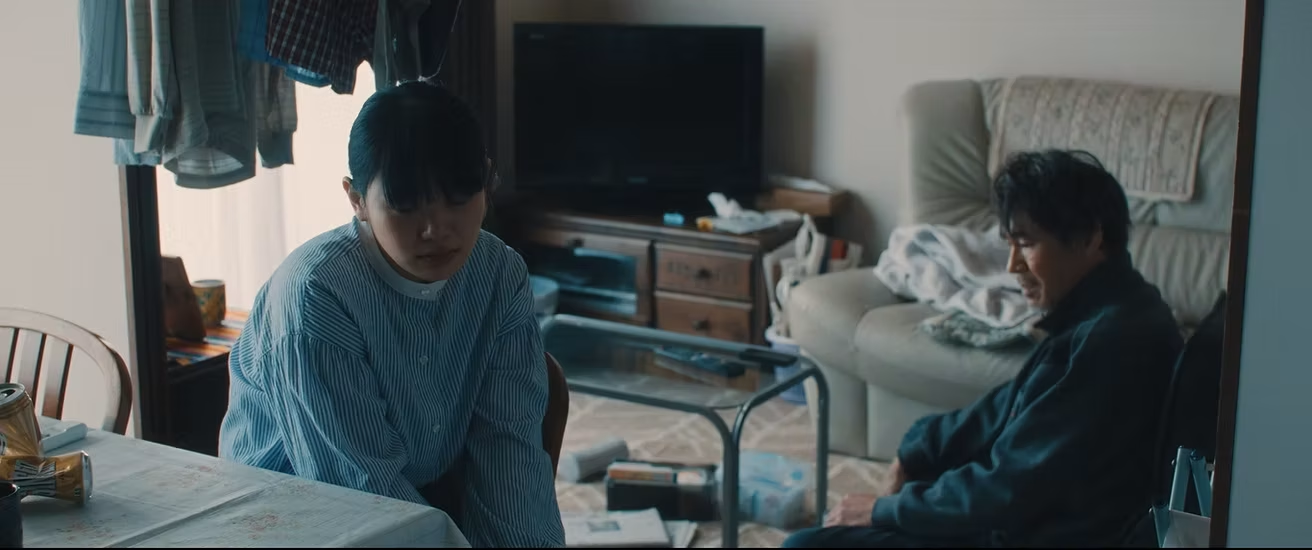
Some spectators might remark that the subjective effect of being a zainichi within the Japanese societal field is mainly talked about, instead of shown (e.g. Miyu talks about becoming Japanese to safe her future children from possible discrimination).
Yet, the way The Harbor Lights approaches this kind of discrimination within the narrative subtly emphasizes that what Zainichi suffer from within the Japanese societal field is function of the symbolic, of the signifier – they are not victim of their descent, but of its signifier. While most of the Zainichi are culturally Japanese, the Other’s knowledge of their descent – introduced either through the written or the uttered signifier, still succeeds in arousing a tangle of Anti-Korean prejudices in some Japanese subjects (General-note 1). Or, to put it differently, if the signifier of their descent is not known – elided from interactions, these subjects are treated by the Other as belonging to the same cultural sphere (Narra-note 1).
Yet, the societal struggle of the Zainichi rears its head also in a different way, via intergenerational and intrafamilial conflict. Akari, Miyu, and Koichi are indirectly subjected to the hardships of the past through the signifiers of the father and the mother. Kazuo is blinded by the hardships he and his parents had to endure as Zainichi and is unable to acknowledge the subjective struggles and desires of his children (General-note 1).
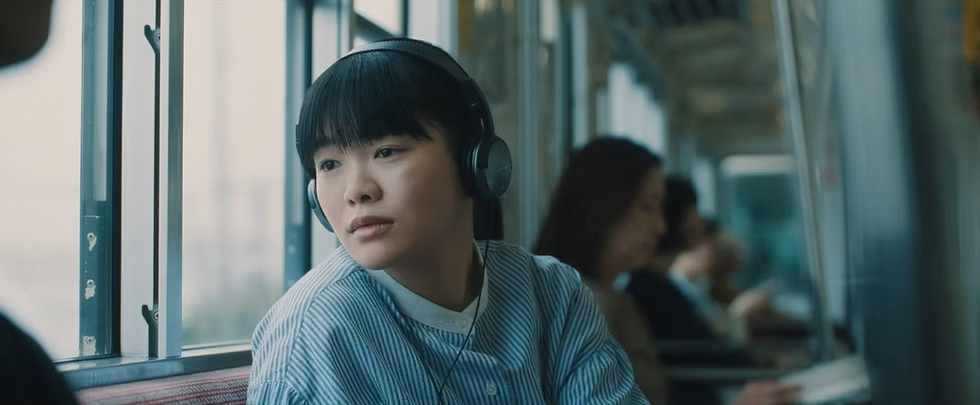
Both dynamics emphasize that the discrimination and the hardships of the past, by structuring the subjective position of the parents and forcing the father to radical dismiss his children’s voice, deeply affected their subjectivity, indirectly forcing upon them a trauma whose burden is felt at the level of their ego and their relation to the Japanese Other. In Akari’s case, one could argue that the familial dynamic kept her ego in a frail state and the stress of living by herself led to its completely collapse – its depressive decompensation.
The first psychiatrist Akari visits erase her subjectivity, dismissing her subjective statements, by filling the lack in her statements with prescriptions of sedatives and sleeping pills. Not much later, a former high school friend introduces a different clinic to her: Tomigawa clinic.
Can Akari find a way to grasp something of what subjective dynamic her depression is an expression of at this new clinic? Can the insights she gains in the psyche help her to understand something of her father’s stance and assuage the subjective burden of his past (Psycho-note 1)? Can a frail ego (Akari) or a fortified ego (the father who is married with his own suffering) for that matter openly receive the signifiers of the Other and accept the subjective truth that resounds in the Other’s utterances (Narra-note 2)?
In the latter half of the narrative, Adachi re-approaches the same dynamic – the inter-generational dimension of trauma and its subjective effects – from a different perspective. Yet, rather than Akari being subjected to it, she is brutally confronted with the effects of this dynamic at her new workplace.
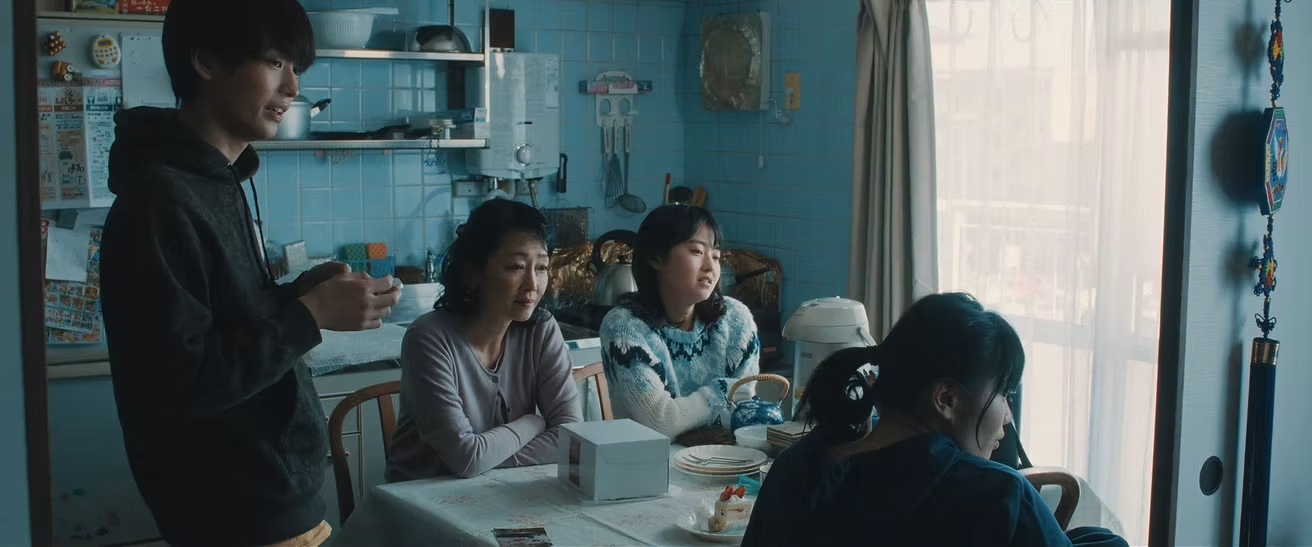
However, The Harbor Lights is not simply a narrative about inter-generational effects of trauma, but also about the importance of the encounter – of sending and receiving signifiers – and interactional dynamics that are able to support the fragmented expression of one’s subjectivity. The signifier is essential in all our dealings with the Other, allowing different ethnical threads to be sewn together into a community-fabric and creating the necessary frame for the exchange of small acts of kindness to happen, for subtle corroborations of the wish to connect and form a community to be exchanged.
Adachi succeeds in making the spectator realize that a fabric of connections is of incredible importance for the subject who, due to intergenerational familial problems, struggles to stabilize their ego. Without a tight knit fabric of social bonds, these subjects run a higher risk to fall through the loosely sewn treads of their social environment into the dark abyss of their destabilized ego, into the hands of their unresolved and untouched complexes (Psycho-note 2).
Taking a closer look at Moijri Adachi’s composition, we conclude that he aims to establish himself as a master of atmosphere. He organizes or orients all elements of his composition to create a sensible atmospheric frame upon with the emotional flow of the main character can be amplified (Cine-note 1).
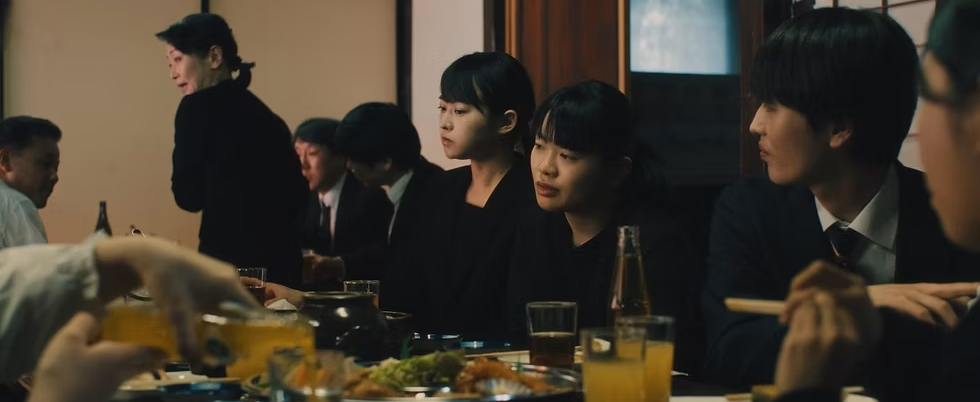
The subdued rhythm of the narrative, in part due to Adachi’s reliance on long takes, is not only effective in making the many evocative images come to their full right, but also in confronting the spectator with the expressed emotions in a more direct way. In the case of the former, the long takes allow certain images, by silently interacting with the enunciated signifiers, to attain a more poetic touch, while, in the case of the latter, the bodies of the cast give the enunciations of their characters a more direct emotional depth – emotions pour into the flow of speech and in the interactional ebb and flow – or emphasize silence, a lack of emotions – the subjective lack becoming a spatial presence (Cine-note 1).
Adachi fully understands that sound-scapes which envelop the spectator pulls him into the spatial atmosphere of the given scene. In most scenes, he adds some diegetic sounds that, by encountering the sounds of enunciating, allows the spatiality of the narrative space come to life – e.g. the faint horn of the ship far away, a truck passing, the sound of a moving train, closing of a door, rumbling of an engine, … etc.
There are, however, some exceptions within the narrative. At certain moments in the narrative, Adachi gives sounds of emotionality (e.g. uncontrolled breathing, … etc.) a rather oppressive presence within the narrative space. In these cases, Adachi nearly always utilizes an austere visual frame (e.g. the sight of ships in the far-away coastal area, a shot of the closed bathroom door, …etc.) to further emphasize the spilling over of emotions and heighten their impact on the spectator.
The beauty of Mojiro Adachi’s The Harbor Lights does not only lie in the touching and atmospheric narrative it stages, but in the fact that the film, due its subtle evocative nature, invites the spectator to think through the dynamic of inter-generational trauma – the dimension of loss – and the destabilizing effect of (structural) discrimination long after the credits have faded. Highly recommended.

Notes
Narra-note 1: Naturalisation is, in this sense, a way to avoid the Korean signifier and its relational, subjective, and societal effects. One could argue that, for some subjects, the Japanese signifier is utilized as a protective shield – shielding all negativity associated withe the Korean signifier away – to allow themselves to explore their Korean descent in peace.
General-note 1: For some more information concerning the shifts in how Zainichi were treated from after the second world war till today, we gladly refer to the following website: https://spice.fsi.stanford.edu/docs/koreans_in_japan
For our purposes, it is sufficient to highlight that while the more structural forms of discrimination have disappeared – due to various changes in the Japanese law, Zainichi are often unable to avoid the demeaning and discriminatory acts by Japanese subjects who bathe themselves in right-wing fantasies of Japanese-ness and societal harmony (wa).
The father represents the older generation of Zainichi who deem naturalisation as a radical act of Ethnic betrayal.
Narra-note 2: Akari’s father’s stance, in fact, resembles the stance of the older guy who loudly expresses his discontent with renovating the decrepit market. Both are driven by a fear of change, of losing something they deem to have a material/physical quality. Others, however, seek to honour the past by investing in its future, even if it means radical change.
Psycho-note 1: One insight is that anxiety often takes the form of anger. To put it somewhat more psycho-analytically, it is because the fear lacks signifiers, because fear remains a vague sense of turmoil, that it can take on different emotional forms.
Psycho-note 2: We must emphasize that the treatment Akari receives at the clinic is highly insufficient. She merely learned some techniques to re-stabilize her ego when the threat of disintegration rears its head – her unconscious struggles are left untouched. One way this is indicated in the narrative is the fact that Akari never verbalizes any signifier concerning her descent to the Other.
Cine-note 1: To introduce the spectator to Akari’s workplace, Adachi takes his time to sketch out the factory’s atmosphere with a combination of long takes and dynamic shots.
Cine-note 2: Adachi’s composition is not without dynamism. In general, he utilizes slow-spatial dynamism to add some variety into the composition and tracking shots to re-emphasize that Akari’s subjective trajectory forms the narrative’s emotional backbone.
 psychocinema
2 Comments Add yours