Language and culture are intrinsically linked together. Subtly changes in the way language is utilized within social contexts betray slight cultural differences. Masanori Tominaga (Pandora’s Box (2009), Vengeance Can Wait (2010), Pumpkin and Mayonnaise (2017), Dynamite Graffiti (2018)) takes the fact of societal twists and subtle speech-differences within different regions in Japan and as his subject in his latest film, Strangers in Kyoto.

In Tominaga’s film, we follow Tokyoite Madoka Shibusawa (Mai Fukagawa) as she, as wife of Mario (Ritsu Otomo), the heir of a centuries-old artisanal folding-fan shop, ventures into a subtly different cultural environment. While things start well with her parents-in-law, offering her lots of material and introducing her to other proprietresses to create a manga about traditional businesses in Kyoto, she soon finds herself struggling to adhere to the unwritten interactional rules – i.e. the social etiquette of Kyoto, that determines and structures interactions.
The light-hearted drama of Strangers in Kyoto is function of three interlocking dynamics: the fact that the very act of uttering signifiers gives rise to multiple signified, that imaginary speech in function of the social ego suppresses the subjective, and that a structural difference exists between the social image – socialized ego – and one’s subjective position – one’s private ego (Psycho-note 1). Tominaga’s film beautifully shows that the utterance of signifiers, by playing with and manipulating different levels of meaning, makes the gap between the social image, as determined by social expectations, and the ego, who resides behind this oppressive image of politeness, truly palpable.
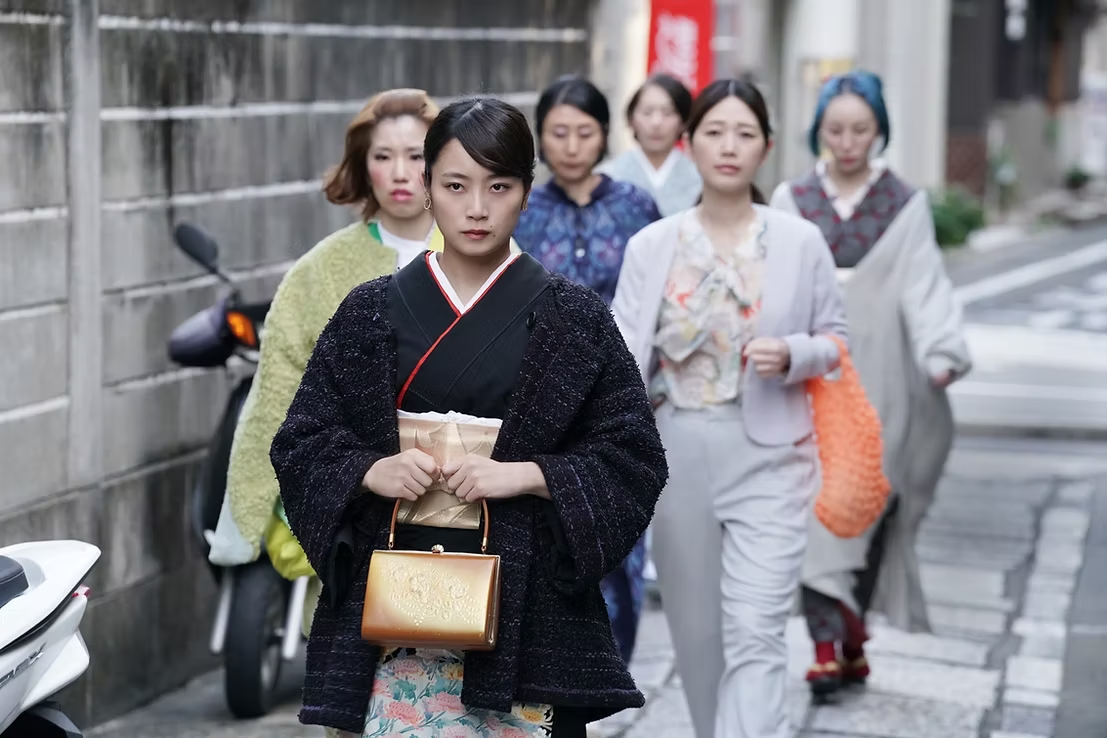
That Strangers In Kyoto succeeds in engaging the (western) spectator is simply because the narrative plays with a contrast that is deeply familiar. In a certain way, every culture, every Other, installs a difference between the social image (Tatemae) and the ego (Honne). Wherever one wanders in the world, one cannot escape such difference, as it structures all interactions, all exchanges based on signifiers.
Tokyoite Madoka is introduced to the spectator as being quite deaf to the peculiar way speech is utilized in Kyoto – its hidden equivocal dimension – and the fact that politeness is something of a forced performance, a performance that forbids the direct uttering of one’s own subjective position. Due to this deafness, she quickly becomes the object of a passive-aggressive game of politeness, politely passed, like a hot-potato, between business owners of traditional arts and crafts (e.g. traditional sweets, Kyoto cuisine [ryotei], …).
As no-one is allowed to give expression to their reluctance to be interviewed or outright decline, they must seek a way to push the ‘unwanted intrusion’ away while abiding by the rather oppressive societal demand to be polite, to support, through act and signifiers, the fiction of omotenashi. This passive-aggressive stance is summarized by the famous Kyoto saying “Green Tea Over Rice”[Bubu-zuke demo dō dosu ka?], which signals that, within Kyoto, a polite offer often masks an indirect push to make someone leave.

Yet, as Madoka, who does not realize she is considered an intrusive foreign element, accumulates transgressions, thus disturbing the strictly organized social equilibrium, the proprietresses have no other choice than to take somewhat more direct measures. However, the accidental disturbance of this equilibrium – of the social tatemae – could force the honne of some to burst forth into the interactional field. If only Madoka could find an ally to better navigate the trap-like facade of politeness that structures interactions and adhere to the subtly implied unsaid. And how to continue the manga she creates with Anzai (Zuru Onodera)? Will she restrict herself to a mere surface reading of Traditional businesses in Japan or will she expose the naked truth of social interactions within Kyoto, ignoring the backlash that will follow?
Spectators might not immediately realize it, but the dynamic between Mario’s mother Tamaki (Shigeru Muroi) and father (Takashi Matsuo) is quite common among ‘Showa’ marriages – marital bonds between people born in Showa Period. The father merely functions as the ‘billboard’ of the family outside the walls of the inner quarters – a performance for the Other, while the mother, with her acts and signifiers, structures and organizes the familial interactions (Narra-note 1). It is thus not surprising that she continually brings up the topic of succession. Moreover, by calling her son the 14th generation, she does not simply efface his subjectivity, but forcefully equates him with his filial duty, the demand to follow in his father’s footsteps.
In this respect, it is interesting to note that the subjects who maintain the strict and rigid social image are all female – the proprietresses. This somewhat contradictory revelation emphasizes the idea that, within a patriarchal society, the patriarch gains his importance mainly through female fantasy – without women, no male master.
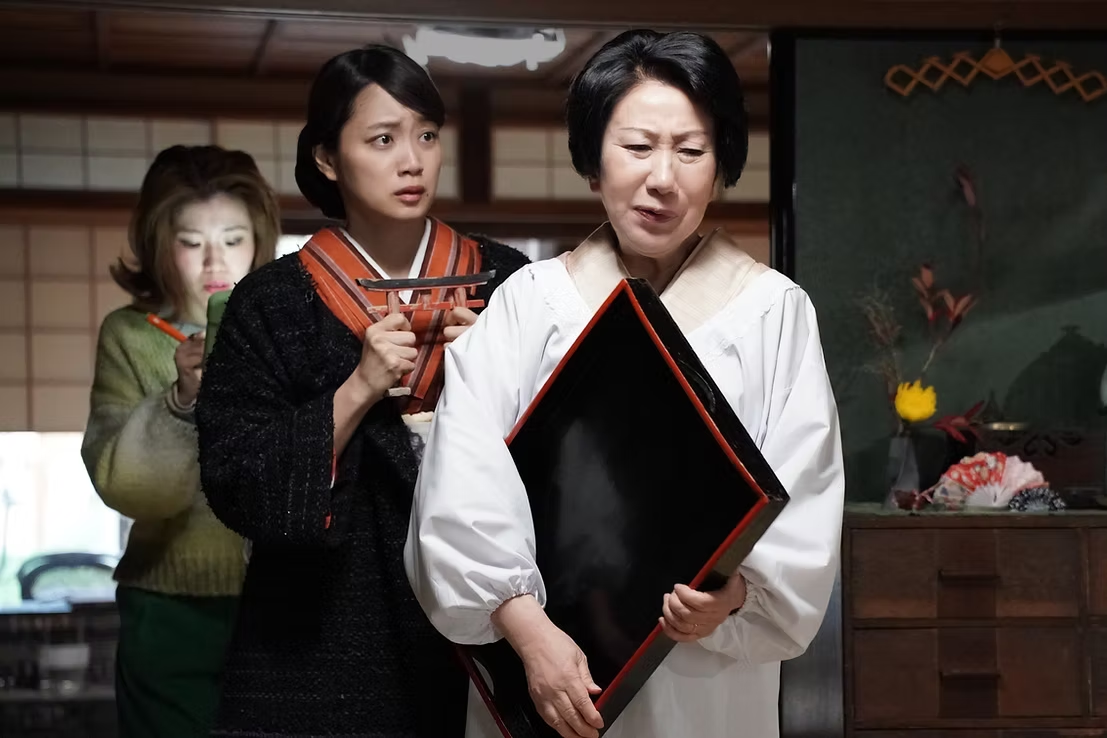
To introduce or reintroduce the spectator to Kyoto, Tominaga smartly decorates the opening of the narrative with a musical composition that does not only echoes the traditionality that Kyoto is known for but signals that this city is the de-facto ‘religious’ centre of Japan – Buddhistic temples and Shinto shrines are everywhere (Cine-note 1).
The concatenation of imagery shows a somewhat different picture, revealing the city-scape of Kyoto as a blend of modernity (e.g. station building) and religious traditionality, as a site where modernity slowly devourers traditionality – e.g. the rise of condominiums, outsiders turning old houses into guesthouses and fancy shops, … etc. However, the fact that the music decorates both images of modernity and tradition signals that, despite the threat ‘foreign’ modernity poses for old Kyoto, the traditional ura – the old ways of thinking – still lingers behind the omote of modernity. On the other hand, the musical accompaniment also underlines that one, to safeguard traditions, must find an appreciate answer to the unavoidable progression of modernity and the societal changes it brings about (General-note 1).
Strangers in Kyoto offers a light-hearted exploration of uncomfortable truths that marks our interactions with others/the Other – what we say is not what we mean; what we want to say we are not allowed to say; politeness is often a fabricated facade that we must believe in. Yet, besides delivering an enlightening relational drama, Tominaga also puts the conflict between strictly holding on to tradition and accepting the change of modernity into a different light.

Notes
Narra-note 1: However, when the patriarch finally enunciates something before his wife, she cannot openly defy him – she must support the letter of his signifier.
Psycho-note 1: The spectator will easily notice that it is not the uttering of signifiers as such that causes conflicting levels of meaning to be evoked, but the hesitations and hiccups that disturb the fluid concatenation of the subject’s signifiers.
General-note 1: We must also highlight the irony of the statement that modernity slowly devourers the traditional atmosphere of a city like Kyoto, as the idea of mono no aware remains paradoxically a determining factor within the approach to house-building in Japan – a house, like all other things, is transient; scrap and build.
The emphasis on transiency in architecture and the centrality of transiency within Japanese philosophy is, of course, determined by the fact that the Japanese archipelago is prone to natural disasters – earthquakes, fires, typhoons.
Cine-note 1: Masanori Tominaga brings his narrative alive with a rather straightforward mix between static shots and dynamic moments.
 psychocinema