In 2022, Yuta Shimotsu surprised friends and enemies of the J-horror genre by delivering an original horror-experience, Best Wishes to All (2023). His first feature film went off the beaten path of supernatural horror – i.e. the onryō and her attack on the societal field – to playfully exploit the imaginary veil of interactions – our peaceful omote hiding our twisted ura – and put happiness within a capitalistic societal system radically into question.

In New Group, Shimotsu returns to the veil of the imaginary to explore, from a somewhat different perspective, the shocking dynamics that support the image of social harmony and the subject’s belief in it. His narrative centres on Ai (Anna Yamada), a student whose ego is but a void, and Yu Kobayashi (Yuzu Aoki), the transfer student who dares to question the importance of relationships. Their day takes a strange turn when students discover a student, planted on all fours, on the playground. The next day, much to Ai’s and her fellow students’ surprise, two students have joined him, forming the beginning of a small pyramid.
The dream-like sequence that opens New Group immediately sets the tone of the narrative by confronting the spectator with an intoxicating yet subtly threatening concatenation of images of practices that brutally show that the dynamic of exploitation determines our pleasure, our jouissance. The fluid concatenation of the figures of the high-school student, the politician, and the paparazzi does not merely emphasize that each generation in their own way seeks to exploit the other for pleasure, but also, in line with Freud’s theoretical apparatus, that each subject desires to exploit and seeks pleasure by doing it.
New Group opens, in other words, with a reformulation of what Yuta Shimotsu elaborated with Best Wishes to All – the idea that the subject’s happiness derives from exploiting a subject as an object, as a sack of flesh and organs. While Shimotsu radicalized this dynamic to grotesque proportions in his first feature film, he shows in New Group that the objectification of the other for one own’s pleasure – bullying – is a widespread dynamic, e.g. the extortion of a student in the bathroom, … etc (Narra-note 1).
Shimotsu contrasts the darker side of the imaginary dynamic with the demands and expectations the Other imposes on its subjects to safeguard the facade of societal harmony. Via the figure of the art-teacher who reminds everyone that there is “no room for individual expression” and the figure P.E. teacher who reprimands Kobayashi for failing at marching and, thus, shattering the synchronicity of movements, he shows that society demands repression and conformity, the radical restraining of subjectivity.
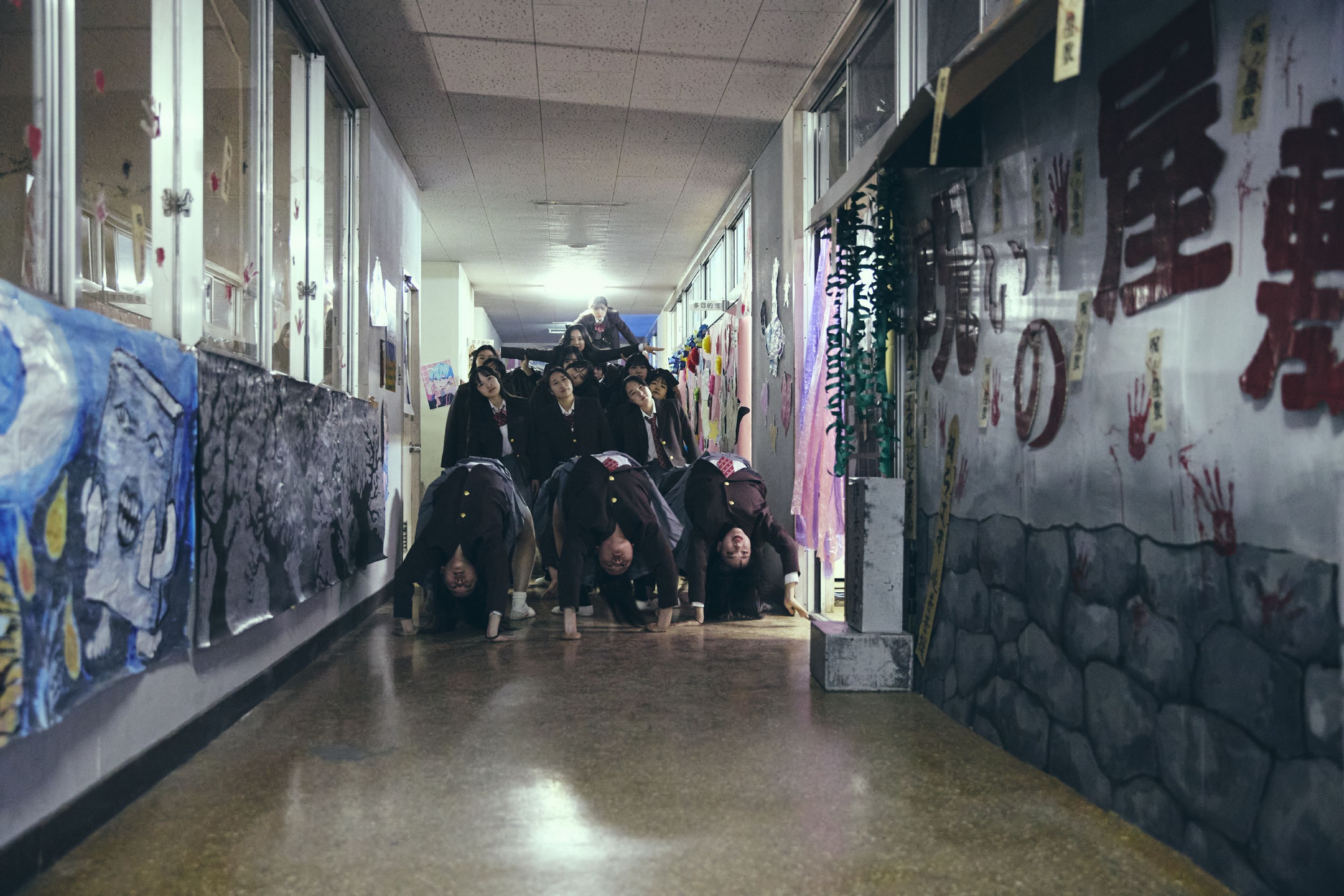
Yet, rather than being antagonistic – the exploitation of the Othered and objectified subject clashing with the societal demand to restrain one’s subjectivity, New Group shockingly evokes – the smile of the principal – that the latter is a prerequisite for the former. The demands of society impose a certain fiction of harmony and completeness on subjects, fiction that can be utilized by those who deems themselves as its representatives to exploit those who fail to fit within the societal puzzle.
Both elements are function of the subject’s desire for recognition or, more concretely, the need to belong. Yet, what regulates both elements, even reinforcing their link, is the simple yet threatening element of societal pressure – external as well as internalized. Subjects, who are surrounded by the demands and expectations of the Other, are not only receptacles of such pressure but also emitters.
As the narrative unfolds, New Group slowly reveals itself to be a biting critique on political systems which focus on the interrelated triad of fictions: national identity, conformity, and similarity. Shimotsu exposes, in a refreshing yet shocking way, the horror of conformity, of the hammering down of the nail that sticks out, of erasing one’s subjectivity for the greater Good – i.e. the obedience to a radicalized ideal image of societal peace.
However, for Ai and Yu things are somewhat different – they refuse, each in their own way, to alienate themselves; they gamble on separation. Ai has become overly sensitive to the signifiers of pressure and exploitation, a sensitivity born from a deeply traumatic experience. As a result, such signifiers and acts have attained a suffocating quality forcing her either to collapse or to flee. Yu, on the other hand, has created a distance between himself and the Other, between his subjectivity and the Other whose pressuring demand to repress and conform linger around via the mouths of others by way of putting the relevance of group-like structures (e.g. family) radically into question (Acting-note 1).
To correctly interpret the relevance of the echo of ‘I’ and ‘You’ in the names of the two main characters, we must contrast this couple with what, in psychoanalysis, is called the imaginary couple: ego versus alter-ego, the dualistic dynamic. While the latter evokes similarity and harmonious completeness – the alienation of one’s subjectivity in the image of the Other, the former echoes an irreducible difference between subjects – Ai can never be Yu, there is a lack that is neither reducible to the one or the other. Yu’s signifiers do not merely attack the reliance of subjects on the desire of others and the demand to be equal, but emphasises the fundamental need to assume one’s own particularity as subject – “Decide yourself, it’s your life” (Psycho-note 1).
The signified of Ai’s name allows us to reformulate the thematical difference between I and You in terms of love. Love (ai) is not, as some might think, the harmonious interlocking of ego and alter-ego – a fiction of sameness refuted by many writers and film directors, but the radical acceptance of subjective difference.
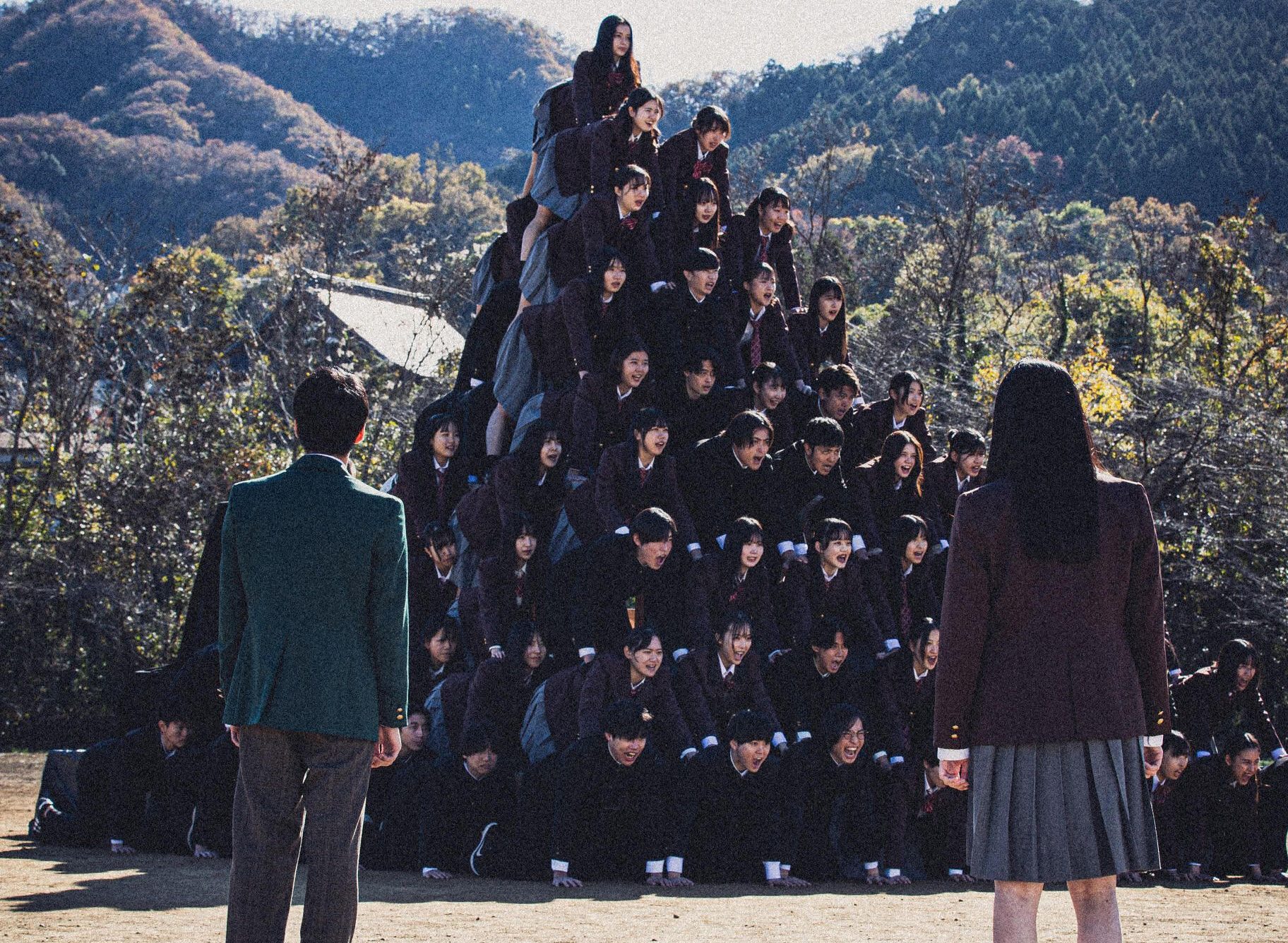
While the composition of New Group is quite straightforward, it is important to realize that Shimotsu seeks to evoke a sense of peaceful mundanity with his composition – the static shots help stage the image of social harmony that lingers in and structures the sun-dripped societal field.
Yet, Shimotsu merely evokes this structuring sense of pacifying contentment in the societal field to perforate it and expose its mendacious nature – to show that horror lies just underneath the peaceful social surface, just outside the reach of the rays of light the Other shines. The slow spatial dynamism, by virtue of being a preferred tool in the tool-box of the horror director, and the intrusion of threatening sounds (e.g. the heartbeat, sounds to make tension within the narrative space palpable, …) signals that the image of peaceful harmony is a mendacious fiction and the prominence of dark shadows in certain narrative spaces (e.g. the bathroom) highlight what hides behind the daily chitter-chatter is the exploitative dynamic that pushes subjects to (ab)use others for their own enjoyment and the lingering societal pressure that forces subjects to rescind their subjectivity.
This unsettling quality of these uncomfortable truths is further emphasized by Shimotsu by utilizing other tools from the horror-director’s toolbox: slow zoom-in movement and disconcerting non-diegetic sounds. Yet, what truly makes these truths haunt the spectator is Shimotsu’s ability to create disconcerting imagery that infiltrates his mind.
What also sets New Group apart from other horror-narratives is its exquisite narrative structure. Shimotsu crafted a structure where every scene fluidly introduces a new fragment of the film’s thematical puzzle, a new signifier to further the development of the narrative’s main themes. Just like in Best Wishes to All, Shimotsu takes a mundane “reality” as his subject to peel off its layers of repression and expose, in a confronting way, the ‘dynamics of horror’ that support it.
With New Group, Yuta Shimotsu delivers a narrative that, in all probability, will be called the first true J-horror classic of the current decade. By crafting an exciting, yet unheimlich narrative puzzle and attacking the spectator with a variety of unsettling images, Shimotsu invites does not only frame the terror of conformity in an unforgettable way but demands that the spectator, whether he likes it or not, puts the way he relates to Otherness into question.

Notes
Narra-note 1: Shimotsu also shows that another aspect of human subjectivity lies behind the veil of imaginary societal peace: theperverse quality of our sexuality, the perverse aspects determining our sexual enjoyment.
Psycho-note 1: We can go even further. What Yu, as you, signals is not merely the difference between subjects, but the Otherness of Ai, as I, that has not realized itself – the push of her unconscious.
I’s subjective void is the place where You, as radical difference, must realize itself. What must realize itself in that empty space is her desire, a desire that, while depending on the Other, will give shape to her particularity and allow her to determine her own trajectory.
Acting-note 1: Anna Yamada, who portrays Ai, brings the confusing cocktail of emotions caused by societal pressure convincingly to life.Yuzu Aoki, on the other hand, does not only succeed in giving the detached subjective position of his character the necessary natural coolness, but also in infusing the necessary emotionality in the desire that lies repressed behind it.
 psychocinema
2 Comments Add yours