In 1909, Sigmund Freud wrote in a short article titled Family Romances that every child, as he grows up, must deal with the sudden dissatisfaction in his parental figures. While in some cases, this realization leads to a criticizing attitude in the child, as illustrated in Ozu’s I Was Born, but … (1932), some children refuse to give up the internalized image of the ideal father. They inscribe themselves in the father’s desire in the hope that the lost ideal might, one day, realize itself again.
As the reader might guess, There Was a Father offers an illustration of the latter. Yet, despite this difference, Yasujiro Ozu’s narrative, inspired by his own separation from the father while in middle school, offers the spectator a similar glance at the way traditional ideals, organized within an imperialistic framework, shape fatherhood and familial functioning and how such fatherly ideal fails the subject.
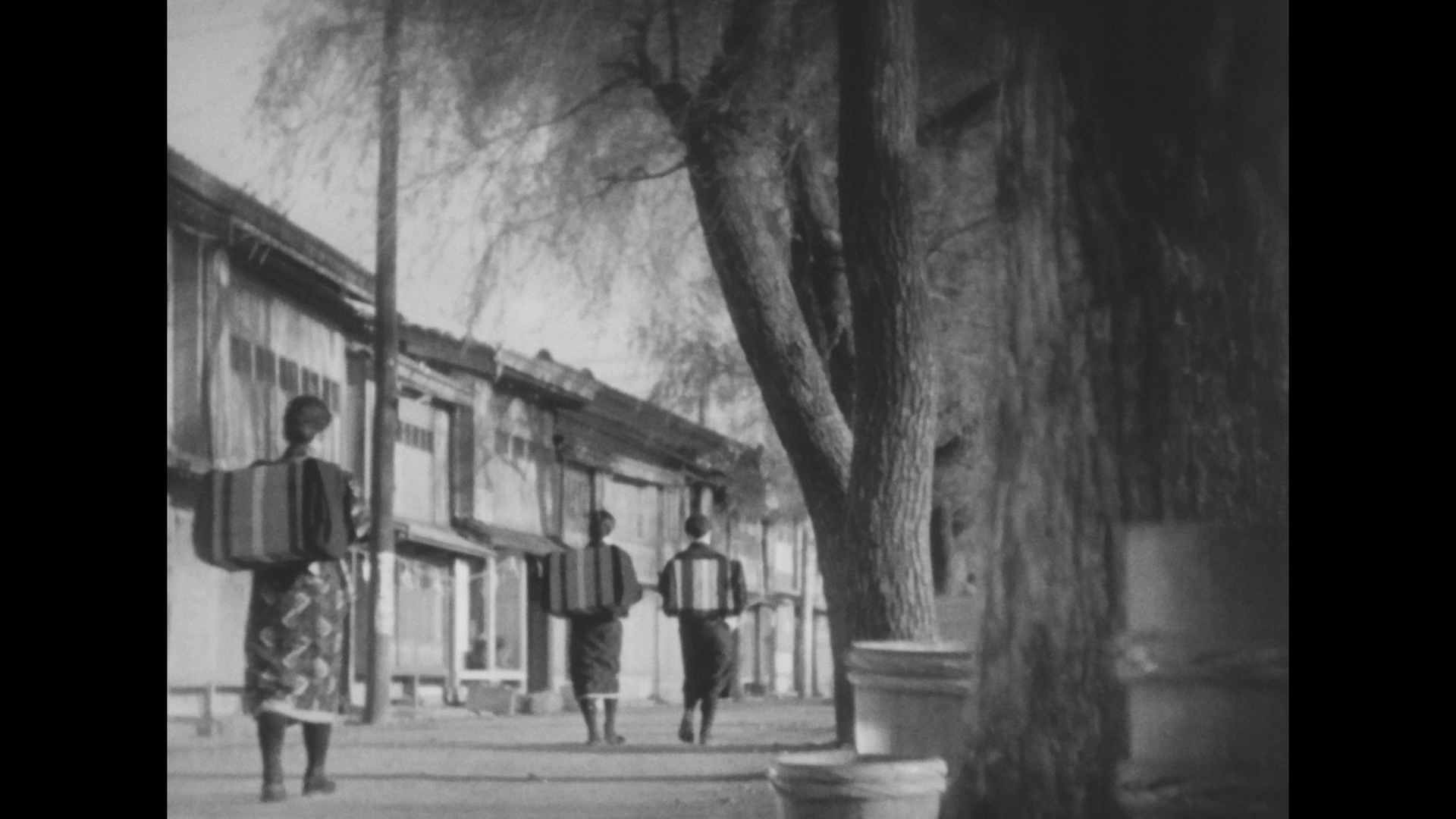
Chuhei Horikawa (Chishi Ryu) emphasizes the discrepancy between his fabricated image of fatherhood, the image Ryohei (Haruhiko Tsuda) has of his father, and the subject that structurally fails to coincide with either image by informing his son about his decision to quit as teacher. Chuhei’s decision is, as revealed earlier in the narrative, caused by a tragic incident – i.e. the death of a student on a school trip – and the surge of guilt this incident gave rise to.
By revealing his societal failure to his son, by granting him a fleeting glance at the failed subject that hides behind the fatherly image, Chuhei unintentionally complicates his own stern and strict fatherly presence. His honesty lays bare the conflictual gap between his fatherly signifiers – ‘Pass your exam, or you’ll never amount to anything’; ‘calm yourself, think hard’, and his own subjective position, as marked by this failure. The son cannot but silently compare the fatherly image he internalized with the educational escape of his father as subject because Chuhei presents himself, first and foremost, as an educator in his version of fatherhood.
A similar dynamic can be discerned in the second time Chuhei complicates his fatherly presence and Ryohei’s image of his father with his honesty. He reveals another lack – a lack of money – and introduces a second decision – I’ll go to Tokyo to find a better paying job. Yet, what sets this second glance at his societal failure apart from the first is the fact that his decision is fatherly in nature. He decides to return to Tokyo to pursue his fatherly desire, the societal ideal of fatherhood, so that his son can continue his education.
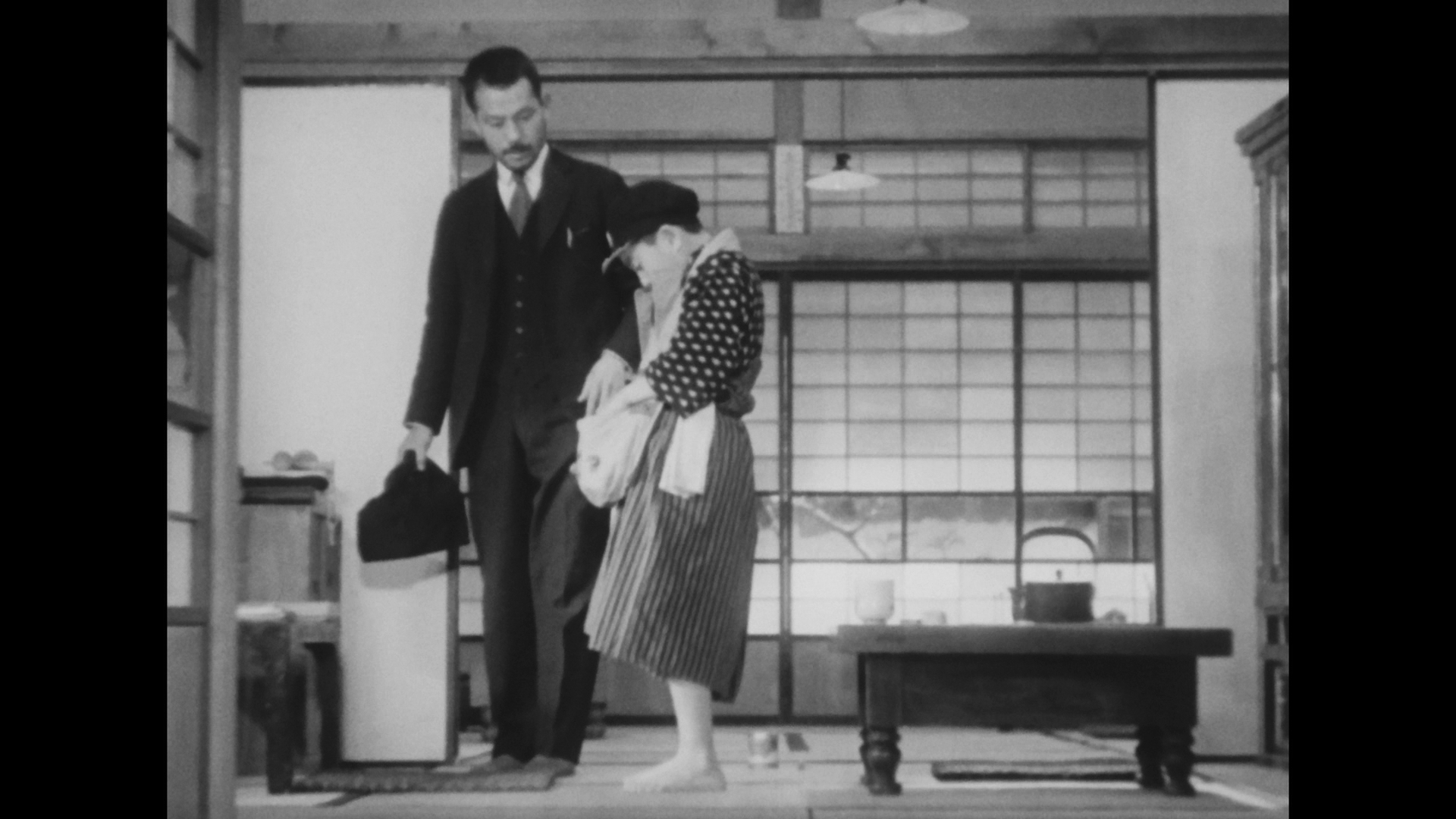
To realize himself as father, Chuhei is led to inscribe himself in the life of his son as an absence. He carries out the Other’s desire (i.e. the internalized desire of his grandfather) irrespective of Ryohei’s subjective desire. Instead of getting the father he needs, he must deal with an absent father who carries out his internalized societal duty, who devoutly follows the lower-middle-class desire of giving one’s offspring a better chance at life. The contradictory consequence of Chuhei’s intervention lies in the fact that Ryohei, by accepting his father’s desire as his own, is forced to distance himself from the subject who supports the fatherly image that fuelled his philomathean passion.
The effect of Chuhei’s two interventions should not surprise anyone. Ryohei ends up evading his father through his further educational and occupational career – a silent refusal of Chuhei as subject, while paying respects to his internalized image of the father by pursuing a career in teaching.
Many years later, when father and son meet again, Ryohei is subjected to a third fatherly intervention. Confronted with his son’s desire to move to Tokyo to be near him, he washes Ryohei’s wish away by subjecting him to a societal ideal – ‘Whatever or wherever, treat your job like it’s your calling’; ‘Do the best your can, go all the way, and fulfill your role’; ‘Trails, tribulations, and tenacity bring true happiness’. Once more, Chuhei presents him the father the Other wants him to be, a father who serves the societal demand, and not the father Ryohei hopes to see. Yet, Ryohei, driven by his love for the idealized father, cannot but inscribe himself in his discourse (Narra-note 1).
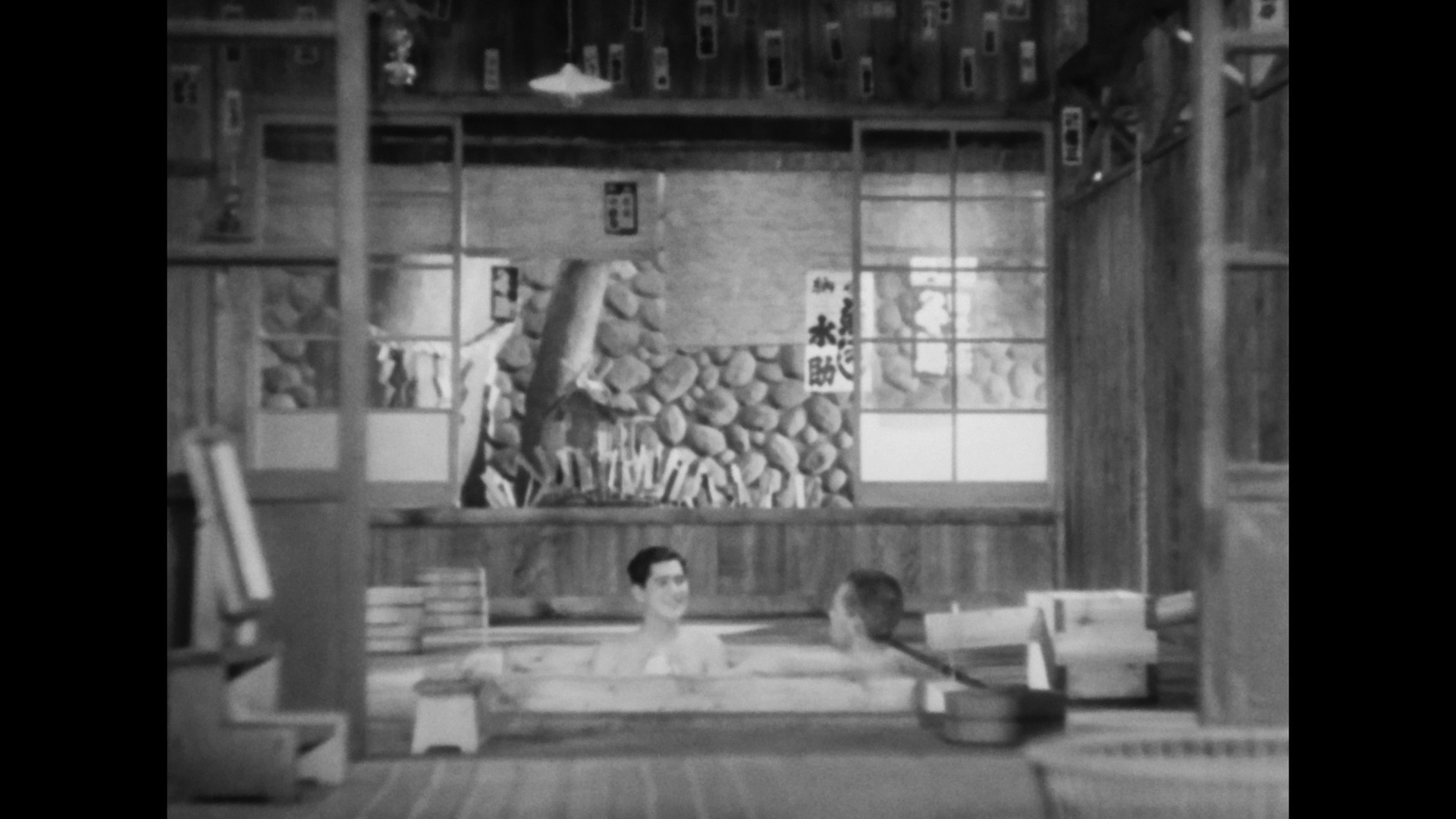
Besides depicting the deceptive relational peace between father and son, There Was A Father also functions as an expression of anti-war sentiment, of the trauma that war inflicts on familial bonds and structures. Rather than offering a direct critique of the pacific war, Ozu lets his thoughts known by contrasting Chuhei’s reaction to the death of one of his students – ‘Raising a child then losing them would be unbearable’; he left full of life, and came back lifeless’ – and the happiness he expresses when his son passes the military exam. This contrast echoes how nationalistic and imperialistic ideals, integrated by Shuhei into his version of fatherhood, blinds the subject for the tragical and nihilistic dimension of the supposedly ‘honourable’ nature of militarism. This blindness is reverberated in his statement ‘Now I Shall think only of being the emperor’s shield’ to his son as well as his reciting of Takeo Hirose’s ‘Song of righteous Spirit’ to his former pupils. Militaristic nationalism, however, does not merely obscure the traumatic real of death, but also demands that subjects – parents as well as children – alienate themselves by inscribing himself in the fabricated national narrative.
Ozu’s compositional style continues to enthral spectators, critics, and scholars. While a consensus exists about the peculiarities of Ozu’s style, there are various interpretations about the aim and the subjective effect of his stylistic choices. What can we add from a psychoanalytic viewpoint to this ongoing conversation?
The first thing the spectator will notice in Ozu’s simple concatenation of static shots are the many visually elegant shot-compositions, the rich tapestry of visual moments satisfying the scopic drive of the spectator. In most cases, the pleasing visual tension of a shot derives from Ozu’s thoughtful play with geometry and monochrome contrasts to create frames within frames. This compositional approach often elevates Ozu’s characteristic tatami shots – i.e. shots filmed at a height generally lower than the eye level of a character kneeling on a tatami mat.
However, the visual tensions that Ozu creates within his shots are not only function of the rather discrete creation of frames within frames, but also of Ozu’s thoughtful set-design. By carefully placing props in his traditional interiors, he does not merely offer the spectator a glance at the mundane mixture of traditionality and modernity in pre-war Japan, but delivers a more complex spatial relief, a composition layered in depth, that does not fail to visually please the spectator.
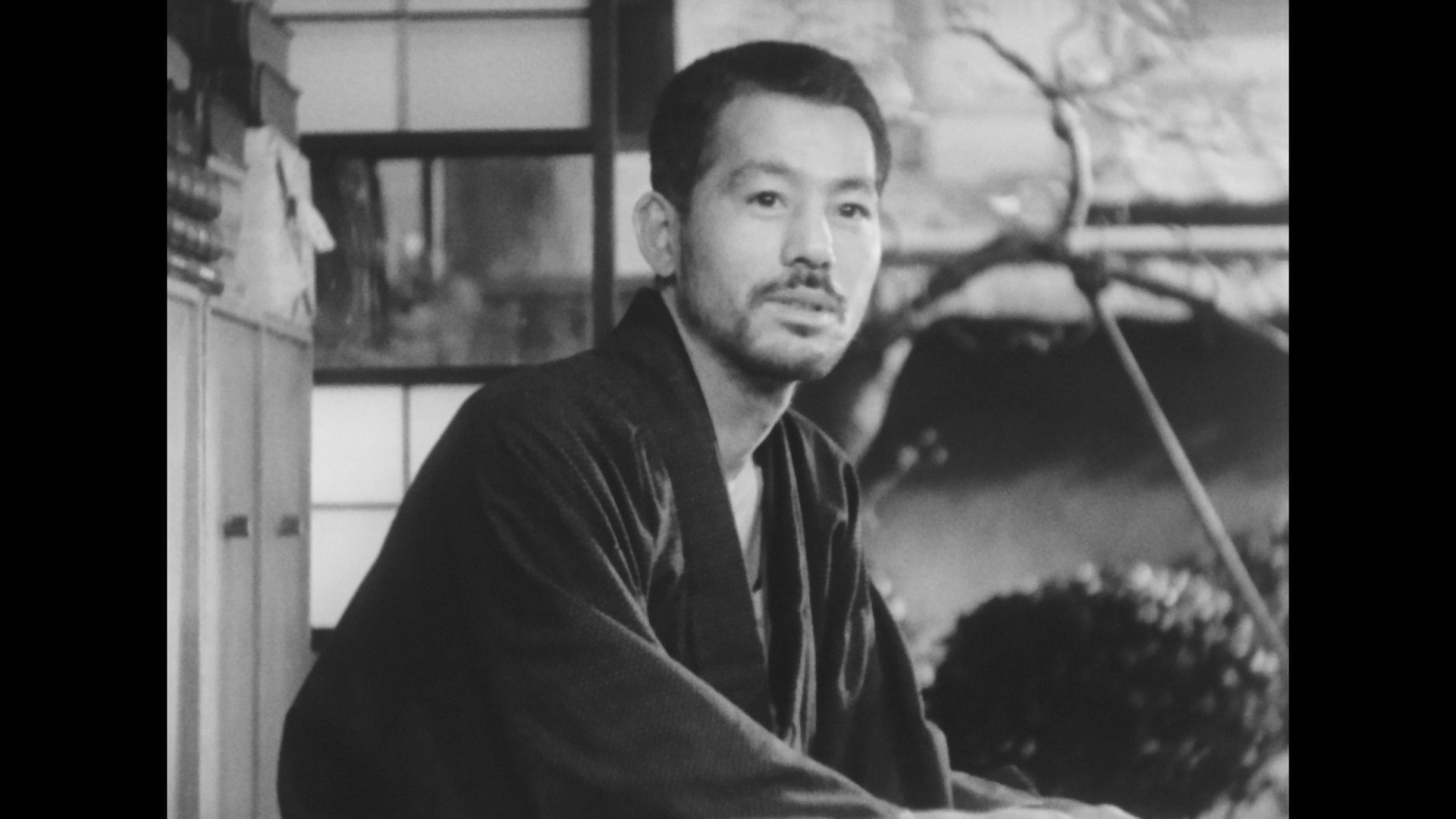
In the framing of conversations, Ozu often lets the camera directly gaze on the speaker. Yet, as There Was A Father proves, this is not merely a stylistic choice, but a device to invite the spectator’s interpretation and emotional investment in the themes of the narrative. By concatenating shots that single out the speaker, Ozu creates spatial contrasts that echo the failed encounter that hides behind the seemingly peaceful exchange of signifiers. In the case of There Was A Father, Ozu elegantly reverberates Ryohei’s unfulfilled desire and the unbridgeable distance this dissatisfaction creates between Chuhei and Ryohei.
Spectators familiar with Ozu’s work will have no trouble in discerning the pillow shots in There Was A Father. While critics and scholars have advanced various interpretations of these still-life moments that often separates scenes, we will argue that these narrative pauses demand the spectator’s reflection on what has been said, what is not shown, and what might come. These transitorily moments of stillness, which single out a single cultural object, invite the spectator to invest in the narrative with his own subject. The spectator who accepts the director’s call will breathe life in the emotional fabric of the narrative and allow the understated drama reverberate strongly in these moments of reflection.
One object Ozu focuses repeatedly on with his pillow-shots in There Was A Father is the Gorinto. The importance of these pagoda-like stone structures, whose meaning might not be known to the contemporary spectator, lies in their funerary function – they are memorial structures. By turning these Gorinto into a still-life motive, Ozu echoes the presence of death – a trauma haunting Chuhei and the societal field embroiled in war, a trauma washed away by imperialistic glorification of selfless sacrifice.
There Was A Father is a quintessential Ozu narrative that, despite its age, still succeeds in engaging the spectator. The continued power of the narrative, however, does not simply lie in the purified composition nor in the simple narrative, but in the thematic depth evoked by their fruitful encounter. The elegant orchestration of this encounter ensures that the contemporary spectator can still heed his call of putting his own subject into the emotional fabric of his narratives.

Notes
Narra-note 1: The attentive spectator will surely have noticed that the event of Chuhei informing his son of his decision to move to Tokyo echoes strongly within Ryohei’s sudden confession of his wish to give up his job as an educator and life together with his father.
This repetition, which reveals Ryohei’s wish to reunite with his father, is also function of his identification with the image of the ideal father – the father of his childhood. This identification is emphasized when Ryohei offers his father some pocket money the following morning.
 psychocinema