“Those who dare to try do something new or different, are always laughed at and criticized.”
While the golden era of the tokusatsu film has passed, the image of Godzilla and, to a lesser extent, other gigantic creatures have become a shared cultural good. The fact that kaiju have become cultural symbols, attaining a presence in different media, have led the kaiju film to transform into a CGI-centred affair.

Luckily, there are still some directors that try to keep the artistry and wonder of the Tokusatsu film alive. One such director is Junichiro Yagi, who chose to craft a comical narrative that pays homage to traditional Tokusatsu filmmaking and celebrates the joy of indie-filmmaking, of creating film in accordance to one’s desire, one’s Otherness.
Yagi’s Kaiju Guy is a narrative that unfolds at a high-pace, keeping the spectator engaged by not giving him the chance to become bored or lose interest. While the ending of this comedy is predictable – Yamada will fulfill his long-time dream to create a Kaiju film, Yagi inserts enough twists and turns into his film to give the unfolding of Kaiju Guy a sprinkle of comical unpredictability.
The thematical set-up of Kaiju guy is quite simple and made explicit straight from the get-go. With his film, Yagi underlines the importance of breaking the societal room, as formed by the interlocking hands of those who clothe themselves with the ideological fabric of ‘normality’ and indirectly demand repression, inhibition and submission, to forcefully create a place for one’s Otherness. To not succumb to the subtle yet oppressive demand to attain and maintain mundane ‘normality’, one must not give way to one’s desire and force the Other to integrate and, subsequently, utilize one’s Otherness.
Given this thematical backbone, it comes to no surprise that, after the beginning credits have faded, the adult Ichiro Yamada (Gunpee) is introduced as being safely entrapped within the ‘normalizing’ walls of the Other. He lives a monotonous life as a staff member of the Seki City Hall Tourism Department and his Kaiju dreams have long faded due to repressive demands of the interlocking societal hands.
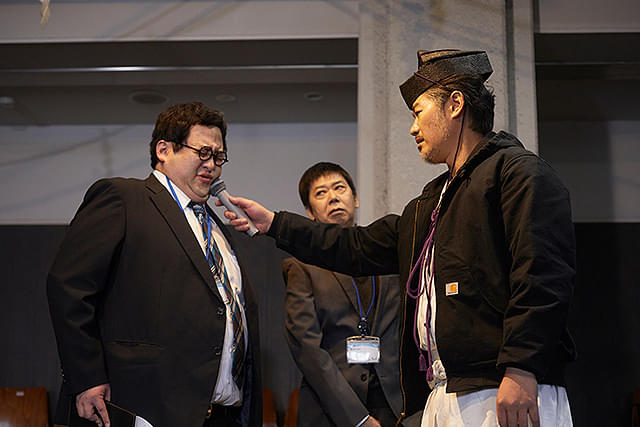
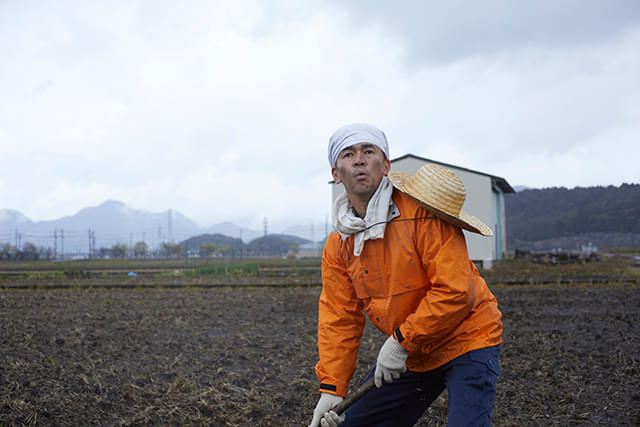
When master-swordsmith Takaba (Hiroyuki Hirayama) fulminates against Yamada, his colleague Furukawa (Natsume Mito), and his bootlicking manager Muto (Tezuka Toru) for their lack of love and passion for Seki City, he lays bare that their ‘mundane normality’ is attained by meekly following order and rules, by letting the written and unwritten rules determine their comportment. With this funny revelation, Yagi cheekily underlines that the Japanese subject, to function within the societal field as normal, does not need any kind of desire.
Luckily, Yamada sees a chance to reawaken his faded dreams of being a director when the strict and conservative mayor (Michiko Shimizu), in response to their half-hearted attempts to boost tourism in Seki city, forces the tourism department to create a local PR movie that captures the city’s tradition. Of course, not long after the film project has begun, Yamada silently clashes with the personification of the conservative societal walls: the mayor. Her passionate demand to create a PR-film by the books does not merely form an obstacle to Yamada’s creative desire – his desire to visually shape the mayor’s screenplay – but also becomes an active ‘dictatorial’ force that seeks to repress any kind of expression of Otherness (Narra-note 2). On a side-note, one could even argue that the whole dynamic between the mayor and Yamada echoes the way many production-committees treat their directors – forcing them into a strict straightjacket of risk-averse mundanity and demand the creation of an easy-digestible vehicle for young and well-established talents.
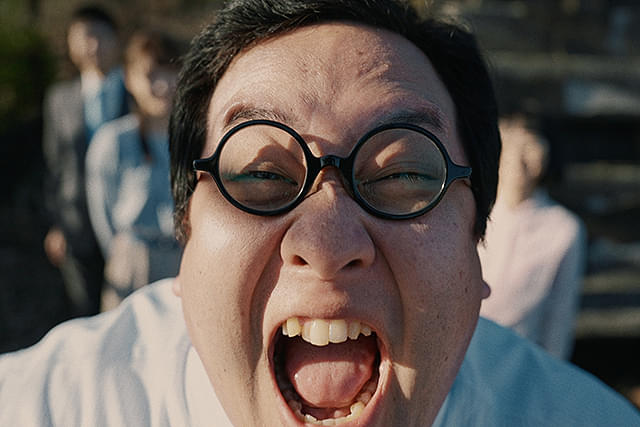
The composition of Kaiju Guy is quite dynamic in nature and, thus, fully support the high-paced unfolding of the narrative. Yagi utilizes dynamic camera-movements to add variety to his visual fabric, to accentuate and energize certain movements, and to support the staging of the subjective mood of his protagonist. The subtle tracking camera-movements in the opening sequence of Kaiju Guy single out the nodal point that structures the entire narrative – the protagonist, the Kaiju Guy – and, by, for example, amplifying the impact of laughter on his subjective position, he invites the spectator to empathize with Ichiro Yamada’s fears, obsessions, and desires. Yagi is, moreover, not afraid to include some stylistic decorations to keep things light-hearted and to evoke, in a more figurative way, the inner state of Yamada.
Kaiju Guy is not only a narrative that engages the spectator from start to finish, but offers him one of the funniest yet heartfelt celebrations of Tokusatsu filmmaking. Junichiro Yagi, moreover, subtly invites the spectator to question how the societal Other has determined his relation with his own desire.

Notes
Narra-note 1: Some might argue that the swordsmith is able to align his desire within the walls of the Other, yet they forgot that the tradition of sword making is a dying art, an art deemed dispensable by the Other. However, the political Other does seek to exploit those who, by following their Otherness, keep the superfluous traditions of the past alive touristically as well as economically.
Narra-note 2: The pulsating extra-terrestrial-like clew of meat that appears in front in Yamada is nothing other than his own desire. Yagi visualizes the fact that subjects often become alienated from their own desire by meekly accepting the repressing walls of the societal field.
 psychocinema