There are many successful genre-blend narrative in Japanese cinema. Yet, while certain genres blend well, like action and comedy (Baby Assassins (2021)) and horror and drama (Audition (2001)), other genre-combinations require more narrative precision and visual subtly to become a cohesive filmic experience that can please audiences. Hisayasu Sato’s Hana Dama Phantom is a narrative that, while offering many enjoyable sequences, fails to combine horror, comedy, and soft-erotica into a satisfying whole.
While it is commendable that Sato took the challenge to bring Shinji Imaoka’s genre-blending screenplay to the silver screen, it is evident from the disjointed end-product that he struggled to rhyme all the various genre-elements together into a satisfying harmony.
Before we explore what works and what doesn’t in Hana Dama Phantom, we will introduce the narrative thread that structures the unfolding of Imaoka’s story and analyse the structuring thematical elements. The day before cinema Kurara is set to close its doors forever, Teiichi Sawamura (Shima Ohnishi), the projectionist, experiences an inexplicable event. During a screening of Intense Love, the passionate moment of intimacy between a male lead (Yota Kawase) and female lead (Ai Kanade) is disturbed by the appearance of a mysterious woman dressed in black.

The tear that leaves Teiichi’s eye signals that this woman has an unknown subjective important for him. Yet, upon double-checking the film roll, he finds no trace of the woman. The very same evening, as he storms out of his apartment, he catches a glance of her in a darkish doorway. Despite having some hesitation and misgivings, he decides to heed his curiosity and follow this mysterious appearance.
The first structuring thematical element introduced in Hana Dama Phantom is the dimension of deathly aggressivity. The girl with the doll equates the closure of the cinema with a radical fracture of social bonds – “Everything is over. It breaks into pieces, and everyone will be gone”. In the film ‘Intense Love’, the female fleetingly touches upon the destructive finality of being in love is – “I can even die if you’re with me”. Yet, it is only in the twisted finale that this theme comes to full blossom. Sato and Imaoka’s finale illustrates that aggressivity, as intrinsically linked to the ego’s primal narcissism, is what allows the subject to establish social bonds – aggressivity marks the dimensions of sexuality and love – and disturb and annihilate these bonds – the unrestrained search for enjoyment is destructive.
The second thematical dimension of Hana Dama Phantom concerns the unconscious and the dynamic of repression. The spectator is elegantly forced to consider the woman-in-black as a subjective projection, as a return of a fragment of his repressed. This ghostly appearance, which Teiichi fails to capture, as objective presence, with his camera, is a materialization of an unconscious subjective appeal – the repressed comes knocking on the door of his consciousness. The fact that the woman appears when the lovers on the screen passionately kiss invites the spectator to consider the encounter between love, aggression, and death as that what binds the protectionist to this misrecognized woman.

One could also describe the sudden appearance of the woman with terminology Freud uses to explain the functioning of the dream. The woman is, in this respect, a manifest dream-element that Teiichii decides to follow. By chasing this manifest element, he enters his own unconscious and is led, via the dynamic of association, to uncover the latent dream-thought, the subjective truth he repressed. Without giving too much away, Teiichi’s wandering ultimately confronts with a truth born from the clash between voyeuristic pleasure and sexual transgression. Her seductive gaze, as she traverses streets and riverbanks, invites him to question his own subjective position with respect to an encounter she was subjected to (Narra-note 1 (spoiler)).
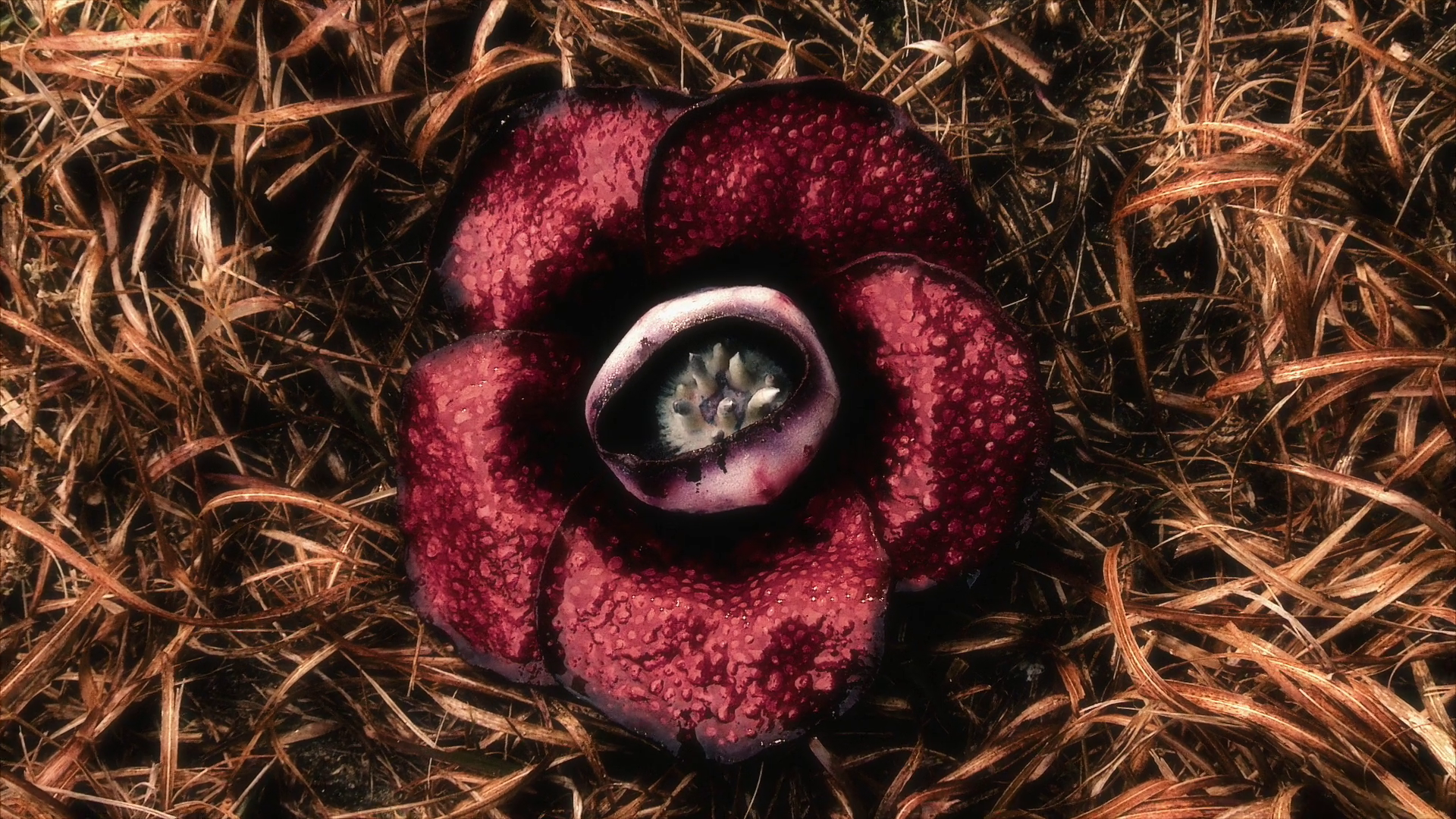
The final thematical element is introduced via the Hana Dama – the bloody flower. How should we interpret this narrative element? It would be stupid to equate the flower, which vaguely resembles female genitalia, with the threat of the female shape – women are not, as Christianity would have it, the root of all evil. Rather, this flower, which signals the presence of an angered and traumatized spirit, awakens repressed fantasies (e.g. of infidelity, sex, riches, inequality, separation, and greed) and forces subjects to violently act upon these fantasies to generate enjoyment. The gaping hole of the flower metaphorizes the lack of the subject around which transgressive fantasies have been spun and which seeks to be overstuffed by demanding enjoyment – an orgy of Eros that ultimately Thanatos.
Now that the thematical threads of Hana Dama Phantom are unfurled, we can direct our attention to what causes atmospheric disjunctions and narrative clashes. What, at every turn, endangers to disintegrate the integrity of the narrative are nothing other than the way eroticism is framed. While the visual moments of erotic incitement and insinuation – moments that veil and frame nakedness – do not fail to arouse the spectator’s imagination, the theatricality of the performances turns these erotic sequences into farcical eruptions (Cine-note 1). The farcical flavour of these sequences fractures the atmosphere in a pattern of ill-fitting puzzle pieces – a concatenation of false notes that leave a sour taste in the spectator’s mouth.
Hisayasu Sato shows promise with the way he has brought Hana Dama Phantom visually to life, yet his composition cannot counter the disorganizing impact of the uneven acting performances. Sato delivers some truly pleasant visual sequences by playing with contrast-levels and colours-schemes (Colour-note 1). The opening of Hana Dama Phantom, for instance, fractures a romantic-beach scene between two lovers with an unexpected close-up of an unidentifiable bloody flower. What makes this contrast so impactful is the sudden shift in the intensity of colour, giving the blood that gushes out the flower a nightmarish quality.

Sato utilizes music also in an effective manner. For instance, to amplify the uneasiness of Teiichi and evoke a sense of dread in the spectator, he relies in chaotic industrial musical pieces. To give the atmosphere an unheimlich quality he resorts to minimalistic musical pieces, using dull bass-like sounds to signal the possibility that an unheimlich element will ripple the frail consistency of the narrative’s atmosphere.
Hana Dama Phantom is a narrative that delivers many pleasing moments, but ultimately fails to satisfy the spectator. While all clashing fragments of eroticism, horror, and comedy come sort of together in the twisted finale, it is not enough to wash away the sourness left by the ill-fitting theatrical performances.

Notes
Narra-note 1: The problematic dimension of his subjective positionconcerns the fact that he, faced with the sexual transgressive act, remained immobilized by his own sexual desire. The voyeuristic hole of the camera did not merely transfix his gaze on the sexual act, but also helped enhance the pleasure of his gazing.
The repressed truth is foreshadowed in Teiichi’s strange desire to protect her and keep her locked up in his room. His act, fuelled by an unrecognized guilt linked with the repressed moment of transgressive enjoyment, expresses his unrealized wish to prevent the past from happening.
Cine-note 1: The eroticising veiling is not only obtained by using props (e.g. blankets, mirrors, pubic hair, … etc.) and exploiting shadows, but also by veiling the body through framing and by positioning it in a veiling manner within the frame.
Colour-note 1: Sato confines his play withcolour-schemes to the opening of Hana Dama Phantom.
 psychocinema