A name is a signifier that offers the subject a symbolic frame to organize all his identifications into a consistent imaginary whole, into an ego. Kei Ishikawa’s tale of identity laundering, based on Keiichiro Hirano’s novel of the same name, invites the spectator to separate the subjective assumption of one’s name with the inscription of the name in the societal field and question the mediating impact of the Other on both dimensions of the name.
Ishikawa’s narrative opens by introducing the spectator to Rie (Sakura Ando), a woman whose marriage fell apart after the untimely death of her youngest son Ryo, and Daisuke Taniguchi (Masataka Kubota), a man who recently turned up at the village to work as a woodcutter. While his sudden appearance raises some eyebrows in the local community – he, the second son of the owner of a big onsen-resort in Gunma, must be hiding something, Rie slowly falls in love with him and marries him, giving her oldest son Yuto (-) a father figure.

Four years later, their familial happiness is cut short when Daisuke Taniguchi dies due to a tragic accident in the woods. On the first anniversary of Rie’s husband’s death, Daisuke Taniguchi’s older brother Kyoichi (Hidekazu Mashima) shows up. At the butsudan, he promptly tells her that the man in the picture is not his younger brother. Confronted with this shocking news, Rie contacts lawyer Akira Kido (Satoshi Tsumabuki) to help her find out who her husband ‘truly’ was.
A Man starts off as a moody familial dramaabout trauma, love and subjective reparation, but slowly transforms into a dark harrowing investigatory tale of identity fraud and venomous societal persecution. Kei Ishikawa foreshadows and prepares the spectator for the darkness of the second hour by structuring the first half of his narrative around three contrasts. Yet, these three contrasts are not merely signs of a yet unrevealed traumatic darkness, but also narrative attempts to pull the spectator into the narrative.
The first contrast Ishikawa confronts the spectator with is the one between the whispers that deem Taniguchi’s departure from his parental home suspicious and Taniguchi’s shy but seemingly innocent approach to Rie. The second invitational contrast is between Taniguchi’s kiss to Rie with his subsequent mental breakdown – his anxiety attack. The second contrast does not merely arouse more mystery surrounding Taniguchi’s presence, but evokes that what animates his subjectivity is an unresolved and unverbalized traumatic experience. The third contrast is introduced by the revelation that the subject who moved within the societal field as Daisuke Taniguchi is not the real Daisuke – he merely assumed his symbolic inscription. For the spectator, the following questions immediately arise: ‘Where is the real Daisuke Taniguchi?’ and ‘Why did this man need another’s symbolic inscription in the societal field?’.

Whether the spectator feels compelled to watch the unhurried unfolding of Akira Kido’s investigation depends largely on the effect Ishikawa’s three invitations have. Yet, even if these invitations fail to fully engage him, the performances of Sakura Ando and Satoshi Tsumabuki are so captivating and the unfolding of the investigation so well-structured – let’s go down the rabbit hole – that it will suck the spectator right into the societal mystery of identity laundering, hidden societal trauma, and persecutory right-wing discourses.
Having highlighted some of the refined structural elements of the narrative, we can finally return to further unpack its thematical dimension. What Ishikiwa’s A Man illustrates is that identity laundering does not truly exist. A subject can only utilize the name of another as symbolic inscription to flee and disappear. This assumed inscription becomes a symbolic facade that helps the subject to repress one’s name as symbolic frame within the societal field, yet the ego and the subject, as designated by the repressed name, remain intact.
While the sudden rupture between the name (symbolic) and the image/ego (Imaginary) and the body (Real) give rise to a certain sense of alienation in Rie, the image of the subject she fell in love withis not a deceitful construction. Despite repressing his past by assuming a different symbolic inscription, the man still reflected his ego, as shaped by his repressed own name, to Rie. The man’s deceit at the symbolic level – the appropriation of another subject’s name – does furthermore not annihilate the shared pleasure of their imaginary interactions nor their intersubjective bond of love. The main reason why Rie remains mentally stable after Kyoichi Taniguchi’s shocking revelation it is because the bond they had was, despite his use of another’s name, ‘real’.

Via a short by touching conversation between Yuto and Rie, A man emphasizes the importance of the family name for the subject to shape his ego with and highlights how subsequent shifts in one’s family name can have alienating effects on subject and his ego.
By offering a harrowing portrait of a single man’s traumatic past, Kei Ishikawa ultimately transforms the story of identity fraud into a biting critique of the prejudices and discourses around crime, which support the legality of capital punishment in Japan (Narra-note 1). A criminal act is, as A Man slowly corroborates, a transgenerational traumatic event that marks the subject profoundly and keeps persecuting him in the societal field. The mental weight of the criminal event on the subject – internally generated by trauma and externally imposed by signifiers – is function of the prejudicial discourses that structures the Other and orientates its mirroring effects. The name becomes a reference for the Other to equate the subject with the sins of his kin.
The composition of A Man is a quite aesthetically pleasing affair. Ishikawa, by thoughtfully exploiting compositional lines, interweaves many visually interesting shot-compositions within his composition. Yet, Ishikawa’s main concern with his composition is not to deliver compositional pleasure, but to establish a serene frame that lets the cast breathe life into their characters and the narrative.
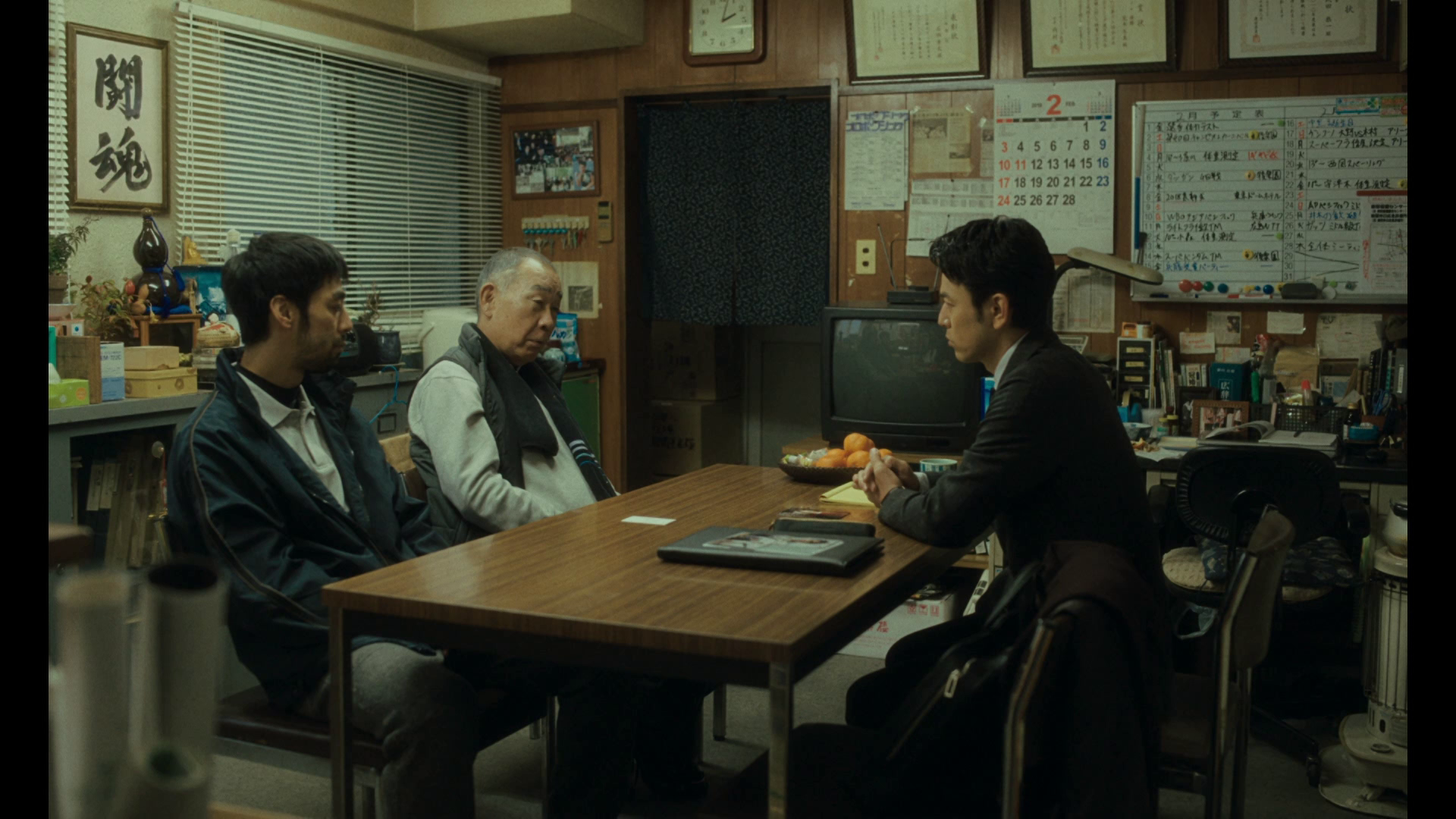
The longer takes Ishikawa makes use of either aim to emphasize the shifting facial expressions of a character or to let the spectator breathe in the natural flow of the interactions. The slow zoom-in movements, on the other hand, aim to focus the spectator on the flow of interactions and to emphasize the physical and emotional presence of characters within the narrative frame. The shaky framing Ishikawa often makes use of aim to enhance the naturalism of the interactions, to ‘document’ the ‘genuineness’ of the interactions, and to reverberate the unvocalized emotionality in the body of a given character.
A Man offers a compelling and thrilling exploration of the reality of identity fraud and the damaging effect societal discourses can have on a subject and his ego. While the narrative’s flow might feel a tad to slow for some at first, the measured nature by which the story unfolds gives Sakura Ando and Satoshi Tsumabuki the time and space to bring the emotional dimension of the narrative come to full blossom.

Notes
Narra-note 1: Through the character ofAkira Kido, a third-generation Zainichi,Kei Ishikawa can draw an elegant parallel between the destructive prejudiced discourses around crime within the Japanese field and the persecutory discourses around race. In both cases, the prejudiced and enjoying Other does nothing other than try to force the subject to prove the veracity of the deceitful right-wing discourses.
 psychocinema